

Define Trading Success Beyond Money
If your only measure of success is P&L, you will chase trades and break rules. Learn how redefining success around skill development changes your daily decisions.

Trading success is not your account balance. It is not the dollar amount on your last trade. And it is definitely not the screenshot you post in a Discord group after a lucky week.
If your only definition of success is making money, you will overtrade to hit targets, oversize after winning streaks, and abandon your plan the moment the P&L turns red. You will chase trades you should skip and skip trades you should take, all because the number on your screen feels wrong.
The traders who stay profitable over years measure something different. They define trading success as becoming a skilled executor who follows a proven process, regardless of what any single trade does. The money shows up as a byproduct of that skill, not as the goal itself.
TL;DR
P&L as your only success metric drives overtrading, oversizing, and rule-breaking.
Redefine success as executing your edge without hesitation or deviation.
Track process metrics (plan adherence, journal streaks, discipline scores) instead of daily dollar targets.
Skill development compounds: 1% improvement daily looks invisible short-term but transforms your results over quarters.
Use a trading progress tracker to measure what actually predicts long-term profitability.
The Problem With Dollar-Based Goals
Ever had a week where you hit your profit target by Wednesday, then gave it all back by Friday? Sound familiar?
That pattern happens because dollar targets create perverse incentives. When you are up, greed tells you to keep going. When you are down, panic tells you to size up and "make it back." Both responses pull you away from your plan and toward emotional decision-making.
Here is what actually happens when your success definition starts and ends with money:
You set a monthly target of 5%. In the first week, you hit 5%. But instead of stopping, you think, "If I can do 5% in one week, why not 10% this month?" So you keep trading. You take B-grade setups. You trade extra sessions. By month end, you are flat or negative because the extra trades were lower quality and your discipline eroded with each one.
The dollar target itself caused the failure.
Walkthrough: How a Profit Target Backfires
A trader on a $10,000 account sets a 5% monthly target ($500). By day 8, she has made $520 across four clean trades on EUR/USD, all following her plan. She should stop. Instead, she takes three more trades during the New York session that same week, none of which meet her full checklist criteria. The first is a small win ($40). The second is a loss ($110). The third, taken in frustration, is another loss ($150). Net for the extra session: negative $220. Her month-end result drops from $520 to $300, a 3% gain instead of 5.2%. The three off-plan trades taught her nothing and cost her 42% of her profits.
Math check: 4 clean trades = $520 gain. Extra trade 1: +$40. Extra trade 2: -$110. Extra trade 3: -$150. Net from extras: $40 - $110 - $150 = -$220. Final: $520 - $220 = $300. $300 / $10,000 = 3%.
The extra trades did not come from her plan. They came from her success definition. She saw $520 and thought, "I can get more." That is greed disguised as ambition.
What Skilled Traders Actually Measure
If money is the wrong scoreboard, what is the right one?
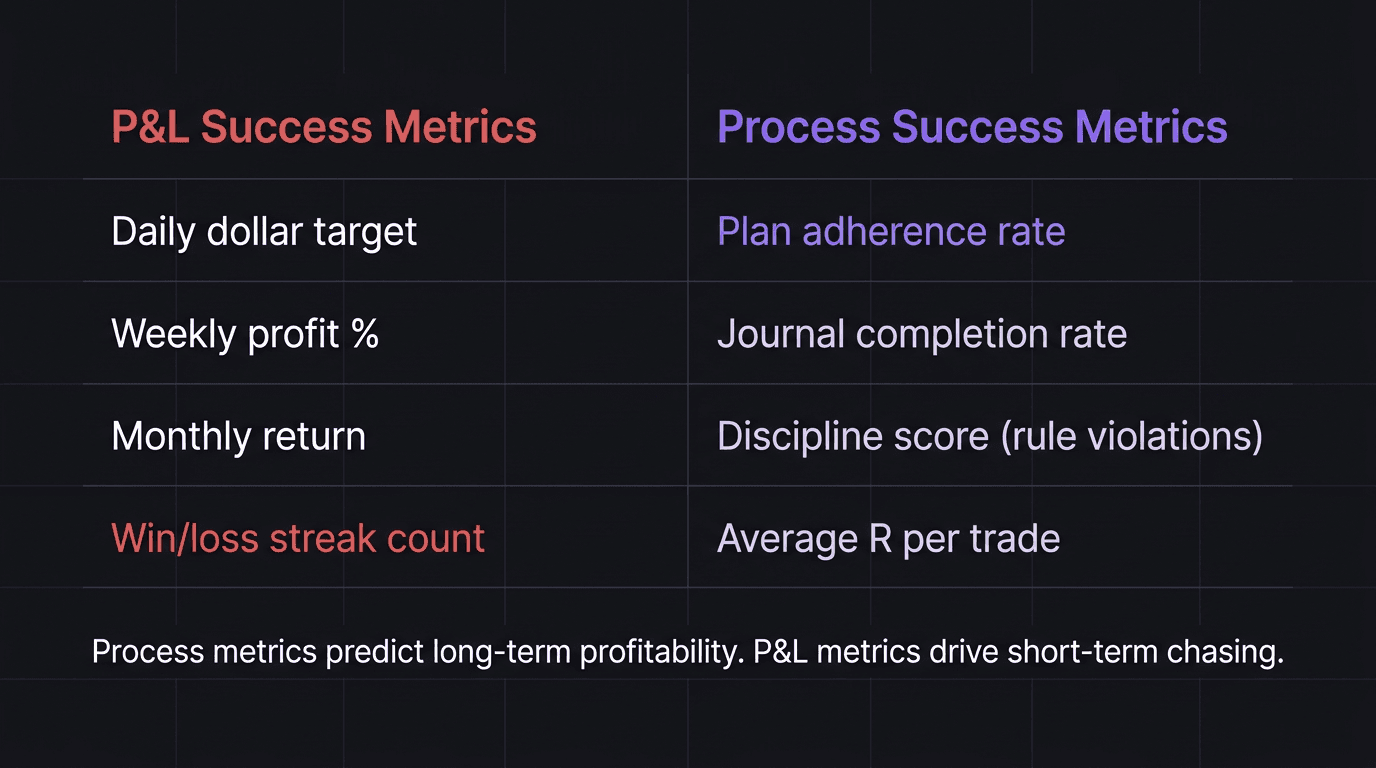
Process metrics. These are numbers that measure how well you executed your system, not how much the market happened to pay you on a given day.
Here are the metrics that predict long-term profitability far better than daily P&L:
Plan adherence rate. Out of every trade you took this week, what percentage followed every criterion on your checklist? If you took 8 trades and 6 were fully plan-compliant, your adherence rate is 75%. That number tells you more about your future than your weekly return.
Journal completion rate. Did you log every trade, including the ones you lost? Did you tag the emotion you felt before entry? Traders who journal consistently build awareness that prevents repeating mistakes. A 100% journal completion rate means you are building a dataset that compounds your edge over time.
Discipline score. Did you move your stop loss? Did you add to a losing position? Did you trade outside your session? Each rule violation is a strike. Count them weekly. A clean week (zero violations) is a bigger win than a $500 day with three broken rules.
Average R per trade. This measures the quality of your execution relative to your risk. If you risk $100 per trade and your average winner is $250, your average R is 2.5. This number reflects edge quality, not luck.
These four metrics do not depend on whether the market moved in your favor. They depend entirely on you.
Redefine Success as Skill Development
Think about any craft that takes years to master. A surgeon does not measure success by how many surgeries she performed today. She measures it by the precision of each procedure. A pilot does not count flights. He counts adherence to pre-flight checklists and standard operating procedures.
Trading is no different. Success means becoming someone who can execute a proven edge without hesitation, without guesswork, and without emotion interfering. That is the trader who makes money over hundreds of trades, not the one who had a lucky Tuesday.
When you redefine success this way, your daily decisions change immediately:
Instead of asking, "Did I make money today?" you ask, "Did I follow my plan on every trade?" Instead of feeling like a failure after a losing day, you feel satisfied knowing you executed cleanly and the loss was simply a cost of doing business. Instead of sizing up after a winning streak, you keep risk consistent because the goal is not to maximize this week but to compound skill over months.
This shift is subtle but powerful. The trader chasing dollars will break rules to hit targets. The trader building skill will protect rules even when it means missing a trade.
The 1% Compounding Effect
Here is the part most traders overlook: getting 1% better at execution each day looks invisible for weeks. But over a quarter, that improvement compounds into something dramatic.
Consider two traders with identical strategies (same 40% win rate, same 3:1 reward-to-risk ratio). Trader A focuses on hitting dollar targets. Trader B focuses on plan adherence and process-oriented trading.
After one month, they look similar. But by month three, Trader B has eliminated two recurring mistakes (trading outside her session, and taking entries without full confirmation). Those two fixes reduce her losing trades by 15%, which changes her net monthly return from breakeven to consistently positive.
Trader A is still bouncing between great weeks and terrible weeks because he never fixed the underlying execution problems. He was too busy watching the P&L.
Walkthrough: What Skill-Based Success Looks Like in Practice
A trader on a $25,000 account decides to stop tracking daily P&L for one full month. Instead, he tracks three numbers each day: (1) trades that matched his full entry criteria, (2) rule violations, and (3) whether he journaled every trade. Week 1: 4 trades taken, 3 plan-compliant (75% adherence), 1 rule violation (traded during news), journal rate 100%. Week 2: 5 trades, 4 compliant (80%), 0 violations, journal 100%. Week 3: 3 trades, 3 compliant (100%), 0 violations, journal 100%. Week 4: 4 trades, 4 compliant (100%), 0 violations, journal 100%.
His plan adherence went from 75% to 100% in four weeks. He identified one specific leak (news trading) in week 1 and eliminated it. At month end, he checks his account: up 4.2%. He did not chase the 4.2%. He chased 100% adherence, and the money followed.
That is the compounding effect of skill development in action. Small process improvements stack on each other because each one removes a leak that was draining the account.
How to Build Your Own Success Scorecard
You need a system that tracks what matters. Here is a practical framework:
Step 1: Pick three process metrics. Start with plan adherence, journal completion, and rule violations. These three cover execution quality, self-awareness, and discipline. Do not track more than five metrics or you will overcomplicate it and stop doing it.
Step 2: Score yourself daily. At the end of each session, give yourself a quick grade. Did you follow the plan? Did you journal? Did you break any rules? This takes less than five minutes.
Step 3: Review weekly. Look at the week as a whole. What was your plan adherence percentage? How many violations occurred? What patterns show up? This is where trading accountability becomes real, because the numbers do not lie.
Step 4: Set skill-based goals. Instead of "make 5% this month," set goals like "achieve 90% plan adherence" or "zero rule violations for two consecutive weeks" or "journal every trade for 30 days straight." These goals drive the behavior that produces money, rather than chasing the money directly.
Step 5: Review monthly and quarterly. Compare your process scores against your returns. You will start seeing the correlation: months with high adherence and low violations produce the best returns. This evidence reinforces the habit and makes it self-sustaining.
For detailed guidance on setting trading goals that drive skill development instead of P&L chasing, build your goal system around these process pillars.
The Greed Trap and Why Redefinition Stops It
Greed in trading is not about wanting money. Everyone wants money. Greed is pushing harder than your edge allows, taking more trades than your plan calls for, and sizing up because recent wins made you feel invincible.
When success equals dollars, greed has no natural limit. You hit your target and immediately want more. You win five trades in a row and think the streak will continue forever. You trade three sessions instead of one because "the market is moving."
When success equals execution quality, greed loses its power. You cannot overtrade your way to a higher plan adherence score. You cannot break rules and improve your discipline grade. The scorecard itself prevents the behavior that greed produces.
This is why the success redefinition is not just a mindset trick. It is a structural change to how you evaluate every trading day. The scorecard you choose shapes the decisions you make.
How EdgeFlo Tracks Process Metrics for You
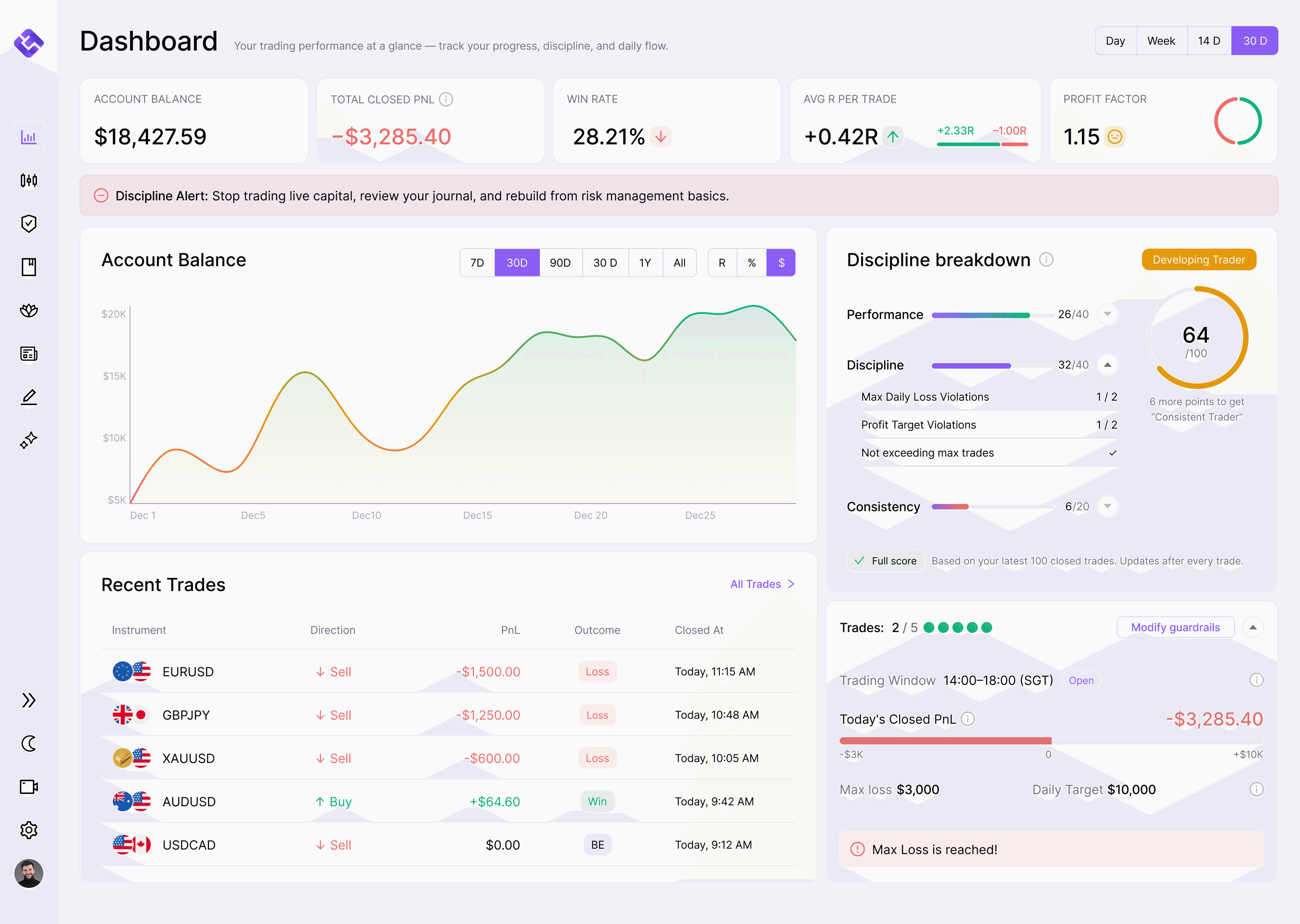
EdgeFlo's dashboard tracks the metrics that predict profitability, not just the ones that feel good. Win rate, average R, profit factor, and EdgeScore sit on a single screen so you can see execution quality at a glance.
The Edge plan builder lets you document your strategy, store your active playbook, and reference your rules during live trading. After each trade, you self-report whether you followed the plan, creating the adherence data that builds real conviction over time.
Combined with the AI-powered journal that auto-imports trades and tags emotions, you get a feedback loop that turns skill development into a measurable, trackable system. That is the infrastructure that makes process-based success definitions stick.
The Edge Brief
Receive Insights on trading psychology, discipline, and the behavioral patterns that create consistent traders from our Founder and the EdgeFlo team, delivered to your inbox.
Think different. Trade different.
How do you define trading success without using P&L?
What are the best process metrics for traders?
Does ignoring profits make you a worse trader?
How long before process-focused trading shows results?

Turn discipline on.
Every session.
EdgeFlo is the environment serious traders operate inside.
Start 7-Day Free Trial
Cancel anytime.
No long-term commitment.

Think Different, Trade Different.