

Trading Without a Stop Loss: Why It Blows Accounts
Trading without a stop loss exposes your entire account to one bad trade. Learn why skipping stops destroys accounts and how to build the habit.
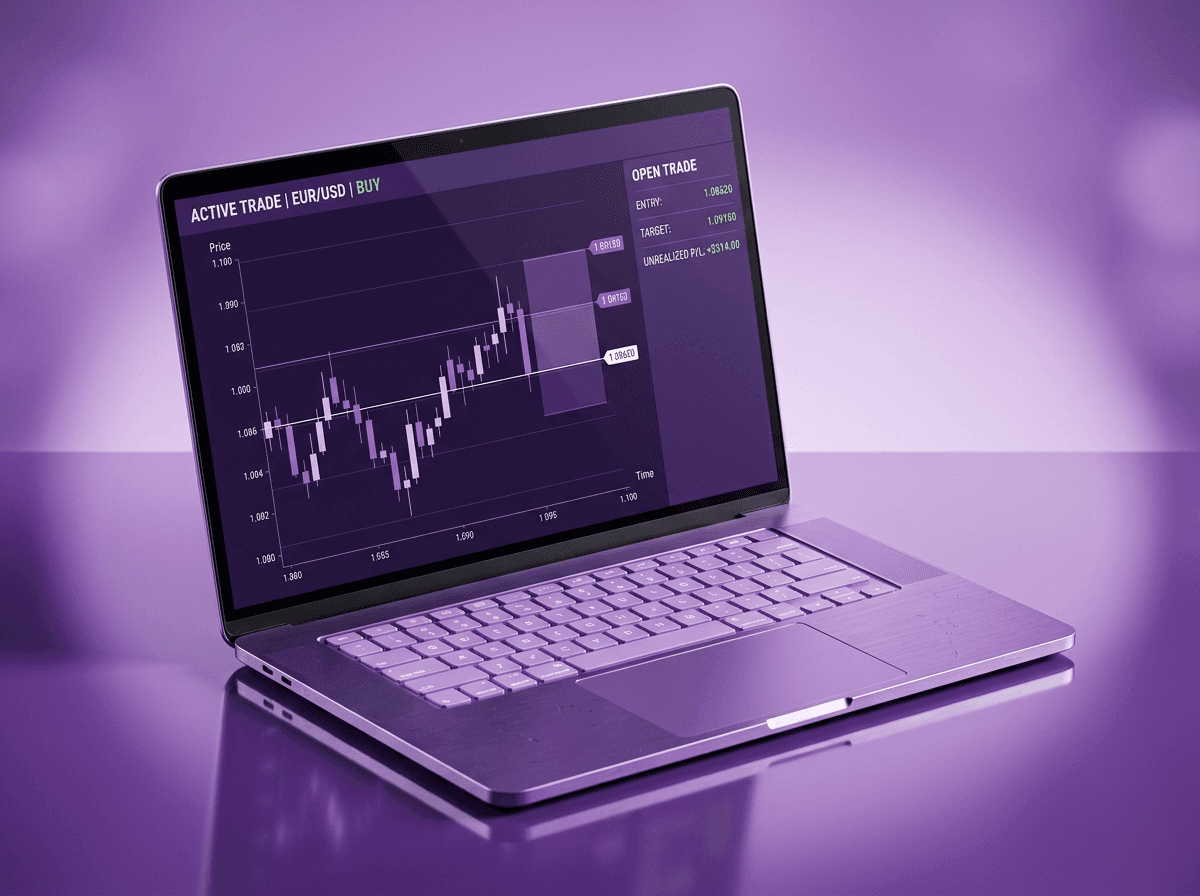
Trading without a stop loss means your account has no floor. One trade can take everything. It does not matter how good the setup looks or how confident you feel. There are always unknown forces operating in the market, and any single trade can move against you farther than you imagined. A stop loss is the only thing standing between a manageable loss and an account-ending one.
TL;DR
Skipping a stop loss turns every trade into an unlimited-risk bet against forces you cannot see or predict.
Confidence in a setup does not reduce the chance of a sudden, catastrophic move against you.
One trade without a stop can erase weeks or months of profits in minutes.
A hard stop in the platform removes the decision from the moment when you are least capable of making it.
Building the stop loss habit starts with treating every order without a stop as an incomplete order.
The 'I'll Just Watch It' Myth
You have probably said this to yourself. "I do not need a stop. I am right here at the screen. If it goes against me, I will just close it."
Sound familiar?
Here is the problem. "Watching it" assumes two things that are almost never true. First, that price will move slowly enough for you to react. Second, that you will actually pull the trigger when the moment comes.
Price does not care about your reaction time. A news headline drops. Liquidity disappears. Price gaps 50, 80, 120 pips in seconds. By the time you move your mouse to the close button, the damage is done.
But the second assumption is worse. Even when price moves slowly against you, you do not close it. You wait. You hope. You tell yourself it will come back. This is not a character flaw. It is how every human brain works under threat. The pain of locking in a loss feels worse than the uncertainty of holding, so you hold. And hold. And hold.
"I will just watch it" is not a risk management plan. It is a way of avoiding the discomfort of setting a hard line before you enter. And that avoidance is what blows accounts.
Anything Can Happen: Why You Need Protection
Anything can happen at any point in the market on any given trade. That is not a cliche. It is a mechanical reality.
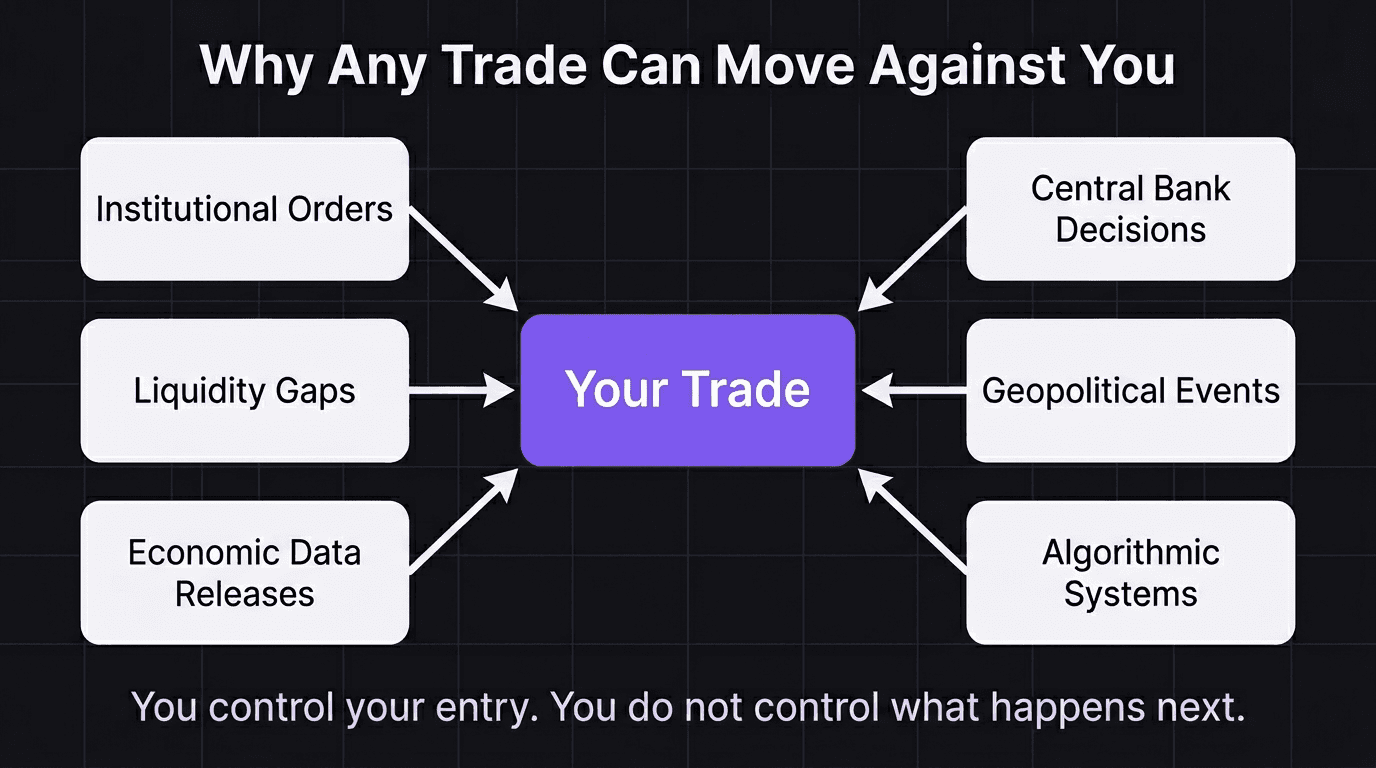
Right now, as you read this, there are hedge funds, central banks, sovereign wealth funds, and algorithmic systems all placing orders in the same markets you trade. You cannot see their positions. You cannot predict their timing. A single institutional order from someone on the other side of the world can move price 100 pips in the opposite direction of your trade.
And that is just the routine stuff.
A war can break out. A pandemic can hit. A central banker can say something unexpected at a press conference. An earnings report can miss by a mile. These events are genuinely unpredictable, and they happen more often than people think. No matter how confident you are in your analysis, there is always a chance you will lose the trade because you do not control the market.
This is why risk per trade matters so much. Your analysis gives you an edge over many trades. It does not give you certainty on any single one. A stop loss is not a sign that you lack confidence. It is a sign that you understand how markets actually work.
What One Trade Without a Stop Can Do
Here is what this looks like in practice.
The EUR/USD Walkthrough
You are trading EUR/USD. Price is at 1.0850, and your analysis says buy. The trend is up on the 4-hour chart. The pullback found support. Your entry checks every box.
You are so confident that you skip the stop loss. "I will just watch it."
What you do not know is that Non-Farm Payrolls data is about to drop, and the number comes in way hotter than expected. The dollar surges. EUR/USD drops 120 pips in under three minutes.
Your account started the day at $2,000. With proper position sizing and a 30-pip stop, you would have risked about 1.5% of your account. A $30 loss. Painful but survivable.
Instead, without a stop, the 120-pip move hits your overleveraged position. If you were trading 1 standard lot, that 120-pip move just cost you $1,200. Your $2,000 account is now at $800. A single trade wiped out 60% of your capital.
That is not an extreme scenario. NFP releases move EUR/USD 80 to 150 pips routinely. And this example assumes you were only trading one lot. Many traders who skip stops also skip position sizing rules, which makes the damage even worse.
The account does not blow up because the trader was wrong about direction. It blows up because there was no predefined exit. The difference between a 1.5% loss and a 60% loss is one click before you enter.
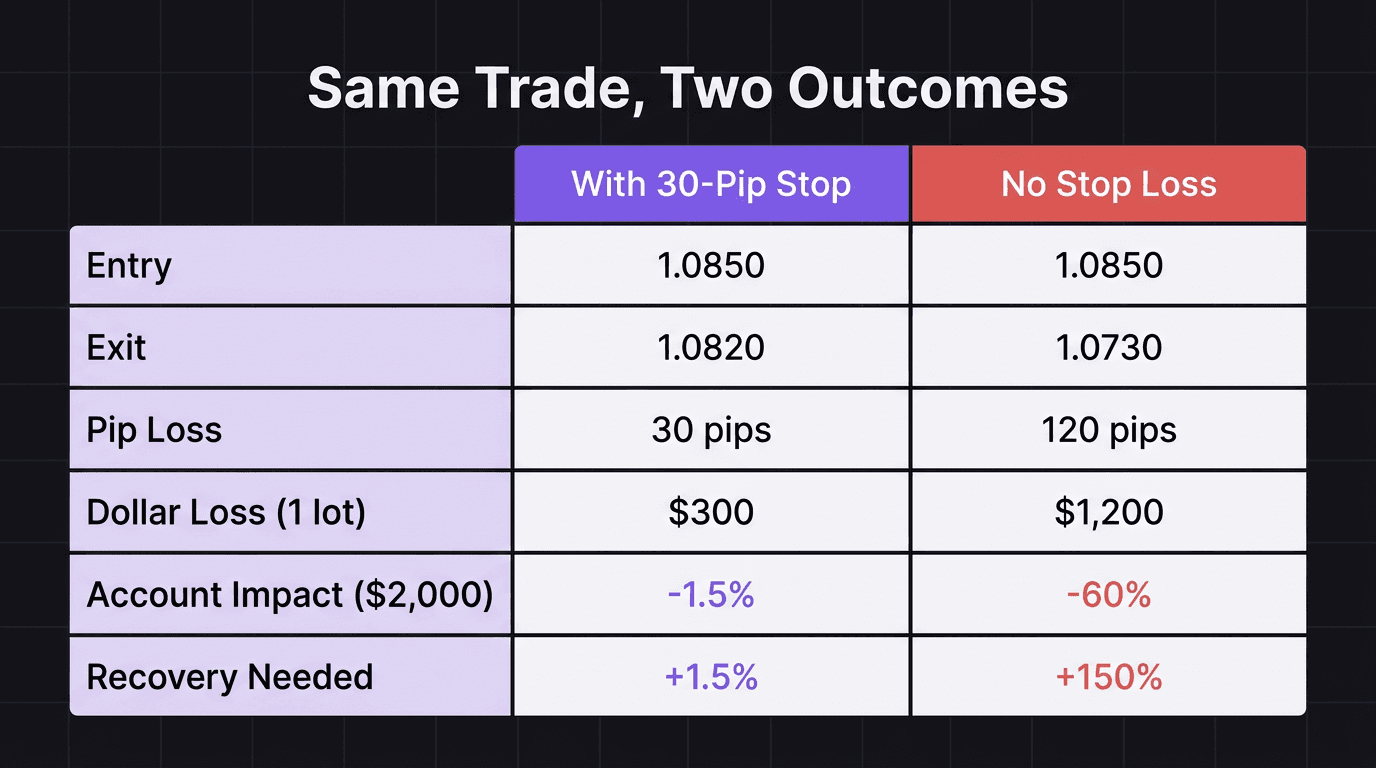
Look at that last row. Losing 1.5% means you need a 1.5% gain to get back to even. Losing 60% means you need a 150% gain just to recover. The math is brutal and it gets worse with every percentage point you lose.
This is one of the most common trading mistakes, and it is completely preventable.
Building the Stop Loss Habit
Knowing you need a stop loss and actually using one every time are two different things. The gap between them is where accounts die.
Here is how to close that gap.
Treat Every Order Without a Stop as Incomplete
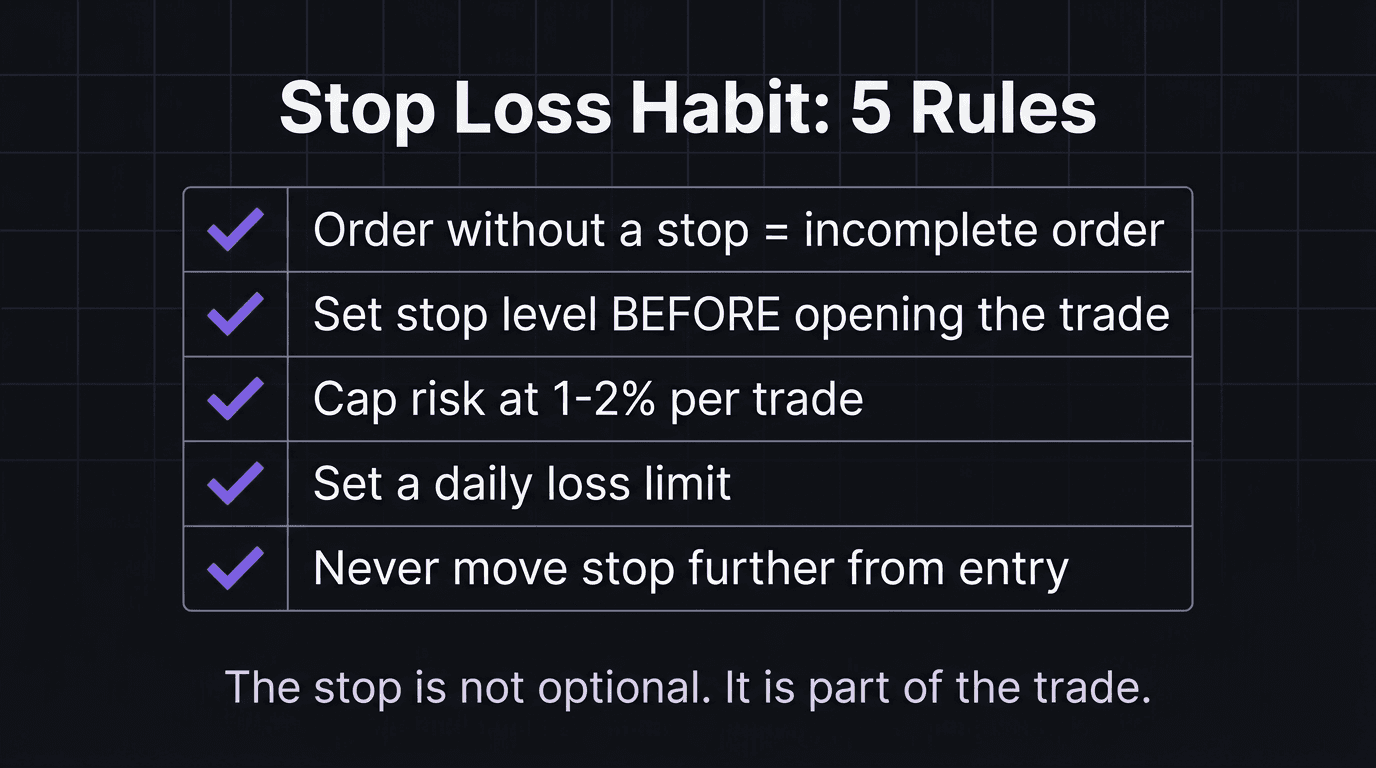
Your order is not placed until the stop is set. Period. Think of it like a seatbelt. You do not decide whether to buckle up based on how safe the road looks. You buckle up every time because the one time you do not is the one time it matters.
Set It Before You Enter
Decide your stop level during your analysis, before you open the order ticket. If you cannot identify where your trade idea becomes invalid, you do not have a trade idea. You have a guess.
Use Fixed Risk Per Trade Rules
Cap your risk at 1-2% of your account per trade. This forces you to calculate your position sizing based on your stop distance, which means the stop has to exist before the position size can be calculated. The math will not work without it.
Set a Daily Loss Limit
A daily loss limit catches you if multiple trades go wrong in the same session. Even with individual stops, three or four losses in a row can add up. Having a daily cap prevents a bad day from becoming a bad week.
Never Move Your Stop Further From Entry
Moving your stop loss closer to entry (trailing) is fine. Moving it further away to "give the trade more room" is just removing your protection after the fact. If the trade hits your original stop, it hit your stop. Accept it.
How EdgeFlo Makes Stop Loss Non-Negotiable
EdgeFlo's auto risk calculator is built around the stop loss. You enter your stop level, and the calculator figures out your position size based on your risk percentage. Without a stop, the calculator cannot run. The stop is literally the input that makes everything else work.
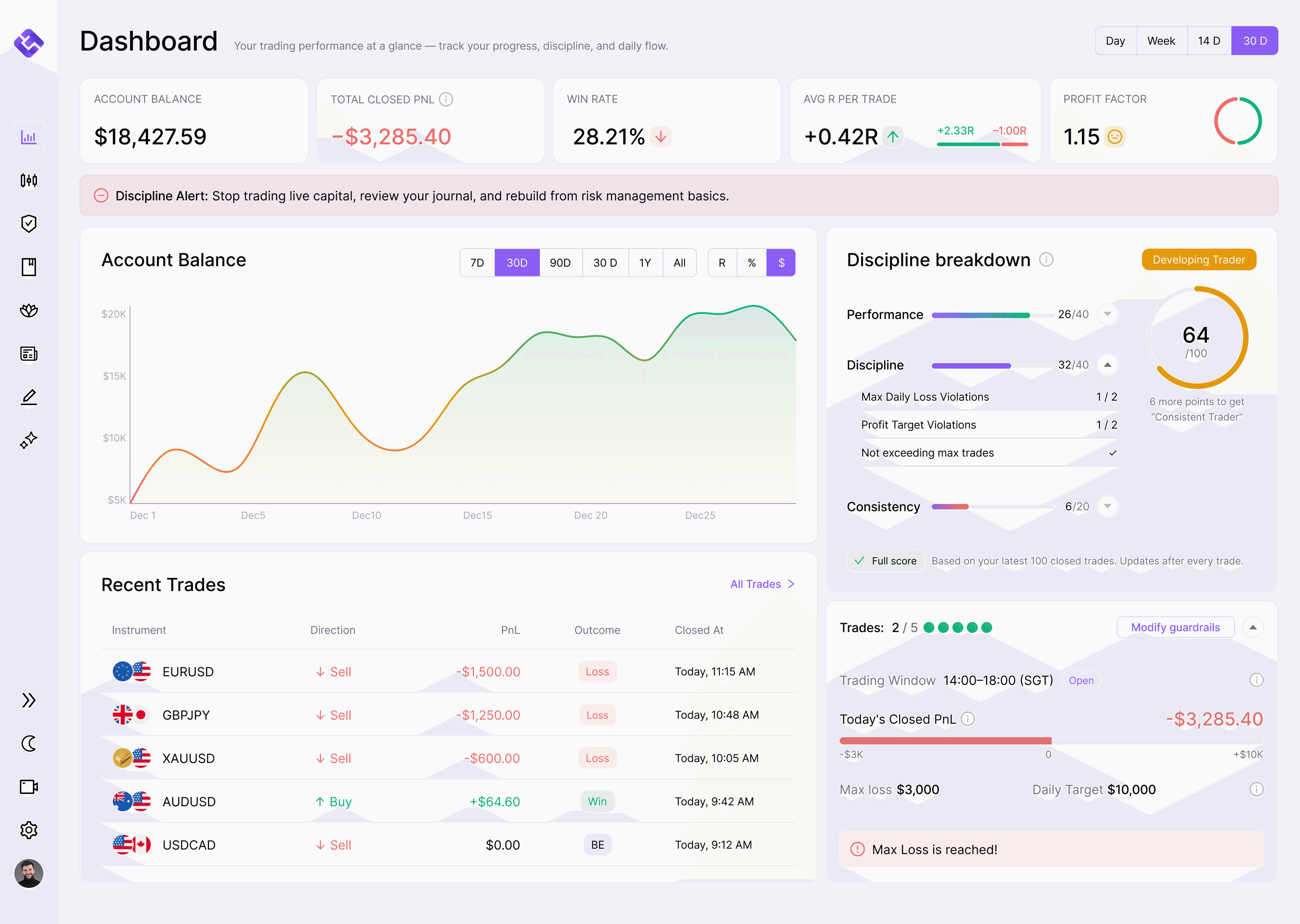
If you try to place a trade without setting risk parameters, EdgeFlo's guardrails flag it. You will see a warning that your risk is undefined. You can override it if you choose to, but you have to actively dismiss the warning. That friction is intentional. It turns a passive omission ("I forgot to set a stop") into an active decision ("I am choosing to trade without protection").
Most blown accounts do not come from traders who consciously decided to skip their stop. They come from traders who just did not think about it in the moment. EdgeFlo puts that thought back in front of you every single time.
The Edge Brief
Receive Insights on trading psychology, discipline, and the behavioral patterns that create consistent traders from our Founder and the EdgeFlo team, delivered to your inbox.
Think different. Trade different.
Can you trade without a stop loss and still be profitable?
What happens if you don't use a stop loss?
Where should I place my stop loss?
Is a mental stop loss good enough?

Turn discipline on.
Every session.
EdgeFlo is the environment serious traders operate inside.
Start 7-Day Free Trial
Cancel anytime.
No long-term commitment.

Think Different, Trade Different.