

Define Your Trading Style: Scalp, Day, or Swing
Your trading style determines your timeframes, session hours, and risk profile. Use this framework to pick scalping, day trading, or swing trading.
Your trading style is the first structural decision you make as a trader. It determines which timeframes you watch, which sessions you trade, how long you hold positions, and how you size your risk. Scalping means fast entries and exits within minutes. Day trading means opening and closing within a single session. Swing trading means holding for days or weeks. Pick the wrong style for your schedule or personality, and every other part of your plan works against you.
TL;DR
Your trading style controls your timeframes, session hours, stop sizes, and daily screen time.
Scalping requires intense focus during 2 to 4 hour blocks with very tight stops.
Day trading fits session-based execution (London, New York) with trades closed by end of day.
Swing trading suits people with full-time jobs who can check charts once or twice a day.
Choose based on your available hours, personality under pressure, and starting capital.
Why Your Trading Style Is the First Decision
Every part of your trading plan flows from your style choice. Your timeframes, your entry criteria, your stop-loss distance, your session schedule, your position size. All of it depends on whether you are scalping, day trading, or swinging.
Think of it like choosing a character in a video game before you start playing. You would not pick the heavy tank and then try to play like the fast assassin. Same logic applies to trading. If you pick swing trading but then sit at your screen for 8 hours watching every candle, you are going to overtrade, second-guess your entries, and close positions too early.
As one trading coach puts it: "You first need to define your trading style, find out what works for you, so that you can even develop a trade plan and do other sort of stuff." That sequence matters. Style first, then plan, then strategy, then testing. Skip the first step and every step after it is built on guesswork.
Most beginners skip this entirely. They jump straight into learning candlestick patterns or indicators without asking, "How much time do I actually have to trade each day?" That question alone eliminates certain styles immediately.
Scalping: Speed, Volume, and Screen Time
Scalping means you are in and out of trades within seconds to minutes. You are targeting small moves (5 to 15 pips on forex) and making it up on volume.
Here is what scalping actually requires:
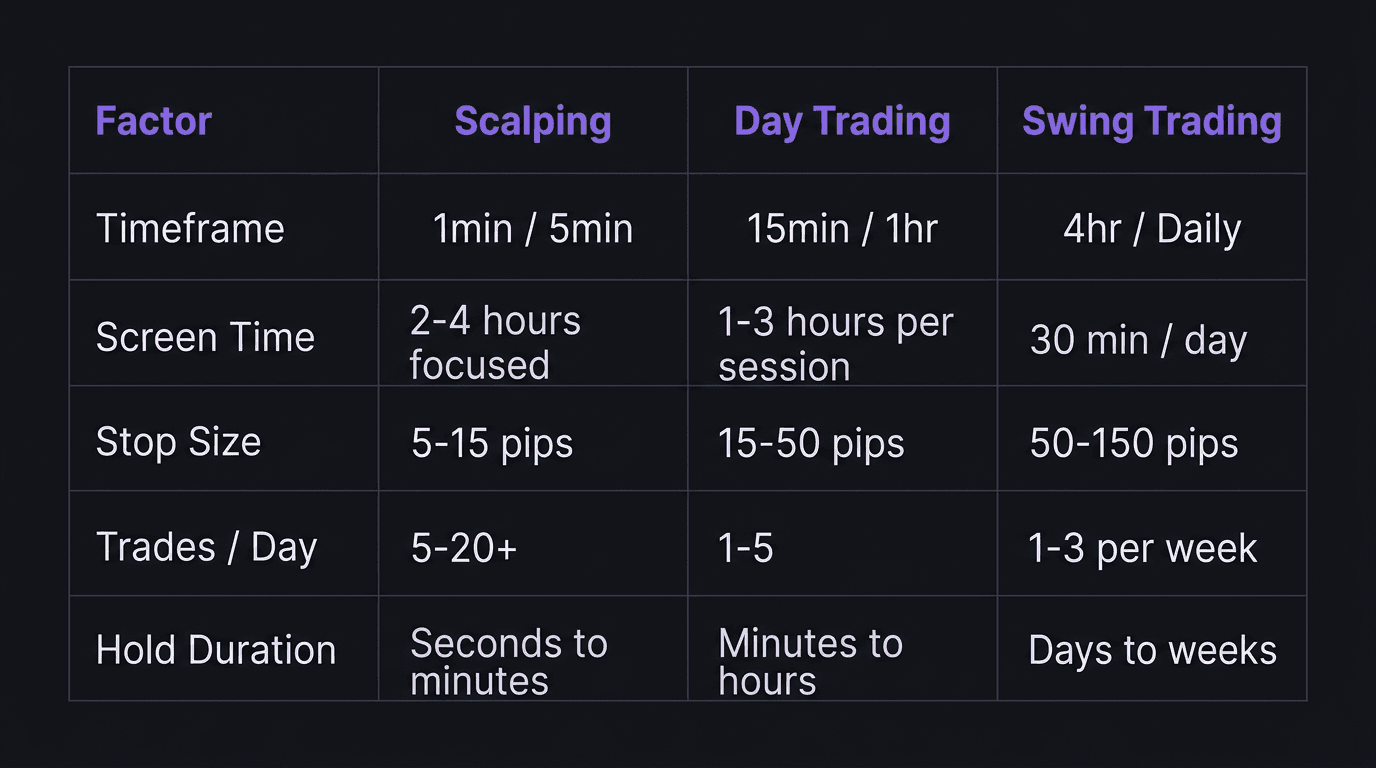
Timeframes: 1-minute and 5-minute charts
Session commitment: 2 to 4 hours of unbroken focus during high-volume windows
Stop-loss range: 5 to 15 pips (tight)
Trades per day: 5 to 20+
Decision speed: Instant. If you hesitate, the setup is gone.
Scalping is not a casual style. You need to be locked in during London or New York sessions because that is when spreads are tightest and volume is highest. Trading the Asian session as a scalper on EUR/USD is like trying to sprint in a swimming pool.
Walkthrough: The Scalper Who Could Not Sit Still
A beginner picks scalping because it "sounds exciting." He trades GBP/USD on the 1-minute chart during New York open. His plan says wait for a break of the 5-minute range, then enter on the pullback.
First trade: the range breaks, he enters on the pullback, targets 10 pips, gets 8 pips. Good. Second trade: no clean pullback, but the candle looks bullish, so he enters anyway. Stopped out for 12 pips. Third trade: he re-enters immediately to "make it back." Stopped out again for 10 pips.
In 40 minutes he turned a winning session into a losing one. The system worked on trade one. Trades two and three were emotional. This is the scalping trap: speed makes you feel like you need to be in the market constantly. Without a mechanical trading plan that defines exactly when to sit out, scalping becomes gambling with a fancy chart open.
Who scalping suits: People with fast reflexes, low emotional reactivity, available blocks of 2+ hours during major sessions, and a personality that does not dwell on losses.
Day Trading: Session-Based Execution
Day trading means you open and close all positions within the same trading day. No overnight holds. Your timeframes are wider than scalping but your exposure window is still limited to one session.
Timeframes: 15-minute, 30-minute, and 1-hour charts
Session commitment: 1 to 3 hours during your chosen session
Stop-loss range: 15 to 50 pips
Trades per day: 1 to 5
Decision speed: Measured. You have minutes, not seconds.
Day trading is the middle ground. You get enough time to analyze properly, confirm your bias with the higher timeframe, and wait for your setup instead of chasing. But you still need to be present during specific hours.
The key constraint is session selection. If you trade EUR/USD, you are looking at London open (3:00 AM to 5:00 AM EST) or New York open (8:00 AM to 11:00 AM EST). Your pre-market routine sets your bias for the day, and then you execute during your chosen window.
Who day trading suits: People who can dedicate a consistent 1 to 3 hour block during a major forex session, prefer to go flat before bed, and want enough time to think but not so much that they overtrade.
Swing Trading: Patience and Larger Moves
Swing trading means holding trades for days or weeks. You are targeting larger moves (50 to 150+ pips) and checking your charts once or twice per day instead of staring at them for hours.
Timeframes: 4-hour and daily charts
Session commitment: 20 to 30 minutes per day
Stop-loss range: 50 to 150 pips
Trades per week: 1 to 3
Decision speed: Slow and deliberate. You set your trade and walk away.
This is the style that fits people with full-time jobs, families, or any schedule where carving out 3+ consecutive hours at specific times is not realistic. You do your analysis in the evening or early morning, set your orders, and check back at the next daily candle close.
The trade-off is patience. Your trade might take 3 to 7 days to play out. During that time, the position will go against you temporarily. If you are the type who checks your phone every 20 minutes and panics at every red candle, swing trading will feel like torture.
Walkthrough: The Part-Time Trader Who Found a Fit
A retail trader works 9 to 5 and tried day trading the New York session on her lunch break. Problem: she had 45 minutes, not 3 hours. She kept entering trades at 12:30 PM when volume was already dying. Her win rate was 28% and she could not understand why.
She switched to the daily chart on EUR/USD. Now her process looks like this: check the chart at 6:00 PM after work, mark the daily candle close, set a limit order at her zone if one lines up, set stop and target, and close the laptop. She checks once in the morning before work. That is it.
Her win rate went to 48% over the next 60 trades. Her average risk-to-reward improved from 1:1 to 1:2.5. Not because she got smarter at reading charts, but because the daily timeframe filtered out all the noise that was triggering bad entries on the 15-minute chart.
The lesson applies directly here: "Consistent action leads to consistent result." She became consistent because she picked a style that matched her actual life.
How to Choose: Lifestyle, Personality, and Capital
You do not pick a trading style because it sounds cool. You pick it because it fits three things.
1. Your available hours.
Be honest. Not "I could probably wake up at 3 AM" honest. Genuinely honest. How many hours can you trade every single day for the next 12 months without burning out?
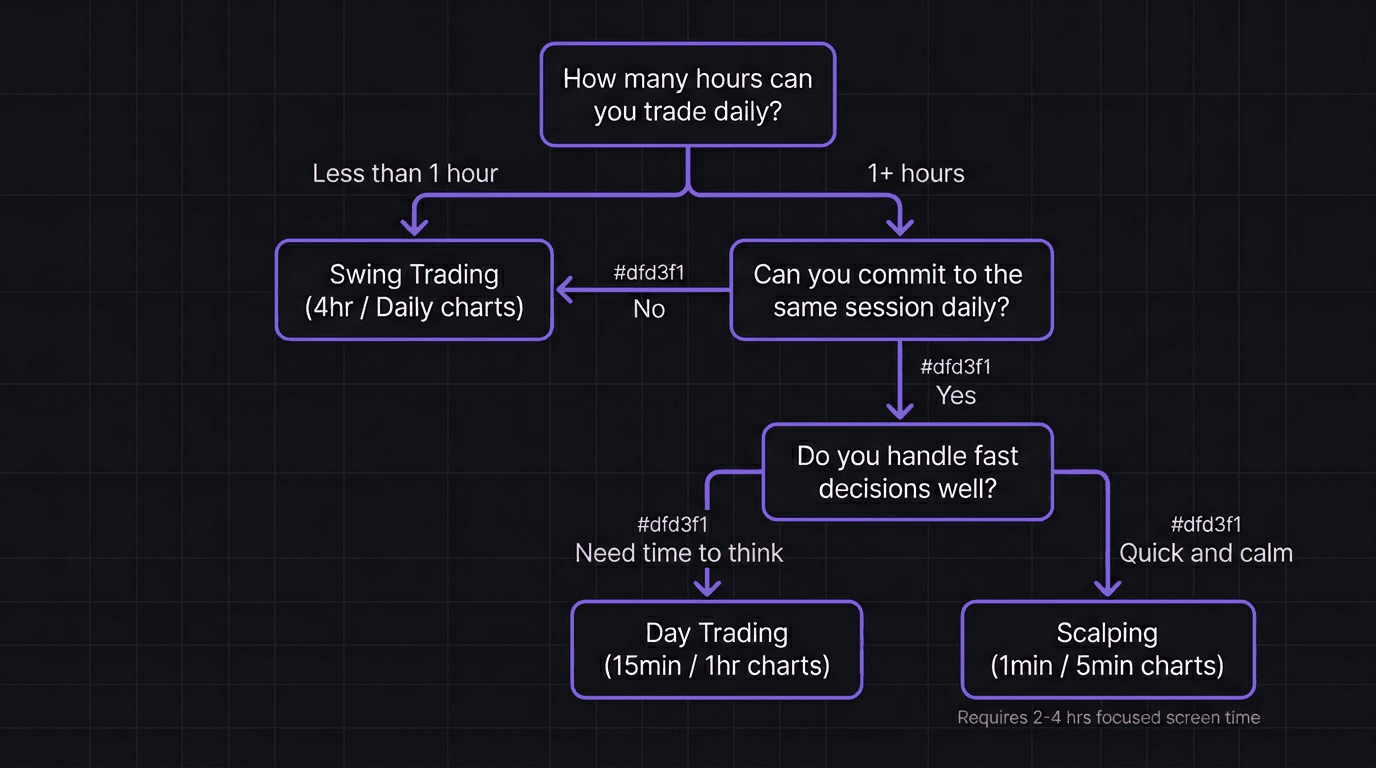
Less than 1 hour per day: swing trading
1 to 3 hours during a specific session: day trading
3+ hours during London or New York open: scalping is possible
2. Your personality under pressure.
Do you make quick decisions well, or do you need time to process? If someone cuts you off in traffic, do you react instantly or do you sit with it?
Scalping rewards fast, emotionally flat decision-making. If you are someone who replays trades in your head for hours, scalping will destroy you. Swing trading rewards patience and the ability to leave a trade alone. Day trading sits in between.
3. Your starting capital.
Scalping with tight stops means you can use slightly larger position sizes relative to account equity. But the volume of trades means commissions and spreads add up fast. On a small account (under $1,000), the math gets unfriendly for scalping because spread costs eat into your thin margins.
Swing trading with wider stops requires smaller position sizes to keep risk-per-trade at 1 to 2%. On a $500 account at 2% risk, a 100-pip stop on EUR/USD means risking $10, which puts you at micro lots (0.01). That is $0.10 per pip. Your 100-pip winner is $10. The gains are small, but the process is identical to trading a larger account. Understand the math before you start.
Once you have your answer, write it down. Your style choice becomes the first line in your trading playbook. Everything else (your entry criteria, your risk rules, your session schedule) gets built on top of it.
Lock It In: Test Before You Commit
Choosing a style on paper is not enough. You need to backtest your strategy on the timeframes that match your chosen style and then forward-test it on a demo account for at least 30 to 50 trades.
Here is why. Your personality on paper and your personality at the screen are different. You might think you have the patience for swing trading until your first trade goes 40 pips against you and you close it manually at a loss, right before it turns around and hits your target.
The testing phase is where you discover the gap between what you think you can handle and what you actually can. If you backtest 50 swing trades and your results are solid, but then you forward-test and you keep closing early, swing trading might not be your style after all. That is useful information.
Do not skip this. Before you try it out on your live account based on your hard-earned money, you need to figure out whether this strategy actually works or not. And you do that by back-testing, forward-testing.
How EdgeFlo Adapts to Your Style
EdgeFlo's Edge plan builder stores your chosen trading style alongside your rules, so your plan stays visible next to your charts during live execution. Whether you selected scalping, day trading, or swing trading, your documented criteria are always one glance away.
The guardrail system adapts to session-based trading. If your plan says you only trade the New York session, you can configure guardrails around those hours. You can always override them (that choice stays yours), but the friction helps you avoid off-plan trades during dead hours. Your journal tracks results by style and session, creating a feedback loop that shows exactly how you performed within your chosen framework.
That feedback loop is the success blueprint: inputs go through your systems and processes, and the output is consistent results. EdgeFlo structures that loop inside one platform instead of scattered across spreadsheets, screenshots, and separate apps.
The Edge Brief
Receive Insights on trading psychology, discipline, and the behavioral patterns that create consistent traders from our Founder and the EdgeFlo team, delivered to your inbox.
Think different. Trade different.
What is the best trading style for beginners?
Can I switch trading styles later?
How many hours per day does scalping require?
Do I need different risk settings for each trading style?

Turn discipline on.
Every session.
EdgeFlo is the environment serious traders operate inside.
Start 7-Day Free Trial
Cancel anytime.
No long-term commitment.

Think Different, Trade Different.