

Capital Preservation: Why It Beats Chasing Profits
Capital preservation is the skill that keeps you in the game long enough to become profitable. Learn why protecting your account matters more than chasing gains.
Capital preservation is the single most important skill in trading. Not entries. Not chart patterns. Not finding the perfect setup. The traders who survive long enough to become profitable are the ones who protect their capital first and worry about gains second.
If you have ever blown an account or watched your balance shrink day after day during a losing streak, you already know what happens when preservation is not the priority. The good news: fixing this does not require a new strategy. It requires a shift in what you treat as your primary job.
TL;DR
Capital preservation is not a defensive tactic; it is the prerequisite for long-term profitability.
You cannot compound an edge if your account is empty. Staying in the game is the first objective.
Funded accounts have hard drawdown limits, making preservation non-negotiable for funded traders.
Risk per trade (1% to 2%), a daily loss cap, and max account exposure rules are the core preservation tools.
The mindset shift: your job is to protect capital first, then let profits come as a byproduct.
Why Capital Preservation Comes Before Profit
Most beginners focus on how much they can make. Every trade is about the target, the potential gain, the R multiple payoff. The problem is that this mindset encourages you to take trades that are too large, too frequent, or too aggressive for your account size.
Here is the reality: a 50% drawdown requires a 100% return just to get back to breakeven. A 20% drawdown only needs 25%. The math is not symmetrical, and it punishes overexposure brutally.
When you shift your focus from "how much can I make?" to "how do I keep my account intact?", every decision changes. Your risk per trade becomes non-negotiable. Your position sizes shrink to a level where a losing streak does not threaten your account. Your daily loss cap actually gets enforced.
The traders who survive their first year are not the ones who hit big winners early. They are the ones who kept their losses small enough that they were still trading when the winners arrived.
You Cannot Play Without Chips
Think of your trading capital like chips at a poker table. Once the chips are gone, you cannot sit at the table anymore. It does not matter if you have the best strategy, the sharpest analysis, or the highest win rate on paper. Zero capital means zero opportunity.
This sounds obvious, but watch how most traders behave. They risk 5% per trade, take three losses in a row, and suddenly they are down 15%. Panic sets in. They increase size to "make it back," take another loss, and now they are down 22%. Sound familiar?
Walkthrough: The Slow Bleed vs. The Blowup
A trader with a $10,000 account risks 1% per trade ($100 per trade). After 10 consecutive losses (a rough streak, but it happens), the account drops to approximately $9,044. That is a 9.6% drawdown. Recovery requires about 10.6% return, which is very achievable over the following weeks.
Now consider a trader risking 5% per trade. After 10 consecutive losses, the account drops to approximately $5,987. That is a 40.1% drawdown. Recovery now requires 67% return, which could take months.
The first trader is inconvenienced. The second trader is in crisis. Same strategy, same losing streak. The only difference is how much they risked per trade. Capital preservation is the difference between a bad week and a blown account. If you want to understand how accounts actually get destroyed, read about how traders blow accounts.
How Preservation Protects Funded Accounts
Funded accounts raise the stakes on preservation because the drawdown limits are hard rules, not suggestions. Most prop firms set a maximum drawdown between 5% and 10% of the starting balance. Breach it, and you lose the account. No second chances.
This changes the game entirely. On a personal account, a 12% drawdown hurts, but you can keep trading. On a funded $100,000 account with a 10% max drawdown limit, a $10,000 loss ends the challenge. You paid for the evaluation, you spent weeks passing it, and one reckless stretch erases everything.
Walkthrough: Funded Account Without Preservation
A funded trader starts a $100,000 account with a 10% max drawdown ($10,000 limit). They risk 2% per trade ($2,000 per trade). After just 5 consecutive losses, the account is down $10,000 and the challenge is over.
Compare that with 0.5% risk per trade ($500 per trade). After 5 consecutive losses, the account is down $2,500. The trader still has $7,500 of drawdown buffer remaining to recover.
This is why funded account management revolves around capital preservation. The profit target will come if you stay alive long enough. The drawdown limit will not forgive you if you get aggressive too early.
Set a daily loss limit that keeps any single session from doing serious damage. Two or three losing trades per day at 0.5% risk means your worst day costs 1.5%, not 6%.
The Mindset Shift: Protect First, Profit Second
The hardest part of capital preservation is not the math. It is the mindset. Every instinct tells you to go bigger after a loss, to make it back, to prove you can still win. That instinct is exactly what destroys accounts.
Here is the shift: your primary job is not to make money. Your primary job is to keep your capital intact so your edge can work over a large enough sample of trades. Profits are a byproduct of survival plus consistent execution.
When you internalize this, several things change:
You stop increasing position size after losses. You might even reduce it.
You enforce your daily loss cap without negotiation. Three bad trades, and you close the platform.
You stop chasing "revenge trades" because you recognize them as the fastest path to a blown account.
You start measuring success by how well you followed your rules, not by daily PnL.
If you are recovering from a drawdown right now, the approach is the same: shrink your risk, protect what remains, and rebuild slowly. The article on trading drawdown recovery covers this process step by step.
Capital preservation is not about being timid. It is about staying in the game long enough for your strategy to do its job. The traders who protect their capital are the ones who are still here next year, compounding small gains into real money.
How EdgeFlo Helps You Preserve Capital
EdgeFlo puts preservation tools directly into your execution environment. The risk calculator shows your exact position size before every trade, so you never accidentally oversize. Set your risk per trade at 1% (or 0.5% during a drawdown), and the calculator adjusts your lot size to match your stop loss distance automatically.
The daily loss limit guardrail warns you when you have hit your cap for the session. You can override it, but you have to make a conscious choice to keep trading after a losing day. That pause is often enough to stop the spiral before it starts.
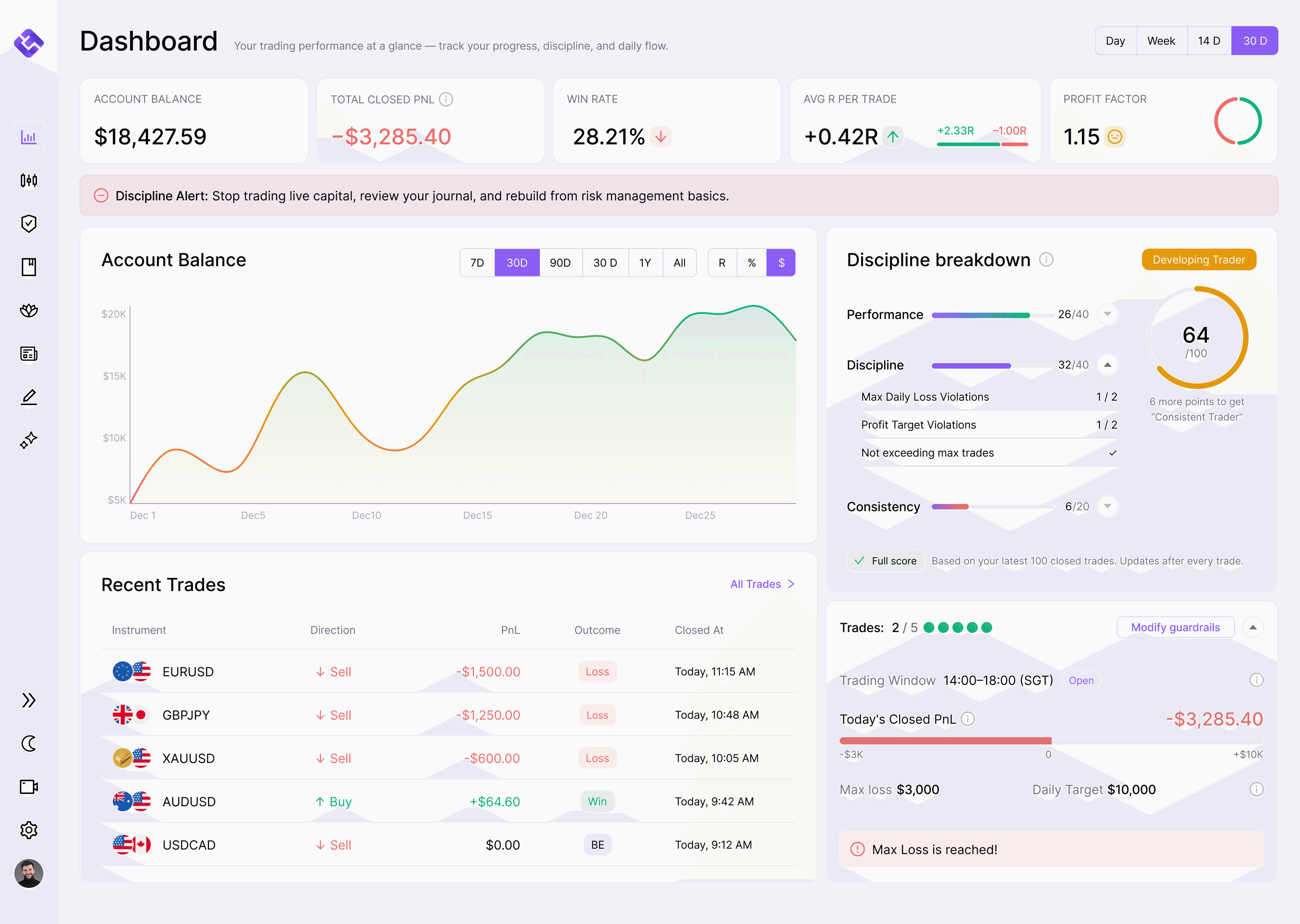
Your trading dashboard tracks drawdown in real time, so you always know where you stand relative to your max exposure limit. On a funded account, that visibility is the difference between staying funded and losing access.
The Edge Brief
Receive Insights on trading psychology, discipline, and the behavioral patterns that create consistent traders from our Founder and the EdgeFlo team, delivered to your inbox.
Think different. Trade different.
What is capital preservation in trading?
How much should I risk per trade to preserve capital?
Why is capital preservation important for funded accounts?
Can you still make money while focusing on capital preservation?

Turn discipline on.
Every session.
EdgeFlo is the environment serious traders operate inside.
Start 7-Day Free Trial
Cancel anytime.
No long-term commitment.

Think Different, Trade Different.