

Calculated Risk vs Gambling in Forex
Gambling is taking risk. Trading is taking calculated risk. Learn the three things that separate a trader from a gambler and how to stay on the right side.
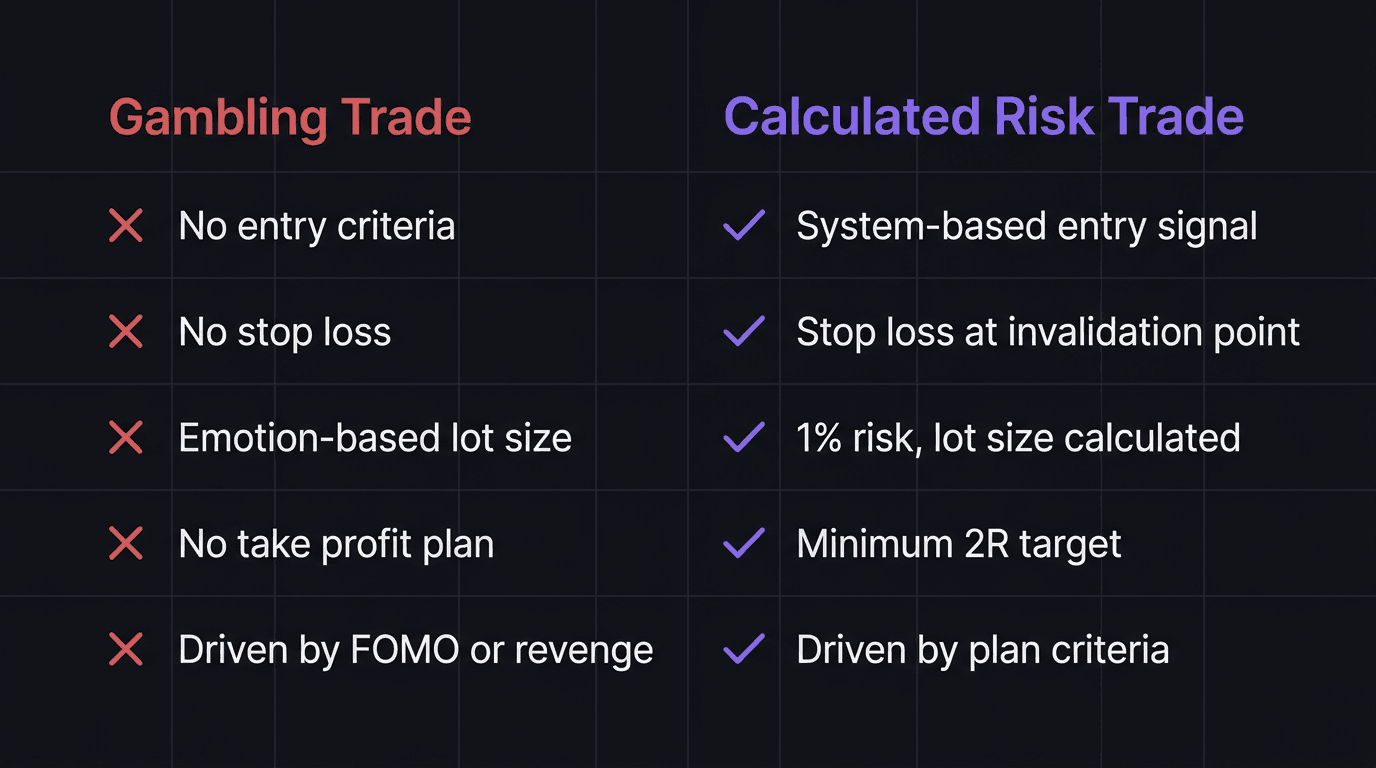
The difference between gambling and trading is one word: calculated. A gambler takes risk. A trader takes calculated risk. That means having a defined entry reason, a stop loss that caps your downside, and a position size based on rules instead of feelings. Remove any one of those three and you have crossed the line back into gambling, even if you are sitting in front of a chart instead of a roulette wheel.
This distinction matters because the forex market makes it incredibly easy to gamble. You can open a $50 account, apply 500:1 leverage, and flip your balance in minutes. The interface looks like trading. The language sounds like trading. But without structure, the only thing separating you from a casino is the lighting.
TL;DR
Gambling is risk without a system. Trading is risk with a system that has a positive expected value over time.
Three things separate traders from gamblers: a tested methodology, a fixed risk per trade, and a stop loss on every position.
High leverage on small accounts is the most common gateway to gambling behavior in forex.
You cannot trade your way to wealth if you are trading like a gambler. Process first, profits follow.
A mechanical trading plan is the structural barrier between calculated decisions and emotional ones.
What Gambling Looks Like in Forex
Gambling in forex does not look like a casino. There is no dealer, no flashing lights, and no one telling you the house always wins. That is what makes it dangerous. It looks exactly like trading until you examine what is actually happening.
Here are the telltale signs:
No stop loss. You enter a trade and "see what happens." If price goes against you, you hold and hope. If it keeps going against you, you add to the position. Eventually, the broker closes you out at margin or you panic-sell at the worst possible price. Every trade without a stop loss is an unlimited risk bet.
No entry criteria. You opened the chart, something "looked good," and you clicked buy. There was no trend analysis, no zone markup, no confirmation model. You traded because you felt like trading, not because your system told you to.
Emotion-based position sizing. You normally trade 0.1 lots. But you just lost three trades in a row and you are angry. So you bump it to 0.5 lots to "make it back faster." The lot size is now driven by revenge, not by your 1% risk rule.
News trading without a plan. A high-impact news event drops in 30 seconds. You open a position because "something big is going to happen." You have no idea which direction, no stop loss, and no exit plan. This is a pure coin flip with leverage.
Walkthrough: A Gambling Trade
A trader with a $2,000 account sees EUR/USD moving fast during a news release. Price spikes up 40 pips in seconds. He enters a buy at 1.0920 with 0.5 standard lots because "the momentum is strong." No stop loss. No take profit. No plan.
At 0.5 lots, each pip is worth $5. Price reverses 60 pips to 1.0860. His unrealized loss is 60 pips times $5, which equals $300. That is 15% of his account from one trade. He holds, hoping for a bounce. Price drops another 40 pips to 1.0820. Now he is down 100 pips times $5, which equals $500, or 25% of his account.
He closes in panic. In under an hour, he lost a quarter of his account on a single trade with no setup, no stop loss, and an oversized position. That is not trading. That is gambling with a charting interface.
What Calculated Risk Looks Like
Calculated risk has three components. All three must be present on every trade.
1. A Tested Methodology
You know why you are entering. Your system identified the trend direction, marked a zone, and price reached that zone with confirmation. You have backtested this setup across at least 30 examples and know its approximate win rate and average R:R.
This is the "calculated" part. You are not guessing. You are executing a system that has demonstrated a statistical edge over a meaningful sample.
2. A Defined Risk Cap
Before you enter, you know exactly how much you will lose if the trade fails. Your stop loss is placed at a price that invalidates the trade idea, and your lot size is calculated so that hitting the stop loss costs no more than 1% of your account.
On a $10,000 account with 1% risk and a 30-pip stop on EUR/USD:
Risk budget: $100
Lot size: $100 / (30 pips times $10) = 0.33 lots
Pip value: $3.30
Maximum loss if stopped: 30 pips times $3.30 = $99
You know the worst-case outcome before you click the button. That is the opposite of gambling.
3. A Minimum Reward Ratio
Calculated risk means the potential reward justifies the risk. A minimum of 2R means your take profit target is at least twice the distance of your stop loss. At $99 risk, your target should offer at least $198 in potential reward.
This is what tilts the math in your favor over time. Even with a 40% win rate, consistent 2R trades produce a positive expected value.
The Leverage Trap
Leverage is not inherently bad. It is a tool that lets you control more currency than your account holds. The problem is that it removes the natural friction that would otherwise stop you from gambling.
In stock trading, if you have $1,000, you can buy $1,000 worth of stock. The downside is limited by the amount you invested. In forex with 500:1 leverage, that same $1,000 gives you $500,000 in buying power. You can open positions that would be absurd for your account size.
A $100 account with 500:1 leverage has $50,000 in buying power. That is enough for 0.5 standard lots. Each pip is worth $5. A 20-pip stop loss (which is tight) would cost $100, or your entire account.
This is why so many forex accounts blow up in the first month. The leverage makes it possible to take positions that have a meaningful chance of wiping the account in a single trade. Without strict risk-per-trade rules, leverage turns every trade into an all-in bet.
Walkthrough: Same Setup, Calculated vs Gambling
Two traders see the same EUR/USD setup. Price is at a demand zone with bullish confirmation on the 15-minute chart. Entry at 1.0900. Stop loss below the zone at 1.0875 (25 pips). Target at the next supply zone at 1.0970 (70 pips).
Trader A (calculated risk): Account is $5,000. Risks 1%. Risk budget is $50. Lot size: $50 / (25 pips times $10) = 0.20 lots. Each pip is $2. If stopped, loses $50. If target hits, makes 70 pips times $2 = $140. That is a 2.8R trade.
Trader B (gambling): Account is $5,000. Wants to "make real money." Uses 2.0 standard lots. Each pip is $20. If stopped, loses 25 pips times $20 = $500, which is 10% of the account. If target hits, makes 70 pips times $20 = $1,400.
Same setup. Trader A risks 1% and gets a clean 2.8R opportunity. Trader B risks 10% on a single trade. Three consecutive losses for Trader A cost $150 (3%). Three consecutive losses for Trader B cost $1,500 (30%). Trader A survives. Trader B is in a hole that requires a 43% gain just to break even.
How to Stay on the Right Side
The line between calculated risk and gambling is not about the market or the pair or the timeframe. It is about your process. Here are the structural barriers that keep you on the trading side:
Never enter without a stop loss. If you do not know where the trade is wrong, you do not know enough to take the trade.
Never risk more than 1% per trade. This is non-negotiable for anyone who wants to still be trading six months from now.
Never enter without matching your plan criteria. If the setup does not check every box in your trading plan, it is not a trade. It is a gamble dressed up as one.
Set daily limits. A maximum number of trades per day and a maximum dollar loss per day prevent spiraling when emotions take over.
Journal every trade. Gamblers do not want to look at their history. Traders review it weekly. The willingness to examine your data is itself a sign that you are operating with structure.
How EdgeFlo Keeps You on the Trading Side
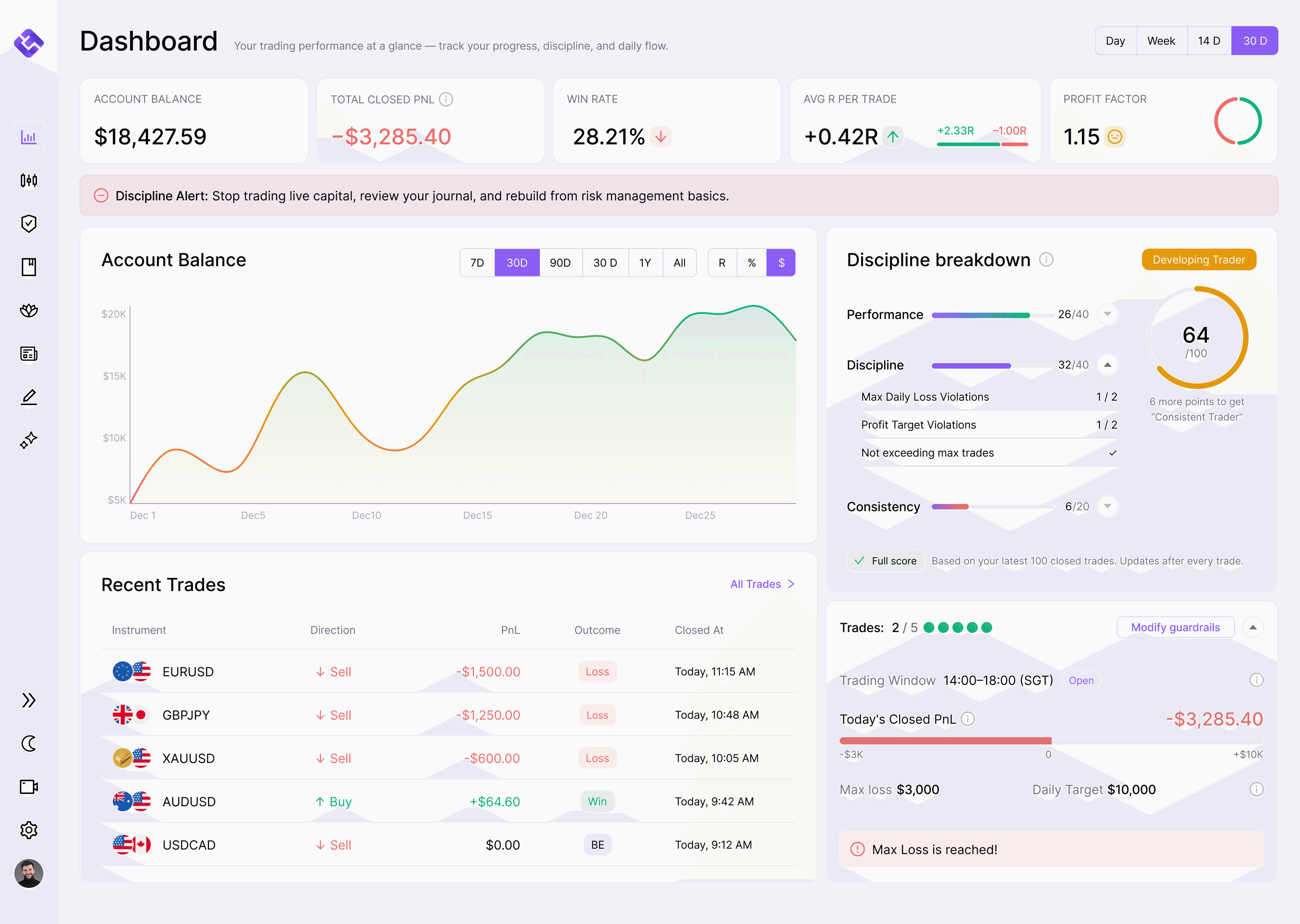
EdgeFlo's guardrails restrict trading when you hit your daily loss limit or maximum trade count. You can override them, but you have to consciously choose to do so. That moment of friction is the difference between a calculated decision and an impulsive one.
Your documented trading plan stays visible during every session through EdgeFlo's Edge feature. Before you enter, your criteria are right there. After you trade, the journal captures the result. Over time, your data tells you whether you are trading or gambling, and the numbers do not lie.
The Edge Brief
Receive Insights on trading psychology, discipline, and the behavioral patterns that create consistent traders from our Founder and the EdgeFlo team, delivered to your inbox.
Think different. Trade different.
What is the difference between calculated risk and gambling?
Is forex trading just gambling?
What makes a trade a gamble?
How do I stop gambling and start trading?

Turn discipline on.
Every session.
EdgeFlo is the environment serious traders operate inside.
Start 7-Day Free Trial
Cancel anytime.
No long-term commitment.

Think Different, Trade Different.