

Best Market to Trade for Beginners: Stocks, Forex, or Futures
Compare stocks, forex, futures, crypto, and options side by side. Learn which market fits your personality, capital, and schedule as a beginner trader.
The Five Markets You Can Trade
Every retail trader picks from the same five games: stocks, forex, futures, crypto, and options. Each one has different rules, different capital requirements, and different weaknesses it punishes. The best market for you depends on your personality, your schedule, and which type of pain you can handle long enough to get good.
That is the part nobody tells you. There is no perfect market. Every market looks great from the outside until you try to pull money from it for six straight months. Stocks punish impatience. Crypto punishes greed. Forex punishes indiscipline. Futures punish bad sizing. Options punish bad timing.
Your job is to pick the game whose rules match how you think, then commit long enough to build a real edge.
TL;DR
Stocks reward patience and long time horizons but require more capital and move slowly.
Forex is the best fit for most active beginners because of low capital requirements, session structure, and daily routine compatibility.
Crypto is accessible but wildly volatile and sentiment-driven, making it dangerous for undisciplined traders.
Futures offer clean price action and low fees but punish oversizing harder than any other market.
Options are the hardest market and should only come after you have mastered one of the other four.
What Each Market Punishes
Understanding each market's weakness is more useful than understanding its upside. The upside sells itself. The weakness is what blows your account.
Stocks punish impatience. Returns compound over months and years. If you need action every day, you will overtrade a stock portfolio into the ground. You can be right about the direction and still be wrong about the timing for weeks. The noise (earnings reports, analyst upgrades, macro headlines) drowns traders who cannot sit still.
Crypto punishes greed. The market is open 24/7, which sounds like a feature until you realize it means you can overtrade seven days a week. Sentiment shifts overnight. One tweet can reverse a trend. If your position size forces you to panic, you are too big. Most crypto traders lose not because the market is random, but because they chase euphoria and panic during fear.
Forex punishes indiscipline. Leverage is high, sessions repeat daily, and the same patterns show up in the same kill zones week after week. The market rewards boring consistency and destroys traders who skip their routine, trade off-plan, or size up after a win streak.
Futures punish bad sizing. One contract of NQ (Nasdaq futures) can move $500 in minutes. If your position is too large relative to your account, a single news candle can end your session. Futures do not care about your ego. They care about your math.
Options punish bad timing. You can be right about direction and still lose if you are late. Contracts decay every day (theta), volatility can crush your premium, and the mechanics (Greeks, expiry, intrinsic vs extrinsic) are the most complex of any market. Options should not be your first game.
Walkthrough: Two Beginners, Two Markets
Trader A opens a $500 forex account. She focuses on EUR/USD during the London session, risks 1% per trade ($5), and trades a set of if-then rules. After 20 trades at a 35% win rate with a 1:3 risk-to-reward ratio, she has 7 wins and 13 losses.
Math check: 7 wins x $15 = $105 gained. 13 losses x $5 = $65 lost. Net = $105 minus $65 = $40 profit. Return = $40 / $500 = 8%.
Trader B opens a $500 crypto account. He trades Bitcoin 24/7 with no session limits and no fixed risk percentage. After the same 20 trades, he sizes up on winners and doubles down on losers. He ends the month down $280 because three oversized losses wiped out every gain.
Same skill level. Different market rules. Trader A survived because forex gave her structure. Trader B bled because crypto gave him unlimited access with no guardrails.
Why Forex Wins for Active Beginners
Forex is not the easiest market. But it is the best starting point for most traders who want to be active (daily or intraday) rather than passive (buy and hold).
Here is why:
Low capital to start. Leverage lets you trade meaningful positions with a small account. A $100 or $500 account is enough to learn real execution. You cannot say the same about stocks or futures.
Structured sessions. The market has three clear windows: Asian, London, and New York. You pick one, show up at the same time every day, and build pattern recognition in that window. This is the repetition that builds intuition. Jumping between sessions or markets resets your learning curve to zero.
Repeatable patterns. Currency pairs behave predictably during their active sessions. GBP/USD moves most during London and New York. USD/JPY wakes up in the Asian session. Once you learn one pair's rhythm, you can trade it half asleep.
Five days a week, not seven. Unlike crypto, forex closes on weekends. That forced break protects you from yourself. Trading without rest leads to burnout and bad decisions.
The biggest risk in forex is the same leverage that makes it accessible. If you do not manage position sizing, you will blow up fast. But that is a skill problem, not a market problem. And it is solvable.
Capital and Leverage Comparison
Here is how the five markets compare on the numbers that matter most to a beginner:
Market | Min. Starting Capital | Leverage Available | Session Hours | Feedback Speed |
|---|---|---|---|---|
Stocks | $500 to $2,000+ | 2:1 (US typical) | ~6.5 hrs/day | Slow (weeks) |
Forex | $50 to $500 | Up to 500:1 | 24 hrs, Mon-Fri | Fast (minutes) |
Futures | $2,000 to $5,000+ | Built-in margin | ~23 hrs/day | Fast (seconds) |
Crypto | $10 to $100 | Up to 100:1 | 24/7 | Instant |
Options | $500 to $2,000+ | Contract-based | Market hours | Variable |
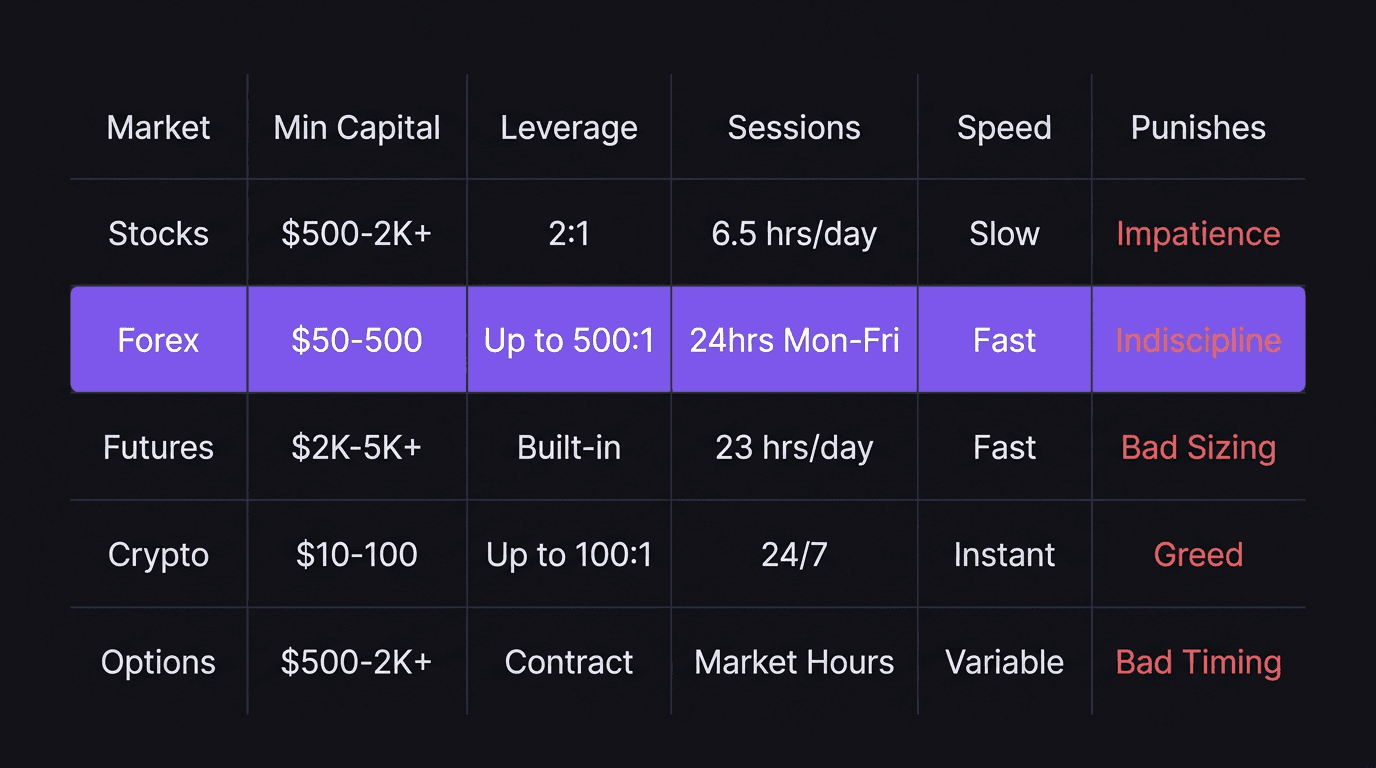
A few things jump out from this comparison:
Forex has the lowest real barrier to entry. You can start small, trade during a specific session, and get fast enough feedback to learn without waiting weeks for a trade to play out.
Crypto also has a low barrier, but the 24/7 access and extreme volatility make it a trap for beginners who have not built discipline yet.
Futures require more capital and punish sizing mistakes instantly. They are better suited for traders who have already proven consistent execution in a simpler market.
Options are the graduate-level course. Do not start here. Master one of the other four first.
How EdgeFlo Helps You Pick Your Lane
The hardest part is not choosing a market. It is staying in one market long enough to build real skill. Most traders hop between strategies and markets every time things get uncomfortable, resetting their pattern recognition to zero each time.
EdgeFlo's Edge plan builder lets you document your strategy for a single market, keep it visible during every session, and track whether you are following it. When you are tempted to switch to the "hot" market, your plan is right there reminding you what you committed to.
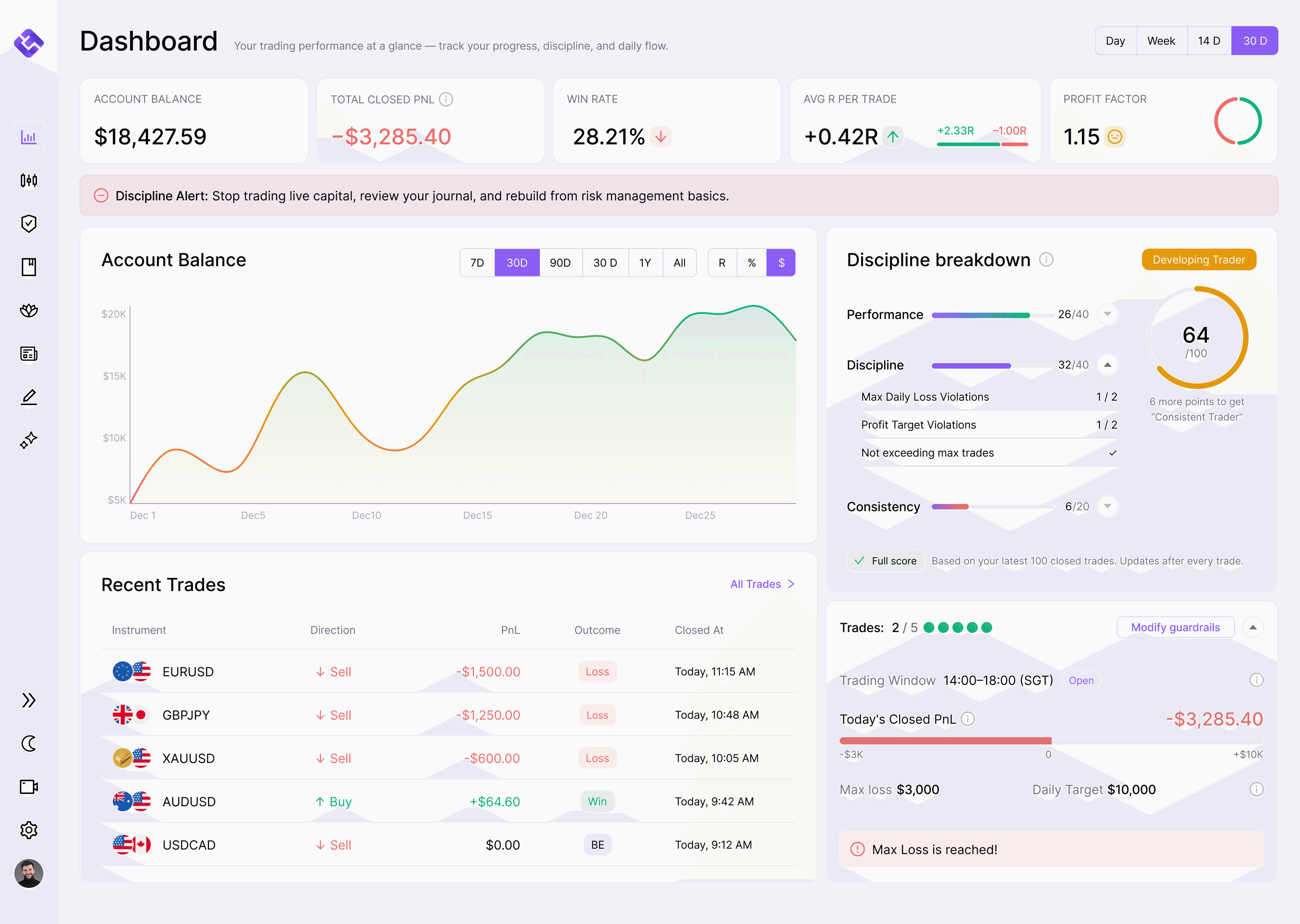
The trading dashboard tracks your performance over weeks and months so you can see real progress. That data replaces the guesswork that drives market switching. When you can see your win rate improving in one market, the urge to jump fades.
The Edge Brief
Receive Insights on trading psychology, discipline, and the behavioral patterns that create consistent traders from our Founder and the EdgeFlo team, delivered to your inbox.
Think different. Trade different.
What is the best market for beginner traders?
Can I trade multiple markets at once as a beginner?
How much money do I need to start trading forex?
Is crypto easier to trade than forex?

Turn discipline on.
Every session.
EdgeFlo is the environment serious traders operate inside.
Start 7-Day Free Trial
Cancel anytime.
No long-term commitment.

Think Different, Trade Different.