

Better Entry Location = Better Risk to Reward
Entering in the middle gives 1:1 R:R. Entering at a demand zone in discount gives 3:1 or better. Same trade idea, wildly different outcomes. Math inside.
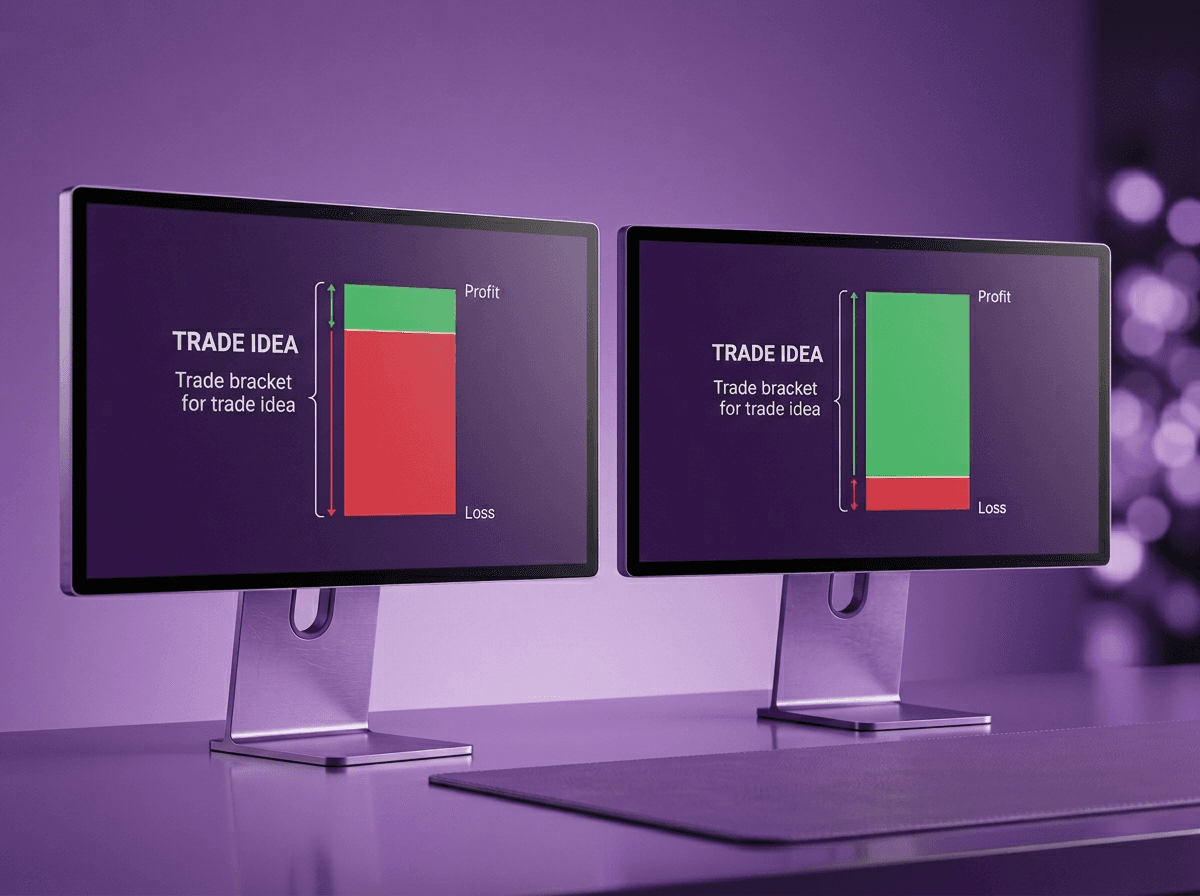
Two traders see the same bullish structure on EUR/USD. Same demand zone. Same target. Same week. One makes $1,500. The other makes $300. They took the same trade. The difference is where they clicked buy.
Entry location is the most underrated variable in trading. Traders spend weeks studying patterns, indicators, and confluence techniques, then enter at a random price because they did not want to wait 4 hours for price to reach the zone.
That impatience does not just reduce their reward. It fundamentally changes whether the trade is worth taking at all.
TL;DR
Entering at the edge of a demand zone in discount pricing can produce 3:1 to 5:1 R:R on the same setup that gives 1:1 from the middle.
Your stop loss distance is determined by structure, not by how much you want to risk. Location controls how far that stop is from your entry.
Better location means smaller risk per trade, more room to target, and a lower win rate needed to be profitable.
Capital allocation is not about which trades to take. It is about where you enter the trades you take.
If the math does not work from your current price, wait or skip. Forcing bad R:R is the same as overpaying.
The Middle-of-Nowhere Problem
When price is in the middle of your swing range, far from any demand or supply zone, your stop loss has to go to the nearest structural level. That is a long way away. Meanwhile, your target (the swing high or low) is equally far in the other direction.
The result: a 1:1 risk-to-reward trade. You risk $10 to make $10. To profit from that over 50 trades, you need a win rate above 50%. That is hard. That is coin-flip territory where commissions and slippage eat you alive.
But if you wait for price to travel to a demand zone in the discount area, your entry is close to the swing low. Your stop goes just below it (tight). Your target is the swing high (far away). The same trade idea that was 1:1 from the middle becomes 3:1 or better from the edge.
Nothing changed except your entry price. The direction was the same. The zones were the same. The pair was the same. Your location was the variable.
How Location Transforms Your R:R
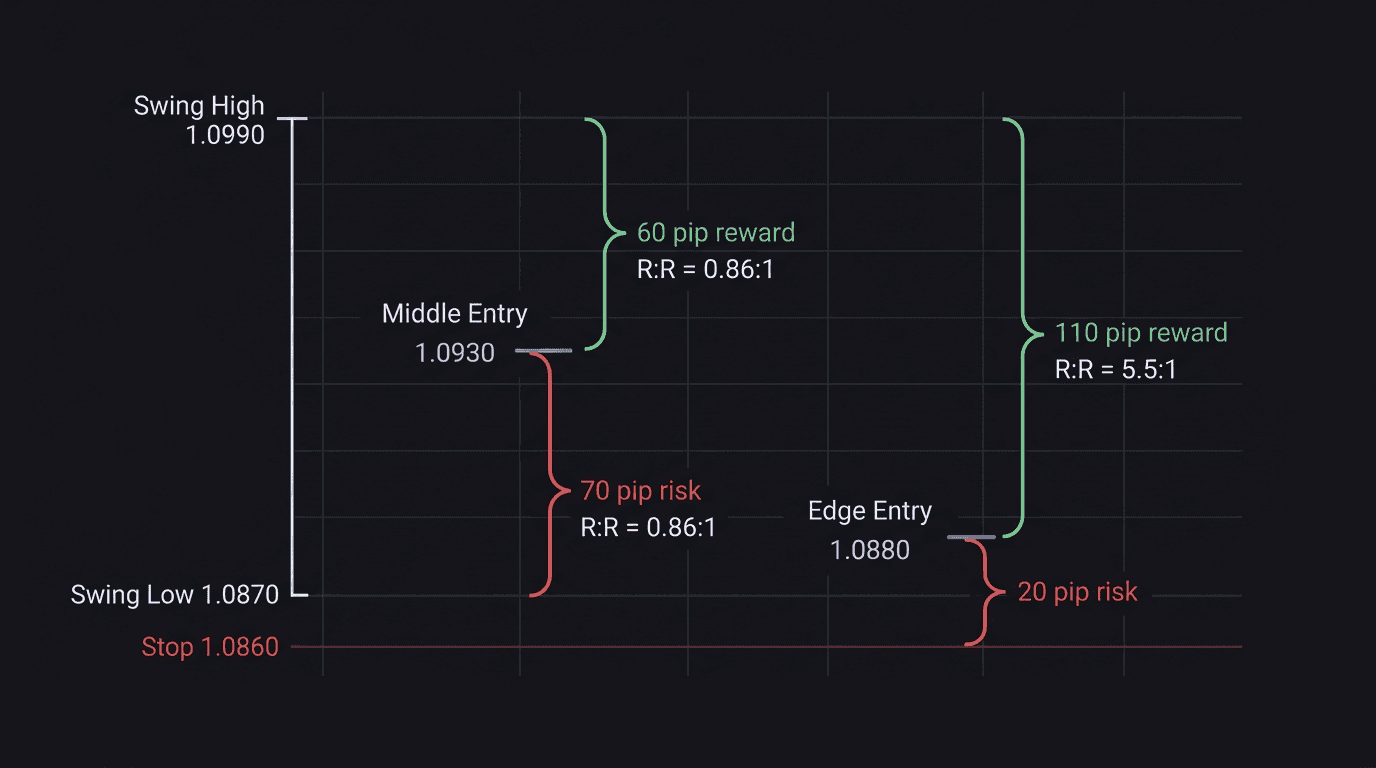
Here is a concrete comparison on EUR/USD.
Swing range: 1.0870 (swing low) to 1.0990 (swing high). Range: 120 pips.
Stop below swing low at 1.0860. Risk: 70 pips.
Target at swing high 1.0990. Reward: 60 pips.
At 1 standard lot ($10/pip): risking $700 to make $600.
Stop below swing low at 1.0860. Risk: 20 pips.
Target at swing high 1.0990. Reward: 110 pips.
R:R = 5.5:1.
At 1 standard lot ($10/pip): risking $200 to make $1,100.
The middle entry needs a 54% win rate to break even (1 / (1 + 0.86) = 0.538). The edge entry needs a 15% win rate to break even (1 / (1 + 5.5) = 0.154). One is grinding. The other is sustainable even through a bad streak.
Walkthrough: 1:1 vs 3:1 on the Same Setup
GBP/USD, 4H bullish. Swing range: 1.2700 to 1.2850. Demand zone at 1.2710 to 1.2725. Equilibrium at 1.2775. Stop for all entries at 1.2695 (below the swing low).
Risk: 1.2790 to 1.2695 = 95 pips.
Reward: 1.2850 to 1.2790 = 60 pips.
R:R = 0.63:1.
At 0.5 lots ($5/pip): risking $475 to make $300.
Risk: 1.2720 to 1.2695 = 25 pips.
Reward: 1.2850 to 1.2720 = 130 pips.
R:R = 5.2:1.
At 0.5 lots ($5/pip): risking $125 to make $650.
Trader A risks $475 to make $300. Trader B risks $125 to make $650. Both took the "same trade." Location is the entire difference.
And here is the kicker: Trader B can afford to lose more often. Even if Trader B only wins 3 out of 10 trades at 5.2:1, they profit. Trader A needs 7 out of 10 wins at 0.63:1 just to stay flat. Location does not just improve your winners. It makes your losses survivable.
Capital Allocation Is About Location Quality
Your job as a trader is not to find more trades. It is to allocate your capital to the trades that offer the best return for the risk taken. That is position sizing combined with location quality.
A B-grade location produces a B-grade trade regardless of how perfect the direction and pattern look. An A-grade location with mediocre pattern timing still produces a favorable R:R because the math is structurally sound.
This does not mean you only take trades with 5:1 R:R. It means you never take trades where location alone forces you below 2:1. If the zone entry gives you 2.5:1 and you are comfortable with your win rate at that ratio, take it. If the only available entry gives you 0.8:1 because price is in the middle, you skip it. No exceptions.
How EdgeFlo Shows Your R Before You Enter
Calculating R:R in your head while price is moving is how mistakes happen. You round numbers, forget the stop distance, or convince yourself that "close to 2:1" is good enough when it is actually 1.4:1.
EdgeFlo's auto risk calculator shows you the exact R:R before you enter. You set your stop, set your target, and the calculator displays the ratio in real time. If it is below your minimum threshold, the number stares at you until you either adjust your entry or walk away.
That visual feedback loop is simple but effective. When your minimum R:R is 2:1 and the calculator shows 1.3:1, there is no rationalizing. The math is visible. The decision is binary: wait for a better entry or skip the trade.
The Edge Brief
Receive Insights on trading psychology, discipline, and the behavioral patterns that create consistent traders from our Founder and the EdgeFlo team, delivered to your inbox.
Think different. Trade different.
How does entry location affect risk-to-reward ratio?
What R:R should I aim for from a good entry location?
Can I improve R:R by moving my stop closer?
Why does the same trade idea produce different R:R for different traders?

Turn discipline on.
Every session.
EdgeFlo is the environment serious traders operate inside.
Start 7-Day Free Trial
Cancel anytime.
No long-term commitment.


Think Different, Trade Different.