

Why Process Goals Beat Profit Targets in Trading
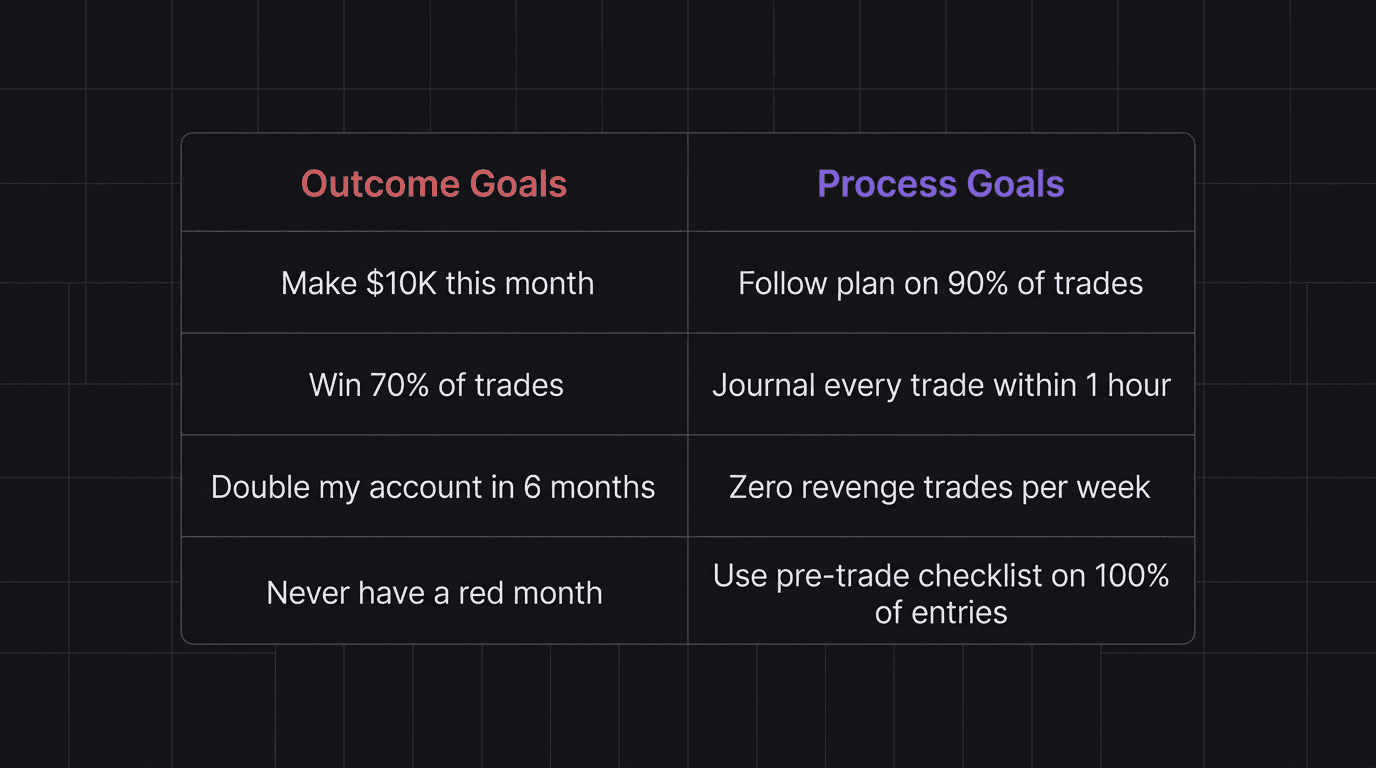
Setting a $10K monthly target is an outcome you cannot control. Process goals like plan adherence give you a scoreboard you can actually win.

You cannot control how much the market gives you this month. You can control whether you followed your plan on every trade. That is the difference between outcome goals and process goals, and it is the single biggest mindset shift that separates traders who survive from traders who quit. Process goals put the scoreboard in your hands. Profit targets hand it to the market.
TL;DR
Dollar targets ($10K/month) create pressure to force trades when opportunities do not exist.
Process goals (90% plan adherence, zero revenge trades) measure what you actually control.
Every trade is a vote for the trader you want to become, not a lottery ticket for your income goal.
Process-focused traders compound improvement because they fix execution errors instead of chasing results.
Profit becomes a byproduct of consistent process, not the other way around.
Why Dollar Targets Set You Up to Fail
"I want to make $10,000 this month." Sound familiar?
Here is the problem. The market does not care about your monthly target. Some months deliver 15 clean setups. Other months deliver 3. If your scoreboard says "$10K or failure," you will start forcing trades during the slow months. You will add positions that do not meet your criteria. You will hold losers too long, hoping they turn around so you can stay on pace.
That is not trading. That is gambling with extra steps.
Dollar targets also create a dangerous emotional cycle. If you are up $8,000 by the 20th, you start protecting gains instead of following your plan. If you are at $2,000 by the 20th, you start swinging for the fences. Both reactions pull you away from the process that generates consistent results.
The irony: traders who chase dollar targets usually make less money than traders who ignore them. Chasing creates emotional drag. Emotional drag creates bad trades. Bad trades drain accounts.
Walkthrough: The $5,000 Target Trap
A trader with a $50,000 account sets a goal of $5,000 per month (10% return). By the third week, he has made $1,800 from 6 clean trades. The market slows down. Instead of waiting, he forces 4 additional trades that do not meet his entry criteria. He risks 1% ($500) per trade. All four lose. That is $2,000 gone. He ends the month at negative $200 instead of positive $1,800. His process was profitable. His target made him unprofitable.
Process Goals You Can Actually Control
A process-oriented approach gives you goals where effort directly equals outcome. You did the thing or you did not. No market luck required.
Here are process goals that actually work:
Plan adherence rate: "I will follow my documented entry and exit criteria on 90% of trades this week." If you took 10 trades and 9 followed your plan, you hit 90%. Done.
Journal completion: "I will journal every trade within 1 hour of closing it." Either you did or you did not.
Zero revenge trades: "If I take two consecutive losses, I will close my platform for 30 minutes." Binary. You followed the rule or you broke it.
Pre-trade checklist compliance: "Every trade must check 4 out of 4 boxes on my checklist before I enter." No exceptions.
These goals are boring. That is the point. Boring goals compound into consistent results. Exciting goals create emotional volatility.
The shift toward outcome independence is uncomfortable at first. You are used to measuring success in dollars. But once you start tracking process metrics, you see patterns that dollar targets hide. Maybe your win rate on plan-compliant trades is 58%, and your win rate on impulsive trades is 22%. That gap is invisible if you only track P&L.
Every Trade Is a Vote for Who You Become
Think of every trade as a vote. A trade that follows your plan is a vote for the disciplined trader you want to be. A trade based on emotion, impulse, or boredom is a vote against that identity.
Over 100 trades, those votes add up. If 80 of them follow your plan, you are becoming a disciplined trader. If 40 of them follow your plan, you are becoming an impulsive one. The percentages do not lie.
This reframe changes how you experience losses. A losing trade that followed your plan is still a vote for discipline. It still strengthens the habit loop. The outcome was negative, but the process was correct. Over a large sample, correct process produces positive outcomes.
A winning trade that broke your rules is actually dangerous. It reinforces bad behavior. It teaches your brain that shortcuts work, which they do, until they blow up your account on the 5th or 6th shortcut in a row.
Protect the process even when the outcome is painful. The compound effect of 200 plan-compliant trades is worth more than any single winning trade.
How to Build a Process Scoreboard
Stop tracking just your P&L. Build a scoreboard that measures what you control.
Here is a simple weekly scoreboard:
Metric | Target | This Week |
|---|---|---|
Trades taken | Record all | (fill in) |
Plan-compliant trades | 90%+ | (fill in) |
Journal completion | 100% | (fill in) |
Revenge trades | 0 | (fill in) |
Checklist used pre-entry | 100% | (fill in) |
Review this every Friday. Not your equity curve. Not your P&L. This.
Over time, you will notice something: the weeks where your process scores are high tend to be the weeks where your P&L is positive. And the weeks where process scores drop are the weeks where you give money back. The correlation is not perfect, but it is strong enough to prove the point.
Your journal habit feeds this scoreboard. Without a journal, you are guessing about your process quality. With a journal, you have receipts.
Once you track consistency metrics alongside P&L, you stop obsessing over individual trades and start seeing the trend in your execution quality. Your equity curve smooths out because you stop the erratic, off-plan trades that create the biggest drawdowns.
How EdgeFlo Dashboard Tracks Process, Not Just Profit
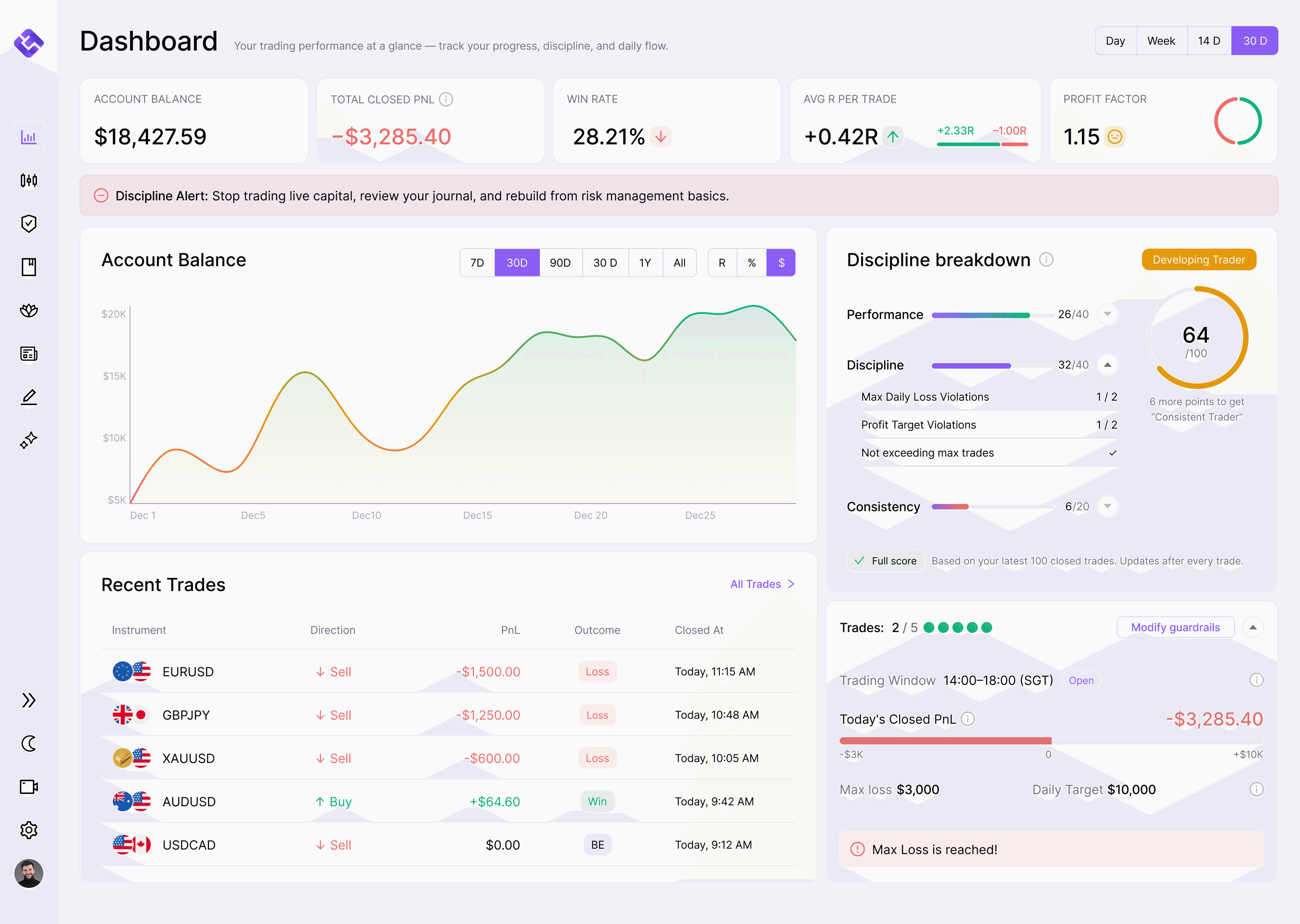
EdgeFlo's dashboard gives you both sides: the financial performance and the discipline performance. Win rate, average R, and profit factor show the financial picture. EdgeScore and the discipline summary show whether you are actually following your rules.
That discipline summary is the process scoreboard built right into your trading workflow. You do not need a separate spreadsheet. After each trade, post-trade self-reporting captures whether you followed your plan, and the dashboard aggregates it over time.
When your EdgeScore trends up while your P&L is flat, you know the process is improving even though the results have not caught up yet. That visibility keeps you going during the hard months when outcomes are negative but execution is clean. That is the kind of data that prevents the "I should just quit" spiral that hits every trader at some point.
The Edge Brief
Receive Insights on trading psychology, discipline, and the behavioral patterns that create consistent traders from our Founder and the EdgeFlo team, delivered to your inbox.
Think different. Trade different.
What is a process goal in trading?
Why do profit targets hurt traders?
How do I measure process in trading?
Do process goals actually lead to profits?

Turn discipline on.
Every session.
EdgeFlo is the environment serious traders operate inside.
Start 7-Day Free Trial
Cancel anytime.
No long-term commitment.

Think Different, Trade Different.