

Trading Doubt Comes From Incompetence, Not the Market
You hesitate because you lack proof your system works, not because the market is hard. Learn how reps and data silence self-doubt faster than motivation ever will.
Trading self-doubt is not a personality flaw. It is your brain telling you that you have not gathered enough proof that your system works. You hesitate before entries, second-guess valid setups, and freeze when price reaches your level, not because the market is too hard, but because you have not yet done the reps that turn a strategy into a reflex.
Every other article on this topic tells you to "believe in yourself" or "trust the process." That advice is useless without something concrete to trust. Doubt disappears when competence replaces ignorance, and competence is built through volume, data, and honest self-assessment.
TL;DR
Self-doubt in trading is a symptom of insufficient reps, not a character weakness.
You cannot affirm or visualize your way to conviction. You earn it through backtesting, forward testing, and journaling.
A mechanical if/then system removes the gray area that doubt feeds on.
Keeping promises to yourself (journaling when you said you would, following the plan when it is uncomfortable) builds the identity that silences doubt.
At least 100 trades following the same rules is the minimum threshold where doubt begins to quiet down.
Why You Doubt Yourself (It Is Not What You Think)
Most traders assume self-doubt is emotional baggage. Something wrong with their mindset. Something they need to fix with meditation or positive thinking.
It is simpler than that. You doubt yourself because you are incompetent. Not as an insult. As a fact. You have not yet done enough work to deserve confidence.
Think about brushing your teeth. Do you hesitate? Do you question whether you are doing it right? Of course not. You have done it thousands of times. It is second nature.
Now compare that to your trading. You stare at a setup that meets every criterion on your checklist, and something inside you whispers, "But what if it does not work?" That whisper exists because you have not executed this same setup 100, 200, or 500 times with recorded results. Your brain has no reference library to pull from. So it defaults to hesitation.
Sound familiar?
The Proof Gap: Where Doubt Lives
Doubt lives in the space between what you claim to know and what you can actually prove. This is the proof gap.
You say your strategy works. But can you show 100 trades proving it? Can you point to a journal entry from last Thursday that shows you followed your rules, took the loss, and moved on without revenge trading?
If you cannot, your doubt is not irrational. It is accurate. Your brain is correctly identifying that you are operating without evidence.
Walkthrough: The Trader Who Knew but Could Not Execute
Picture a trader who studies GBP/USD during London session. She reads about supply and demand zones, watches videos, marks up charts. She spots a demand zone at 1.2640 with a clean break of structure confirming bullish intent.
Her plan says: enter at zone, stop below the low at 1.2610 (30 pips), target the next supply zone at 1.2730 (90 pips). That is a 3:1 reward to risk.
Price touches her zone. She freezes. "What if this time is different?" She watches price bounce without her. It runs 70 pips in her direction. She was right, but she was not in the trade.
Why? She had zero recorded data on this setup. She learned it from a video, never backtested it, never journaled the results. Her brain had no folder to pull from labeled "this works." So doubt stepped in and locked her out.
Reps Are the Only Cure
You cannot motivate your way past doubt. You cannot journal one good week and call it conviction. Conviction is the product of volume.
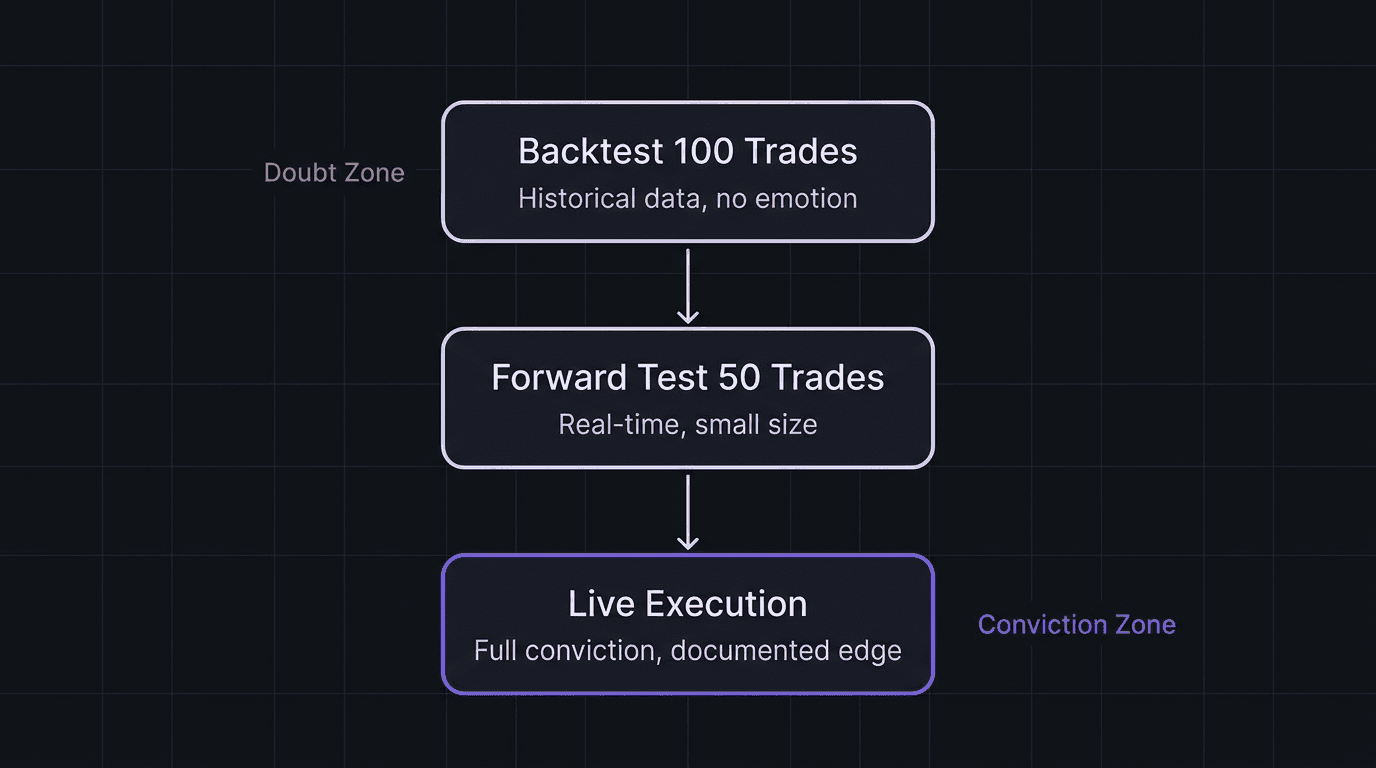
Here is the minimum path:
Define a mechanical system. If price reaches your demand zone AND breaks structure on the lower timeframe, you enter. If those conditions are not met, you stay out. Binary. No gray area.
Backtest 100 trades. Go through historical charts and apply your rules to 100 setups. Record every entry, stop, target, and outcome. This takes work, but it is the single highest-return activity a beginner can do.
Forward test 50 trades. Move to a demo or small live account. Execute the same rules in real time. Log every trade. Note how you felt, what you did, and whether you followed the plan.
After 150 total reps with documented results, something shifts. You stop asking, "Will this work?" because your spreadsheet already answered that question 150 times.
Broken Promises Feed the Voice of Doubt
There is a second layer to self-doubt that has nothing to do with your strategy. It has to do with your identity.
Every time you tell yourself, "I will journal after every trade," and then skip it because you are tired, you break a promise. Every time you say, "I will follow my plan no matter what," and then move your stop loss because a candle scared you, you break another promise.
Stack enough broken promises and your brain reaches a conclusion: "I cannot trust myself." At that point, it does not matter how good your strategy is. You will doubt yourself because you have taught yourself that your word means nothing.
The fix is embarrassingly simple. Start keeping small promises.
Say you will journal three trades this week. Do it.
Say you will walk away after two consecutive losses. Do it.
Say you will not open a chart during your off-session. Do it.
Each kept promise is a brick. Stack enough bricks and you build the identity of someone who does what they say. That identity does not leave room for doubt.
Walkthrough: The Trader Who Sized Up Without Proof
A EUR/USD trader risks 1% per trade on a $10,000 account ($100 per trade). He wins five trades in a row at 1:1 reward to risk. His account grows to $10,500.
He feels invincible. On trade six, he bumps risk to 5% ($525). He does not review his plan. He does not check his criteria carefully. He just "feels it." The trade moves against him and stops him out.
That single 5% loss ($525) wipes out all five previous wins. He is back below breakeven and now doubts everything: his system, his discipline, his ability to trade.
But notice what happened. The doubt did not come from the market. It came from his own decision to abandon the rules he set for himself. Five wins produced $500 in profit, and one oversized loss cost $525. He broke his promise to risk 1%, and his brain recorded that failure. Now the doubt is earned.
A Mechanical System Removes the Gray Area
Doubt thrives in ambiguity. "Should I enter here? Is this a valid setup? Maybe I should wait for one more candle."
A mechanical if/then system kills that noise. Either the criteria are met or they are not. There is nothing to debate.
Your system does not need to be complicated. It needs to be binary:
If price reaches my demand zone AND internal structure shifts bullish, then I enter long.
If either condition is missing, then I stay out.
That is it. No interpretation. No "well, it looks close enough." Close enough is where doubt hides.
When your confidence comes from a documented, tested, binary system, doubt has nothing to latch onto. The setup either qualifies or it does not.
Data Is the Voice That Drowns Out Doubt
Here is the uncomfortable truth: you do not need to eliminate doubt. You need to make the voice of competence louder than the voice of doubt.
After 100 backtested trades, you know your win rate is 42% and your average winner is 2.5R. You know that over the sample, your expectancy is positive. You have the spreadsheet to prove it.
Now when doubt whispers, "This trade might lose," you can respond with data: "Yes, and 58% of my trades lose. But my winners are 2.5 times bigger than my losers, so I come out ahead over the sample."
That is not positive thinking. That is arithmetic. And arithmetic does not care how you feel.
After you backtest and then forward test with real capital on the line, the numbers become personal. They are not someone else's results. They are yours. Your hands placed those trades. Your rules filtered those setups. Your data says it works.
That is conviction. And conviction is the only antidote to self-doubt.
The 100-Trade Threshold
Why 100 trades? Because smaller samples lie. You can win 8 out of 10 trades and think you are a genius. Or you can lose 8 out of 10 and think your strategy is broken. Both conclusions are wrong. The sample is too small.
At 100 trades, patterns stabilize. Your actual win rate starts emerging from the noise. Losing streaks show up (if you flip a coin 100 times, there is a 54% chance you will see seven heads or seven tails in a row). When you see those streaks in your data and notice that the overall result is still positive, doubt loses its grip.
The traders who struggle most with self-doubt are almost always the ones who have fewer than 30 recorded trades. They do not have enough data to trust. Their doubt is rational. The fix is not therapy. The fix is volume.
How EdgeFlo Builds the Evidence That Silences Doubt
EdgeFlo's Edge feature lets you document your trading plan, your if/then rules, and your setup criteria in one place. It stays visible while you trade, so the plan is not buried in a notebook you forgot at home. After each trade, you self-report against that plan: did you follow it or not? Over weeks and months, that data builds the proof trail your brain needs.
The AI-powered journal auto-imports your trades and lets you tag the emotion you felt at entry. When you review 50 tagged entries and see that your plan-following trades win at 45% while your off-plan trades win at 18%, the data answers the doubt for you. No pep talk required.
EdgeFlo's dashboard surfaces your win rate, average R, and discipline summary in one screen. Instead of guessing whether you are improving, you can see the answer. When the numbers trend upward because you are doing the reps, doubt does not stand a chance.
The Edge Brief
Receive Insights on trading psychology, discipline, and the behavioral patterns that create consistent traders from our Founder and the EdgeFlo team, delivered to your inbox.
Think different. Trade different.
Why do I doubt myself before every trade?
How many trades do I need before self-doubt goes away?
Can affirmations fix trading self-doubt?
Is it normal to feel doubt even after winning trades?

Turn discipline on.
Every session.
EdgeFlo is the environment serious traders operate inside.
Start 7-Day Free Trial
Cancel anytime.
No long-term commitment.


Think Different, Trade Different.