

Confidence From Competence: The Only Shortcut
Confidence is not a feeling you summon. It is a side effect of proven competence. Learn why backtesting data and live track records silence doubt faster than any mindset hack.
You have probably heard the advice: "Just be confident in your trades." As if confidence is a switch you flip before the session starts.
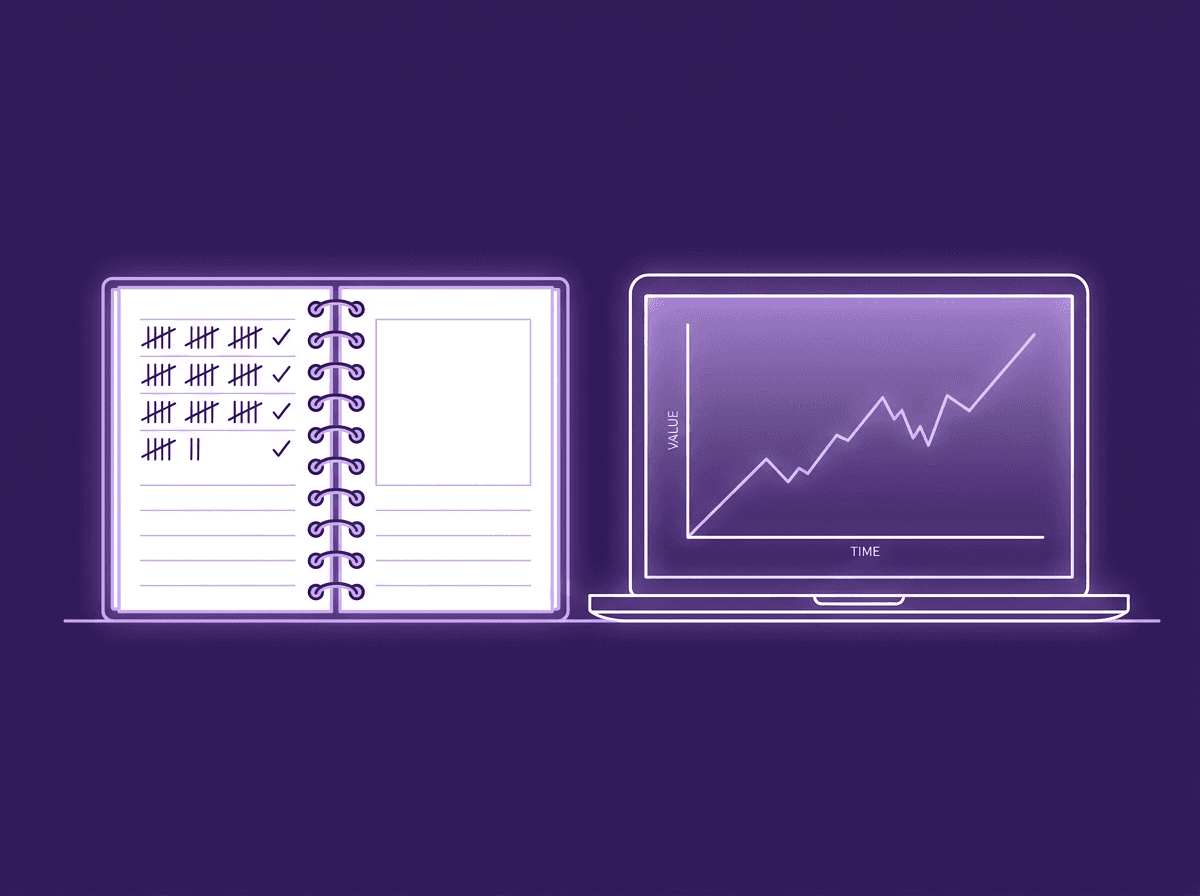
It is not. Confidence in trading is the byproduct of proven competence. You cannot talk yourself into believing your strategy works. You need evidence. Hard, boring, spreadsheet-level evidence that shows your approach has a positive expectancy over a meaningful sample size.
Every trader who struggles with hesitation, second-guessing, or bailing out of trades early has the same root problem. They do not have enough proof that their system works. And no amount of motivational content fixes that.
TL;DR
Confidence is not a feeling you manufacture. It is the side effect of knowing your strategy has been tested and works.
Backtesting over 100+ trades gives you the first layer of proof.
Forward testing on a demo account adds the second layer.
Small live trading adds the third layer, where real emotions meet real data.
Each stage builds on the last. Skip one and your confidence has a gap that pressure will find.
Why "Just Be Confident" Does Not Work
Ever watched a trader enter a position, see it go 5 pips against them, and immediately close it? That is not a discipline problem. That is a proof problem.
If you had 200 backtested trades showing a 40% win rate with a 3R average, you would know that 60% of your trades are supposed to lose. A 5-pip drawdown would not panic you because you have seen this movie before, hundreds of times, and you know how it ends on average.
But if your "testing" was three weeks of demo trading and a YouTube video that said the strategy works, your confidence is built on sand. The first losing streak washes it away.
This is why mindset hacks fail. They try to create confidence without the underlying competence. It is like trying to feel confident about your edge before you have proven one exists.
The Proof Stack: Four Layers That Build Real Confidence
Confidence is not one thing. It is a stack of evidence, and each layer reinforces the one below it.
Layer 1: Backtesting Data
This is your foundation. Backtesting your strategy across at least 100 historical trades gives you the numbers that your emotional brain needs to hear during a drawdown.
What does a completed backtest give you?
Win rate. You know exactly how often your setup wins. Not a guess. A number.
Average R multiple. You know how much your winners pay relative to your risk.
Expectancy. You can calculate the average return per trade. If it is positive, your strategy makes money over time.
Maximum drawdown. You know the worst losing streak your strategy has produced. So when you hit four losses in a row live, you can check: "Is this within my backtested drawdown range?" If yes, the strategy is working as expected.
Without this layer, you are guessing. And guessing under pressure leads to abandoning trades, cutting winners short, and strategy hopping.
Layer 2: Forward Testing Results
Backtesting tells you the strategy worked in the past. Forward testing tells you it works in current market conditions with your real-time decision-making.
Forward test on a demo account for at least 30 to 50 trades. This stage adds something backtesting cannot: execution reality. You will discover that identifying a setup in hindsight is different from spotting it live. Your entries might be slightly worse. Your patience might be tested. Your emotions show up even on a demo.
If your forward test results roughly match your backtest results, you have your second layer of proof. If they diverge badly, you found a gap in your competence before it cost you real money.
Layer 3: Small Live Track Record
Demo confidence is real, but it is incomplete. There is a psychological gap between "no money at risk" and "my money is on the line."
Close that gap with small position sizes on a live account. Risk an amount that matters enough to feel, but small enough that a losing streak will not damage you financially. Trade this way for at least two to three months.
This stage proves something the other two cannot: you can execute your strategy when emotions are present. That is the evidence your brain needs when you eventually size up or take a funded challenge.
Layer 4: Documented Journal Evidence
Each layer generates data. But data only builds confidence if you capture it. Your journal is the container for all of this proof.
When doubt creeps in during a live session, you need to be able to open your journal and see:
150 backtested trades, 42% win rate, 2.8R average winner, positive expectancy of 0.60R per trade.
40 forward-tested trades, 38% win rate, 3.1R average winner, results consistent with backtest.
60 small live trades, 40% win rate, 2.6R average winner, still positive.
That stack of numbers is confidence. Not a feeling. A fact.
Walkthrough: The Trader Who Skipped Layer 2
A trader backtests a supply-and-demand strategy on GBP/USD across 120 trades. Results: 45% win rate, 2.5R average winner, positive expectancy of 0.575R per trade.
Excited by the numbers, the trader skips forward testing and goes straight to a funded challenge. In the first week, the trader takes 8 trades. Results: 2 wins, 6 losses.
Win rate: 2 / 8 = 25%. That is well below the backtested 45%. The trader panics. "My strategy does not work live." They abandon the plan and start improvising.
The problem was not the strategy. The problem was a missing layer. The trader never practiced identifying setups in real time. Their backtested entries were selected with hindsight bias. Live execution introduced timing errors, missed confirmations, and impatient entries that degraded the edge.
If they had forward-tested for 40 trades first, they would have caught the execution gap on a demo account, fixed it, and entered the funded challenge with a more accurate expectation.
Why Six Months Is Not Rushing
Traders in a hurry want to compress this process into weeks. "I will backtest 50 trades, demo for a week, then get funded." That is not a proof stack. That is wishful thinking.
Six to nine months of deliberate practice, moving through each layer with enough trades to be statistically meaningful, is the realistic timeline. Not because trading is inherently slow, but because competence requires repetition.
Think of it this way: you would not trust a pilot who logged 10 hours of flight time. You trust the one with 500 hours. Trading is the same. Your confidence in the cockpit (the live market) is directly proportional to the reps you completed in training (backtesting) and supervised flight (forward testing and small live).
The traders who pass funded challenges on their first or second attempt almost always have six months or more of preparation behind them. The ones who fail after two weeks of demo and wonder why are simply missing the reps.
Competence Is Specific, Not General
One more thing. Confidence does not transfer across strategies. If you are competent at trading supply-and-demand pullbacks on EUR/USD during London session, that competence does not automatically make you confident trading breakouts on NASDAQ during New York.
Every strategy, every pair, every session requires its own proof stack. If you switch strategies, you restart at Layer 1. That is not a setback. That is how genuine edge is built.
The fastest way to lasting confidence is to pick one approach, test it thoroughly, and stay with it until the data tells you whether it works. Strategy hopping is the opposite of this process. It resets your proof stack every time.
How EdgeFlo Supports the Proof Stack
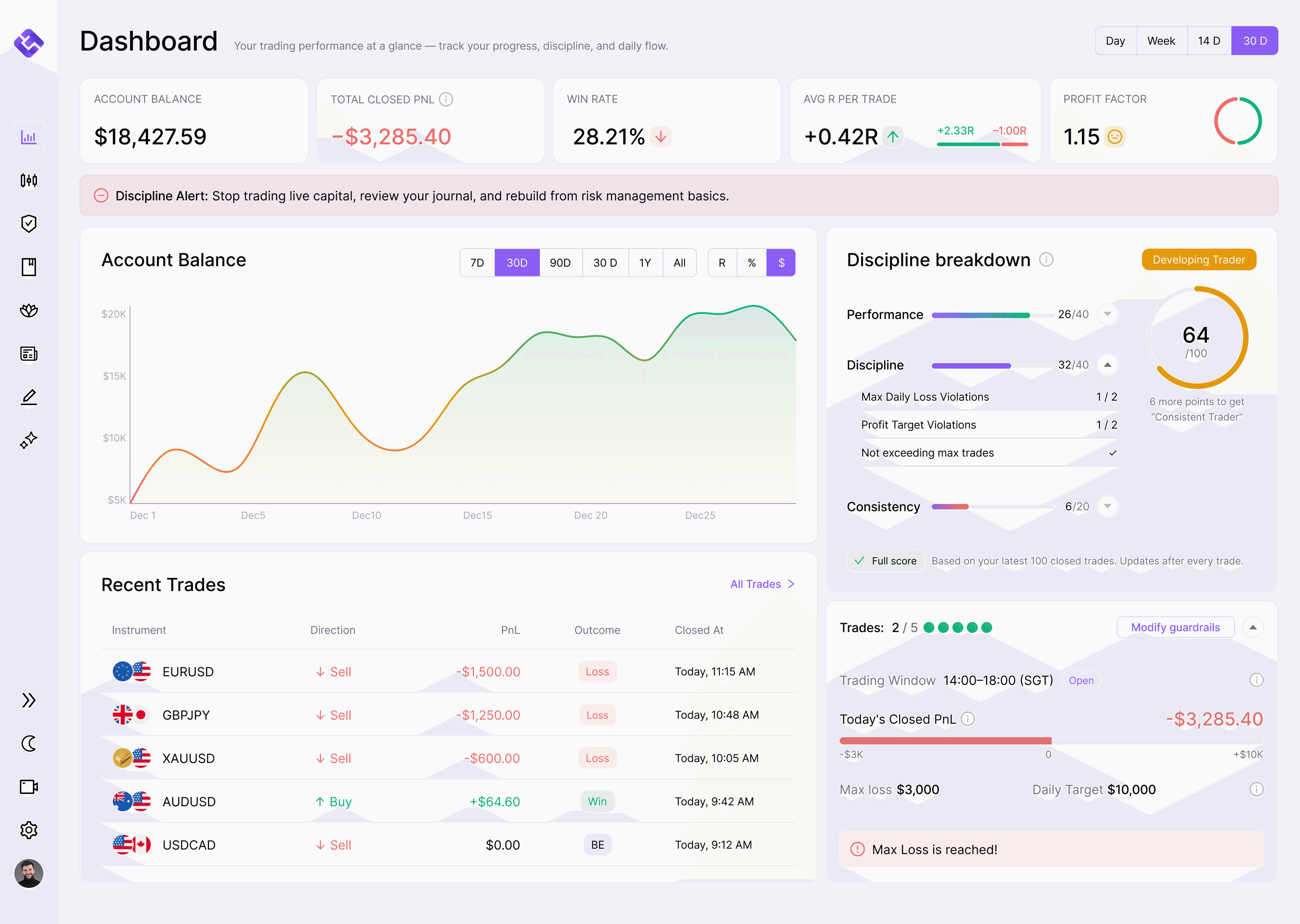
EdgeFlo's Edge feature lets you document your trading plan in one place and keep it visible during every session. Your rules, your entry criteria, your risk parameters. All written down, all accessible when doubt tries to override your data.
The journal auto-imports your trade data and lets you tag each trade with context (setup type, emotion, session quality). Over weeks and months, this creates the documented proof stack that replaces "I think my strategy works" with "I can see that my strategy works across 150 trades."
FloAI (available on the Plus plan) can surface patterns in your journal data that you might miss on your own. It highlights recurring strengths and weaknesses, giving you targeted areas to improve. That targeted improvement is what competence actually looks like: not vague self-belief, but specific skill development backed by your own data.
The Edge Brief
Receive Insights on trading psychology, discipline, and the behavioral patterns that create consistent traders from our Founder and the EdgeFlo team, delivered to your inbox.
Think different. Trade different.
How do I build confidence in my trading strategy?
Why do I lose confidence after a losing streak?
Can affirmations or visualization replace backtesting for confidence?
How long does it take to build real trading confidence?

Turn discipline on.
Every session.
EdgeFlo is the environment serious traders operate inside.
Start 7-Day Free Trial
Cancel anytime.
No long-term commitment.

Think Different, Trade Different.