

The Trading Feedback Loop That Builds Your Edge
The trading feedback loop turns every trade into data that sharpens your edge. Learn the four-step cycle: trade, journal, analyze, improve.
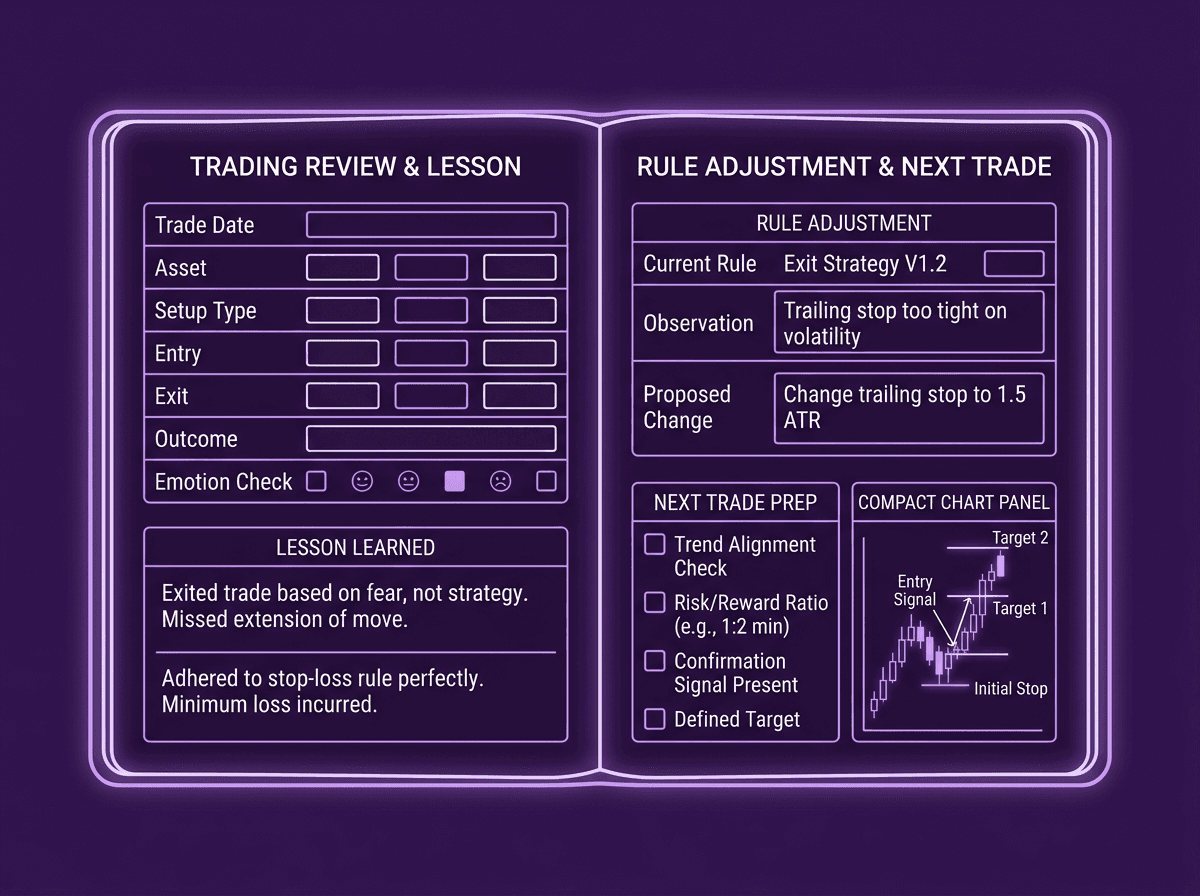
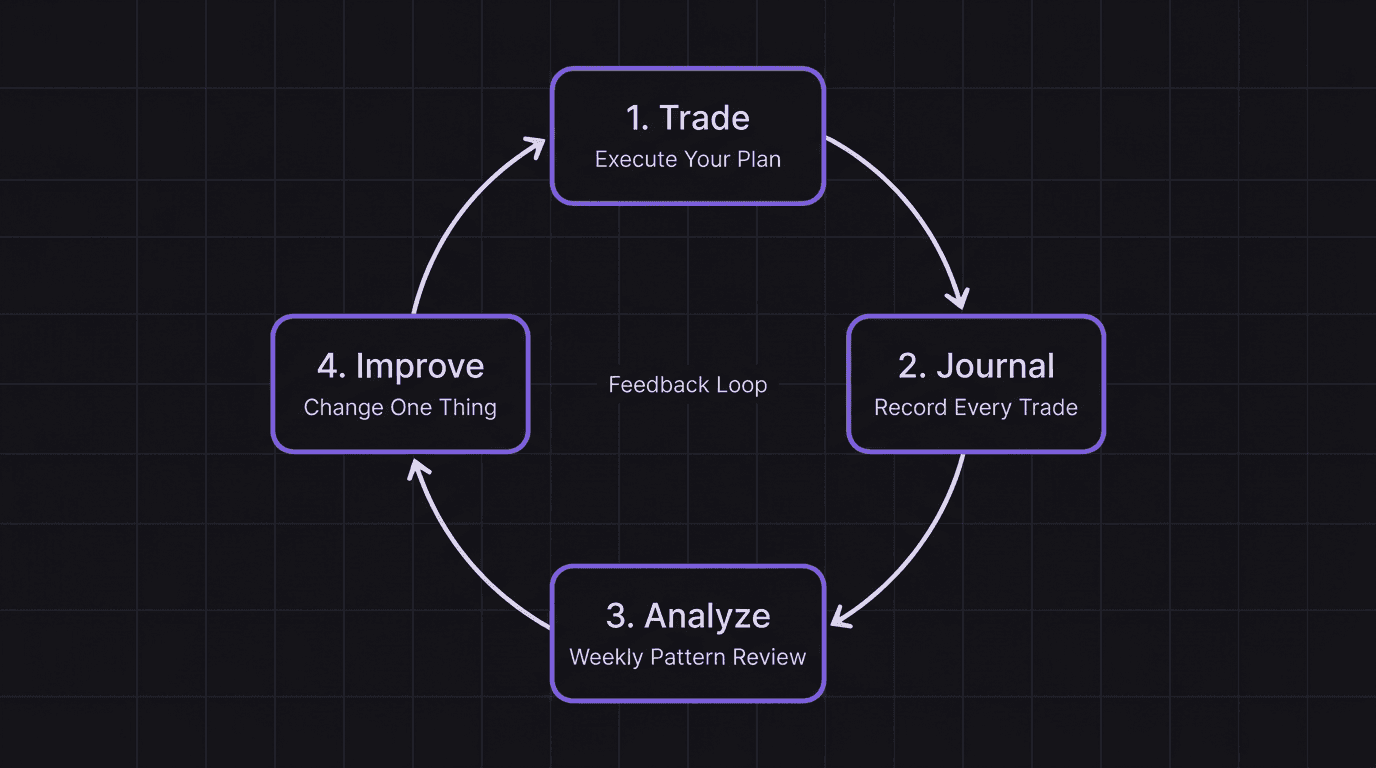
A trading feedback loop is a four-step cycle that turns raw trades into usable data: you trade, journal the result, analyze what went right or wrong, and improve your process before the next trade. Every business runs on feedback systems. Trading is no different. Without this loop, you repeat the same mistakes because you have no structured way to spot them. With it, each week of trading makes the next week sharper. The loop is how inconsistent traders become consistent ones.
TL;DR
A trading feedback loop has four steps: trade, journal, analyze, improve. Then repeat.
The journal is the data layer. Without it, the loop breaks and you trade on memory alone.
Track setup type, emotion, plan adherence, and outcome in every journal entry.
The loop compounds over time because each cycle removes one more leak from your process.
Most traders break the loop by skipping the journal or skipping the analysis. Fix those two gaps first.
What Is a Trading Feedback Loop
Think of any skill you have gotten better at. Cooking, lifting, even a video game. You tried something, saw what happened, adjusted, and tried again. That is a feedback loop. Trading works the same way, but most traders skip the middle steps.
Here is the typical cycle without a feedback loop. You win a few trades and get overconfident. You start forcing setups that are not there. You give back your profits. Then you doubt your strategy, get scared, miss valid setups, and watch them go your way without you. Frustration builds, and you revenge trade to recover losses. Sound familiar?
That cycle is not bad luck. It is the absence of a system that captures what happened and feeds it back to you in a usable way. The trading feedback loop replaces that emotional spiral with a mechanical process: trade, journal, analyze, improve.
The difference between the two cycles is information. In the emotional spiral, you react to feelings. In the feedback loop, you react to data from your own trading journal. Feelings say "my strategy is broken" after three losses. Data says "I took two off-plan trades and one valid loss. The strategy is fine. My execution needs work."
The Four Steps: Trade, Journal, Analyze, Improve
Each step in the loop feeds the next one. Skip a step and the whole thing collapses.
Step 1: Trade
Execute your plan. That is it. You are not trying to learn anything new during a live trade. You are following the rules you already wrote down. If you do not have a written plan with clear entry criteria, exit rules, and risk parameters, the feedback loop has nothing to measure against. The plan is the baseline.
Step 2: Journal
Immediately after the trade closes (win or loss), record it. Not tomorrow. Not at the end of the week. Right after. You want to capture the details while they are fresh: what setup you saw, why you entered, what emotion you felt at entry and exit, whether the trade matched your plan, and the result.
This is where most traders quit. Journaling feels tedious when you would rather move on to the next trade. But the journal is the data layer. Without it, steps 3 and 4 are impossible. Building a consistent trading journal habit is not optional for this loop. It is the foundation.
Step 3: Analyze
Set a weekly time to sit down and review your journal entries. Not glance at them. Actually read through each trade and ask: did I follow my plan? Where did I deviate? What patterns show up across multiple trades?
This is your trading review process. You are looking for repeating behaviors, not isolated events. One revenge trade is a bad day. Three revenge trades after Wednesday losses is a pattern you can fix.
Step 4: Improve
Take what you found in the analysis and change one thing. Not five things. One. Maybe you noticed you take impulsive trades in the first 15 minutes of a session. The fix: wait 15 minutes before your first entry. Test that change for a week, journal the results, and analyze again.
The improvement step feeds back into Step 1. Your next batch of trades now follows a slightly better version of your plan. That is the loop.
What to Track in Each Cycle
Not everything in your journal matters equally. Here is what actually moves the needle when you sit down to analyze.
Per-trade entries (Step 2):
Setup type: What pattern or signal triggered the trade? Label it consistently so you can filter later.
Entry and exit reason: Why you got in and why you got out. "It looked good" is not a reason. "Price rejected the H4 demand zone with a bullish engulfing on the M15" is.
Emotion at entry: Were you calm, anxious, excited, angry? One word is enough. Over time, this field reveals which emotions lead to your worst trades.
Plan adherence: Yes or no. Did the trade match your written plan? If no, note what you did differently.
Outcome in R: Not dollars. R multiples normalize your results across different position sizes and let you compare trades fairly. A 2R win and a 1R loss tell you more than "$400 profit" and "$200 loss" because R connects the result to your original risk.
Weekly review (Step 3):
Win rate by setup type: Which setups actually work for you and which ones drain your account?
Average R per trade: Are you making more than you risk on average?
Plan adherence rate: What percentage of your trades followed the plan? This is the number that predicts consistency.
Emotional correlation: Do your worst trades cluster around a specific emotion or time of day?
Walkthrough: One Week of the Loop in Action
Say you are a swing trader on GBP/USD. You take five trades this week. You journal each one right after it closes.
On Friday, you sit down for your weekly review. Three trades followed your plan (two wins at 1.5R and 2R, one loss at 1R). Two trades did not follow your plan (both losses at 1R each).
Your plan-following trades produced a net of +2.5R. Your off-plan trades produced a net of -2R. Total week: +0.5R.
The data tells you something your gut would not: without those two off-plan trades, your week would have been +2.5R instead of +0.5R. The strategy is working. The problem is you. Specifically, both off-plan trades happened on Wednesday after you took a full 1R loss on a valid setup. You felt frustrated and forced two entries that were not in your plan.
Your improvement for next week: after any 1R loss, close the charts for 30 minutes before looking for another setup. That is it. One change. Journal the results of that change next week, and the loop continues.
This is the kind of clarity a post-trade review gives you. Without the journal data, you would just remember "rough week" and change nothing.
How the Loop Compounds Over Time
The feedback loop does not produce overnight results. It compounds. Each cycle removes one small leak from your process. After four weeks, you have fixed four things. After twelve weeks, your plan, your execution, and your emotional management are all measurably better than when you started.
Here is why compounding matters. Say your plan adherence starts at 60% in week one. You fix one execution leak per week. By week four, you are at 75%. By week eight, 85%. You are not trading a different strategy. You are trading the same strategy with fewer unforced errors.
Consistent action leads to consistent results. That is not a motivational quote. It is math. If your strategy has a positive expectancy (say, a 40% win rate with a 2.5:1 reward-to-risk ratio), and you increase the percentage of trades that actually follow the strategy, your results improve without changing anything about the strategy itself.
The traders who grow accounts over months and years are not the ones who find a magic setup. They are the ones who run this loop every single week without skipping it. The loop is the edge.
Common Mistakes That Break the Loop
The feedback loop is simple. That does not mean traders follow it. Here are the most common ways it breaks.
Skipping the Journal
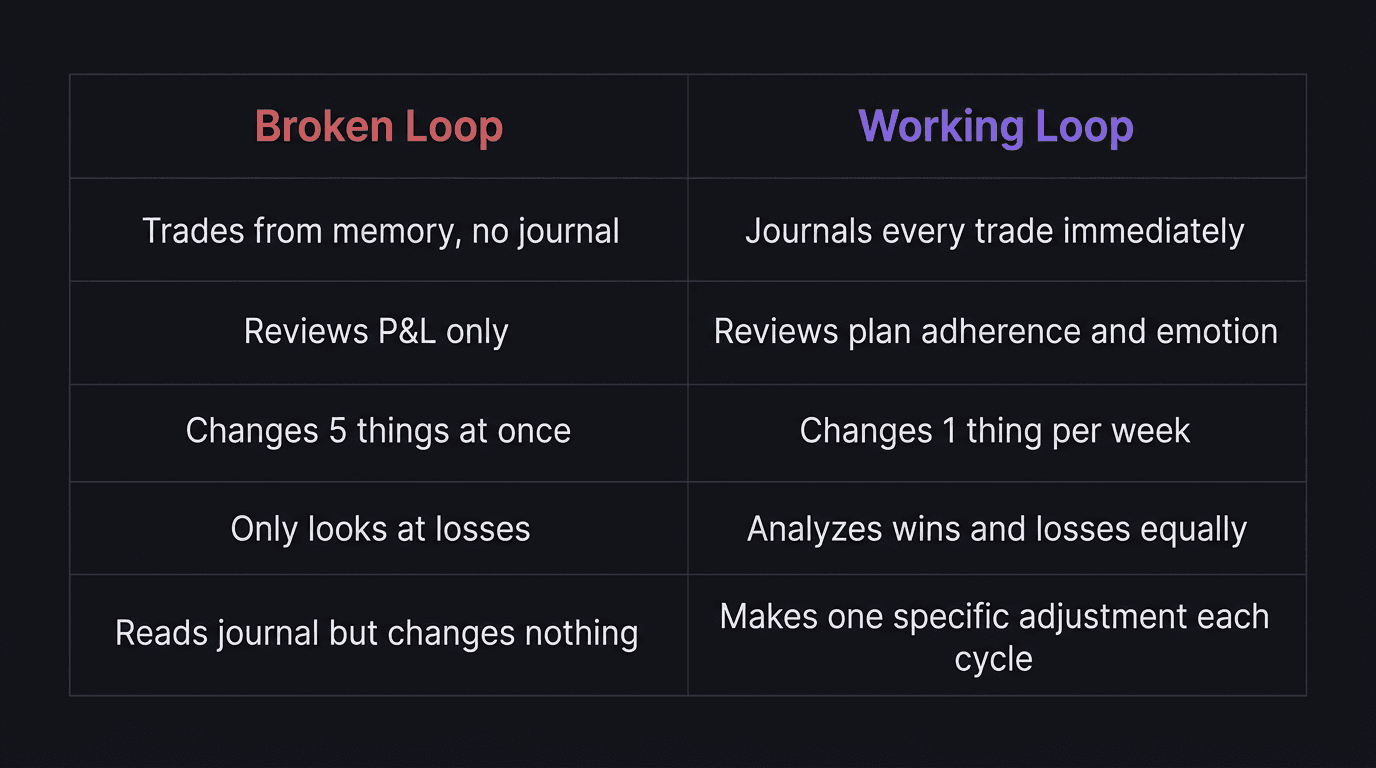
This is the number one killer. You take trades, you see the P&L, and you move on. No written record means no data for analysis. You are flying blind and relying on memory, which distorts after a losing streak. If you journal nothing else, journal plan adherence and emotion. Those two fields alone will show you patterns within two weeks.
Analyzing Without a Plan to Compare Against
If you do not have a written trading plan with specific rules, the analysis step has no baseline. You cannot measure "did I follow my plan" if the plan does not exist on paper. Vague ideas in your head do not count. Write the plan first, then start the loop.
Changing Too Many Things at Once
You review your week, find five problems, and try to fix all of them simultaneously. Now you have no idea which change helped and which one made things worse. Change one variable per cycle. Test it. Measure it. Then move to the next one.
Only Reviewing Losses
Your wins contain data too. Did you win because of the setup, or because the market bailed you out on a sloppy entry? If you only review losses, you miss the patterns in your winning trades that you should be repeating. A proper trading performance review covers both sides.
Doing the Review but Not Changing Anything
Some traders journal religiously and review every week but never actually adjust their behavior. The analysis is not the goal. The improvement is the goal. If your review shows that you overtrade on Mondays, and you do nothing about it, the loop is broken at Step 4.
How EdgeFlo Supports the Feedback Loop
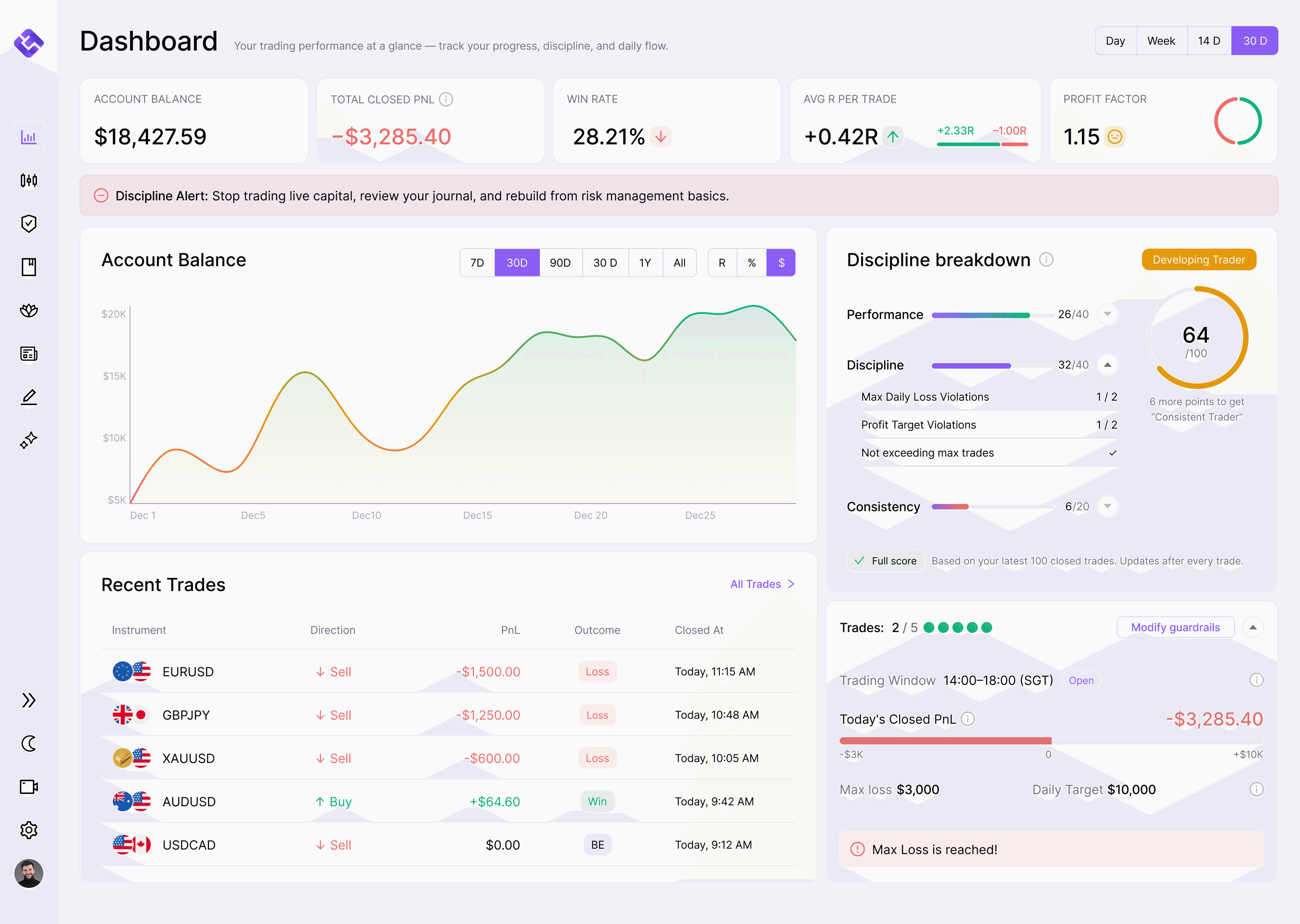
EdgeFlo's AI journal auto-imports your trades so Step 2 happens without manual data entry. Every trade gets pulled in with the numbers already filled. You add the context: what setup you saw, what emotion you felt, whether you followed your plan. Emotion tagging is built into each journal entry, so the data you need for weekly analysis is always structured and searchable.
The post-trade self-reporting feature in Edge (the trade plan builder) connects your journal entries back to your written plan. After each trade, you answer a short set of prompts about whether the trade matched your criteria. That link between plan and execution is what makes Step 3 (analysis) meaningful instead of guesswork.
If you are on the Plus plan, the weekly AI report pulls patterns from your journal data and surfaces them for you. It highlights which setups performed best, when your plan adherence dipped, and where emotional trades clustered. That does not replace your own review, but it gives you a starting point so you spend less time searching and more time fixing.
The Edge Brief
Receive Insights on trading psychology, discipline, and the behavioral patterns that create consistent traders from our Founder and the EdgeFlo team, delivered to your inbox.
Think different. Trade different.
What is a trading feedback loop?
How often should I complete a feedback loop cycle?
What should I track in my trading journal for the feedback loop?
Can a feedback loop work without a trading journal?

Turn discipline on.
Every session.
EdgeFlo is the environment serious traders operate inside.
Start 7-Day Free Trial
Cancel anytime.
No long-term commitment.

Think Different, Trade Different.