

Why Winning Streaks Lead to Blown Accounts
Winning streaks are the most dangerous moment in trading. Learn why overconfidence after wins leads to blown accounts and how to protect your gains.
The account that blows up on a losing streak is not the one that surprises people. The account that blows up right after a string of wins? That catches everyone off guard, including the person who did it.
Winning streaks are the most dangerous phase in retail trading. Not because winning is bad, but because what happens inside your head after five, six, seven wins in a row is the exact psychological state that produces the biggest drawdowns. The complacency that follows peak confidence is the bridge between "best month ever" and "back to zero."
TL;DR
Winning streaks breed overconfidence, which leads to blown accounts faster than losing streaks do.
The danger is not the wins; it is the behavioral shift that follows (bigger lots, skipped rules, more trades).
Complacency shows up as zero emotional discomfort, and zero discomfort means zero vigilance.
Rules that survive your best days are the only rules that matter.
A daily loss limit is your strongest protection when overconfidence kicks in.
The Winning Streak Confidence Trap
Picture this. You have won 8 out of your last 10 trades. Your account is at an all-time high. You have never made this much money in trading before. Every setup seems to work. You feel like you have finally cracked the code.
That feeling? It is not mastery. It is the trap.
When confidence peaks, pain drops to zero. You are comfortable. You are not worried about anything. And that absence of worry is precisely when traders make their worst decisions.
Think about what happens next. Since the last 8 trades all worked, why not increase the lot size? Since you are on a roll, why bother with the pre-session checklist? Since everything is going right, why not take that trade that is only a "maybe" setup?
Every one of those decisions is the direct product of overconfidence. And every one of them sets the stage for what comes next.
How Complacency Creeps Into Your Risk Management
The shift from disciplined trading to reckless trading does not happen overnight. It creeps in through small compromises that feel harmless at the time.
Here is the typical sequence:
You stop preparing. The pre-session routine feels unnecessary because "you already know what the market is doing."
You increase size. Your plan says 0.5 lots, but you bump it to 1.0 because "the streak is hot."
You take more trades. Instead of 3 setups per day, you are taking 6, because you trust your reads.
You skip the journal. Why write down what went right? You already know.
You ignore your daily loss limit. After the first loss in a while, you double down to "get it back."
Walkthrough: The $500 to $2,000 to $0 Pattern
A trader starts with a $500 account trading EUR/USD. Builder mode kicks in: she risks 2% per trade ($10), uses 0.1 lots with a 10-pip stop loss, and targets 20 pips.
Math check: 0.1 lots on EUR/USD = $1/pip. $1 times 10 pips = $10 risk = 2% of $500. Correct. Math check: $1 times 20 pips = $20 profit per winning trade.
Over 3 weeks, she accumulates enough wins to push the account to $2,000. She is thrilled. She has never seen this number before.
Now the wrecker arrives. She jumps to 0.5 lots because "the account can handle it" and keeps the same 10-pip stop.
Math check: 0.5 lots = $5/pip. $5 times 10 pips = $50 risk per trade. That is $50 on a $2,000 account = 2.5% risk. Slightly high, but manageable.
She also starts taking 5 to 6 trades per day instead of 2 to 3. On one bad day, she hits 4 consecutive losses.
Math check: 4 losses at $50 each = $200 lost in one session. That is 10% of the account gone in hours.
Frustrated, she doubles down with 1.0 lots to "recover." Two more losses at 1.0 lots with a 10-pip stop: $10/pip times 10 pips = $100 per loss. Two losses = $200 more.
Total damage in one session: $400, or 20% of the account. Two more sessions like that, and the $2,000 is gone.
This pattern repeats across thousands of retail accounts. The math tells the story: the position sizing that fuels a streak is not the same position sizing that blows the account. The blow-up happens when size increases without a corresponding increase in account balance to justify it.
The Predictable Path from Peak to Blow-Up
The path from peak confidence to blown account follows a specific emotional sequence, and it is the same nearly every time.
Stage 1: Pride (pain level: low). You are doing the right things and seeing results. You feel good about yourself. This is healthy.
Stage 2: Comfort (pain level: zero). You have achieved your goal. There is no urgency, no fear, no pressure. This feels like mastery, but it is actually the most dangerous stage.
Stage 3: Complacency (pain level: zero). You start cutting corners because discipline feels unnecessary. The rules that got you here start to feel like training wheels you have outgrown.
Stage 4: Overexposure. Bigger lots, more trades, less preparation. Your risk per session is now multiples of what it was during the winning streak.
Stage 5: The hit. Markets are random enough that even good setups lose. When losses arrive and you are overleveraged, the damage is catastrophic.
Stage 6: Panic and revenge. You try to win it back immediately, which multiplies the damage.
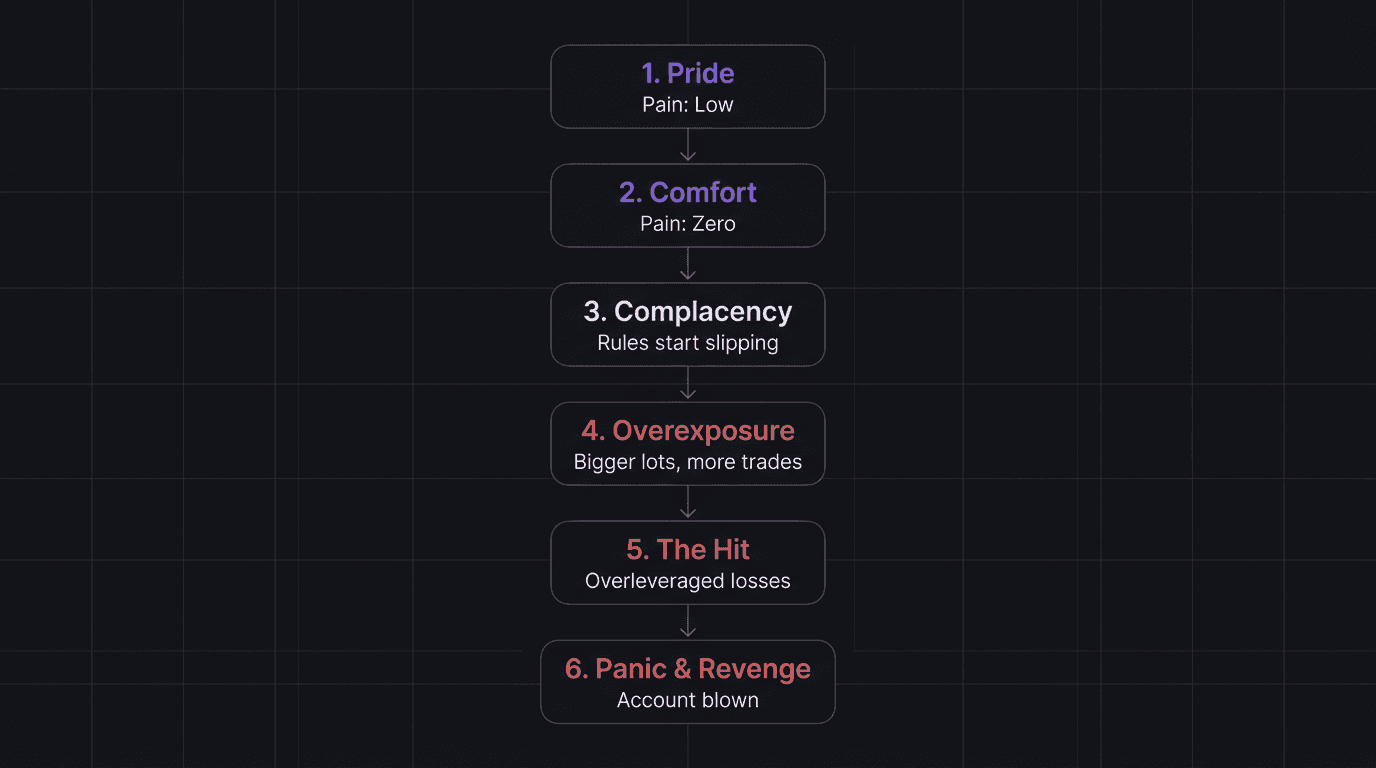
The difference between traders who survive winning streaks and those who do not comes down to one thing: whether their rules flex with their emotions or stay fixed regardless.
Rules That Survive Your Best Days
The only rules that matter are the ones you follow when everything feels great. Anyone can follow a risk plan during a losing streak, because fear enforces discipline for free. But during a winning streak, when confidence is high and pain is zero, only pre-committed rules keep you safe.
Here is what that looks like:
Fixed risk per trade. Your plan says 1% or 2%. It does not change based on recent results. Whether you have won 10 in a row or lost 5, the number stays the same.
Hard trade cap. Three trades per day means three trades per day. Not "three unless I'm feeling it." Not "three on normal days but unlimited on good days."
Daily loss limit. Set a maximum amount you are willing to lose in a single session. Once you hit it, you stop. Period. This is the single most powerful protection against the post-streak blow-up.
Walkthrough: How a Daily Loss Limit Saves the Streak
A trader on AUD/USD has a $10,000 account. His daily loss limit is 2% ($200). He risks 1% per trade ($100) using 0.2 lots with a 50-pip stop.
Math check: 0.2 lots on AUD/USD = $2/pip. $2 times 50 pips = $100 risk = 1% of $10,000. Correct.
After a great two weeks (account up to $11,400), he has a bad morning. First trade: loss of $100. Second trade: loss of $100. Total session loss: $200 = 2% daily limit hit.
He stops trading. The wrecker inside him wants to take one more trade, to "end the day green." But the rule says stop, and he follows it.
The next day, he starts fresh. His account is at $11,200, still up $1,200 for the period. The winning streak's gains are protected because one bad day could not spiral into a catastrophe.
Mandatory journaling. Log every trade before you take the next one. This creates a small friction point that forces a moment of reflection between trades.
How EdgeFlo Guards You During Hot Streaks
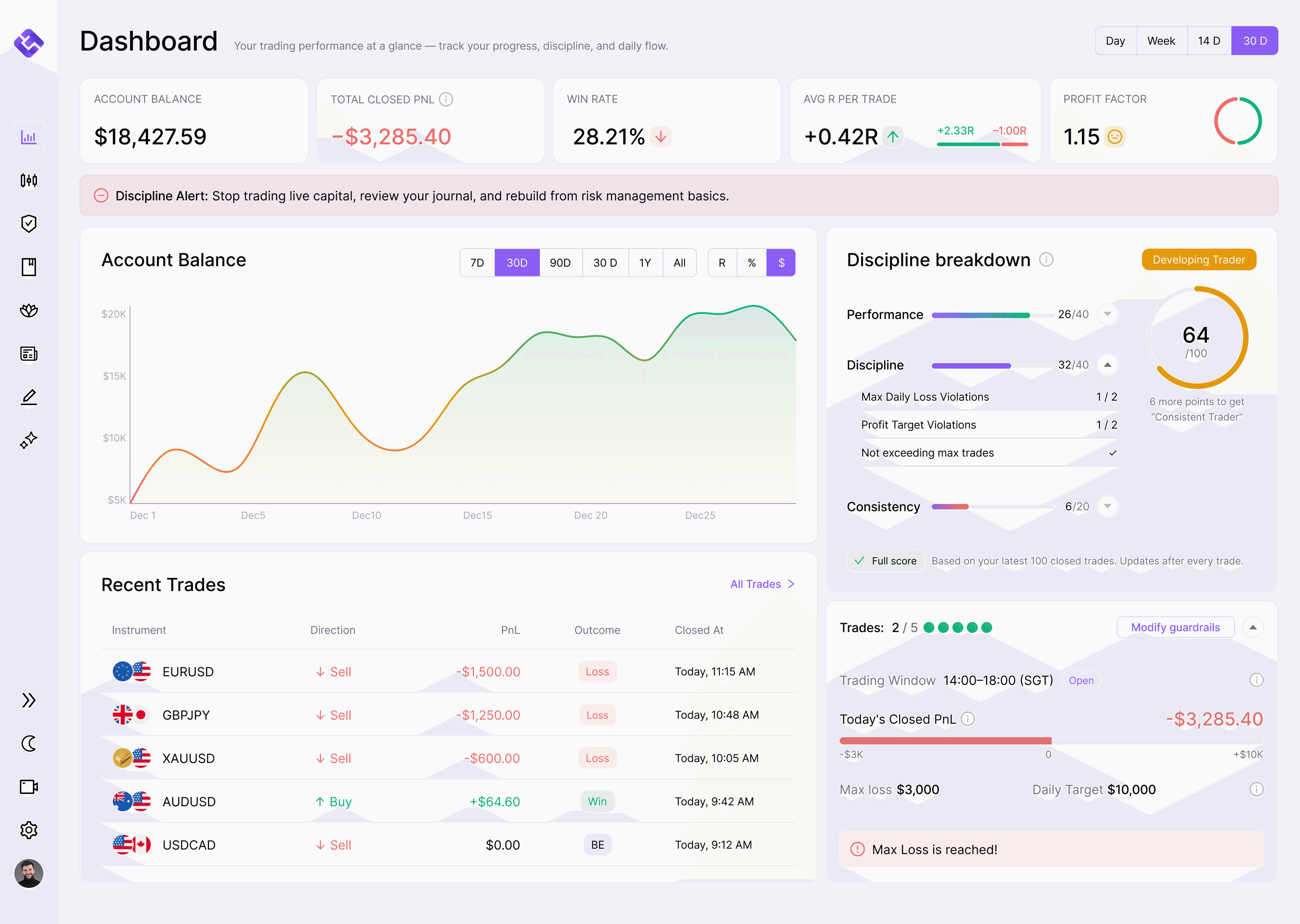
EdgeFlo's guardrail system is built for exactly this scenario. You set your daily loss limit and trade cap when you are thinking clearly, and the system holds those limits even when your emotions want to push past them. You can override them, but you have to actively choose to, which means the wrecker cannot sneak through.
The smart risk calculator computes your lot size automatically based on your account balance, risk percentage, and stop distance. It removes the temptation to "round up" your position size after a good run.
Between the guardrails and the calculator, your rules stay active on your best days and your worst. And that consistency is the difference between a winning streak that compounds into growth and a winning streak that ends in a blown account.
The Edge Brief
Receive Insights on trading psychology, discipline, and the behavioral patterns that create consistent traders from our Founder and the EdgeFlo team, delivered to your inbox.
Think different. Trade different.
Why do traders blow accounts after winning streaks?
How many wins in a row before overconfidence becomes dangerous?
Should I reduce my position size after a winning streak?
What is the best way to protect profits during a hot streak?

Turn discipline on.
Every session.
EdgeFlo is the environment serious traders operate inside.
Start 7-Day Free Trial
Cancel anytime.
No long-term commitment.

Think Different, Trade Different.