

Overconfidence After Wins: Size Down, Not Up
Five wins in a row feel unstoppable. Then one oversized loss wipes them all. Learn why sizing down after a winning streak protects your edge from overconfidence.

Overconfidence in trading is past success making you underestimate risk. You win five trades in a row, feel untouchable, and then blow all five gains on a single oversized position. The fix is counterintuitive: after a winning streak, size down, not up. Keeping your risk flat (or deliberately reducing it) prevents one bad trade from erasing a week of discipline.
TL;DR
Overconfidence is the gap between how good your recent results look and how much risk you actually face on the next trade.
Winning streaks trigger a sizing reflex: traders increase lots right when they should stay flat or go smaller.
One oversized loss after five disciplined wins can wipe the entire streak to zero.
Size down after three consecutive wins if you notice any urge to deviate from your plan.
Consistent risk per trade is the single strongest guardrail against complacency.
What Overconfidence Actually Looks Like
You probably know the feeling. Three wins in a row turns into four. Four turns into five. Each green trade reinforces a story: you are reading the market perfectly. Your entries are clean. Your timing is sharp. And somewhere around win number four or five, a quiet thought appears. "I should go bigger."
That thought is overconfidence, and it almost never feels like a problem when it shows up. It feels like confidence. It feels earned. You followed your plan, you got results, and now you want to capitalize.
Here is what actually happens. Your last five trades used 1% risk per trade. You followed your trading rules, managed your entries, and stacked five clean wins. Now your account is up 5% (assuming 1:1 reward on each). The next setup appears, and instead of risking 1%, you risk 5%. Not because the setup is five times better. Because you feel five times more certain.
That 5% trade loses. And in one position, you give back everything those five wins produced.
The Math Behind the Wipeout
This is not a vague warning. The numbers are specific and brutal.
Walkthrough: Five Wins, One Oversized Loss
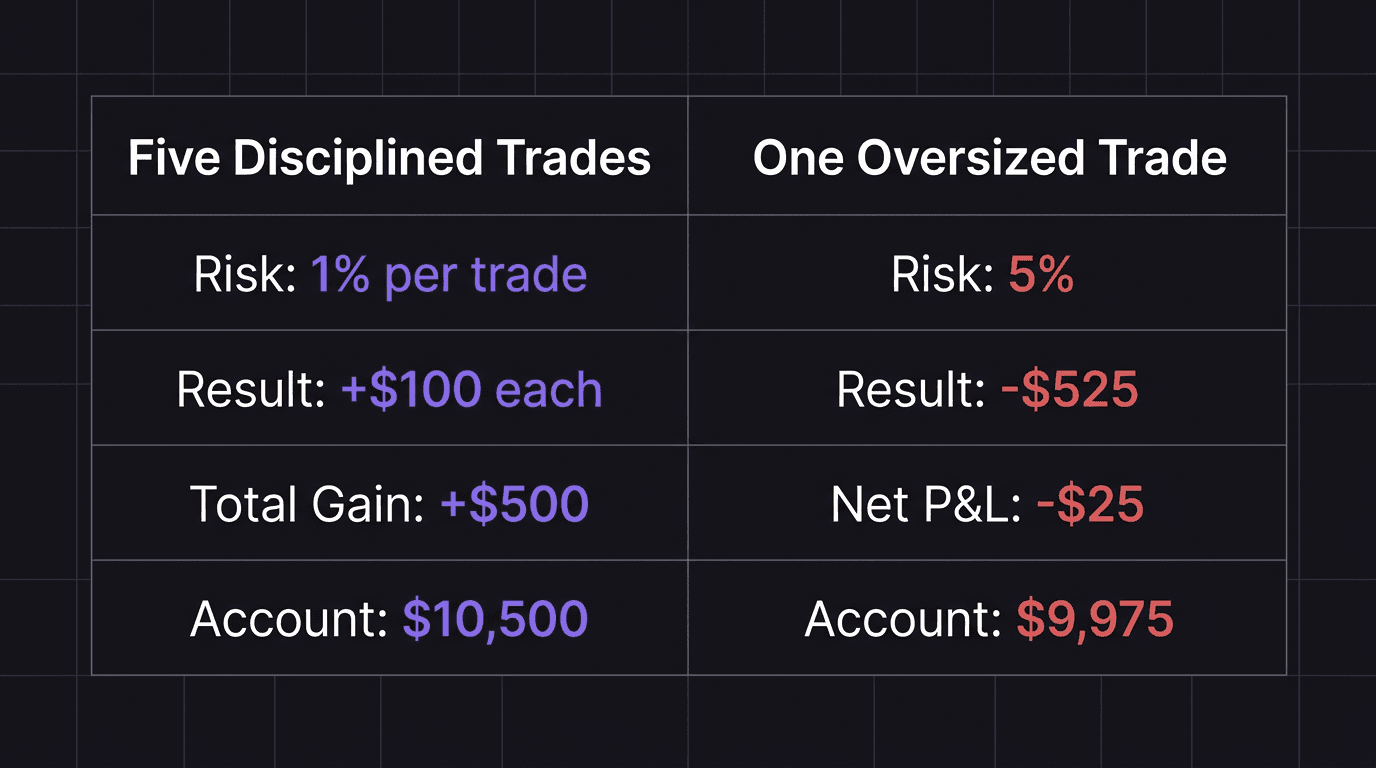
A trader starts with a $10,000 account, risking 1% per trade with a 1:1 risk-to-reward ratio. Five consecutive wins at 1% risk produce five gains of $100 each (1% of $10,000 = $100). After five wins, the account sits at $10,500.
Feeling invincible, the trader sizes up to 5% risk on trade six. 5% of $10,500 = $525. The trade loses. The account drops from $10,500 to $9,975.
Five wins produced $500 in profit. One oversized loss cost $525. Net result: down $25 from where the streak started. Five trades of discipline, erased by one trade of overconfidence.
Sound familiar? Five trades of execution, one moment of greed, and the P&L is worse than when the streak began.
Why Winning Streaks Break Your Rules
The problem is not the winning. The problem is what the winning does to your perception of risk.
After a string of wins, your brain rewires the relationship between action and outcome. You entered, you won, you entered again, you won again. Each repetition strengthens a pattern: entering trades produces profit. Risk feels theoretical. Your plan feels optional because you have been executing well without consciously checking every box.
This is the exact mechanism behind trading complacency. The wins themselves become evidence that you do not need your rules anymore. You skip your pre-trade checklist. You ignore the part of your plan that says "1% max risk." You tell yourself you have memorized the plan, so reviewing it before each trade is unnecessary.
And then the sixth trade punishes the shortcut.
Walkthrough: The Complacent EUR/USD Trade
A trader has been working the London session on EUR/USD for two weeks. Four consecutive winning trades, all taken at supply and demand levels with confirmed entries. Risk: 0.5 lots (1% of a $50,000 account, which equals $5 per pip on EUR/USD).
On trade five, the trader sees a setup forming. Instead of waiting for confirmation, they enter early and double their size to 1.0 lot ($10 per pip) because "this level always holds." The trade moves 40 pips against them before hitting stop loss.
The four wins at 0.5 lots averaged 30 pips each. Four wins times $5 per pip times 30 pips = $600 in total profit. The fifth trade lost $10 per pip times 40 pips = $400. Net result: $200 in profit from five trades instead of the $600 that four clean trades produced.
The trader still made money, but gave back two-thirds of their gains. And this was only a 40-pip stop loss. Imagine the same scenario with a 60-pip adverse move or a news spike that blows past the stop.
The Size Down Rule
The counterintuitive fix: after three consecutive wins, reduce your position size.
Not because your strategy got worse. Not because you distrust the setup. You size down because your emotional state has shifted, and that shift makes you more likely to deviate from your plan. Smaller size keeps the consequences small if the deviation happens anyway.
Here is how it works in practice:
Trades 1 through 3: Normal risk. Follow your plan. Execute your edge.
After win number 3: Drop your risk to 50% of normal. If you usually risk 1%, risk 0.5% on the next trade.
Stay at reduced size until you take a loss or the streak naturally ends.
After the streak ends: Return to your normal risk level.
This is not a permanent reduction. It is a circuit breaker. You are deliberately making the next few trades less consequential so that if overconfidence causes you to loosen your entry criteria or skip your checklist, the damage is capped.
Some traders argue that sizing down after wins is leaving money on the table. That is true in a perfect world where your execution stays flawless during euphoric stretches. But execution does not stay flawless. The whole point is that winning streaks erode execution quality. Sizing down accounts for that erosion.
Keeping Risk Flat as a Default
If the size-down rule feels too aggressive, the minimum standard is keeping risk perfectly flat. No changes. No adjustments. No "earning" the right to go bigger.
Whether you win five in a row or lose three in a row, the risk stays the same. 1% means 1%. Every trade, every session, every week.
This is harder than it sounds. After a winning streak, the temptation is obvious: go bigger. After a losing streak, the temptation reverses: go smaller to "protect what is left." Both adjustments are emotional. Both break consistency.
Flat risk means you are treating every trade as what it actually is: one independent event in a long series. Your last five results have zero statistical influence on trade number six. The market does not know you are on a streak, and it does not care.
If your lot size is already too big for your account, flat risk still applies, but the first step is correcting the baseline.
Spotting the Drift Before It Costs You
Overconfidence does not announce itself. It creeps in through small behavioral changes you might not notice in real time. Here are the warning signs:
You skip your pre-trade checklist. You have done this setup so many times that reviewing each criterion feels redundant. But redundancy is the point. The checklist exists for exactly the moments when you feel like you do not need it.
You enter before confirmation. You see the level, you see price approaching, and you pull the trigger early because "it always works here." That is your recent wins rewriting your entry criteria.
You increase size without a plan change. Any position size increase that is not documented in your trade plan is an emotional decision. If your plan says 1% and you are risking 2%, that is not adaptation. That is overconfidence.
You stop journaling wins. Losses get journaled because they hurt. Wins get skipped because they feel self-explanatory. But the wins contain the data that reveals the drift. When you stop reviewing winning trades, you lose visibility into whether your execution is still clean.
You trade outside your session. Your plan says London session only. But you had a great London session, and now you see a setup forming in New York. The urge to keep going is strong. That extra trade is not discipline. It is greed wearing a confidence mask.
The Accountability Check
You cannot always see your own blind spots. An accountability partner (a trading peer, a mentor, or even a structured self-review process) catches the drift that you miss.
The simplest version: at the end of each trading day, write one sentence answering this question. "Did I follow my plan on every trade today, or did I deviate on any entry, exit, or position size?" Force yourself to be specific. "Yes" is not an acceptable answer if your risk was 1.5% instead of 1%.
A more structured version: share your daily journal with someone who trades the same style. Give them permission to flag any trade where your size deviated, your entry was early, or your stop was wider than the plan specifies. You will be surprised how quickly someone else spots what you cannot see.
The point is not policing. The point is visibility. Overconfidence thrives in environments where no one is watching, including yourself.
What Happens After a Big Win
The most dangerous trade in your career is the one immediately after a big win. Not because the market is different. Because you are different.
A big win inflates your confidence more than five small wins combined. The dopamine hit is stronger, the feeling of certainty is deeper, and the urge to "do it again" is immediate. This is where traders go from a $2,000 day to a $3,000 loss the next morning.
The protocol is simple: after any trade that significantly exceeds your average win, take the rest of the day off. Do not enter another position until the next session. Journal the win, review the execution, and let the emotional charge fade before you sit back down.
How EdgeFlo Helps You Catch Overconfidence Early
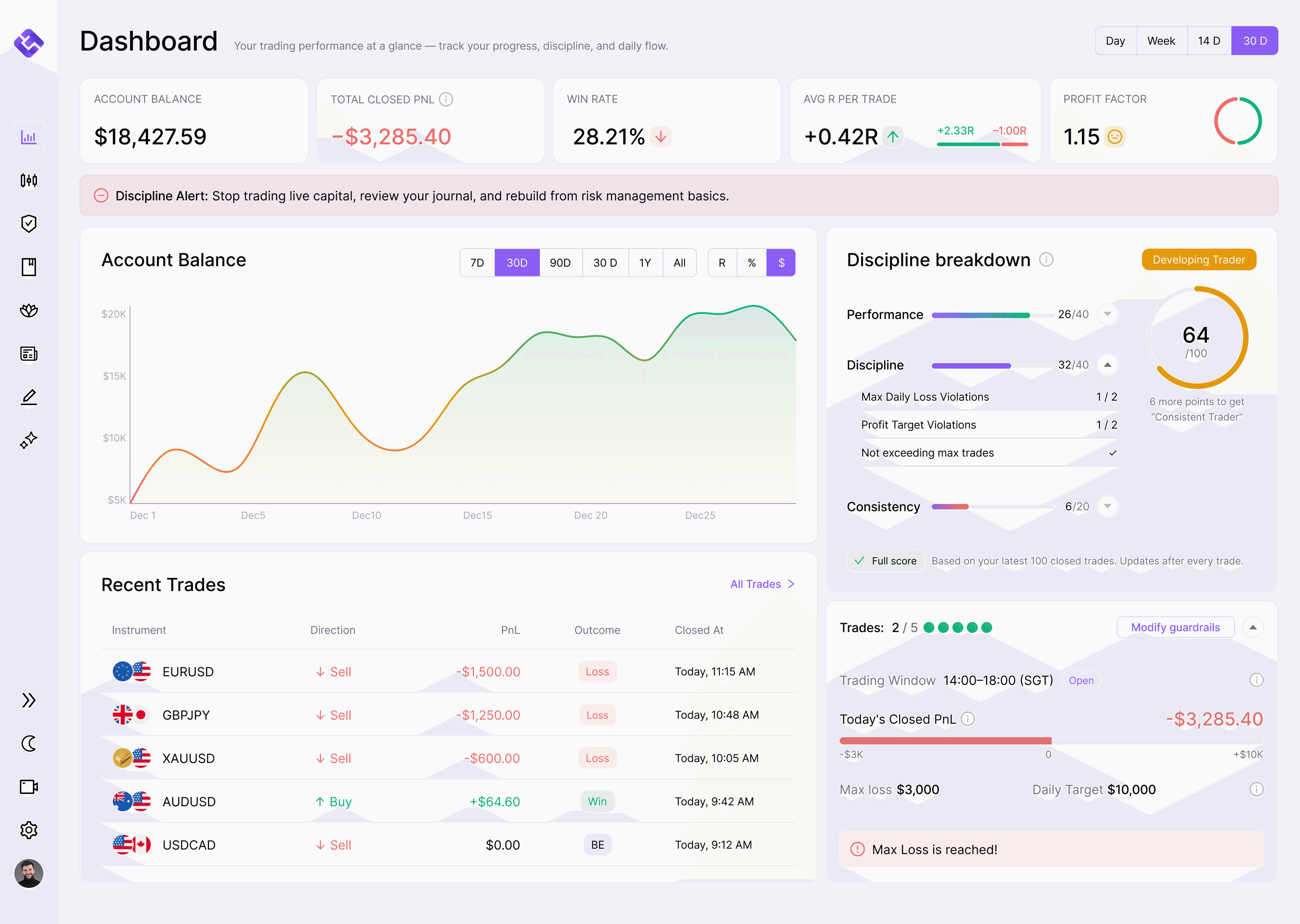
EdgeFlo's guardrails restrict your trading when you push past predefined risk parameters. If you set a max risk per trade and a daily loss cap, the system warns you before you can size up on impulse. You can override the restriction, but you have to consciously choose to break your own rule (strategy.md rule 4: guardrails restrict with override).
The trading dashboard tracks your risk consistency over time (strategy.md pillar 3). If your average risk per trade suddenly spikes after a winning streak, the data shows it. You do not have to rely on self-awareness alone. The numbers surface the drift before it becomes a habit.
Combined with the AI-powered journal's emotion tagging, you build a record of how your emotional state correlates with your sizing decisions. Winning streaks followed by size increases become a visible pattern, not a hidden one.
The Edge Brief
Receive Insights on trading psychology, discipline, and the behavioral patterns that create consistent traders from our Founder and the EdgeFlo team, delivered to your inbox.
Think different. Trade different.
Why do traders size up after winning?
How many consecutive wins before overconfidence becomes dangerous?
Should I keep my risk the same after every trade?
Can overconfidence affect experienced traders too?

Turn discipline on.
Every session.
EdgeFlo is the environment serious traders operate inside.
Start 7-Day Free Trial
Cancel anytime.
No long-term commitment.

Think Different, Trade Different.