

Why You Cannot Learn Trading From Books Alone
Books teach theory. Only live markets teach execution. Learn why the trade, journal, review loop is the only path to real trading competence.
You have read the books. You have watched the videos. You understand support and resistance, risk management, candlestick patterns, and market structure. On paper, you know what to do.
Then you open a live chart, and everything falls apart.
That gap between knowing and doing is not a knowledge problem. It is a practice problem. Trading is a performance skill, closer to surgery or competitive sports than to academic study. You cannot become a surgeon by reading textbooks, and you cannot become a trader by watching YouTube courses. The skill lives in execution under pressure, and the only way to build it is by doing it.
TL;DR
Books and courses teach theory. Only live market experience teaches execution.
The daily loop of trade, journal, review is the fastest path to competence.
Most traders repeat mistakes because they skip the review step.
Expect 6 to 18 months of consistent daily practice before stable results.
Journaling turns raw experience into structured learning.
The Gap Between Knowing and Doing
Every trader hits this wall. You can explain supply and demand zones perfectly. You know that revenge trading is destructive. You understand that you should risk 1% per trade.
Then price drops 40 pips against you and you move your stop loss. Then you take a second trade to make back the loss. Then you ignore your lot size rules because "this one is a sure thing."
You knew better. So why did you do it anyway?
Because knowledge and skill are different things. Knowledge is stored information. Skill is automated behavior under pressure. You can know the right thing to do and still fail to do it because the skill has not been trained through repetition.
Reading about a trading mistake once does not prevent you from making it. Making the mistake, journaling it, reviewing why it happened, and then catching yourself the next time it starts to happen: that is how the behavior actually changes.
Sound familiar? You have probably read the same advice in three different books and still done the exact opposite the following week. That is not a character flaw. It is a training gap.
Why Live Market Experience Cannot Be Simulated
Backtesting and demo trading have their place. They help you validate a strategy and build initial familiarity with your plan. But they cannot replicate the one thing that makes live trading so difficult: real emotional stakes.
When you backtest, you already know the outcome. The candle already closed. The hindsight bias is baked in. You are not making a decision under uncertainty. You are confirming what already happened.
When you demo trade, the money is not real. Your brain knows it. The stress response is muted. The fear of loss, the greed during a winning streak, the impulse to revenge trade after a bad entry: none of these show up at full intensity on a demo account.
Live trading forces you to make decisions with incomplete information while real money is at risk. Your heart rate goes up. Your judgment gets clouded. Your plan seems less certain when price moves against you.
That is the environment where skill is built. Not in a textbook. Not in a simulator. In the arena.
Walkthrough: The Trader Who Studied Everything
A trader spends 8 months consuming trading content. He reads four books on price action, completes two online courses, and watches 200 hours of chart analysis videos. He can identify market structure, draw zones, and explain risk-to-reward ratios in detail.
He opens a live account with $2,000 and takes his first trade on EUR/USD. Price moves 15 pips against him. His palms sweat. He moves his stop loss wider. Price reverses and he exits at breakeven, relieved but having learned nothing from the books about how to sit through a drawdown.
After three weeks, he has taken 14 trades, won 4, and lost 10. Not because his strategy was bad, but because he kept interfering with his own entries and exits. He had never practiced holding a position through temporary discomfort.
This is the gap. Knowledge without repetition under pressure does not transfer to execution. Forward testing bridges that gap by putting your plan into live conditions while you track every decision.
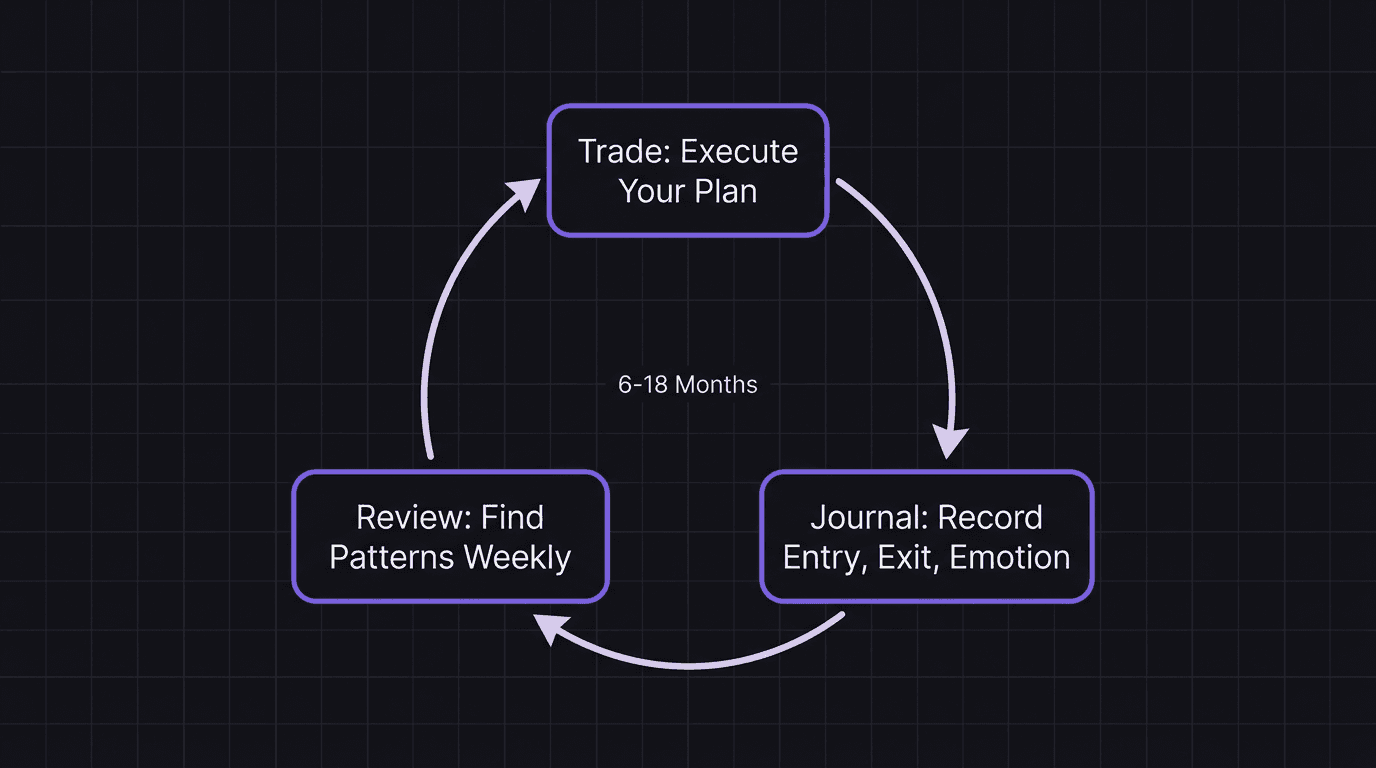
The Daily Loop: Trade, Journal, Review
The fastest path to real competence is not more content. It is more reps combined with structured reflection.
Trade. Take setups according to your plan. One session per day is enough. Quality of attention matters more than hours logged.
Journal. Immediately after every trade, write down what you saw, what you did, why you did it, and how you felt. Do not wait until the end of the day. The emotional context fades within minutes. Use a journal template that captures the data you actually need.
Review. At the end of each week, read your journal entries. Not to judge yourself. To find patterns. Which setups produced the best results? Where did you deviate from your plan? Which emotional states led to bad decisions?
This loop is boring. It is repetitive. It is the only thing that works.
The traders who skip the review step are the ones who repeat the same unconscious patterns for years. They take thousands of trades but learn nothing because they never examine what happened. That is like going to the gym and doing random exercises without tracking progress. You might get tired, but you will not get stronger.
Walkthrough: The Loop in Action
A trader takes three trades in the London session on GBP/USD. She journals each one immediately after closing, noting her entry reason, her emotional state, and whether she followed her plan.
Trade 1: Valid demand zone entry. Followed plan. Won 2.5R. Trade 2: FOMO entry with no zone. Broke rules. Lost 1R. Trade 3: Valid setup but exited early out of fear. Won 0.5R instead of the planned 2R.
Net result: 2.5 + 0.5 - 1 = 2R. Profitable day.
During Friday review, she spots the pattern: Trade 3's early exit has happened four times this month. Every time, she was up 1R and got scared of giving it back. She adds a rule: once price moves 1R in her favor, she moves her stop to breakeven and stops watching. No more early exits.
The following week, two trades hit her original target because she stopped interfering. That single review insight, discovered through journaling, is worth more than any book chapter on trade management.
How Long the Learning Loop Actually Takes
There is no shortcut. The honest answer is 6 to 18 months of consistent daily practice before most traders see stable improvement.
That does not mean 6 months of occasional trading. It means 6 months of daily participation in the loop: trading, journaling, reviewing. Every session. Every week.
The timeline depends on three things:
Quality of practice. Deliberate practice with journaling and review beats mindless screen time. Five focused trades with full documentation teaches more than fifty trades taken on impulse.
Frequency of review. Weekly reviews catch patterns early. Monthly reviews let problems compound for weeks before you notice them. Do both, but never skip the weekly one.
Willingness to change. The post-trade review reveals what needs to change. But the trader has to actually change it. Many traders see the data, acknowledge the pattern, and then do nothing different. That is consumption, not learning.
Learning means changing behavior. If your behavior did not change after reviewing your journal, you did not learn. You just read your own notes and moved on.
How EdgeFlo Structures Your Daily Practice Loop
The biggest reason traders skip the journal step is friction. Opening a spreadsheet, typing up trade details, uploading screenshots, recording emotions: it takes effort, and after a losing trade, you do not feel like doing any of it.
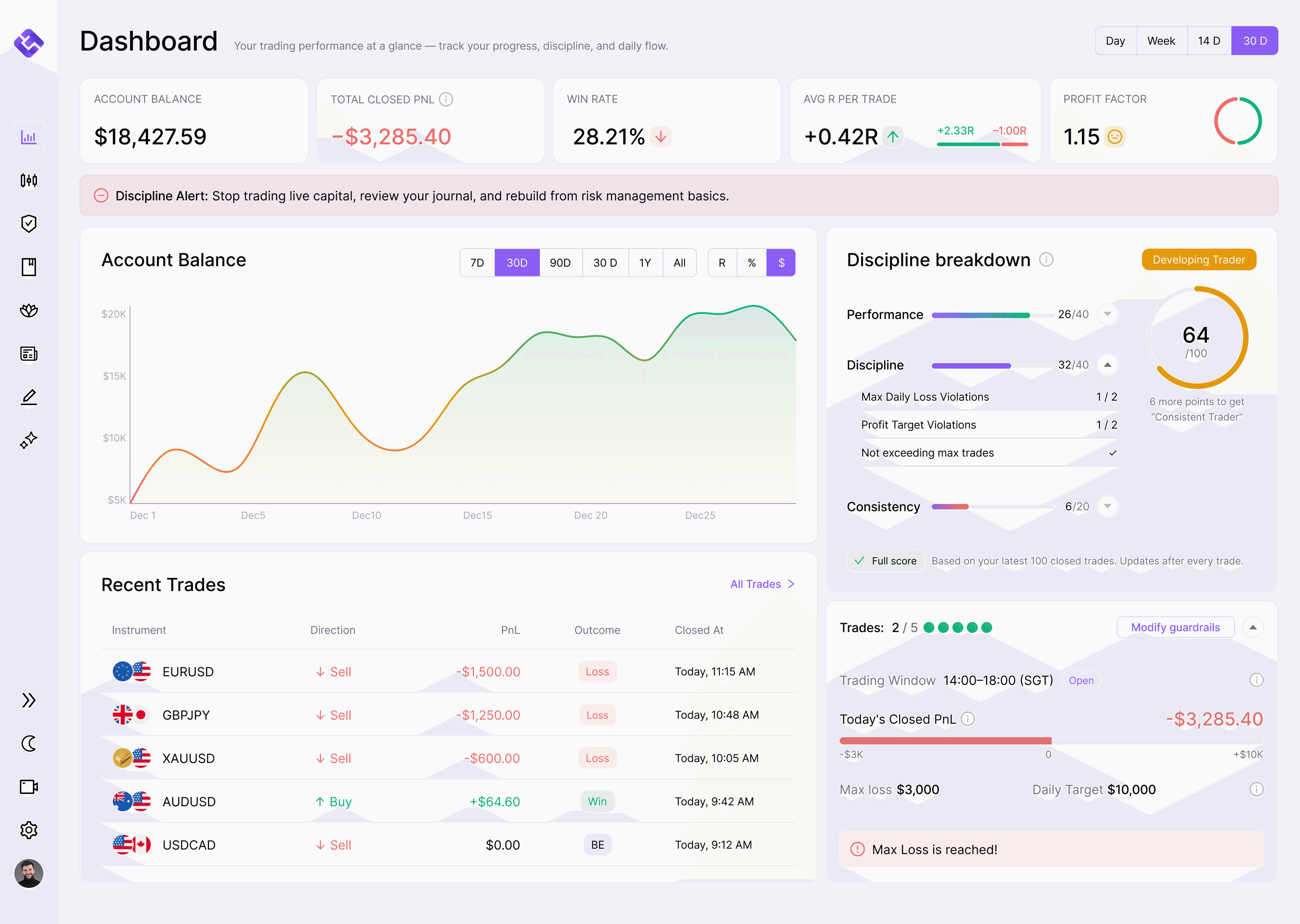
EdgeFlo structures the trade, journal, review loop with integrated tools that reduce friction at every step. When you close a trade, EdgeFlo immediately asks how you felt. Your entry, exit, and P&L are already logged. You add your charts, write a quick reflection, and the journal entry is complete in under a minute.
At the end of each week, your journal data feeds into a review that shows win rate, average R-multiple, and emotional patterns. You do not need to calculate anything manually. The data is already organized.
The loop still requires your effort. You still need to trade, reflect, and change. But when the tools eliminate the busywork, you spend your energy on the part that actually matters: learning from your own experience.
The Edge Brief
Receive Insights on trading psychology, discipline, and the behavioral patterns that create consistent traders from our Founder and the EdgeFlo team, delivered to your inbox.
Think different. Trade different.
Can you learn trading from books?
How long does it take to learn trading by doing?
What is the best way to practice trading?
Why do traders repeat the same mistakes?

Turn discipline on.
Every session.
EdgeFlo is the environment serious traders operate inside.
Start 7-Day Free Trial
Cancel anytime.
No long-term commitment.

Think Different, Trade Different.