

What Is Forex Trading? A No-Fluff Beginner Guide
Forex trading is buying one currency while selling another to profit from exchange rate changes. Learn how pairs work and who moves the market.
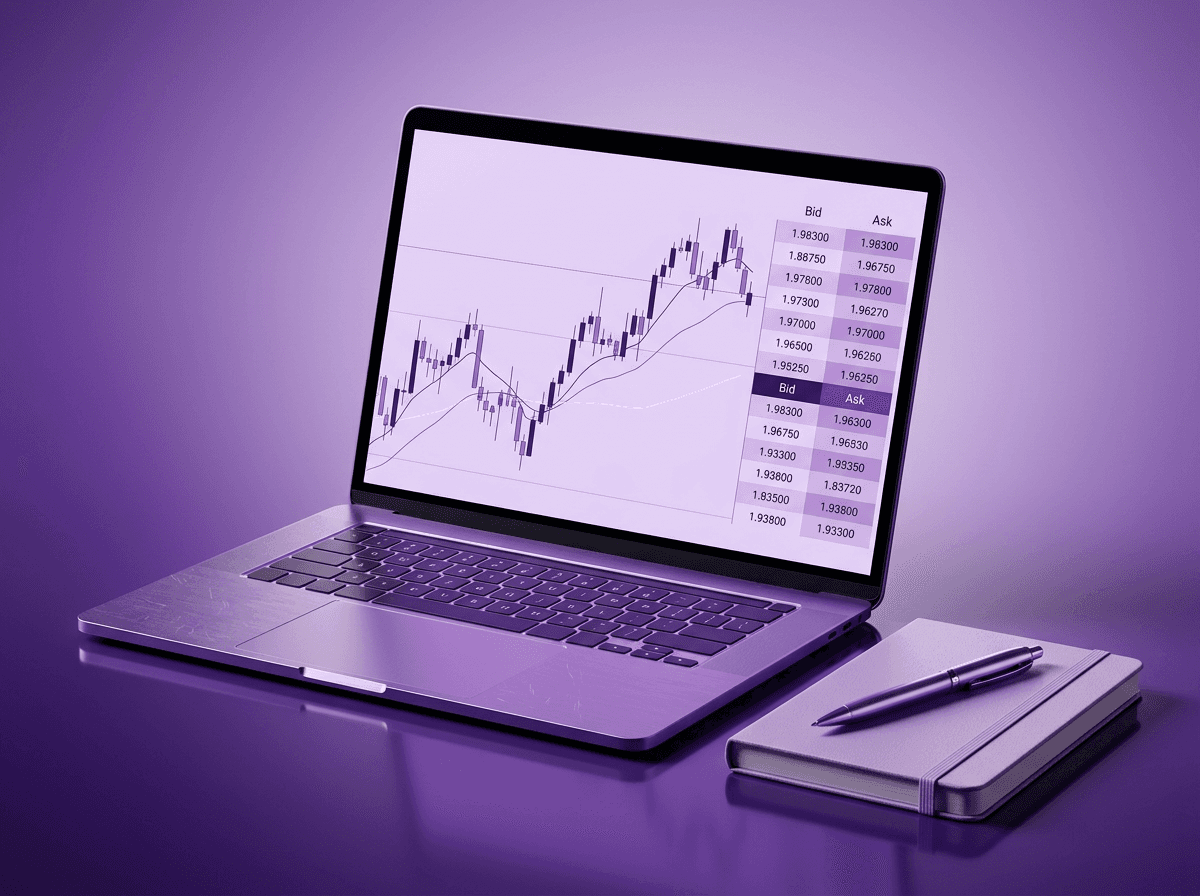
Forex trading is buying one currency while selling another, and profiting when the exchange rate moves in your favor. The forex market is the largest financial market in the world, with over $6.6 trillion traded every single day. That is roughly 200 times bigger than the New York Stock Exchange. If you have ever exchanged money at an airport before a trip, you have already participated in the forex market without realizing it.
TL;DR
Forex stands for "foreign exchange," and trading it means speculating on whether one currency will strengthen or weaken against another.
Currency pairs have a base currency (left) and a quote currency (right), and the price tells you how much of the quote currency buys one unit of the base.
Banks, hedge funds, central banks, corporations, and retail traders all participate, but smart money (institutions) controls the majority of volume.
Retail traders profit by developing a tested trading edge and trading with the flow of institutional activity, not against it.
The market runs 24 hours a day, five days a week, giving you flexibility to trade around your schedule.
What Forex Actually Means
Forex is short for "foreign exchange." It refers to the global marketplace where currencies change hands at a mutually agreed exchange rate. That rate fluctuates every second based on supply and demand, and those fluctuations are where traders find opportunity.
Here is the simplest way to think about it. You are in London and need US dollars for a trip to New York. You walk to a currency exchange booth and hand over British pounds. They give you dollars at a posted rate. If the rate was 1.28, you received $1.28 for every pound. That transaction, at its core, is the same thing forex traders do online every day. The difference is scale, speed, and the fact that you can profit from rates moving in either direction.
The forex market never sleeps during the business week. It opens Sunday evening (US time) when the Sydney session begins and closes Friday afternoon when the New York session ends. That 24-hour cycle means you are never locked out by a closing bell, which is one reason so many new traders start with forex rather than stocks.
Why Forex Moves
Exchange rates shift because of interest rate decisions from central banks, employment reports, GDP numbers, geopolitical events, and pure market sentiment. You do not need to track every data release. But you do need to understand that currencies reflect the economic health of their country. A strong economy generally means a strong currency. A weakening economy generally means a weakening currency.
How Currency Pairs Work
Forex is always quoted in pairs. You never buy or sell a currency by itself. You are always trading one against another.
Every pair has two sides:
Base currency (left side): This is the currency you are buying or selling. It always equals one unit.
Quote currency (right side): This tells you how much of this currency it costs to buy one unit of the base.
Take EUR/USD at 1.0926. That means it costs $1.0926 US dollars to buy one euro. If you believe the euro will strengthen against the dollar, you buy EUR/USD (going long). If you believe the euro will weaken, you sell EUR/USD (going short).
A Quick Example
Say EUR/USD is sitting at 1.0900. You buy the pair, expecting the euro to strengthen. Over the next few hours, the rate climbs to 1.0950. That 50-pip move in your favor means you profited. If you had sold instead and the price dropped to 1.0850, the same logic applies in reverse.
The price you see is not a single number. Your broker shows a bid price (the price you sell at) and an ask price (the price you buy at). The gap between them is the spread, and it is essentially your cost to enter the trade.
Walkthrough: Your First Currency Pair Read
You open your chart and see GBP/USD quoted at 1.2750. The base currency is GBP (British pound). The quote currency is USD. The price tells you it costs $1.2750 to buy one pound. You check the news and see UK employment data came in strong. You think the pound will strengthen. You buy GBP/USD at 1.2750. Four hours later, the pair is at 1.2800. That is a 50-pip gain. On a micro lot (0.01 lots), each pip is worth $0.10, so your profit is $5. On a standard lot (1.0 lots), each pip is worth $10, so your profit would be $500. The lot size you choose directly controls how much each pip movement costs or earns you.
Who Trades Forex
The forex market is not one centralized exchange like the NYSE. It is a decentralized network of participants, and understanding who is on the other side of the screen helps you trade smarter.
Big banks and financial institutions. JPMorgan, Goldman Sachs, Deutsche Bank, and similar giants make up the bulk of daily volume. They trade for clients, manage pension funds, and run their own proprietary trading desks. These players are what traders call "smart money." They have the capital to move prices.
Central banks and governments. The Federal Reserve, European Central Bank, Bank of Japan, and others set monetary policy. When a central bank raises or cuts interest rates, it sends shockwaves through the currency market. Central bank decisions are the single biggest driver of long-term currency trends.
Large commercial companies. Multinational corporations exchange currencies constantly. Amazon paying employees in Japan converts USD to JPY. A German automaker selling cars in the US converts USD back to EUR. This commercial flow adds consistent volume to the market every day.
Retail traders. That is you. Retail traders make up the smallest slice of daily volume. You do not have the capital to move the market on your own. Not even close. This is actually an advantage because it means your orders get filled instantly with virtually no slippage on major pairs, and you can enter and exit freely without worrying about affecting the price.
The key insight for retail traders is simple: you cannot fight smart money. You trade with them or you lose. Understanding how institutional liquidity works helps you stop being the exit liquidity for bigger players.
Why Retail Traders Can Still Profit
If banks control the market, how do small traders make money? By playing a different game.
Banks are managing billions in positions, hedging client risk, and executing mandates. They are not sitting on a 15-minute chart waiting for a supply zone to fill. Retail traders can be selective. You can wait for the exact setup you want, take one clean trade a day, and walk away. A hedge fund cannot do that with a $2 billion book.
Your edge as a retail trader comes from three things:
A tested strategy. You need a method that has been backtested and forward-tested with real data. Not a gut feeling, not a signal you saw on social media. A system with a known win rate and average R-multiple.
Disciplined risk management. Every professional trader manages risk first and targets profit second. You define how much you are willing to lose before you ever think about how much you could gain.
Patience. The market is open five days a week during specific high-volume sessions. You do not need to trade every hour. One or two high-quality setups per day, executed with discipline, will outperform twenty random entries every time.
Walkthrough: What Not to Do on Day One
You deposit $500 into a live account. You have watched three YouTube videos about forex. You open EUR/USD and see the price going up, so you click buy with a 0.5 lot position. No stop loss, no plan, no idea how much you are risking. The price drops 40 pips. On 0.5 lots, each pip is $5. That is a $200 loss, wiping out 40% of your account in one trade. You panic and close. This is not a strategy. This is a coin flip with real money. The fix: never place a trade without knowing your entry criteria, stop loss, take profit, and lot size in advance.
Trading is a probability game. Every individual trade outcome is uncertain. You could follow your plan perfectly and still lose. That is normal. What separates profitable traders from everyone else is that over 50, 100, or 200 trades, their edge produces more profit than loss. But only if they execute the same way every time.
Sound familiar? You have probably taken a trade and immediately felt doubt creep in. That doubt comes from not having proof that your method works. The proof comes from testing. Backtest your strategy on historical data, then forward-test it on a demo account for at least a month before risking real money. Once you have data showing a positive expectancy, confidence follows naturally.
How EdgeFlo Helps You Start Right
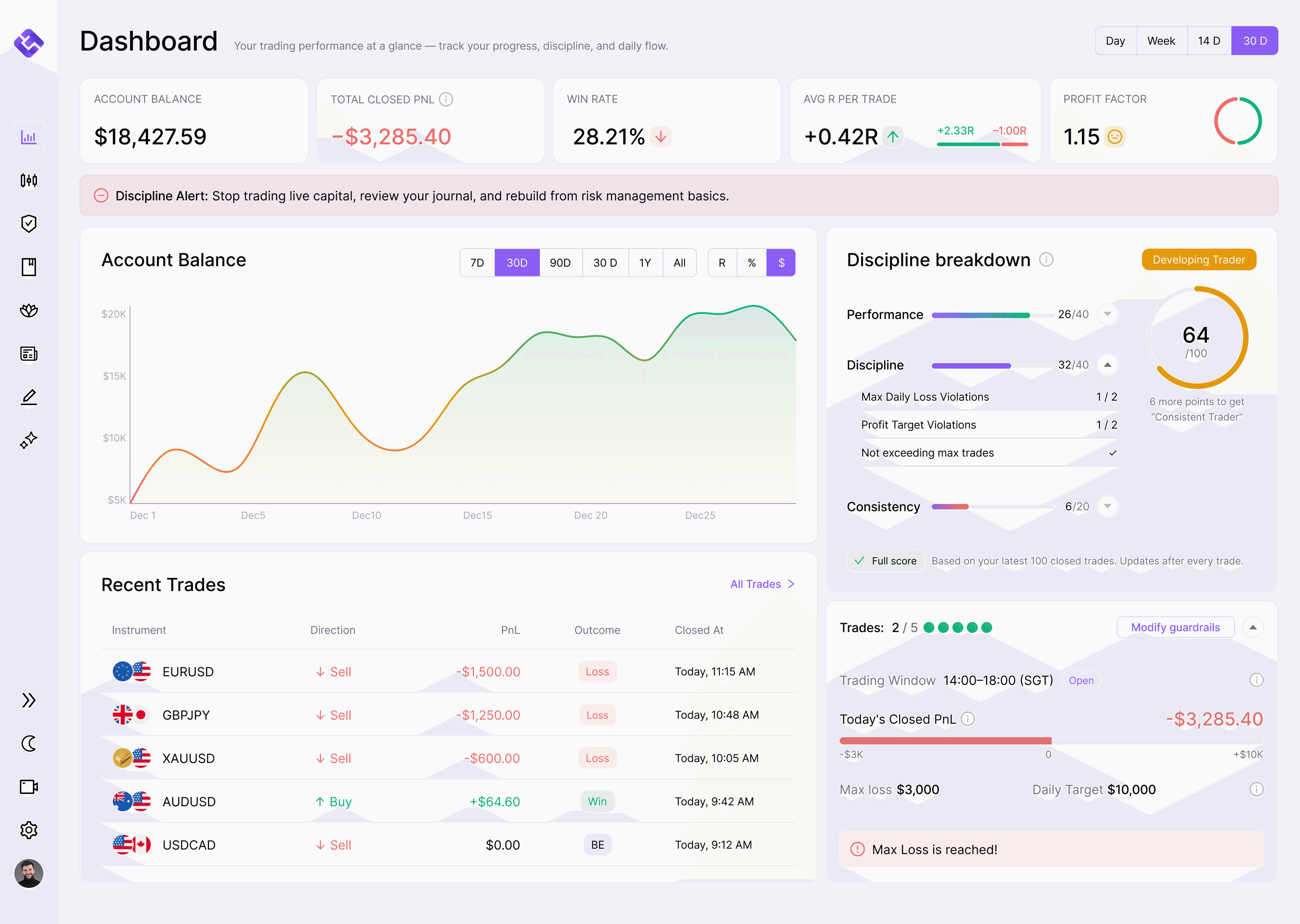
Starting forex trading without structure is how most beginners blow their first account. EdgeFlo gives you the structure from day one. You define your trading plan inside the app, set your risk parameters, and the built-in guardrails flag when you are about to break your own rules (with the option to override if you choose to).
The AI-powered journal auto-imports your trades so you can track your data without manual entry. After a week of trading, you can already see your win rate, average R, and which sessions are producing your best setups. That data is what turns a beginner into a process-driven trader.
EdgeFlo is not going to tell you when to buy or sell. What it does is keep your execution consistent so your edge has room to work. When you are ready to place your first forex trade, having your plan, risk rules, and journal in one place makes the difference between learning fast and burning through accounts.
The Edge Brief
Receive Insights on trading psychology, discipline, and the behavioral patterns that create consistent traders from our Founder and the EdgeFlo team, delivered to your inbox.
Think different. Trade different.
Is forex trading gambling?
How much money do you need to start forex trading?
What hours is the forex market open?
Can you make a living from forex trading?

Turn discipline on.
Every session.
EdgeFlo is the environment serious traders operate inside.
Start 7-Day Free Trial
Cancel anytime.
No long-term commitment.

Think Different, Trade Different.