

Welcome Losses: Each One Brings You Closer to a Win
If your edge has positive expectancy, every loss moves you statistically closer to a win. Learn the mathematical proof that makes losses feel less threatening.
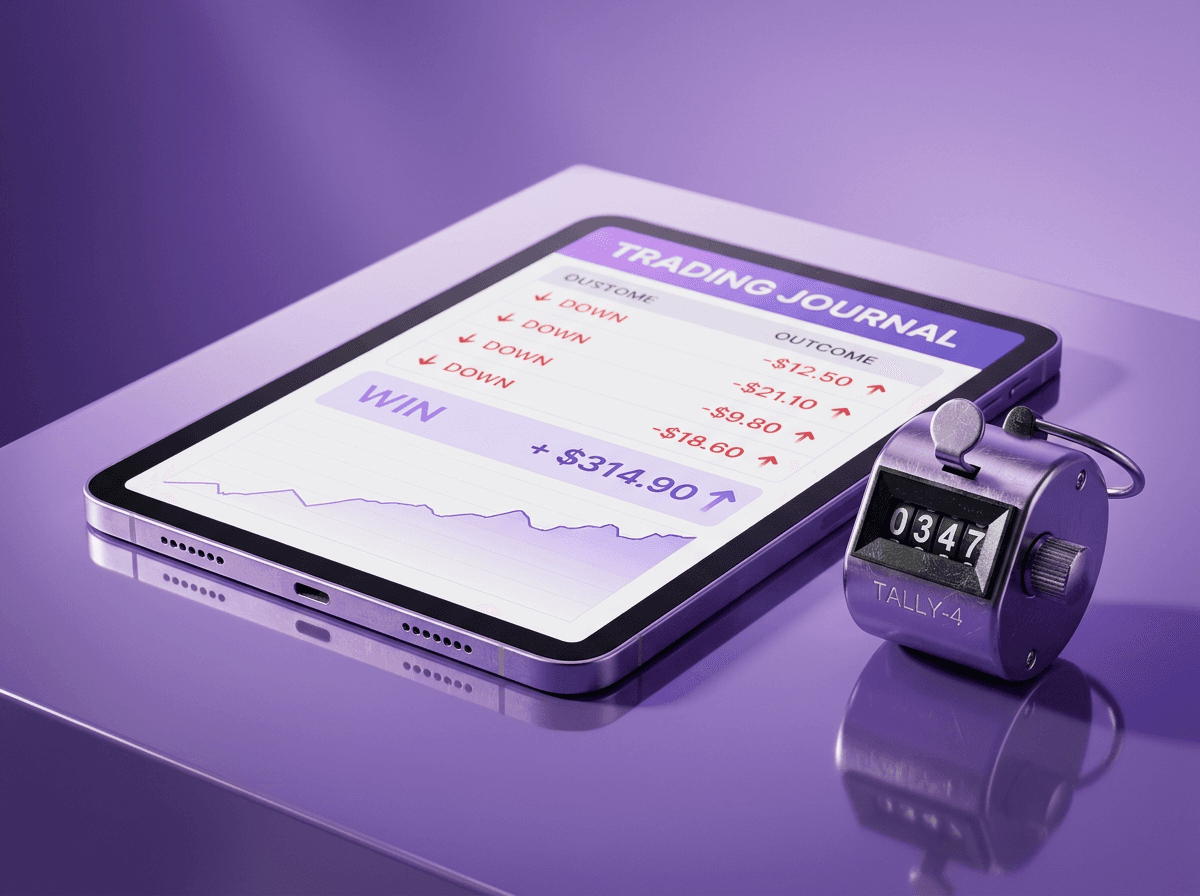
You just took your third loss in a row. Your stomach drops. Your finger hovers over the lot size, itching to double up and win it back.
Sound familiar?
Here is the truth most traders miss: if your strategy has a genuine edge, that third loss did not set you back. It moved you one step closer to the next win. The math behind this claim is not motivational fluff. It is probability working exactly as designed.
Every strategy with positive expectancy produces wins and losses in clusters. When you understand the numbers, losses stop feeling like punishment and start looking like progress through a statistical sequence.
TL;DR
A positive expectancy strategy profits over a large sample even when most individual trades lose.
Each loss in a proven system is not a setback. It is one fewer loss standing between you and the next win.
The law of large numbers guarantees your edge plays out, but only if you keep taking trades without changing your rules.
Casinos welcome every bet because they trust a 5.4% edge over thousands of rounds. You can adopt the same mindset.
Risk management is what keeps you in the game long enough for probability to do its job.
Why Losses Feel So Much Worse Than They Are
A single trading loss triggers a response that is wildly out of proportion to its actual impact on your account. You know this intellectually. But in the moment, the loss feels like proof that something is wrong.
The problem is not the loss itself. The problem is evaluating your strategy on a sample size of one.
Imagine flipping a coin that lands heads 60% of the time. You flip it three times and get tails, tails, tails. Does that mean the coin is broken? Obviously not. Three flips is not enough data. But traders do this exact thing every day. They take three losses and conclude their strategy is failing.
A 40% win rate strategy will produce 5 consecutive losses about 7.8% of the time. That means roughly 1 out of every 13 five-trade sequences will be a complete streak of red. Not because the strategy broke. Because probability has variance.
When you judge your system by individual outcomes, every loss feels like evidence against you. When you judge it by a 50 or 100 trade sample, each loss is just noise inside a larger pattern that trends in your favor.
The Casino Edge: Proof That Losses Fund Profits
Casinos do not win every hand. They do not win every spin. And they could not care less.
A standard American roulette wheel has 38 slots: 18 red, 18 black, and 2 green. When you bet on black, you have an 18 out of 38 chance of winning. That is 47.3%. The casino's odds? 20 out of 38, or 52.7%.
That difference is just 5.4%. For every dollar bet, the casino earns about 5.4 cents. Tiny. Almost invisible on a single spin.
But zoom out. Over 1,000 bets at $1,000 each, the players collectively win $473,000. The casino collects $527,000. Net profit: $54,000. And the casino runs thousands of spins per day, across dozens of tables.
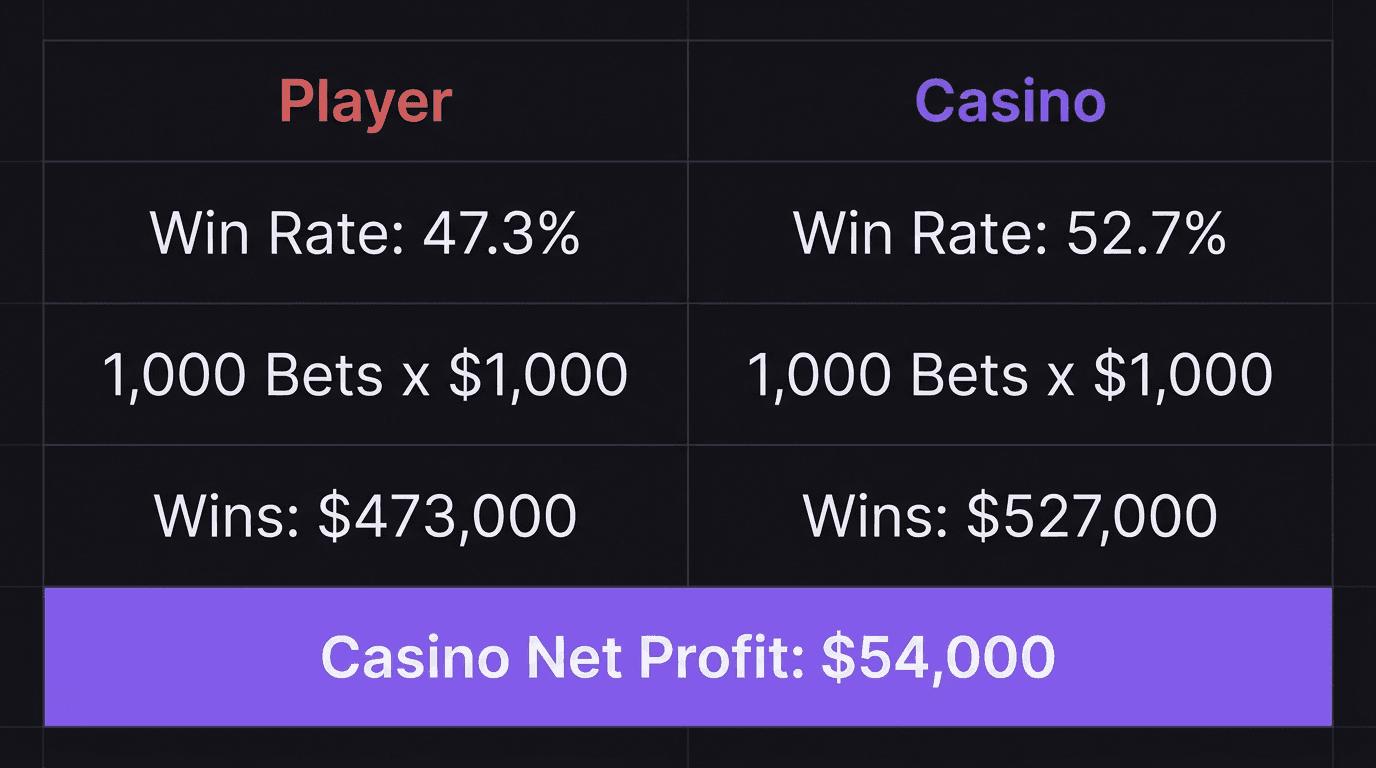
The critical lesson: the casino does not panic after a losing hour. It does not shut down the roulette table after a player wins big. It knows, with mathematical certainty, that its edge will assert itself over enough rounds.
This is exactly how a positive expectancy trading strategy works. You do not need to win every trade. You need to win enough, with the right reward relative to your risk, over a large enough sample.
Positive Expectancy: Your Personal House Edge
Positive expectancy means your strategy generates more money from winners than it loses on losers, measured across a meaningful sample. Here is the formula:
Expectancy = (Win Rate x Average Win) minus (Loss Rate x Average Loss)
If the result is positive, your system makes money over time. Period. The individual trade results are irrelevant as long as you keep executing.
Walkthrough: A 40% Win Rate Strategy That Prints Money
Say your strategy wins 40% of the time. Your average winner is $500 (a 2.5R trade at 1% risk on a $20,000 account). Your average loser is $200 (1R).
Over 100 trades:
40 wins x $500 = $20,000
60 losses x $200 = $12,000
Net profit: $8,000
Your expectancy per trade is $80. That means every time you click "enter," the statistical value of that click is +$80, whether this particular trade wins or loses.
Now look at the loss column: 60 losses out of 100 trades. You lost more often than you won. And you still made $8,000. That is probabilistic thinking in action.
The 60 losses were not obstacles to your profit. They were part of the profit. Without taking those 60 trades, you would not have captured the 40 winners that paid for everything.
Every Loss Moves You Closer (Here Is the Math)
This is the part that changes how you feel about losing trades.
If your strategy wins 40% of the time, then on average, for every 10 trades you take, 4 will be winners. The losses and wins are distributed randomly across that set. You cannot know which trade will win before you take it.
But you can know this: after each losing trade, the probability of encountering a winner in your remaining sequence increases. Not because of the gambler's fallacy (individual trades are independent), but because of sample convergence. Over enough trades, your actual results will converge toward your tested win rate.
Walkthrough: Watching a Streak Play Out
Picture this. You trade EUR/USD with a 40% win rate, risking 1% per trade on a $10,000 account. Each loss costs $100. Each win, at 2.5R, pays $250.
You start the week on Monday and take 10 trades:
Trade 1: Loss ($100)
Trade 2: Loss ($100)
Trade 3: Loss ($100)
Trade 4: Win (+$250)
Trade 5: Loss ($100)
Trade 6: Loss ($100)
Trade 7: Win (+$250)
Trade 8: Loss ($100)
Trade 9: Win (+$250)
Trade 10: Win (+$250)
Results: 4 wins, 6 losses. Exactly a 40% win rate.
Total losses: 6 x $100 = $600
Total wins: 4 x $250 = $1,000
Net: +$400
After trade 3, you were down $300 and staring at three straight losses. If you had quit or changed your rules out of fear, you would have missed all four winners. The three losses were the price of admission for the $1,000 in wins that followed.
That is what "welcome losses" actually means. Not that losing feels good. It means you understand that each loss is consuming one of the inevitable losing trades in your sequence, bringing you statistically closer to the cluster of wins your edge guarantees.
The Law of Large Numbers Is Your Safety Net
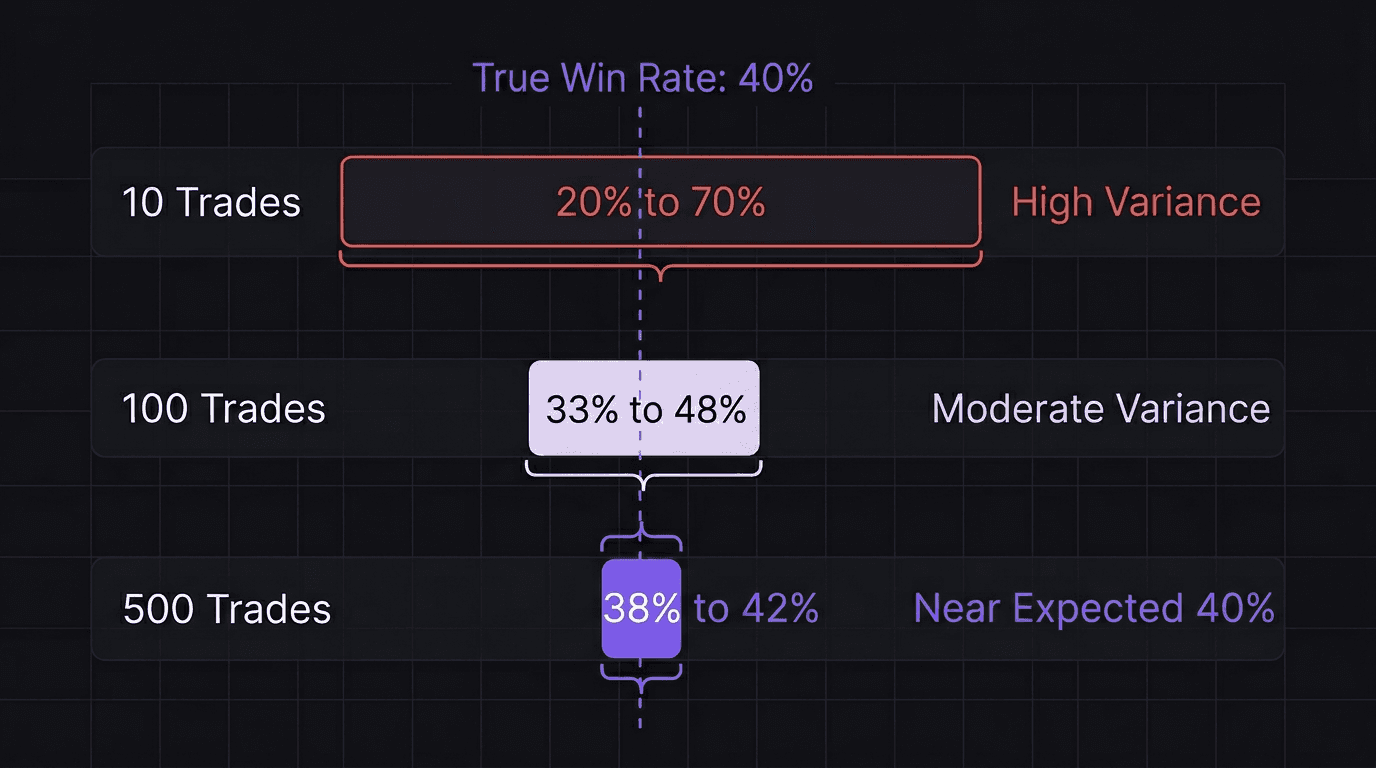
The law of large numbers states that as your sample grows, your actual results converge toward the expected value. With 10 trades, you might see a 20% win rate or a 70% win rate. Random noise dominates. With 100 trades, the variance tightens. With 500 trades, your results will sit very close to your backtested expectancy.
This is why casinos operate 24 hours a day, 365 days a year. They are not worried about the guy who wins $50,000 on a Tuesday night. They know that across the millions of bets placed each month, their 5.4% edge will produce predictable profit.
Your job as a trader is to survive long enough for the law of large numbers to kick in. That means two things:
Keep your risk per trade small. If a single loss can blow 5% or 10% of your account, you might not survive the natural losing streaks your strategy produces.
Keep taking trades. Every trade you skip out of fear of losing is a trade that might have been a winner, and it delays the convergence toward your expected results.
Why Traders Sabotage Their Own Edge
If the math is this clear, why do most traders still panic after losses? Three reasons:
They evaluate on single trades, not samples. When the unit of measurement is one trade, every loss feels like 100% failure. When the unit is 100 trades, a single loss is 1% of the process.
They change rules after streaks. Five losses in a row, and suddenly the moving average gets swapped, the session gets changed, the risk gets doubled. Every rule change resets the sample to zero. Your edge cannot play out if you keep restarting the experiment.
They confuse a good loss with a bad loss. A good loss is a trade that followed your plan and simply did not work out. A bad loss is a trade you took on impulse, with no setup, or with oversized risk. Good losses are the cost of doing business. Bad losses are leaks. Learn to reframe losses as business expenses, and the emotional weight drops immediately.
The casino never changes the rules of roulette after a player wins three times in a row. The casino knows that changing the rules would destroy the very edge that makes the game profitable. Refine your plan once per quarter, during a structured review. Never in the middle of a trading day.
How to Actually Welcome Your Next Loss
Knowing the math is one thing. Feeling it in your body when the trade hits your stop loss is another. Here are three practical steps to bridge the gap.
Step 1: Track your expectancy, not your P&L. After each trade, calculate your running expectancy. When you see that number stay positive across 30, 50, 80 trades, individual losses become boring. They are just data points feeding a positive trend.
Step 2: Write down your sequence number. Keep a simple count. "This is trade 47 of my current 100-trade sample." When you frame losses inside a larger set, they shrink. Trade 47 being a loss is not a crisis. It is expected. You are collecting data.
Step 3: Pre-commit to your next trade. Before a trade closes (win or lose), know what your next valid setup looks like. When the loss hits, you already have a plan. You are not reacting to the loss. You are executing the next step in a process. This is how probabilistic thinkers operate.
How EdgeFlo Helps You Trust the Process
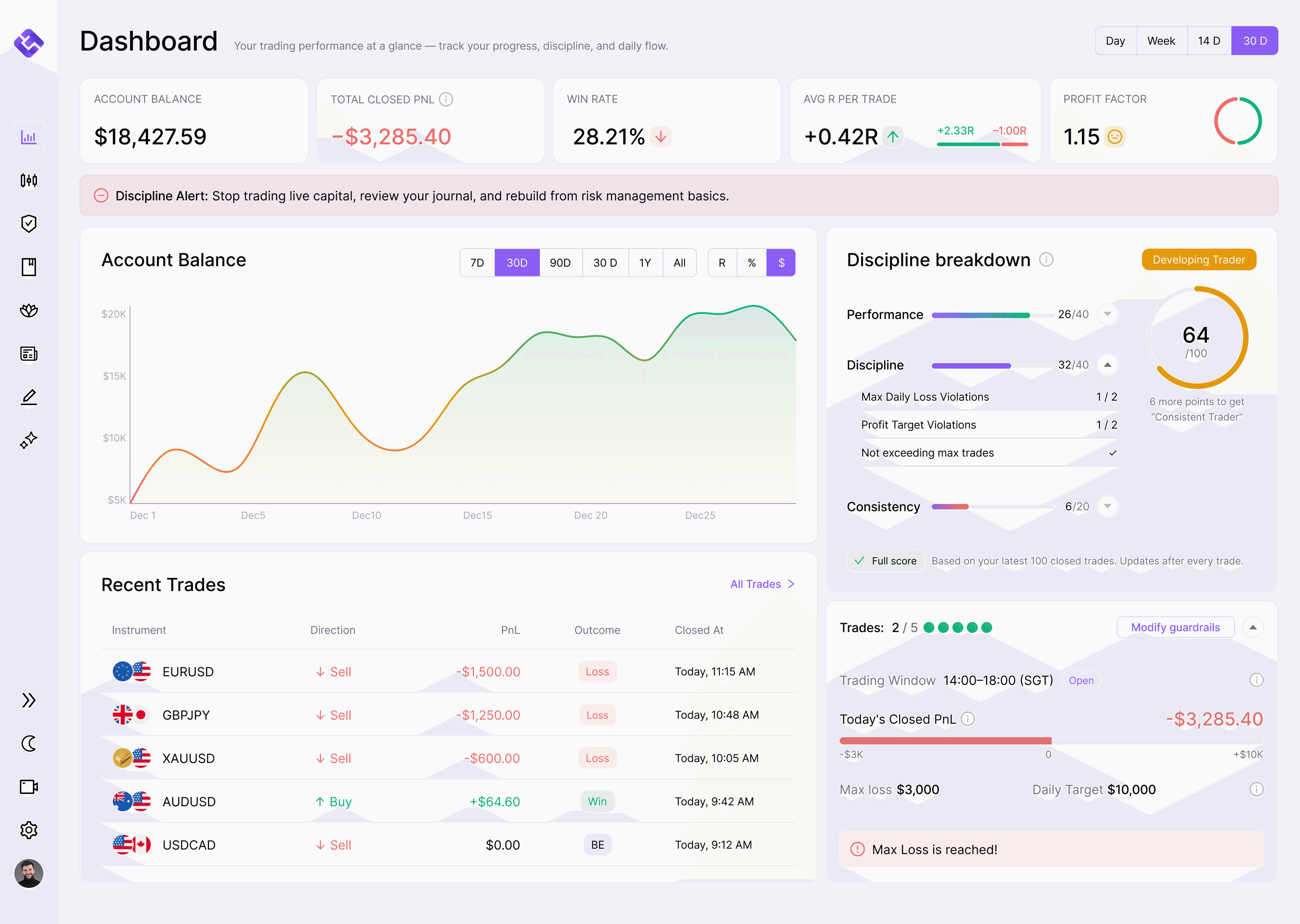
Trusting your edge across hundreds of trades is easier when you can see the evidence. EdgeFlo's trading journal auto-imports your trades and tracks your running expectancy, win rate, and average R, so you always have proof that your system works, even during a rough patch.
When a losing streak shakes your confidence, Sanctuary guides you through a structured reset routine before your next session. It does not promise to fix the feeling instantly. But it gives you a process to follow instead of letting frustration drive your next trade.
And if you notice yourself changing rules mid-streak, EdgeFlo's Edge plan builder keeps your documented strategy visible right next to your charts. The plan does not enforce itself, but it makes rule-breaking a conscious choice rather than an emotional reflex.
The Edge Brief
Receive Insights on trading psychology, discipline, and the behavioral patterns that create consistent traders from our Founder and the EdgeFlo team, delivered to your inbox.
Think different. Trade different.
How many losses in a row is normal in trading?
What does positive expectancy mean?
Should I change my strategy after a losing streak?
How do I stop fearing losses in trading?

Turn discipline on.
Every session.
EdgeFlo is the environment serious traders operate inside.
Start 7-Day Free Trial
Cancel anytime.
No long-term commitment.

Think Different, Trade Different.