

Why Retail Traders Become Liquidity
Institutions need retail stop losses as fuel. Learn how support and resistance traders become liquidity and how to avoid being on the wrong side of the sweep.
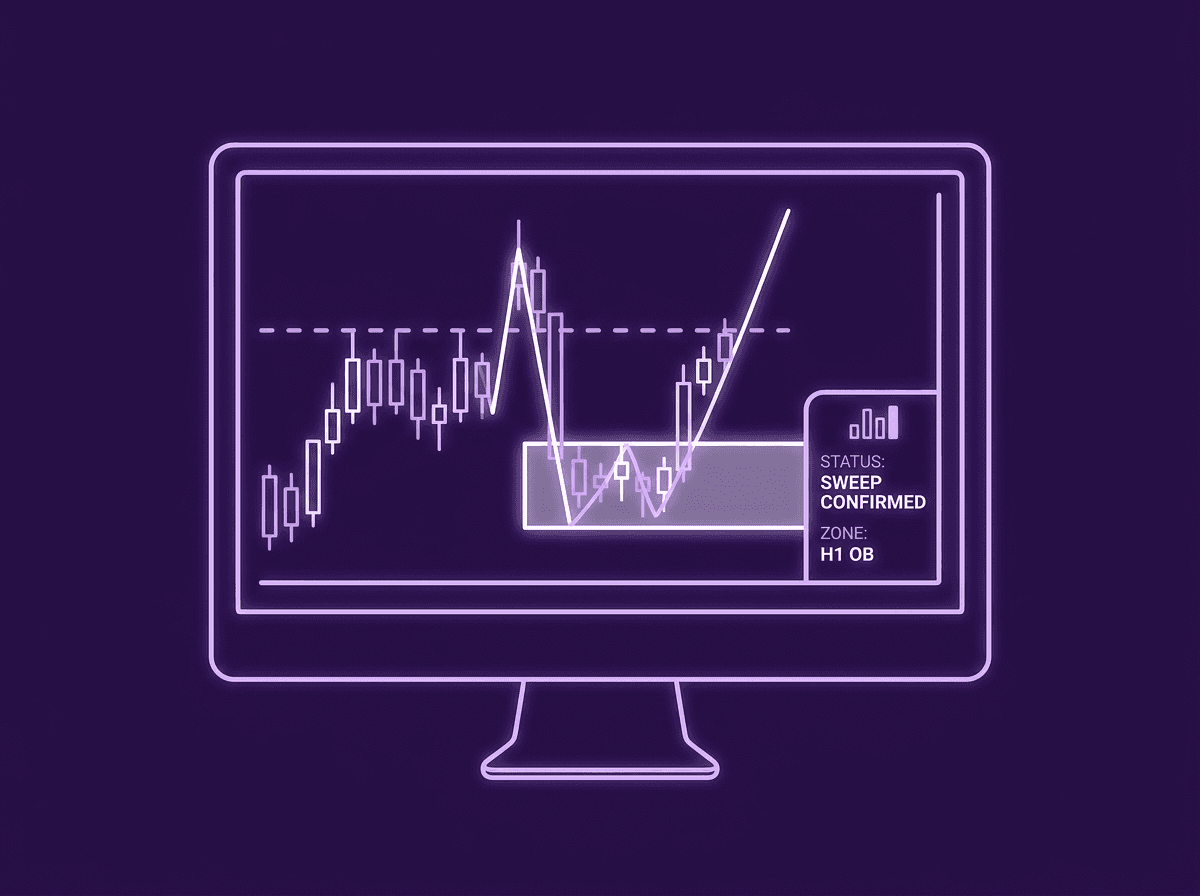
Every trader remembers the first time it happened. You entered a buy right at support, placed your stop loss a few pips below, and watched price drop through your level like it was not even there. Ten minutes later, price reversed and rallied exactly where you expected it to go.
You were right about the direction. You were just the fuel.
Retail traders become liquidity when their predictable stop loss placement gives institutions the order flow needed to enter large positions. Your stop loss getting hit is not random bad luck. It is the mechanism that makes institutional entries possible.
TL;DR
Retail traders become liquidity when their stop losses get triggered to fill institutional orders.
Support and resistance levels attract clustered stops, making them prime targets for liquidity sweeps.
Institutions need your sell orders (triggered stops) to fill their buy orders at scale.
Trading after the sweep instead of before it puts you on the same side as smart money.
Supply and demand zones offer better entry precision than support and resistance because they track institutional order origin points.
How Retail Stops Become Institutional Fuel
Think about what a stop loss actually is. If you buy EUR/USD at 1.0880 and place your stop at 1.0850, that stop is a pending sell order sitting on the books. When price drops to 1.0850, your broker triggers that sell. You exit at a loss.
But who takes the other side of your sell? Someone buying.
Institutions need enormous order volume to enter positions. A hedge fund looking to buy 500 standard lots of EUR/USD cannot just click "buy" without moving price against itself. It needs sellers, lots of them, at the price it wants to enter.
Where do those sellers come from? From retail traders whose stops just got hit.
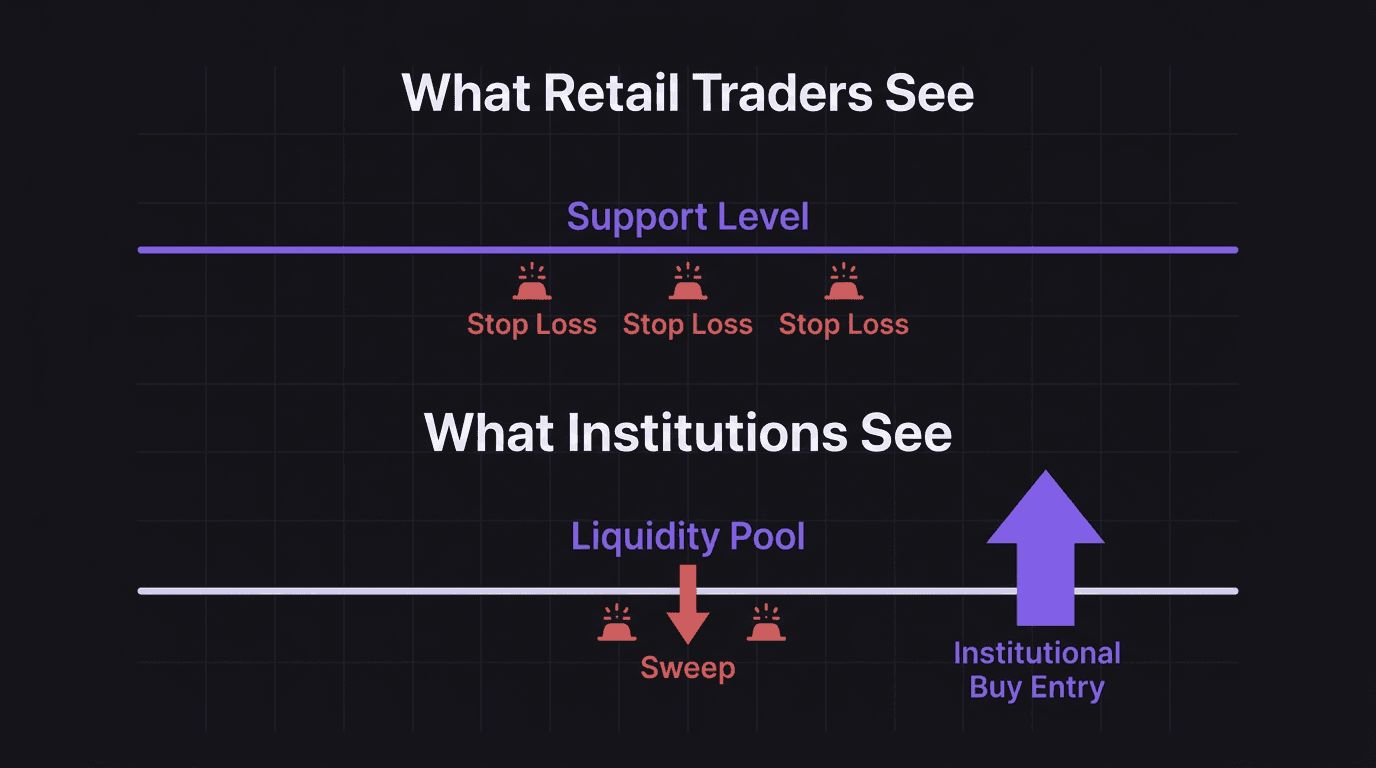
Every triggered stop loss below a support level is a sell order. Hundreds of retail traders placing stops at the same obvious level creates a pool of sell orders that institutions can absorb. Your loss becomes their entry.
Why Support and Resistance Creates the Trap
Support and resistance is the first concept most traders learn. Draw a horizontal line where price bounced before. Buy at support, sell at resistance. Simple.
Too simple.
The problem is not that support and resistance "does not work." The problem is that everyone sees it. When thousands of retail traders draw the same line and place stops in the same spot, they create a concentrated liquidity pool. Institutions know exactly where those stops are sitting.
Here is the typical sequence:
Price pulls back to a visible support level.
Retail traders enter long and place stops just below the level.
Price drops through support, triggering all those stops.
The triggered stops (sell orders) provide the liquidity institutions need.
Price reverses and moves in the original direction.
Sound familiar? That is not a coincidence. That is how market structure actually functions at the institutional level.
Walkthrough: The Classic Support Trap on EUR/USD
Picture EUR/USD trending up on the 4-hour chart, creating higher highs and higher lows. Price pulls back and bounces off 1.0850 twice. Textbook support.
You buy at 1.0855. Stop loss at 1.0840 (15 pips below). Target at 1.0920 for a clean 65-pip move.
Price consolidates near 1.0850 for a few hours, then drops to 1.0832. Your stop triggers. You lose 15 pips on a mini lot (0.1 lots).
Math check: 0.1 lots = $1/pip. $1 times 15 pips = $15 loss.
Twenty minutes later, price is at 1.0890 and climbing. It reaches 1.0920 by end of session. The move you predicted happened. You were just 18 pips too early, and that 18-pip dip was the liquidity sweep that stopped you out.
The Institutional Perspective
Institutions do not think in terms of support and resistance. They think in terms of order flow. Where are the orders sitting? Where can we get enough volume to fill without moving price against us?
A bank needs to buy 200 standard lots of EUR/USD. If it enters a market order for 200 lots at once, the price spikes before the order fills. Slippage destroys the entry.
Instead, the bank waits. It watches for price to approach a level where retail traders have clustered their stops. When price sweeps through that level, all those stop losses trigger simultaneously, flooding the market with sell orders. The bank absorbs those sell orders as its buy entry.
This is why supply and demand zones matter more than horizontal lines. A demand zone marks where institutions originally placed large buy orders. Support just marks where price bounced, which tells you nothing about why.
How to Stop Being the Fuel
The fix is straightforward. Stop trading like everyone else trades.
Step 1: Replace support and resistance with supply and demand zones. A demand zone identifies the origin point of an institutional move, the candle or consolidation where large buy orders first entered. This is more precise than "price bounced here before."
Step 2: Wait for the sweep before entering. If price reaches your demand zone, do not enter immediately. Wait for price to sweep the obvious liquidity below the zone first. Once the retail stops are cleared, you enter on the same side as smart money.
Step 3: Place your stop below the swept level, not below the zone. After the sweep, the liquidity below those lows is gone. Placing your stop below the swept low means institutions already absorbed the orders there. Your stop sits in clean space.
Walkthrough: Trading After the Sweep Instead of Before It
Same setup: EUR/USD in an uptrend on the 4-hour chart. Price pulls back to a demand zone between 1.0845 and 1.0860.
Instead of buying at the zone immediately, you wait. Price dips to 1.0838, sweeping below the previous swing low at 1.0842. Retail stops trigger. Then price prints a bullish candle and starts moving up.
You enter a buy at 1.0852 after the sweep confirms. Stop loss at 1.0830 (22 pips, below the swept low). Take profit at 2R.
Math check: 0.1 lots = $1/pip. $1 times 22 pips = $22 risk. 2R target = $44. $1 times 44 pips = $44 profit.
Same pair, same direction, same demand zone. But you entered after the trap instead of inside it. Your stop sits below swept liquidity where there are no more orders to hunt.
Recognizing Liquidity Pools Before They Get Swept
You can learn to spot where liquidity is building before the sweep happens. Look for these patterns:
Equal lows: Two or more swing lows at nearly the same price create a visible line that retail traders treat as support. That is a liquidity magnet.
Tight consolidation below a level: When price chops sideways just above a previous low, retail traders accumulate longs with stops below the lows. The longer the consolidation, the bigger the liquidity pool.
Multiple touches of the same level: Three or four bounces off the same price means three or four rounds of stops building beneath it.
Every time you see a "strong support level," ask yourself: how many stops are sitting below it? That is the liquidity the market needs before making the next real move.
How EdgeFlo Helps You Stay on the Right Side
The difference between being liquidity and trading alongside smart money comes down to discipline. You need a written plan that defines your entry rules, including the requirement to wait for a sweep before entering.
EdgeFlo lets you define and document your entry criteria inside the Edge plan builder. You can structure your supply and demand rules, your sweep confirmation requirements, and your stop placement logic so they are visible every time you open a trade. Having those rules on screen during execution makes it harder to abandon them when price dips into a zone and you feel the urge to buy early.
The auto risk calculator handles lot sizing based on your stop distance, so you spend less time on math and more time watching for the sweep confirmation that actually matters.
The Edge Brief
Receive Insights on trading psychology, discipline, and the behavioral patterns that create consistent traders from our Founder and the EdgeFlo team, delivered to your inbox.
Think different. Trade different.
What does it mean when retail traders become liquidity?
Why do institutions target retail stop losses?
How can I stop being used as liquidity?
Is the forex market really manipulated against retail traders?

Turn discipline on.
Every session.
EdgeFlo is the environment serious traders operate inside.
Start 7-Day Free Trial
Cancel anytime.
No long-term commitment.

Think Different, Trade Different.