

Weekly Trading Review Checklist (20 Minutes)
A structured weekly trading review checklist that turns raw journal data into patterns you can act on. Takes 20 minutes.

A weekly trading review checklist is the difference between traders who repeat mistakes for months and traders who catch problems within days. Most traders either skip reviews entirely or stare at their P&L without learning anything useful.
The weekly level is where pattern recognition begins. Individual trades are too noisy. Monthly reviews are too slow. But five days of trading data reveals repeating behaviors clearly enough to act on them.
TL;DR
Weekly reviews take 20 minutes and catch mistakes before they compound into monthly problems.
Review three categories: rule violations, missed setups, and emotional patterns.
Grade every trade as plan-win, plan-loss, off-plan-win, or off-plan-loss before looking at P&L.
Look for the same mistake appearing twice or more in one week, because that is a pattern.
Update one specific action item for the following week based on your biggest finding.
What a Weekly Review Covers
A weekly review is not about recalculating your win rate or stressing over your P&L. You do that monthly. The weekly review answers one question: did you follow your process this week?
That question breaks into three parts.
First, rule violations. Which trades broke your plan? Maybe you entered before confirmation. Maybe you moved your stop loss. Maybe you traded outside your session window. Write them down with no excuses attached.
Second, missed setups. Which valid trades did you see but not take? This matters because missed trades create FOMO, and FOMO creates forced entries the following week. If you keep missing the same setup, your execution rules might need adjusting.
Third, emotional patterns. Were you anxious before entries on Tuesday and confident on Thursday? Did a Monday loss affect your decision-making for the rest of the week? These connections only become visible when you line up five days side by side.
The 20-Minute Weekly Review Template
Block 20 minutes every Friday after your last session, or Sunday before the new week starts. Use a consistent format so you can compare weeks against each other.
Here is the template:
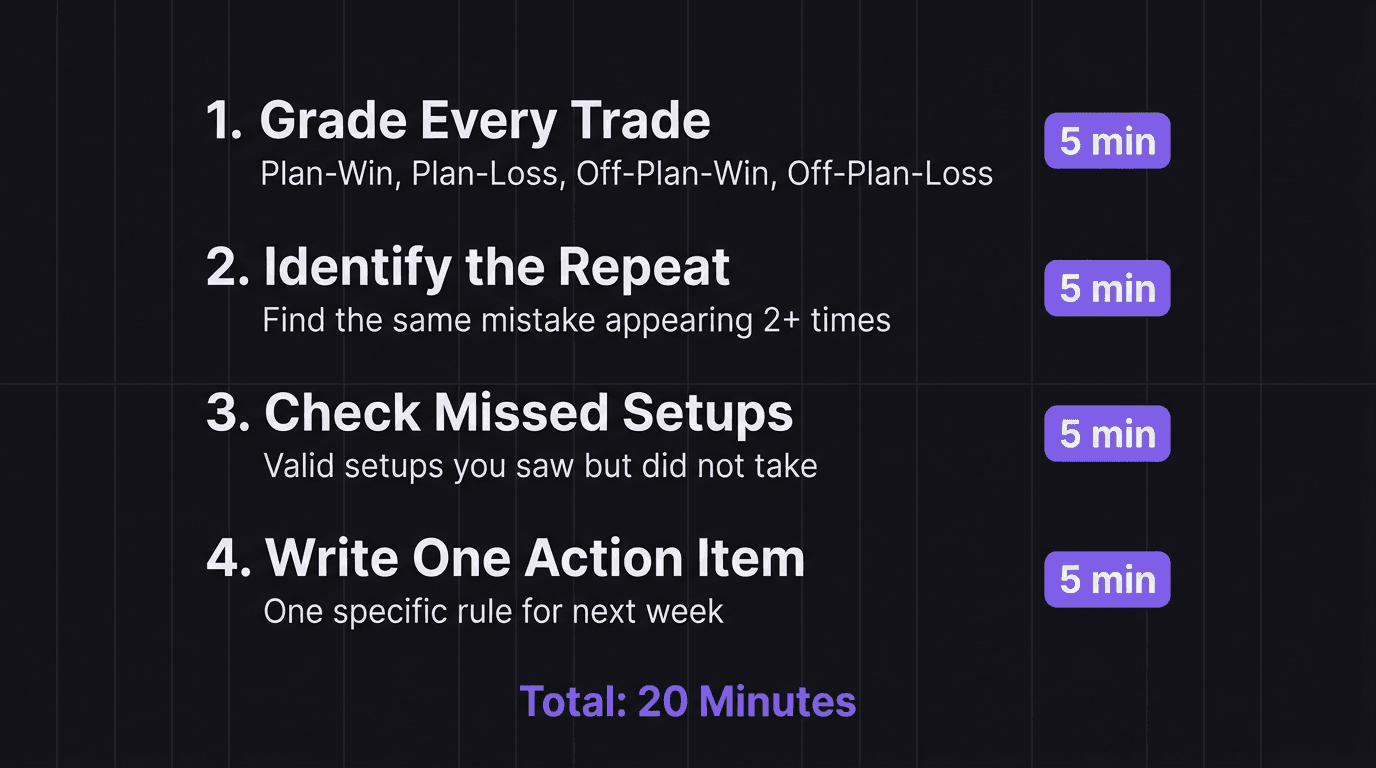
Step 1: Grade Every Trade (5 Minutes)
Open your trade journal and assign each trade one of four grades:
Plan-Win: You followed every rule and the trade was profitable. Save this screenshot.
Plan-Loss: You followed every rule and the trade lost. This is a good loss. Celebrate it.
Off-Plan-Loss: You broke a rule and the trade lost. Mark the specific rule you broke.
Off-Plan-Win: You broke a rule and the trade won. This is the most dangerous grade. Mark it.
Count them up. If more than 30% of your trades are off-plan (either win or loss), you have a discipline problem, not a strategy problem.
Step 2: Identify the Repeat (5 Minutes)
Scan your off-plan trades. Is the same mistake appearing more than once? Common repeats include entering before confirmation, trading during news, sizing up after a win, and re-entering after a stop-out.
If you find a repeat, write it as a single sentence: "I entered without waiting for the London session to open on 3 out of 5 trading days."
One sentence. That is your problem statement for the week.
Step 3: Check Missed Setups (5 Minutes)
Review your watchlist or post-trade notes for setups that met your criteria but you did not take. Were you away from the screen? Were you hesitating after a loss? Were you already in a different trade?
Missed setups are data. If you consistently miss the same type of setup, either your session timing is off or your confidence needs rebuilding through more backtest reps.
Step 4: Write One Action Item (5 Minutes)
Based on Steps 2 and 3, write one specific action item for next week. Not three. Not five. One.
Example: "Next week, I will not enter any trade before 8:00 AM London time, regardless of what price does at 7:45."
That is concrete, time-bound, and verifiable. At your next weekly review, you can check whether you followed it.
Patterns You Can Only See at the Weekly Level
Individual trades are random. You can follow every rule and lose. You can break every rule and win. That is why single-trade analysis is unreliable.
But when you line up five trading days, patterns emerge that you cannot see from a single post-trade review.
Day-of-week patterns. Maybe you lose money every Monday because you rush entries after a weekend of chart watching. Maybe Fridays are your worst day because you force trades to "end the week green." This only shows up at the weekly level.
Sequence patterns. A loss on Tuesday leads to oversized positions on Wednesday. A winning Monday makes you overconfident by Thursday. These cause-and-effect chains are invisible trade by trade but obvious across a week.
Session-time patterns. You might find that 80% of your off-plan trades happen in the first 30 minutes of your session. That is actionable information. You could add a rule: no trades in the first 30 minutes.
Walkthrough: Catching a Monday Pattern
A trader reviews her week on EUR/USD. Monday: off-plan-loss (entered before London open, hit stop at 1.0845). Tuesday: plan-win. Wednesday: plan-loss. Thursday: plan-win. Friday: off-plan-loss (entered before London open again, hit stop at 1.0830).
The weekly review reveals that both off-plan losses happened on the same day-type: market opens. The trader writes her action item: "No entries before 8:00 AM London for the next two weeks." The following two weeks, her off-plan trade count drops from 2 per week to zero.
Walkthrough: Missing the Same Setup
A trader reviews his missed trades on GBP/USD. He had three valid setups at the 15-minute level during London session. He took one, missed two. Both missed setups occurred between 8:00 and 8:30 AM while he was still doing analysis.
The pattern: his pre-session routine runs too long and bleeds into prime entry time. His action item: "Complete all analysis by 7:50 AM so I am execution-ready at 8:00."
From Review to Refinement
A weekly review is not a quarterly review. You are not changing rules at the weekly level. You are catching violations and building awareness.
Think of it this way: the weekly review tells you what went wrong. The monthly review tells you whether the pattern is real. The quarterly review tells you whether to change your rules.
If your weekly reviews consistently show the same problem for four weeks straight, that is a signal for your monthly review. If the monthly review confirms the pattern over 30 or more trades, that becomes a candidate for a rule change at the quarterly level.
The weekly checklist feeds everything above it. Without it, your monthly and quarterly reviews are built on memory, and memory lies.
Most traders who start weekly reviews report the same experience: they already knew what they were doing wrong. They just had never written it down and looked at it honestly. The 20-minute review is not about discovering something new. It is about forcing yourself to see what you have been avoiding.
How EdgeFlo Supports Your Weekly Review
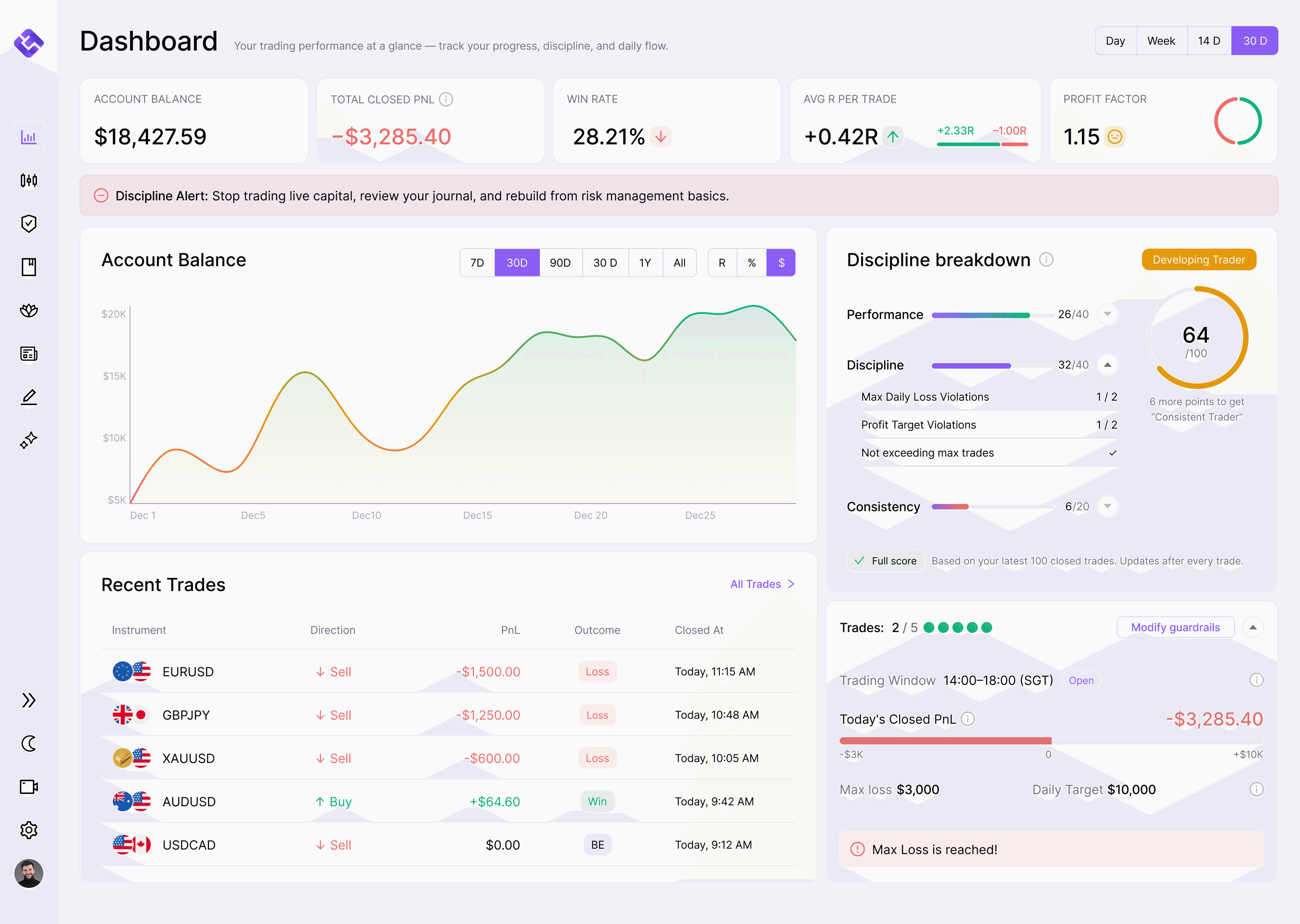
EdgeFlo's AI-powered trading journal auto-imports your trades and tags each one with your emotion state and session context. When you sit down for your weekly review, the data is already organized.
The trading dashboard shows your grade distribution for the week, so you can see plan-adherence at a glance without manually counting. And the weekly AI report (Plus plan) highlights patterns across your recent trades, surfacing the repeat mistakes before you even start looking.
Instead of spending 20 minutes digging through spreadsheets, you spend 20 minutes thinking about what the data means. That is where the real improvement happens.
The Edge Brief
Receive Insights on trading psychology, discipline, and the behavioral patterns that create consistent traders from our Founder and the EdgeFlo team, delivered to your inbox.
Think different. Trade different.
How long should a weekly trading review take?
What should I look for in a weekly trading review?
Should I review wins or losses first?
Can I skip weekly reviews and just do monthly?

Turn discipline on.
Every session.
EdgeFlo is the environment serious traders operate inside.
Start 7-Day Free Trial
Cancel anytime.
No long-term commitment.

Think Different, Trade Different.