

Waiting for Price to Reach Your Zone Saves Thousands
Set an alert at your point of interest, walk away, and do nothing until price arrives. This single habit prevents overtrading and transforms your R:R.

You marked the zone. You identified the direction. You know exactly where you want to buy. And now price is 60 pips away from your level, drifting slowly, candle by candle.
So you start watching. Staring, really. And after 45 minutes of nothing happening, you think: "Price is close enough. The structure looks good. I will just enter here and adjust my stop."
That decision, made thousands of times by thousands of traders, is the single most expensive habit in retail trading. Not because the zone was wrong. Because you refused to wait for it.
TL;DR
Set an alert at your point of interest and close the chart. Do not watch price travel to your zone.
Entering before price reaches your zone forces a wider stop and destroys your risk-to-reward ratio.
Overtrading almost always starts with impatience during the wait between analysis and execution.
If price never reaches your zone, you skip the trade. That is not a loss. That is discipline.
The hardest skill in trading is doing nothing, and it is also the most profitable one.
Why Doing Nothing Is the Hardest Skill
Every other profession rewards activity. Work more hours, produce more output, earn more money. Trading is the opposite. The trader who takes 3 trades a week from perfect locations outperforms the trader who takes 15 trades from wherever price happens to be.
But doing nothing feels wrong. You did the analysis. You found the setup. Your brain wants the payoff now, not in 6 hours when price finally reaches your level. So you compromise. You enter early, in the middle of nowhere, with a stop that is too wide and a target that is too close.
Patience in trading is not a personality trait. It is a structural decision you make before the session starts. You decide: I will not look at the lower timeframe until my alert fires. You set the alert. You close the chart. And you go do something else.
Set an Alert and Walk Away
Here is the exact process:
Complete your analysis on the higher timeframe. Identify direction and map your swing range.
Find your point of interest (demand or supply zone) within the discount or premium pricing.
Set a price alert at the top of the zone (for buys) or the bottom of the zone (for sells).
Close the chart. Not minimize. Close.
When the alert fires, open the chart, drop to the 15-minute timeframe, and look for your confirmations.
The alert replaces you as the chart watcher. It does not get bored. It does not get anxious. It does not convince itself that "close enough" is good enough. It fires at the exact level you specified, and only then do you engage.
This is not a nice-to-have productivity tip. This is a structural guardrail that prevents the most common entry mistake in zone-based trading.
What Happens When You Enter Too Early
Here is the math that most traders feel but never calculate.
EUR/USD. Your demand zone sits at 1.0880. Price is currently at 1.0920, 40 pips away. Your planned stop is below the zone at 1.0865.
If you wait: Entry at 1.0885 (inside the zone after confirmation). Stop at 1.0865. Risk: 20 pips. Target at swing high 1.0990. Reward: 105 pips. R:R = 5.25:1.
If you enter early at 1.0920: Same stop at 1.0865. Risk: 55 pips. Same target at 1.0990. Reward: 70 pips. R:R = 1.27:1.
Same setup. Same direction. Same zone. The early entry turned a 5.25R trade into a 1.27R trade. Over 20 trades, that difference is the gap between a growing account and a stagnating one.
And here is the part nobody talks about: early entries also get stopped out more often. Your stop at 1.0865 was placed based on the zone structure. But your entry at 1.0920 is floating in no-man's land. Price will wick against you, shake you emotionally, and sometimes hit your stop before reversing at the actual zone.
The R:R Difference Between Middle and Edge
The "middle of nowhere" is not just a vague warning. It has a precise definition: any price level that is not at a point of interest within discount (for buys) or premium (for sells).
When you enter at the edge of a zone, your stop is right behind structural support. It is tight, protected, and meaningful. If it gets hit, the trade thesis is genuinely wrong.
When you enter in the middle, your stop is arbitrary. It is either too tight (and gets clipped by normal price movement) or too wide (and produces a terrible R:R). There is no structural reason for the stop to be where it is.
This is why A+ setups always start with location. Direction without location is a bias. Location without direction is a zone. Both together, at the edge of a discount zone with a tight structural stop, is where the real money is made.
Walkthrough: The Cost of Impatience on a Real Setup
GBP/USD, bullish 4H structure. You mark a demand zone at 1.2690 to 1.2705. Price is at 1.2745. You set an alert at 1.2710 and close TradingView.
Two hours pass. You check your phone. No alert. Price is at 1.2730. You think: "It is pulling back. Might not reach my zone. What if I miss it?"
You open the chart. No rejection candle. No break of the 15m structure. You enter anyway at 1.2730 with a stop at 1.2680. Risk: 50 pips. Target: 1.2820 (the swing high). Reward: 90 pips. R:R: 1.8:1.
Price continues to 1.2695, enters your original zone, prints a rejection, breaks the 15m structure, and rallies to 1.2820.
If you had waited: entry at 1.2710, stop at 1.2680, risk of 30 pips, reward of 110 pips, R:R of 3.67:1. Your impatience cost you nearly 2R on a single trade.
Now multiply that across a month of trading. The patient trader is not smarter. Not luckier. Just willing to know when to stop looking at the screen and let the alert do the work.
How EdgeFlo Guardrails Support Patience
Knowing you should wait is not the problem. Actually waiting, while your brain screams "you are missing the move," is the problem.
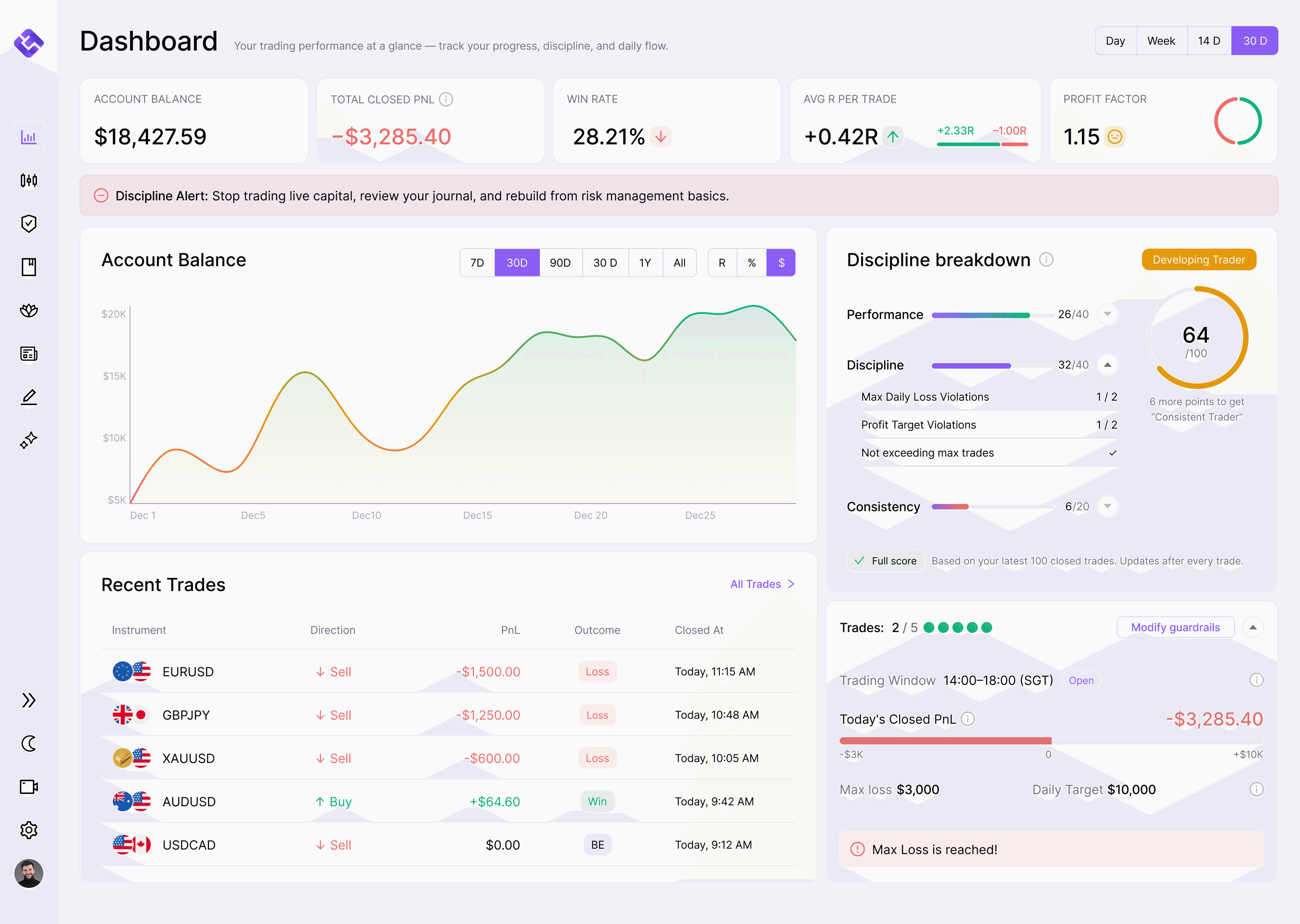
EdgeFlo's guardrails restrict trading when you hit your daily loss limit or maximum trade count (with override available if you choose). This structural limit means that even if you enter early on one trade and lose, the system makes you pause before throwing another trade at the market. It creates a forced gap between impulse and action.
The journal tracks whether each entry happened at your planned zone or somewhere else. Over time, that data builds a case for patience that your emotions cannot argue with. When you see 30 trades at zones averaging 2.8R and 12 trades away from zones averaging 0.9R, the decision to wait stops being hard. It becomes obvious.
The Edge Brief
Receive Insights on trading psychology, discipline, and the behavioral patterns that create consistent traders from our Founder and the EdgeFlo team, delivered to your inbox.
Think different. Trade different.
Why should I wait for price to reach my zone before trading?
How do I set a price alert on TradingView?
What if price never reaches my zone?
How does waiting prevent overtrading?

Turn discipline on.
Every session.
EdgeFlo is the environment serious traders operate inside.
Start 7-Day Free Trial
Cancel anytime.
No long-term commitment.

Think Different, Trade Different.