

Voice Journaling for Traders: Capture What Text Misses
Text journals filter out emotion. Voice captures raw tone, hesitation, and frustration. Learn how voice journaling creates your most honest trading feedback.
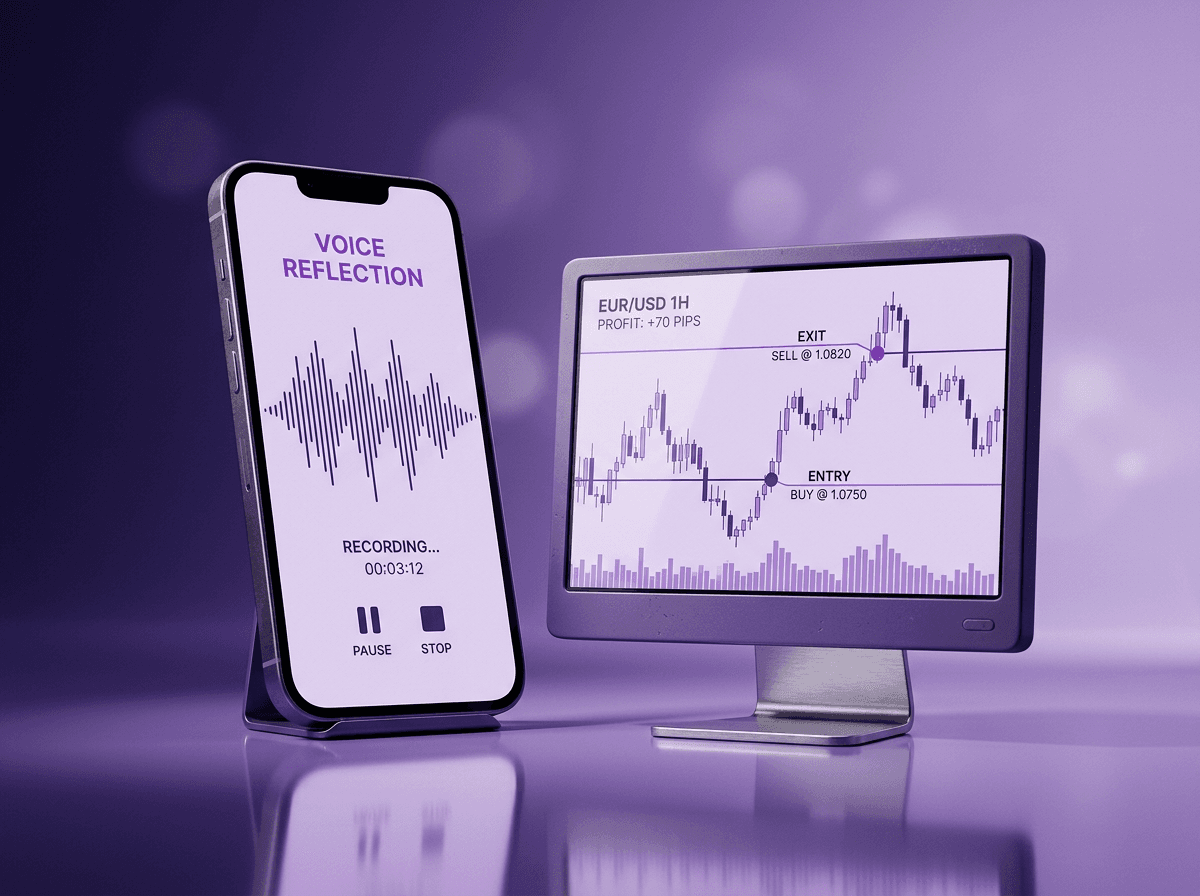
After a bad trade, you sit down to write a journal entry. By the time you open the spreadsheet, your brain has already started editing the story. "I entered a bit early, but the setup was still valid. I should have been more patient." Clean. Rational. Polite.
But what were you actually feeling 30 seconds after closing that trade? Something closer to: "That was so stupid. I knew it was wrong and I did it anyway. I feel sick."
Text journals are useful. But they filter out the raw emotional signal that makes self-awareness possible. Your brain sanitizes the experience between feeling it and writing it down. By the time the words hit the page, the real intensity is gone.
Voice captures what text cannot.
TL;DR
Text journals filter out emotional intensity. Your brain sanitizes the experience before you finish writing.
Voice recordings capture raw tone, hesitation, speed, and frustration that text erases.
Record immediately after closing every trade. Waiting 30 minutes is too late.
During weekly review, listen for emotional patterns: what you sound like before wins versus losses.
Voice and text together create the most complete journal entry.
Why Text Journals Miss the Full Story
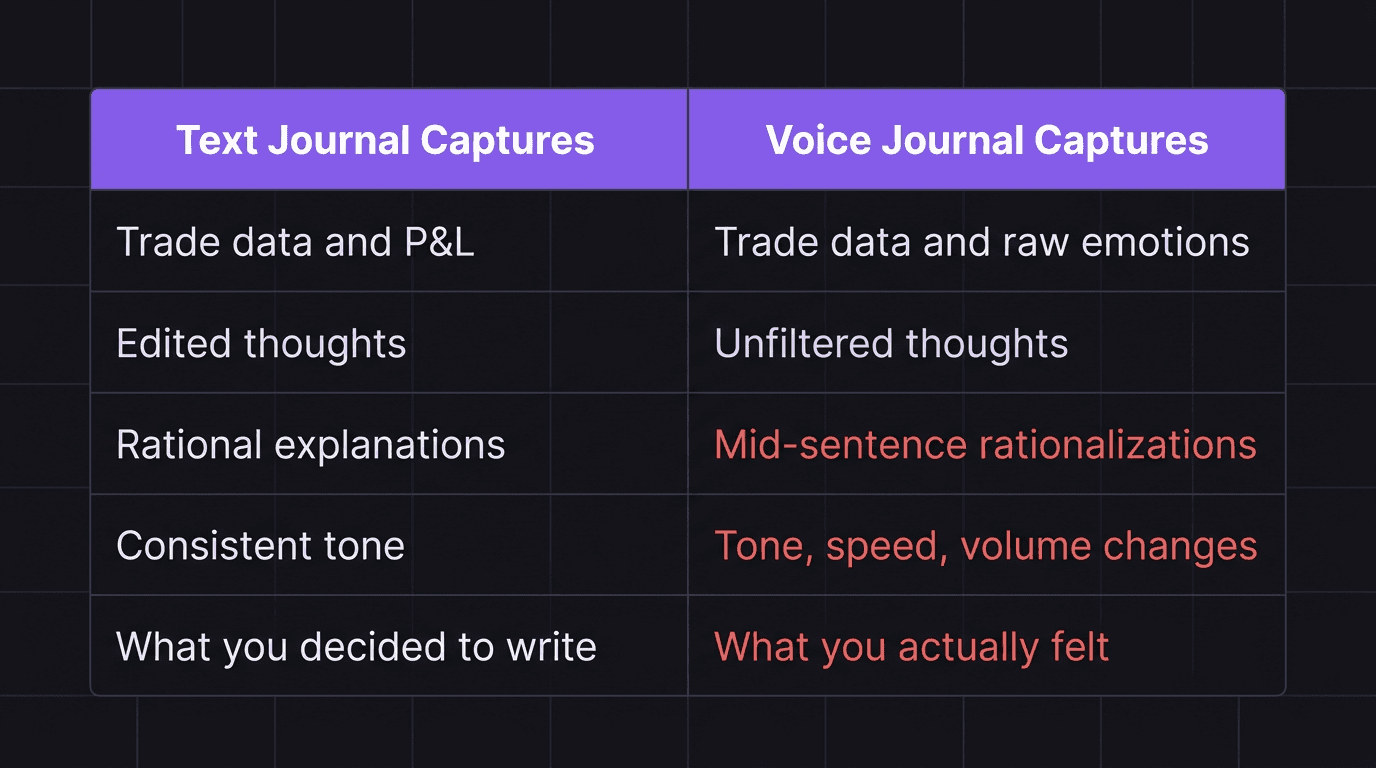
A text journal entry records what you thought happened. A voice entry records what actually happened inside your head.
Consider the difference:
Text entry after a losing trade: "Took a long on EUR/USD at 1.0840. Setup was valid but price reversed. Hit stop at 1.0820. Loss of 1R. Need to be more patient with entries."
Voice entry after the same trade: "Okay, I just got stopped out again. I... I think I entered too early. Like I saw the zone and I just clicked buy before the candle even closed. I was scared it would leave without me. That FOMO thing again. I'm frustrated because I knew to wait and I still did it. Third time this week."
The text entry tells you what happened. The voice entry tells you why. The frustration, the self-awareness, the pattern recognition in real time: none of this survives the translation from feeling to typing. But when you speak immediately after the trade, it all comes through.
Your voice carries data that your fingers cannot type:
Tone. Are you calm or rattled? Confident or shaken?
Speed. Rapid speech after a trade often signals anxiety or overstimulation.
Pauses and hesitation. When you pause mid-sentence, it usually means you are catching yourself in a rationalization.
Volume and energy. A quiet, deflated voice after a loss tells a different story than an upbeat "it's fine, I followed the plan."
These signals are invisible in a spreadsheet. But they are the raw material of emotional awareness in trading.
What Voice Captures That Text Cannot
When you journal by typing, you engage the analytical part of your brain. You organize, structure, and edit. That is helpful for recording trade data. But it actively works against capturing your emotional state because the analytical process smooths out the rough edges.
Voice bypasses that filter. Speaking is faster than typing, so there is less time for your brain to rationalize. The words come out before the internal editor can clean them up.
Here is what you will hear in voice entries that you will never see in text:
Rationalization in real time. You start saying "I think the setup was valid" and then pause, because you realize mid-sentence that it was not. In text, you would delete the first sentence and replace it with something cleaner. In voice, the contradiction stays recorded.
Emotional escalation. After three consecutive losses, your voice entries get faster, more clipped, more irritated. That escalation pattern is completely invisible in text because you type at the same speed regardless of emotion.
Honest self-assessment. When you speak right after a trade, you are more likely to say "I should not have taken that trade" than when you write it 20 minutes later. The delay allows your ego to intervene and soften the admission.
Walkthrough: Two Journal Entries, Same Trade
A trader takes a short on GBP/USD at 1.2680 based on a supply zone. Price initially moves in her favor by 15 pips, then reverses and hits her stop at 1.2700. Loss of 1R.
Text entry (written 15 minutes later): "Short GBP/USD at 1.2680, stop at 1.2700. Valid supply zone from 1H chart. Price reacted initially but reversed. 1R loss. Entry was fine, but the zone may have been mitigated by a prior test."
Voice entry (recorded immediately): "Ugh. I just got stopped out. The zone was... okay, honestly the zone was already tested once before. I knew that when I entered. I was looking for the entry, so I kind of convinced myself it was fresh. I need to stop doing that. If it has been tested, skip it. I am so annoyed at myself right now."
The text entry says "the zone may have been mitigated." The voice entry says "I knew that when I entered." Completely different level of honesty. Completely different usefulness for a post-trade review.
When to Record a Voice Journal Entry
Timing matters more than length. A 30-second voice note recorded immediately after closing a trade is worth more than a 5-minute recording made an hour later.
Record immediately after closing the trade. The moment the position is closed, hit record. Do not check P&L first. Do not look at what price did after you exited. Just speak. Say what you felt, what you were thinking during the trade, and whether you followed your plan.
Record after deciding NOT to take a trade. Some of the most revealing voice entries come from skipped setups. "I saw the setup but did not take it because I was scared after two losses" is critical data that most traders never capture.
Record at the end of each session. A 60-second summary of how you feel after the session. Were you calm? Frustrated? Bored? Overstimulated? This data, over time, reveals which session states correlate with good and bad performance.
Do not record during a trade. While a position is open, you need to focus on management, not journaling. Record after the trade is fully closed.
Keep entries short. Under two minutes is ideal. You are not recording a podcast. You are capturing a snapshot of your internal state.
How to Review Voice Entries for Patterns
Voice entries are only useful if you listen to them again. Otherwise they are just audio files collecting dust.
During your weekly review, listen to every voice entry from the week alongside your journal template data. Listen for these patterns:
Emotional signatures before wins vs losses. You might discover that your calmest, most matter-of-fact voice entries precede your best trades. And your most excited, confident entries precede your worst trades. That pattern alone can change how you approach entries.
Rationalization frequency. Count how many times in a week you catch yourself mid-sentence rationalizing a bad entry. If the number is climbing, your plan adherence is slipping.
Tone after consecutive losses. If your voice gets tighter and faster after loss two, you know that loss three is likely to be an emotional trade. That data supports adding a hard stop after two losses.
Phrases that repeat. "I knew I should not have" or "I just had a feeling" or "one more trade" are warning phrases. If you hear them repeatedly across multiple weeks, they point to a journaling habit gap or a plan adherence problem.
How EdgeFlo Transcribes Voice Reflections Into Your Journal
Most traders do not voice journal because there is no system for it. Recording a voice memo on your phone and then manually transcribing it is too much friction. So the voice notes pile up unlistened, or the habit dies after a few days.
EdgeFlo auto-transcribes voice reflections into journal entries. After closing a trade, you speak your reflection directly in the app. The voice recording is transcribed and attached to that specific trade in your journal. No separate app. No manual transcription. No lost audio files.
During your weekly review, the transcription sits right next to your trade data and charts. You can read it or listen to the original recording. The emotional context stays connected to the trade it belongs to, which is what makes the pattern recognition possible.
Text and voice together give you the complete picture. The text handles the data. The voice handles the truth. EdgeFlo keeps them in the same place so your review process has access to both.
The Edge Brief
Receive Insights on trading psychology, discipline, and the behavioral patterns that create consistent traders from our Founder and the EdgeFlo team, delivered to your inbox.
Think different. Trade different.
What is voice journaling in trading?
Is voice journaling better than writing a trade journal?
When should I record a voice journal entry?
How do I review voice journal entries?

Turn discipline on.
Every session.
EdgeFlo is the environment serious traders operate inside.
Start 7-Day Free Trial
Cancel anytime.
No long-term commitment.

Think Different, Trade Different.