

Trailing Stop Loss Using Market Structure
Learn how to trail your stop loss using higher lows and market structure. Includes liquidity sweep risk and when not to trail.
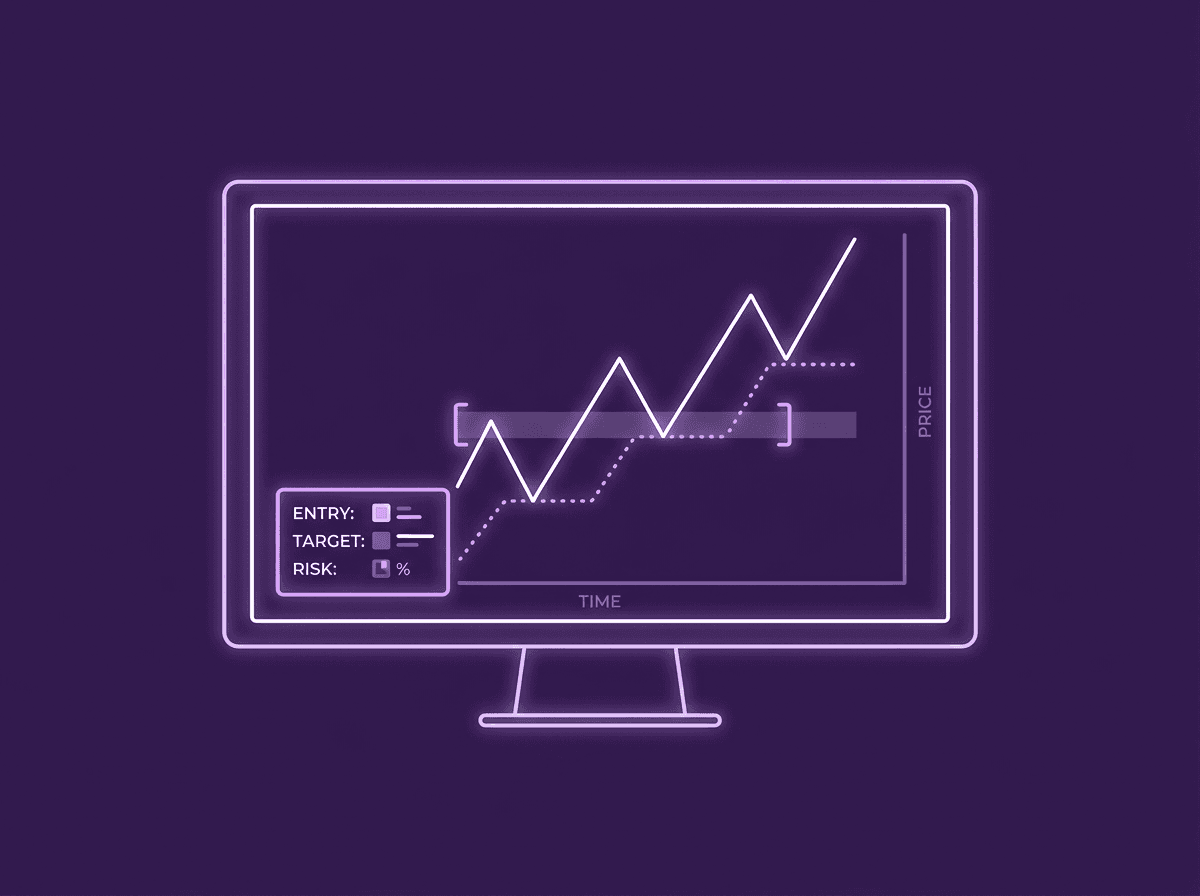
A trailing stop loss moves with price as your trade becomes profitable. Instead of keeping your stop at the original level, you advance it to each new higher low in an uptrend (or lower high in a downtrend). This locks in profit and reduces risk as the trade develops.
The concept sounds simple. The execution is where most traders get burned.
TL;DR
Trail your stop to confirmed higher lows in an uptrend, never to the first swing you see.
Wait for liquidity sweeps before trailing, not before.
Moving your stop too early is the most common trailing mistake.
Trailing works best in trending markets with clean market structure.
In choppy conditions, set and forget often beats trailing.
How Trailing Stop Loss Works
When you enter a long trade, your initial stop loss sits below the most recent swing low. As price moves up and creates new structure (higher highs and higher lows), you move your stop to the next higher low.
First move: from your initial stop to break even (your entry level). This happens when price creates a higher low at or above your entry price. At this point, you have a risk-free trade. If the market reverses, you exit with zero loss.
Second move: from break even into profit. As price continues upward and forms the next higher low above your entry, you trail your stop to that level. Now even a losing trade exits with profit.
Each trailing move shrinks your exposure. You are systematically taking risk off the table without closing the position. The trade stays open to capture more upside, but your worst-case outcome keeps improving.
In a downtrend, the logic flips. You trail your stop to each new lower high as price descends.
Walkthrough: Trailing on GBP/USD 4H (Clean Structure)
You enter long on GBP/USD at 1.2700 after price bounces off a demand zone. Stop loss at 1.2660 (40 pips below entry). Take profit at 1.2840 (140 pips, 3.5R). Risk: 1% of $10,000 = $100. Position size: 0.25 lots.
Price pushes to 1.2760 (higher high), pulls back, and forms a higher low at 1.2720. This is 20 pips above your entry. You trail your stop from 1.2660 to 1.2720. You now have 20 pips of locked profit ($50 on 0.25 lots at $10/pip).
Price pushes again to 1.2800, pulls back, forms a higher low at 1.2770. You trail to 1.2770. Now you have 70 pips locked ($175).
Price makes one more push to 1.2830, reverses hard. It drops back to 1.2770 and hits your trailed stop. You exit with 70 pips of profit ($175) instead of the full 140-pip target.
Without trailing, this trade either hits your full take profit at 1.2840 or your original stop at 1.2660. Trailing gave you $175 on a trade that missed the target by 10 pips.
This is trailing at its best. Clean market structure, clear higher lows, and a trade that reversed near the target. Trailing saved you from a potential $100 loss (if price continued down to your original stop) and captured $175 instead.
Trail Using Market Structure
The key word is "structure." You trail to structural levels, not arbitrary ones.
A structural higher low in an uptrend is a level where price pulled back, found buyers, and resumed the trend with a new push higher. It is visible on the chart as a clear swing point. It is not just any dip. It is a dip that was followed by a new high.
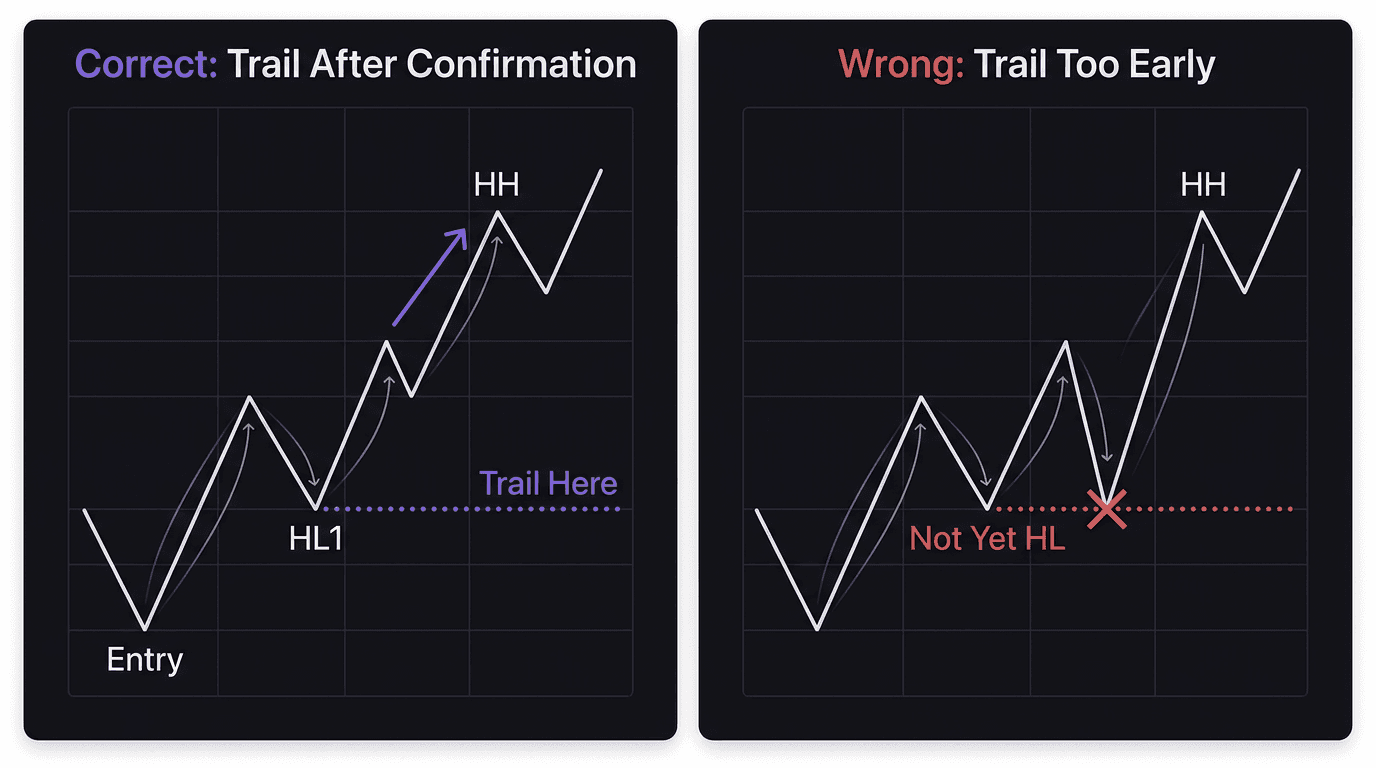
When you see price create a higher high followed by a pullback, wait. Do not trail your stop yet. Wait for the pullback to complete and for price to show it has found support. Once price creates a new push (ideally breaking the previous high), the level where it bounced becomes a confirmed higher low.
That confirmed higher low is where you trail your stop.
Common mistake: moving your stop to a level that "looks like" a higher low while price is still forming it. Price may still be in a pullback. What appears to be a higher low might just be a pause before a deeper pullback sweeps the level.
For downtrend trades, you trail to confirmed lower highs. Wait for price to break structure to the downside again before trailing your stop down to the rejection level. In choppy markets where structure is unclear, trading without a trailing stop and using a fixed exit may produce better results.
The Liquidity Sweep Problem
Market structure is not always clean. Price regularly sweeps below swing lows to collect liquidity before continuing the trend.
Here is how it happens. Price is in an uptrend. It creates a higher high and pulls back to form a higher low. Stops accumulate below that higher low (from traders who trailed their stops there). Larger players push price below the level, triggering those stops and absorbing the sell orders. Then price reverses and continues higher.
If your trailed stop was at that higher low, you just got swept out. The trade idea was right. The trend continued. But you exited because the market collected liquidity at your exact stop level.
Walkthrough: Liquidity Sweep Trap on EUR/USD
You enter long on EUR/USD at 1.0850. Stop at 1.0820. Price creates a higher low at 1.0870, and you trail your stop there. Price pushes to 1.0910, pulls back, and creates what looks like another higher low at 1.0885. You trail again.
Price dips to 1.0880, sweeping your stop at 1.0885. You exit with 30 pips of profit ($30 on 0.1 lots, $10/pip).
Price then rejects the sweep level, pushes back above 1.0900, and eventually reaches 1.0960. Had you waited for the sweep before trailing, you could have moved your stop to 1.0875 (below the sweep) and captured the move to your original target.
The fix: do not trail your stop to the first higher low. Wait for liquidity below that level to get taken. Once you see a sweep followed by a strong rejection and a new push higher, trail your stop below the post-sweep low. That level is stronger because the obvious liquidity has already been cleared.
This requires patience and experience. You need to recognize where liquidity is likely to sit and wait for it to get cleaned before committing your stop to that level.
When to Trail and When to Hold
Trailing is not always the right choice. It works best when:
The market is trending with clean higher highs and higher lows
You are trading on a timeframe where structure is clearly visible (4H, daily)
You can monitor the trade to identify new structure levels
The move is large enough that multiple higher lows will form before your target
Trailing performs poorly when:
The market is ranging or choppy (no clear structure to trail to)
Liquidity sweeps are frequent on your timeframe
You are on a low timeframe where "structure" changes every few minutes
You cannot watch the charts to make trailing decisions
In choppy markets, your stop gets swept repeatedly because the levels are too close together and too obvious. Set and forget often performs better in those conditions because your stop stays at the original level, protected by more distance from random noise.
Track your trailing decisions in a trading journal. After 20+ trades, compare: how many times did trailing save you money versus how many times did it cost you a full winner? If trailing is reducing your average R, you may need to adjust when and where you trail, or consider a different management method for your strategy.
Your risk per trade should remain consistent regardless of management method. Trailing changes where your stop sits, but your initial risk amount is determined at entry.
How EdgeFlo Supports Trailing Decisions
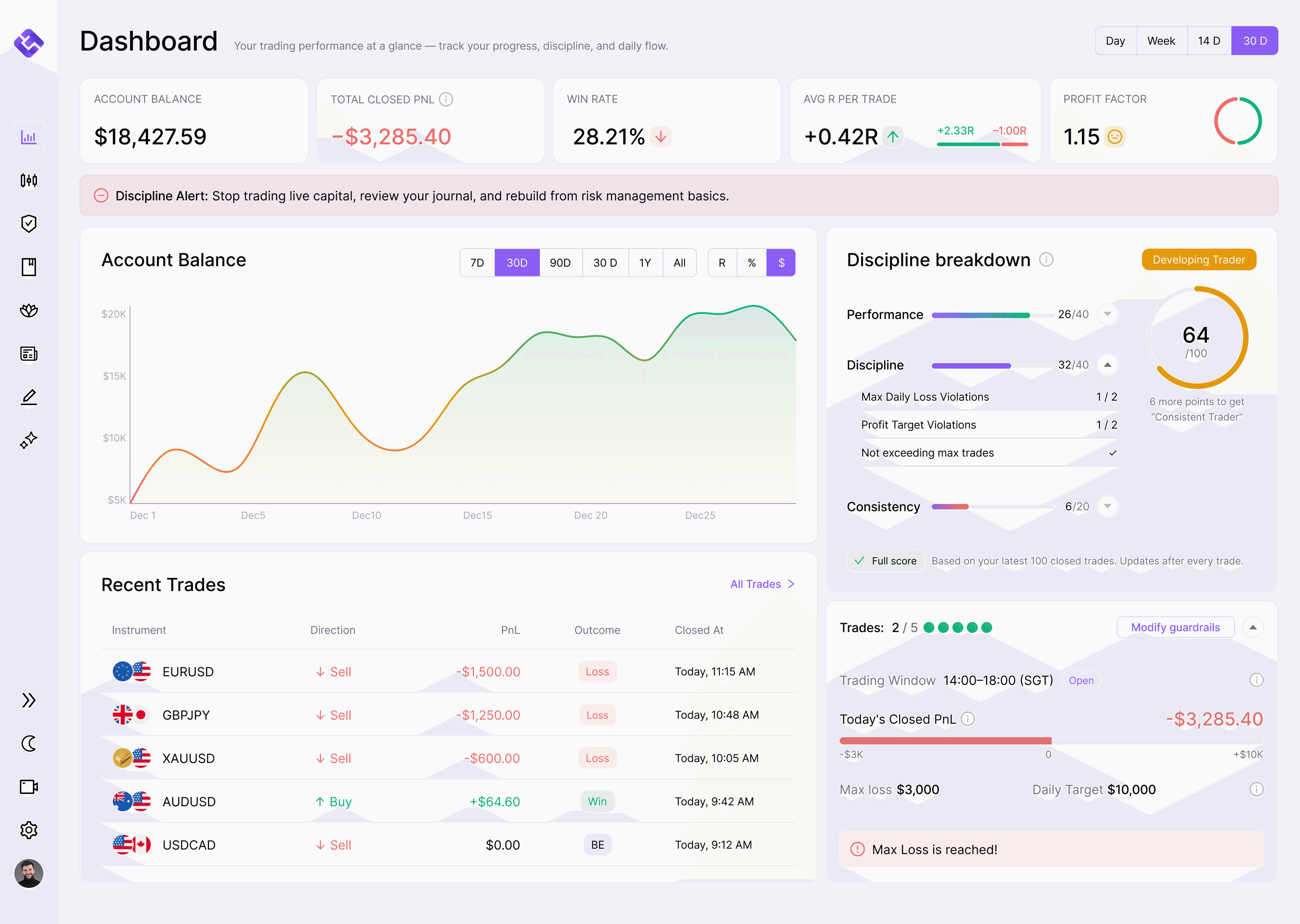
EdgeFlo's trading journal tracks every trailing stop decision you make, including how you felt when you moved it. Emotion tagging captures whether you trailed because your plan told you to, or because fear pushed you to lock in profit early.
Over time, this data reveals patterns. You might discover that you trail too early on certain pairs, or that your best R outcomes come from trades where you waited for the sweep before trailing.
The journal auto-imports your trade data, so you do not need to manually log every stop adjustment. Review your trailing decisions during your weekly performance review, and refine your rules based on what the data shows, not what felt right in the moment.
The Edge Brief
Receive Insights on trading psychology, discipline, and the behavioral patterns that create consistent traders from our Founder and the EdgeFlo team, delivered to your inbox.
Think different. Trade different.
How do you trail a stop loss with market structure?
When should I move my stop loss to break even?
What is the biggest risk of trailing stop loss?
Should I trail every trade?

Turn discipline on.
Every session.
EdgeFlo is the environment serious traders operate inside.
Start 7-Day Free Trial
Cancel anytime.
No long-term commitment.

Think Different, Trade Different.