

Trading With No Experience: A 6-Month Path
A realistic 6-month learning path for complete trading beginners. What to study first, when to go live, and why process matters more than profits early on.
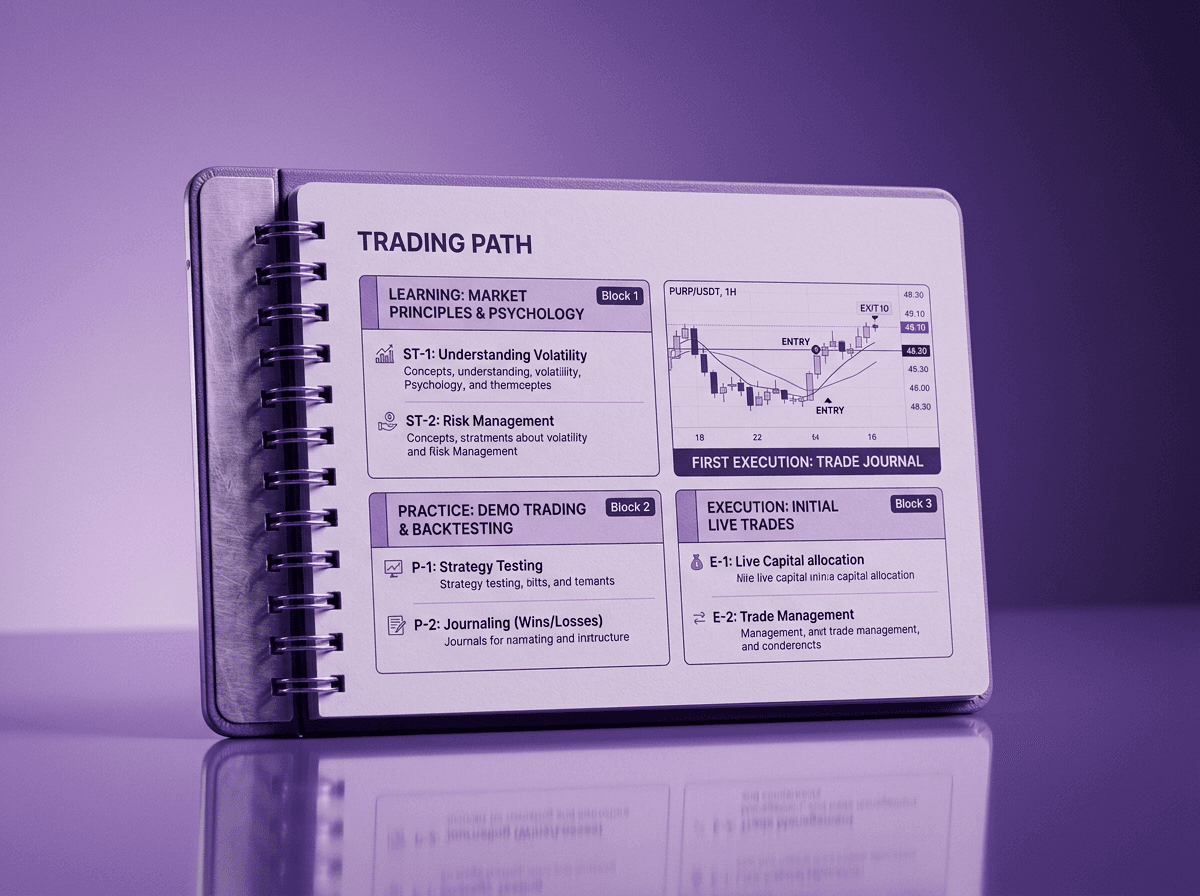
If you have never placed a trade before, your first six months should focus on one thing: building a process you can repeat. Not finding a holy grail strategy. Not making money. Not proving you can beat the market. Just building a clear, written system for how you identify, enter, manage, and review trades. Profit comes after the process is solid, and rushing past the process phase is the single most expensive mistake beginners make. A trader named Yousef went from zero experience to $850,000 in funded accounts within 8 months, but his first 4 to 5 months were pure learning and process-building, not earning.
TL;DR
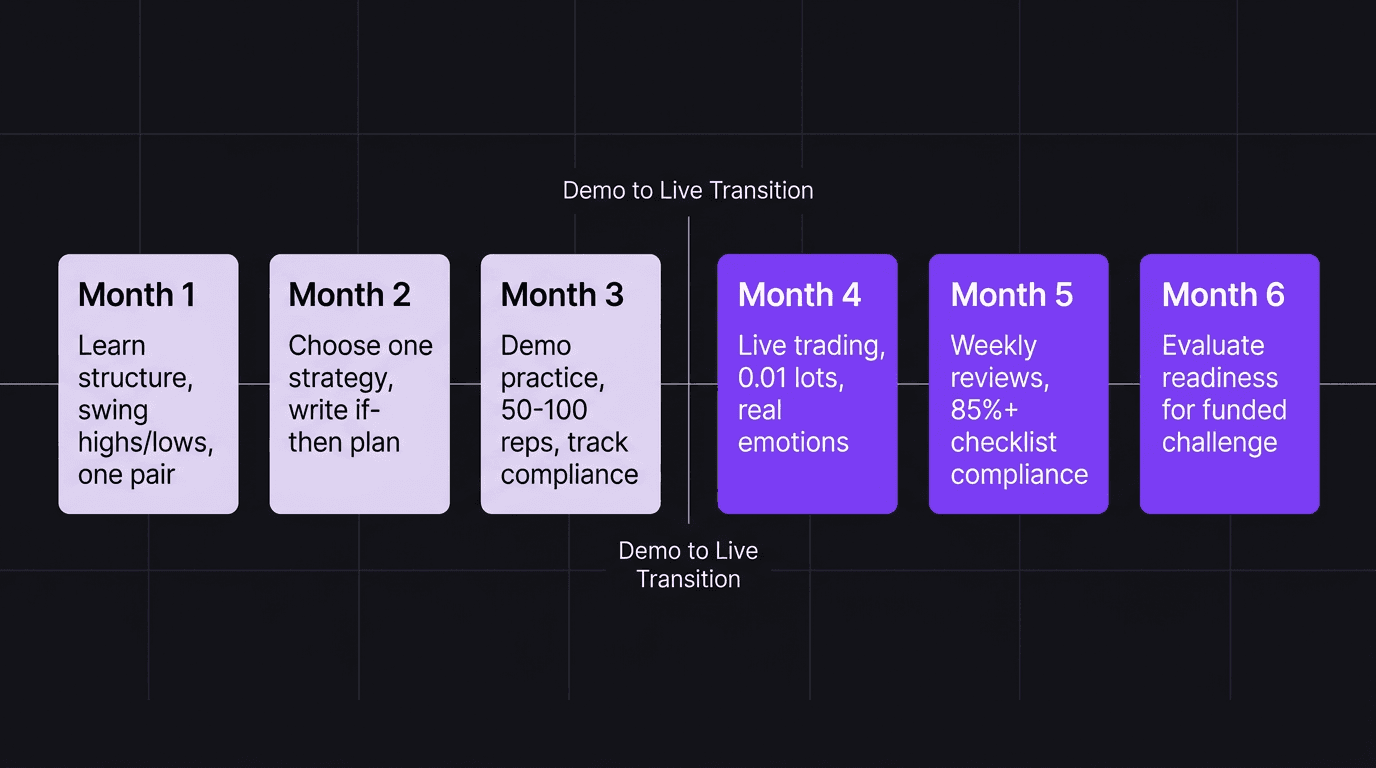
Months 1 to 3: Learn one strategy, build a written plan, practice on demo or replay.
Months 4 to 6: Trade live with tiny size, focus on execution quality over profit.
Do not attempt funded challenges until your process produces consistent results for at least 8 weeks.
The biggest beginner mistake is optimizing for profit before the process is reliable.
One strategy, one pair, one session. Master that before adding complexity.
Month 1-3: Build the Foundation
Your first three months are not about trading. They are about learning how markets work, choosing one strategy, and creating a written plan you can follow mechanically.
Month 1: Understand Structure
Before you can trade, you need to read a chart. Not predict where price is going. Just understand what price has done and what levels matter.
Focus on these concepts only:
Swing highs and swing lows. The building blocks of everything. Practice marking them on historical charts until it becomes automatic.
Market structure. Higher highs and higher lows mean bullish. Lower highs and lower lows mean bearish. When the pattern breaks, the trend might be shifting.
Support and resistance. Levels where price has previously reversed. Not exact lines, but zones.
Candlestick basics. You do not need 50 patterns. Learn what a wick rejection looks like, what an engulfing candle means, and how to read a doji. That covers 90% of what matters.
Pick one pair (EUR/USD is a good starting pair for forex) and one timeframe (15-minute or 1-hour). Study only that pair on that timeframe. The urge to look at ten charts is strong. Resist it.
Month 2: Choose One Strategy
Here is where beginners go wrong: they collect strategies like trading cards. One week it is moving average crossovers, the next week it is order blocks, the next week it is ICT concepts.
Pick one. Just one. Learn it deeply enough to write it down as a set of if/then rules.
A confirmation-based strategy works well for beginners because it gives you specific conditions to check before every entry:
Has a key level been swept? (Inducement)
Has market structure shifted on my timeframe? (Confirmation)
Is price pulling back into my entry zone? (Timing)
Write these as an if-then trading plan. "If price sweeps the Asian low AND a 15-minute candle closes above the last lower high AND price pulls back to the order block, THEN I enter long with a stop below the sweep."
If any condition is missing, you do not trade. That is the entire plan.
Month 3: Practice Without Real Money
Use a demo account or a chart replay tool to practice your strategy. The goal is not to make demo profits. The goal is to run through your plan 50 to 100 times so the process becomes automatic.
Track these metrics during demo practice:
Checklist compliance: Did you check every condition before entering?
Stop placement: Was your stop at the correct level every time?
Trade management: Did you follow your exit rules, or did you panic-close or move targets?
Do not skip this phase. Every trader who skips demo practice and goes straight to live trading pays for that education in real dollars. Backtesting your strategy on historical data gives you confidence that your approach works before you risk real capital.
What Yousef Did Differently
Yousef had never traded before April 2025. He joined a structured trading community and spent 4 to 5 months learning before attempting funded accounts. He did not backtest in the traditional sense. Instead, he went directly to the market with small size, treating live practice as his learning environment. His approach was faster than most, but the principle was the same: months of building process before expecting results.
Month 4-6: Practice on Live Markets
Once you can execute your demo plan consistently (80%+ checklist compliance over 50 trades), transition to live trading. But change your goal. You are not trading to make money. You are trading to prove that your process works with real stakes.
Start With Tiny Size
Your position size during months 4 to 6 should be the minimum your broker allows. If you are trading forex, that might be 0.01 lots. The point is to experience real emotions (the fear of losing real money, the greed of wanting more) while the financial impact is negligible.
This is where the real learning happens. Demo trading teaches you mechanics. Live trading teaches you psychology.
The Emotional Curriculum
Here is what you will encounter in your first weeks of live trading. Every single beginner hits these:
Your first live loss feels 10x worse than a demo loss. Even if it is $3. The emotional weight of real money changes everything.
You will want to move your stop. "Just give it a little more room" is the thought that precedes most blown accounts.
You will overtrade. After a win, you will want another one. After a loss, you will want revenge. Recognize both impulses and do not act on them.
You will question your strategy after 3 losses in a row. This is normal. Three losses do not invalidate a strategy. Thirty losses with consistent checklist compliance might.
The most common trading mistakes beginners make are not analytical. They are behavioral. You will know the right thing to do and still do the wrong thing. That gap between knowledge and execution is what months 4 to 6 are designed to close.
Weekly Review Protocol
At the end of each week, answer these questions in a journal:
How many trades did I take? How many met all my confirmation criteria?
Did I follow my stop loss and target rules on every trade?
What was my biggest emotional trigger this week?
If I could replay one trade, which one would I change and why?
This weekly review is more valuable than any strategy video you will watch. It builds self-awareness, which is the actual foundation of consistent trading.
Walkthrough: A Beginner's First Live Week
You are trading EUR/USD on the 15-minute chart during London session only. Your plan says: wait for a sweep of the Asian range, confirm with a market structure shift, enter on the pullback. Risk 0.5% per trade, maximum 2 trades per day.
Monday: No sweep of the Asian range during your session. Zero trades. This feels uncomfortable, but you followed the plan.
Tuesday: Asian low is swept at 8:40 AM. A 15-minute candle closes above the last lower high at 8:55 AM. You enter long at the order block, 1.0847, stop at 1.0835. Price hits your target at 1.0872 for a 2.1R win. You close charts.
Wednesday: Asian high is swept, but no bearish structure shift follows. Price continues higher. No trade.
Thursday: You take a valid short after a sweep and shift. Stopped out for 1R. You feel the urge to re-enter immediately. You do not. You journal the loss and note that the setup was valid, the outcome was just negative.
Friday: One valid setup, 1.5R win.
Weekly total: 3 trades, 2 wins, 1 loss. Net: +2.6R. More importantly: 100% checklist compliance, zero revenge trades, zero off-plan entries. That is a successful first week.
When You Are Ready for Funded Challenges
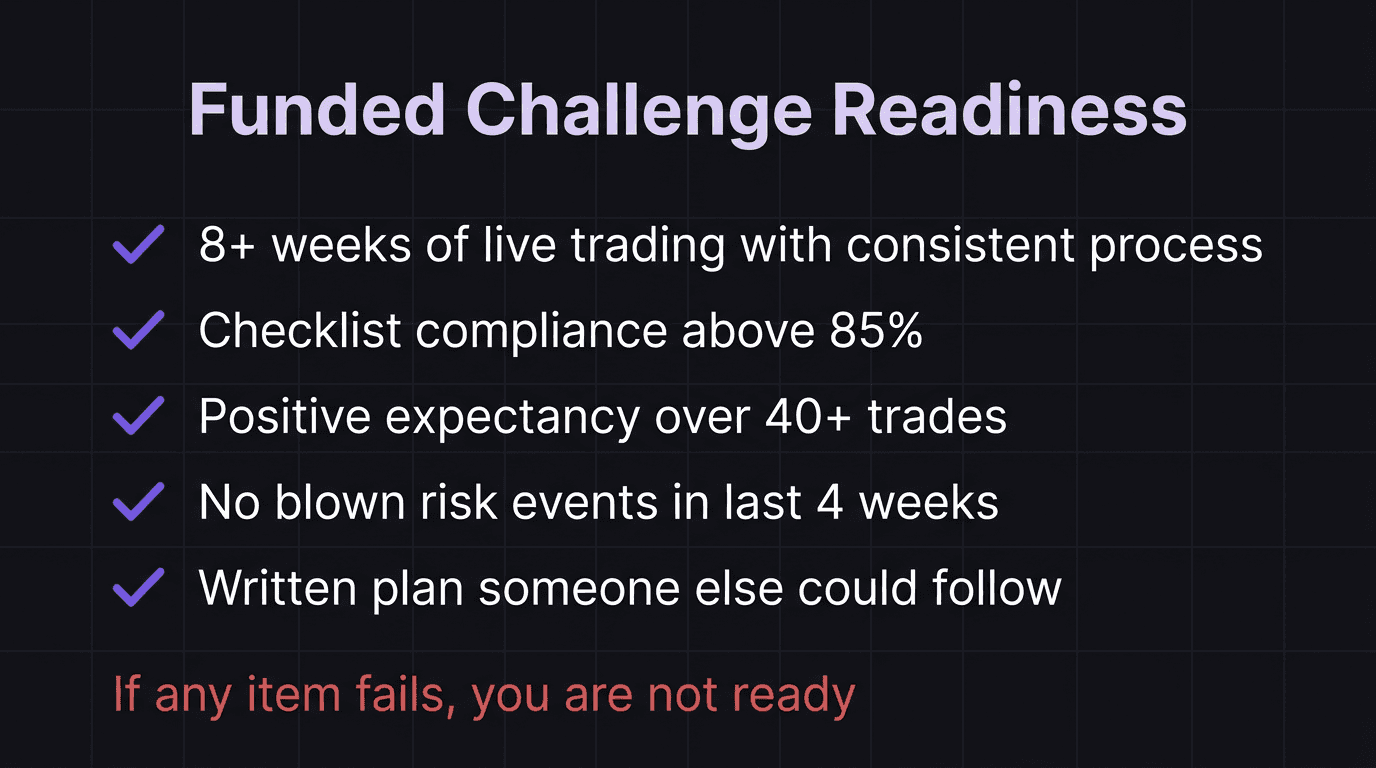
You are not ready for a prop firm challenge after one good week. Or two good weeks. Here is a realistic readiness checklist:
8+ consecutive weeks of live trading following your process
Checklist compliance above 85% (you followed your plan on at least 85% of trades)
Positive expectancy over at least 40 trades (your average winner multiplied by win rate exceeds your average loser multiplied by loss rate)
No blown risk management events in the last 4 weeks (no moved stops, no oversized positions, no revenge trades)
Written plan with clear rules that someone else could follow without your help
Yousef attempted funded challenges after roughly 4 to 5 months of learning. He failed some early on, burning accounts through overtrading and revenge trading. But once his process locked in, he passed multiple challenges and scaled to $850,000 in funded capital within 4 months. The speed was impressive, but it was only possible because the process was already solid.
Your trading edge is not your strategy. It is your ability to execute your strategy without deviation, session after session, month after month. That is what funded firms are actually testing.
The Biggest Mistake New Traders Make
Trying to make money before building a process.
Every beginner does it. You open your first chart, learn a pattern, and immediately start thinking about how much money you can make per day. You calculate lot sizes based on desired income instead of risk management. You size up after a win and spiral after a loss.
Yousef lived this. His early months were defined by overtrading and burning accounts. He was trying to earn before he had a system. The transformation happened when he stopped focusing on outcomes and started focusing on what price was doing right now. "I completely detached from outcomes," he said. "Focus on what price does NOW."
The Process-First Alternative
Instead of asking "How much can I make?", ask these questions during your first 6 months:
Can I identify my setup on a blank chart within 30 seconds?
Can I write my entry criteria from memory without checking my notes?
Can I take a loss and not change anything about my next trade?
Can I sit through an entire session with zero trades and not feel like I wasted my time?
When the answer to all four is yes, you are ready to start thinking about scaling size and pursuing funded accounts. Until then, protect your capital and build the process.
How EdgeFlo Supports Beginner Traders
EdgeFlo is designed for the exact learning path described in this article. The Academy provides step-by-step education that covers market structure, strategy building, and risk management in the order you need to learn them. You do not have to piece together information from ten different YouTube channels.
The Edge trade plan builder lets you document your if-then rules and keep them visible while you trade. During months 4 to 6, when you are learning to execute with real stakes, having your plan next to your chart eliminates the "I forgot my rules" problem. After each trade, you log whether you followed the plan, building the compliance data that tells you when you are ready for funded challenges.
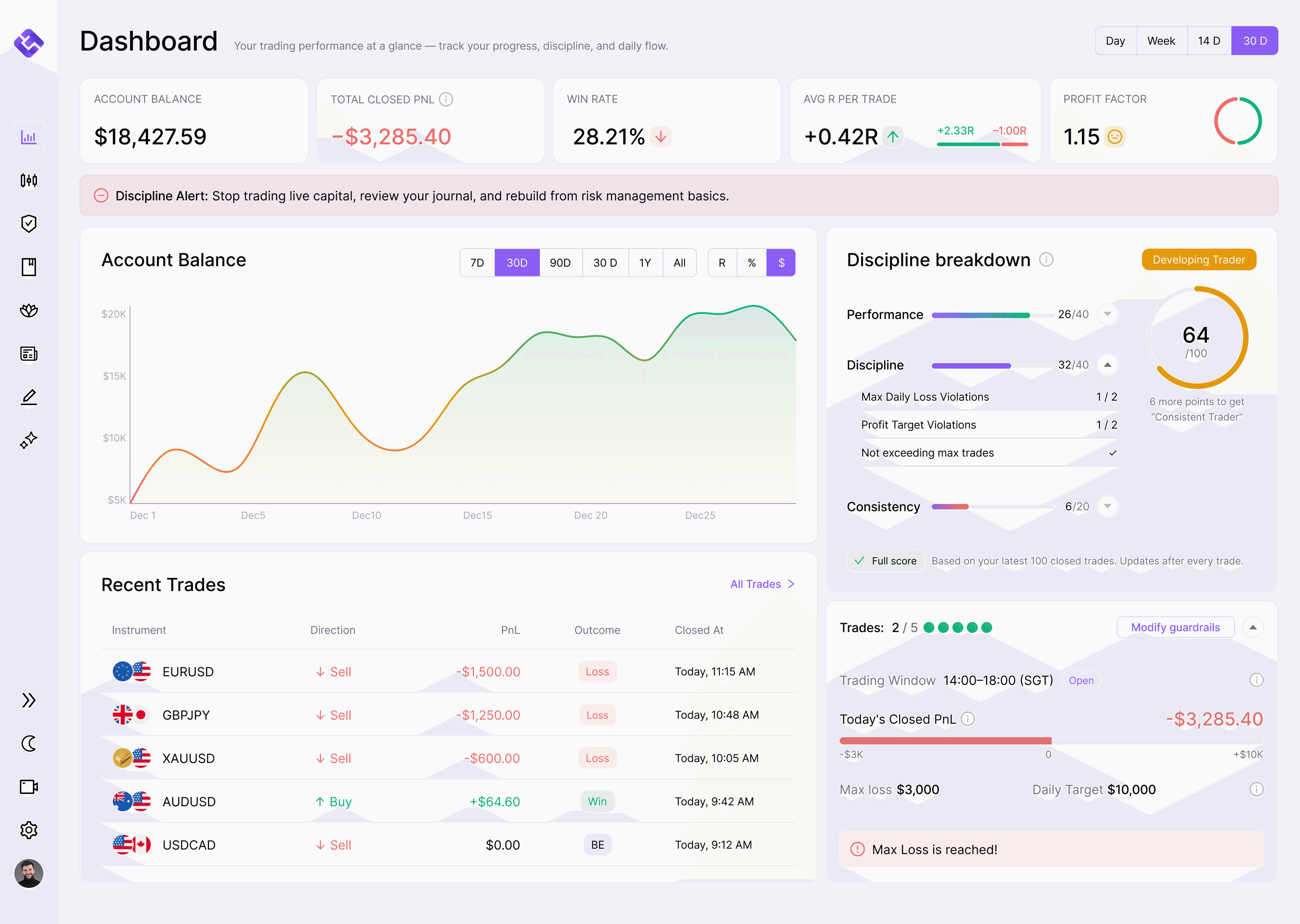
Guardrails set daily loss limits and trade count maximums that protect you during the emotional learning curve. When you hit your daily limit, EdgeFlo flags the trade button. You can override it, but that extra step of friction prevents the autopilot revenge trading that drains beginner accounts faster than anything else.
The Edge Brief
Receive Insights on trading psychology, discipline, and the behavioral patterns that create consistent traders from our Founder and the EdgeFlo team, delivered to your inbox.
Think different. Trade different.
Can you learn trading in 3 months?
Should beginners trade forex or stocks?
How much money do I need to start trading?
What is the biggest mistake new traders make?

Turn discipline on.
Every session.
EdgeFlo is the environment serious traders operate inside.
Start 7-Day Free Trial
Cancel anytime.
No long-term commitment.

Think Different, Trade Different.