

Stop Moving Your Stop Loss: Execute Without Interference
Moving your stop loss after entry leads to bigger losses. Learn why traders widen stops, what it costs, and how to build a set-and-forget execution habit.
You enter a trade. You have a plan. Stop loss is set. Then price dips toward your stop and your hand reaches for the mouse.
"Just a little more room."
That one sentence has probably cost you more money than any bad setup ever did. Moving your stop loss after entry is one of the most common habits in trading, and it is also one of the most destructive. Your stop loss exists for one reason: it marks the price where your trade idea is wrong. Once you move it, you are no longer managing risk. You are just hoping.
TL;DR
Your stop loss marks where your trade thesis is invalid. Moving it means you are trading without a thesis.
Widening stops creates a losing math problem: big losses paired with small wins drain accounts over time.
The urge to move your stop comes from trading fear, not from analysis.
Set-and-forget execution removes you from the decision loop after entry.
Write your invalidation level into your plan before you enter. Then do not touch it.
Why You Keep Widening Your Stop
The honest answer? You do not want to be wrong.
Taking a loss means admitting your analysis missed something. That stings. So instead of letting the stop do its job, you drag it back another 15 pips and tell yourself the trade "just needs more room."
But think about what you are actually doing. Your original stop was placed at a level for a reason. Maybe it was below a swing low, below a support zone, or below a structure that would invalidate the setup. When you widen the stop, you are no longer protecting a trade idea. You are protecting your ego.
There is a second driver that is less obvious: inconsistency in your trading rules. If you do not have a clear rule for where your stop goes, every trade becomes a judgment call in the moment. And judgment calls under pressure almost always go the wrong way.
Sound familiar? You planned for a 20-pip stop, price gets within 3 pips, and suddenly you decide 35 pips "makes more sense." It never made sense. You just panicked.
The Fear Loop
Here is how the pattern usually plays out:
You enter with a stop loss based on your analysis.
Price moves against you and approaches the stop.
Fear kicks in. You widen the stop by 10, 15, 20 pips.
Price hits the new stop anyway. Now the loss is twice what you planned.
Next trade, you widen even earlier because the last one hurt.
Each cycle trains you to interfere more, not less. The losses get bigger. The trust in your own process gets smaller. And your trading consistency falls apart because every trade has different rules.
What Micromanaging Trades Actually Costs
The damage is not just one bad trade. It is the math over 50 or 100 trades.
When you move your stop loss further away, you are increasing your risk on that trade without increasing your reward. Worse, most traders who widen stops also tighten their take profit. They get nervous and grab whatever profit is available.
The result: small wins and big losses. Over the long term, that combination destroys accounts no matter how good your entries are.
Here is a simple example. Say you risk 1% per trade with a 2:1 reward-to-risk ratio. Over 10 trades with a 50% win rate:
Planned: 5 wins at +2% each = +10%. 5 losses at -1% each = -5%. Net: +5%
With stop-widening: 5 wins at +1.5% (took profit early) = +7.5%. 5 losses at -2% (widened stop) = -10%. Net: -2.5%
Same win rate. Same setups. But micromanaging flipped the outcome from profitable to negative.
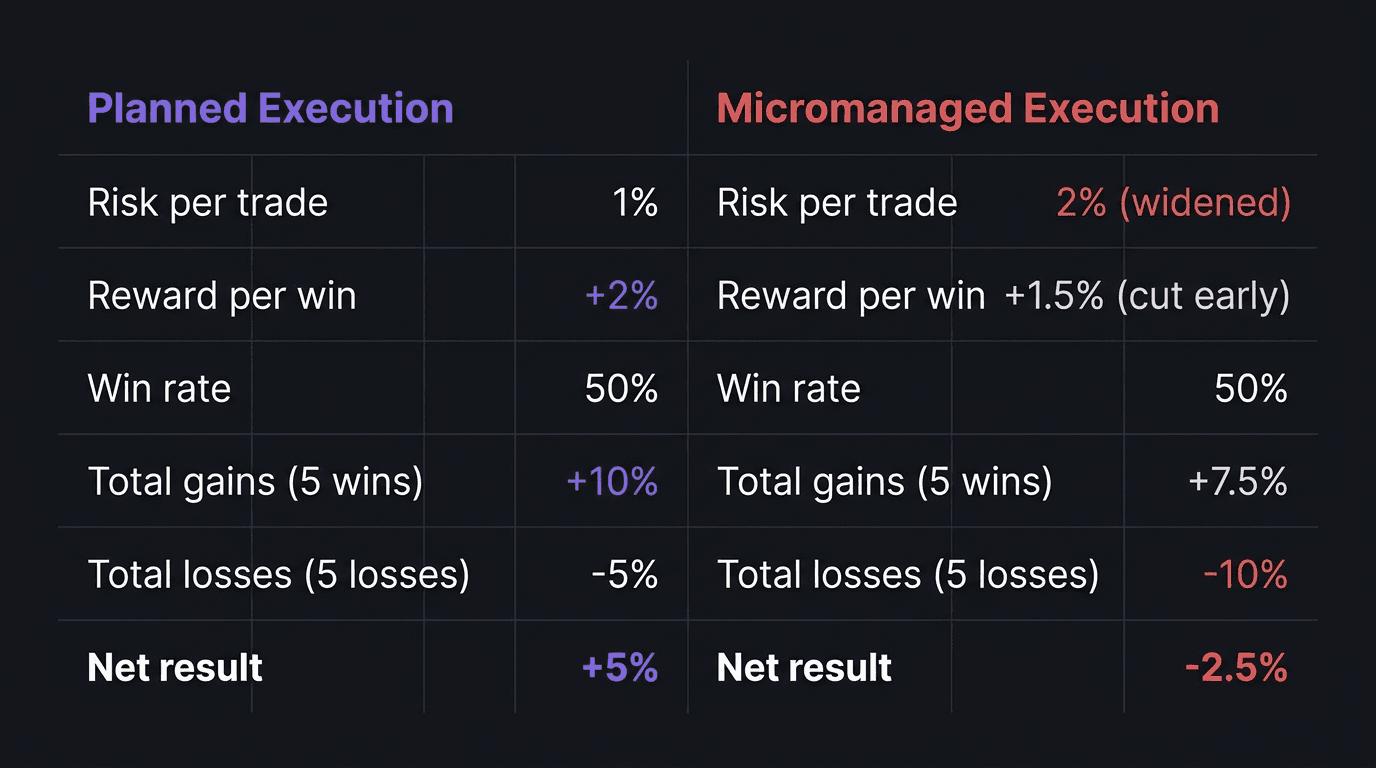
That 7.5% swing is not from bad analysis. It is entirely from interference after entry.
Your position sizing only works if you actually honor the stop that your position size was built around. Widen the stop and you have blown past your intended risk before the trade even resolves.
The Set-and-Forget Mindset
"Place your stop loss, place your take profit, trust your analysis, don't interfere."
That sounds simple. It is not easy. But it is the only approach that keeps your risk math intact over hundreds of trades.
Set-and-forget does not mean you never manage a trade. It means you do not make changes based on fear, impatience, or the hope that price will "come back." The only valid reason to move a stop is to trail it in your favor after price has moved significantly toward your target.
How to Build This Habit
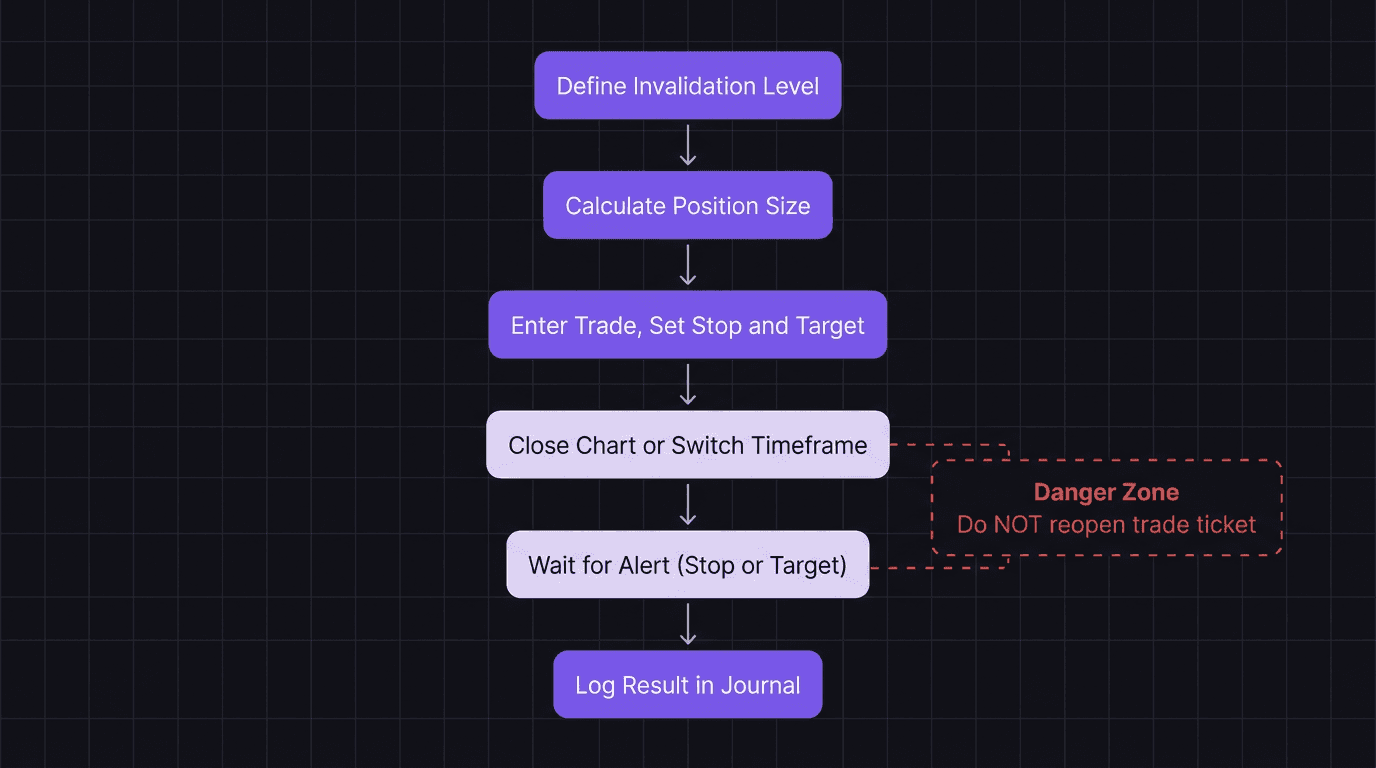
Define the exact price that invalidates your setup. Write it down.
Calculate your position size based on that stop distance. Not on a "flexible" range.
Include your stop and target in your pre-market routine plan for the session.
Step away from the screen, or at minimum switch to a higher timeframe.
Set an alert at your target and at your stop. Let the alerts do the watching.
Do not reopen the trade ticket until one of those alerts fires.
The goal is to remove yourself from the decision loop between entry and exit. You already made the decision when you entered. Now your only job is to let it play out.
Ever notice that your best trades are the ones you forgot about? There is a reason for that. When you are not watching, you cannot interfere.
Walkthrough: A Trade You Should Have Left Alone
The Setup
A trader spots a short setup on EUR/USD during the London session. Price has rallied into a resistance zone around 1.0940 and formed a bearish engulfing candle on the 1-hour chart.
Entry: 1.0935 (after the engulfing candle closes)
Stop loss: 1.0960 (25 pips above the resistance zone high)
Take profit: 1.0885 (50 pips, 2:1 reward-to-risk)
Risk: 1% of account ($100 on a $10,000 account)
What Actually Happened
Price drops 10 pips to 1.0925 in the first 30 minutes. Looking good. Then the New York session opens and a small bullish candle prints. Price retraces to 1.0945, putting the trade 10 pips offside.
The trader panics. "What if it breaks above resistance?" He widens the stop to 1.0980 (now 45 pips of risk instead of 25). That doubles his dollar risk from $100 to $180 without changing his position size.
Price pushes to 1.0955, then stalls. The trader widens again to 1.0995 (60 pips, $240 at risk). "It has to come back down."
It does not. EUR/USD grinds higher through the afternoon and hits 1.0995. The trader takes a $240 loss, nearly 2.5% of his account, on what was planned as a 1% risk trade.
What Would Have Happened
If he had left the original stop at 1.0960, price would have hit it at 1.0960 during the New York retrace. That is a $100 loss. Exactly 1% of his account. Exactly what the plan allowed.
Yes, he still would have lost. But a $100 loss is a normal cost of doing business. A $240 loss from the same setup is a self-inflicted wound. Multiply that pattern across 20 trades in a month and the difference is enormous.
The trade idea was not wrong in concept. Resistance held loosely and price eventually came back down to 1.0900 the next day. But by then, the trader was already stopped out at his widened level and missed the entire move.
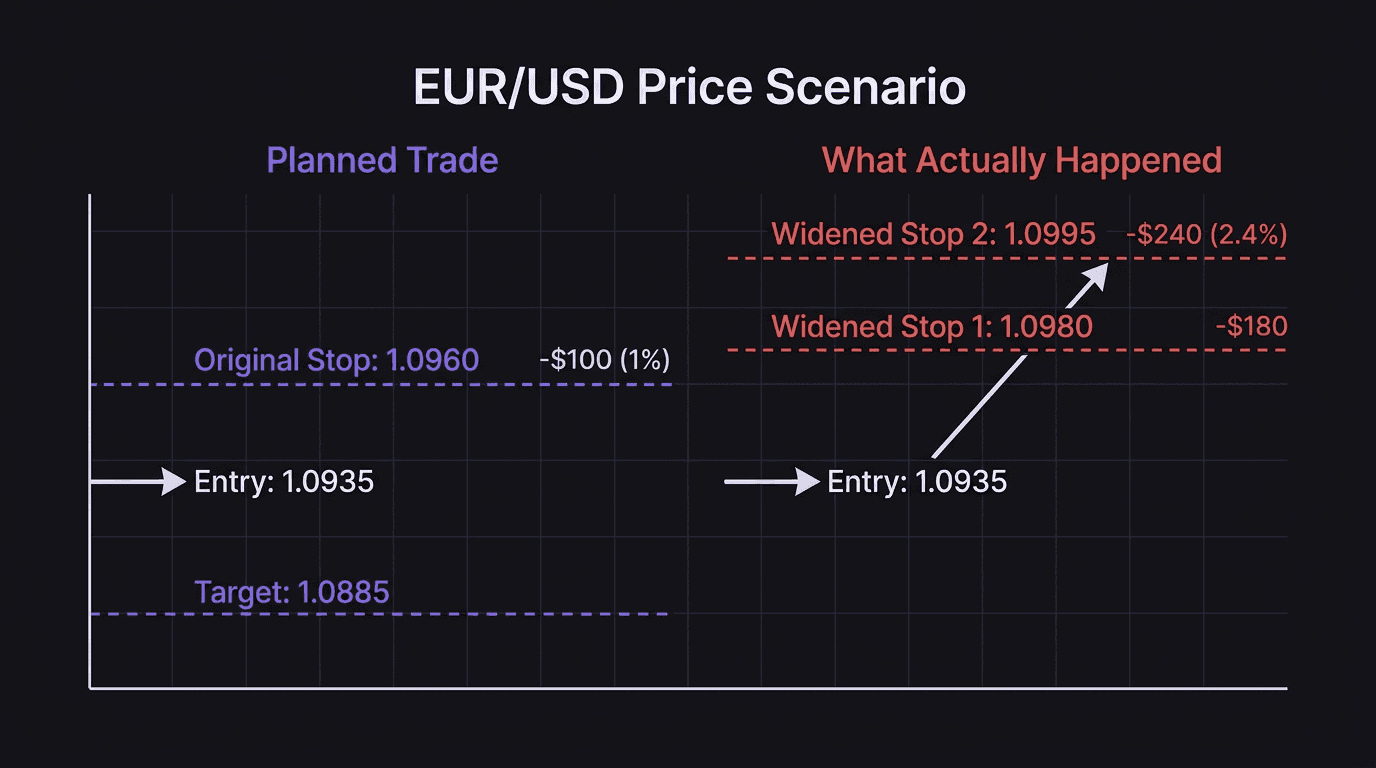
The lesson is not that the setup was bad. The lesson is that interference turned a manageable loss into a damaging one.
How EdgeFlo Locks Your Risk Parameters
This is where environment design matters more than willpower.
EdgeFlo's auto risk calculator sets your position size based on your stop distance and your account risk percentage. You define the stop before entry, and the calculator handles the math. That removes one excuse for widening: "I'll just add more room and adjust the size later." The size is already locked.
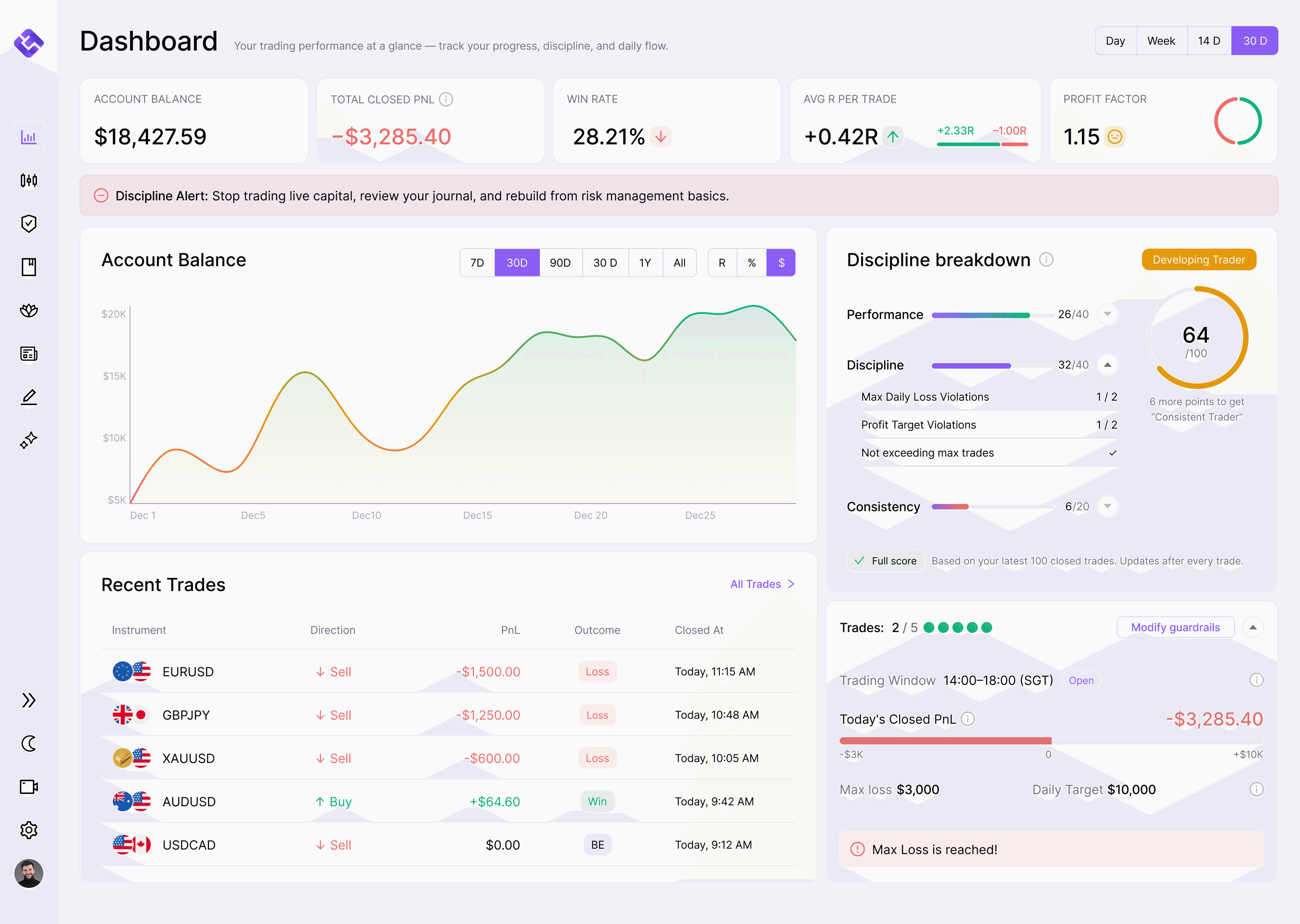
But the bigger piece is the guardrails system. If you try to modify a trade in a way that violates your predefined risk parameters (like widening a stop past your maximum risk percentage), EdgeFlo flags it with a warning. You can still override it. The platform does not lock you out of your own trades. But it forces a deliberate choice: you have to acknowledge that you are breaking your own rules before the change goes through.
That pause, even a few seconds of it, is often enough to snap you out of the fear response. Instead of mindlessly dragging a stop loss, you see a clear message telling you that this action violates the plan you set when you were calm and rational. Most traders, when they see that message, close the dialog and leave the trade alone.
The goal is not to remove your control. It is to add a speed bump between impulse and action, so your trading rules have a chance to work the way you designed them.
The Edge Brief
Receive Insights on trading psychology, discipline, and the behavioral patterns that create consistent traders from our Founder and the EdgeFlo team, delivered to your inbox.
Think different. Trade different.
Why do traders keep moving their stop loss?
Should you ever move your stop loss after entering a trade?
What happens if you keep widening your stop loss?
How do I stop myself from moving my stop loss?

Turn discipline on.
Every session.
EdgeFlo is the environment serious traders operate inside.
Start 7-Day Free Trial
Cancel anytime.
No long-term commitment.

Think Different, Trade Different.