

The Trading Success Formula: Input, Process, Output
The trading success formula is input, process, output, feedback. Learn how this loop turns raw effort into consistent profits over time.
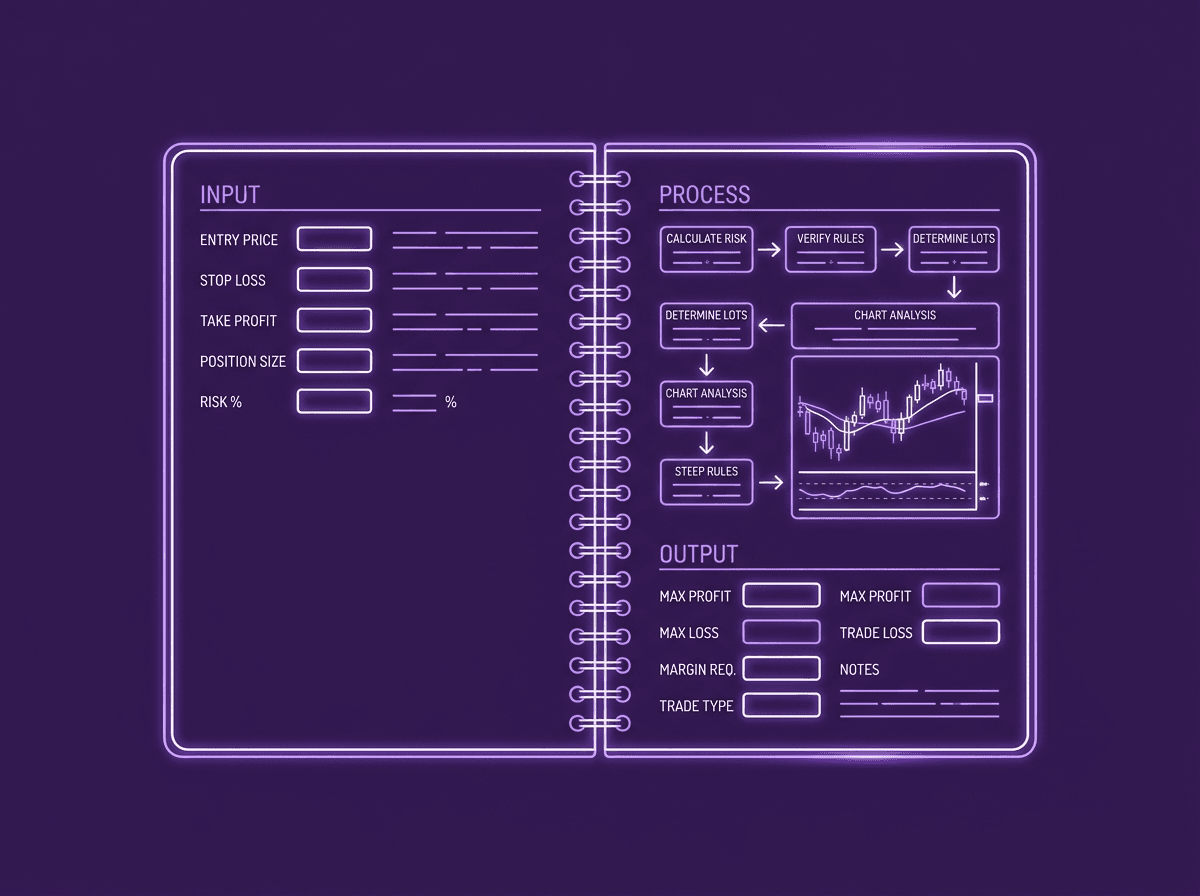
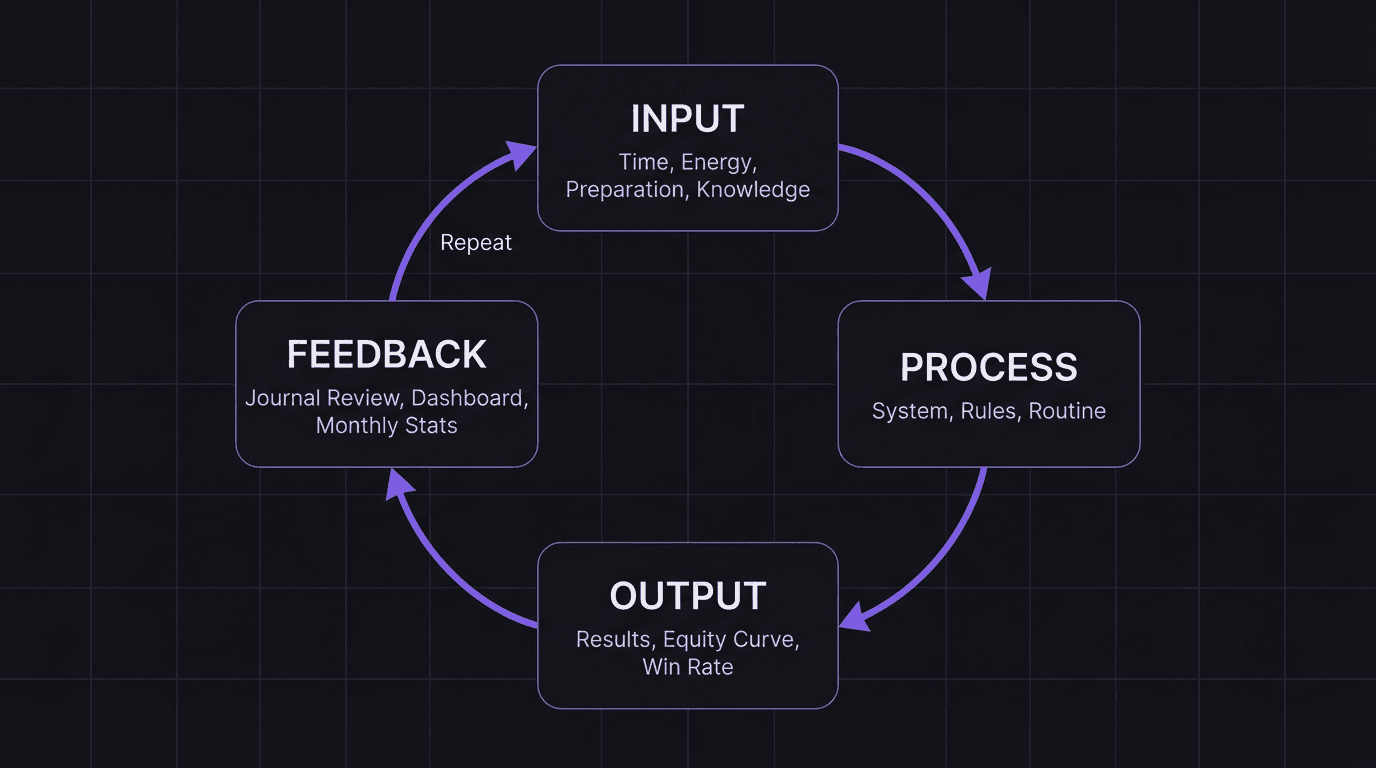
The trading success formula is not a secret indicator or a magic entry technique. It is a four-part loop: input, process, output, feedback. You pour in time, energy, and study (input). Your trading system and rules convert that effort into trades (process). Those trades produce results (output). Then you review what happened and feed the lessons back into your next round of inputs (feedback). Every consistently profitable trader runs this loop, whether they call it that or not.
Most beginners focus entirely on output. They want the money. But output is just a symptom. If your inputs are weak and your process is nonexistent, no amount of screen time will fix the results. The formula works because it forces you to look at the pieces that actually move the needle.
TL;DR
The trading success formula is a four-part loop: input, process, output, feedback.
Inputs are what you bring to the table each day (time, energy, preparation, knowledge).
Your process (system, rules, routine) transforms raw input into tradeable decisions.
Output is not just money; it includes consistency, execution quality, and discipline metrics.
The feedback loop is what separates traders who grow from traders who repeat the same mistakes for years.
The Formula: Input, Process, Output, Feedback
Think of it like a factory. Raw materials go in one end (input). Machines shape them (process). Finished goods come out the other end (output). And quality control sends reports back to the floor so the next batch is better (feedback).
Trading works the same way. The raw materials are your time, your energy, your chart study, and the knowledge you bring each session. Your mechanical trade plan, your rules, your routine, those are the machines. The finished goods are your trades, your equity curve, your win rate. And the quality control report is your journal review, your performance dashboard, your monthly stats.
Skip any piece and the whole thing breaks. Most traders skip two: process and feedback. They show up, stare at a chart, take a trade based on a feeling, and then never look at it again. That is not a system. That is gambling with a candlestick chart open.
The formula is not complicated. The hard part is doing it every single day.
What Counts as Input in Trading
Input is everything you bring to the table before you click a button. It is not just "screen time." Sitting in front of charts for six hours while scrolling your phone is not input. It is presence without purpose.
Real trading input looks like this:
Time spent on preparation. Pre-market analysis, marking key levels, reviewing overnight moves, checking the economic calendar.
Energy management. Are you trading rested and focused, or exhausted after a bad night? Your mental state is an input, whether you track it or not.
Knowledge and skill. The strategies you have studied, the setups you have backtested, the hours of deliberate practice you have banked.
Journaling your trades. Writing down what you did and why is an input for your next session. It is how you deposit experience into the system.
Here is the thing most beginners miss: increasing input does not mean trading more. It means preparing better. A trader who spends 30 minutes on a pre-market routine and takes two trades will often outperform someone who trades all day with zero preparation.
If you are not sure what your inputs actually are right now, start tracking them. Write down how many minutes you spent preparing, how your energy felt on a 1 to 5 scale, and whether you reviewed your plan before your first trade. Do this for a week and patterns will emerge fast.
How Systems and Processes Transform Input
Input alone does not produce profit. You need a machine to shape it. That machine is your process: a set of well-defined rules that tell you exactly what to do when specific conditions appear on the chart.
A system says: "If I see this setup, I take the trade. If I do not see this setup, I stay out." That is it. No guessing, no gut feelings, no "I think it might go up." A system turns analysis into action through rules, not emotions.
Your process includes three layers:
Your trading style. Are you a scalper, day trader, swing trader, or position trader? Each style has different timeframes, different hold periods, and different preparation needs. You cannot build a process until you pick a lane.
Your mechanical trade plan. Entry criteria, exit criteria, risk parameters, invalidation levels. Written down. Visible during your session. Not in your head.
Your routine. What you do before the session, during the session, and after the session. The daily actions that make your system repeatable.
Walkthrough: The Trader Who Had Input but No Process
Picture a trader named Alex. Alex watches four hours of chart analysis videos every weekend. He reads trading books. He knows what supply and demand zones are, he understands market structure, and he can explain risk-to-reward ratios to anyone who asks.
But Alex has no written trade plan. He sits down each morning and "feels out" the market. Some days he scalps EUR/USD. Other days he swing trades gold. He enters when things "look right" and exits when he gets nervous or excited.
Alex's input is strong. His knowledge bank is full. But without a process to channel that knowledge into repeatable actions, the output is random. One week he is up 4%. The next week he gives it all back. He cannot figure out why, because there is no system to diagnose.
Now imagine Alex writes a mechanical plan: "I trade EUR/USD only, London session only, bullish setups above the Asian session high, 1% risk per trade, 2:1 minimum reward." Suddenly his input has somewhere to go. The same four hours of weekend study now feeds a specific, testable process. His output becomes measurable because the rules are consistent.
The system did not make Alex smarter. It gave his intelligence a container.
Measuring Your Output (Beyond Money)
Here is where most traders get it wrong. They measure output in one dimension: dollars. "I made $500 this week" or "I lost $200 today." And that is the end of the review.
But dollar P&L is a lagging indicator. It tells you what happened, not why. If you want the formula to actually work, you need to measure output across multiple dimensions:
Win rate. What percentage of your trades hit the target? Is that number stable, or does it swing wildly week to week?
Average R. When you win, how many R do you capture on average? When you lose, is it always 1R, or are you letting losers run past invalidation?
Execution quality. Did you follow the plan? A trade that followed every rule and lost 1R is a good trade. A trade that broke three rules and made 2R is a bad trade. Your dashboard should reflect this.
Discipline score. How many of your trades were on-plan versus off-plan this week? This is the metric that predicts future profitability more than any other.
When you track all four, something powerful happens. You stop chasing P&L and start chasing process quality. A week where you followed your rules on 95% of trades but lost money is actually a strong output signal. It means your process is being executed. The results will follow if the edge is real.
If the edge is not real, your output metrics will tell you that too. And that is where the fourth part of the formula comes in.
The Feedback Loop That Drives Growth
Feedback is the part of the formula that most traders skip entirely. They take trades, see the P&L, and move on. No review. No journal entry. No reflection. Then they wonder why they keep making the same mistakes.
The feedback loop works like this: after a defined period (daily, weekly, or monthly), you sit down and review your output. Not your feelings about your output. The actual numbers.
How many trades did you take?
How many followed the plan?
What was your win rate? Your average R?
Were there patterns in your losses? Same session, same pair, same emotional state?
This review produces specific, actionable information. "I overtrade during New York session" is feedback. "I need to be more disciplined" is not. The first one tells you exactly what to fix in your next round of inputs. The second one is a wish.
Walkthrough: Feedback That Changed the Process
Consider a swing trader named Maya. She trades GBP/USD on the 4-hour chart. After her first month, she reviews her performance using her journal and dashboard.
The numbers: 18 trades taken. 7 wins, 11 losses. Win rate: 38.9%. Average winner: 1.75R. Average loser: 1.05R. Net result: positive, barely, at +0.7R for the month.
On the surface, this looks mediocre. But Maya digs deeper. She separates her trades by day of the week. Monday through Wednesday: 10 trades, 5 wins, 5 losses. Thursday and Friday: 8 trades, 2 wins, 6 losses.
Her Thursday and Friday trades are dragging the entire month down. She looks at why. Most of them were entered late in the week when the weekly candle was already extended. She was chasing moves that had already played out.
The feedback is clear: stop taking new swing entries on Thursday and Friday. That is a specific input adjustment. Maya updates her mechanical plan, adds the rule, and runs month two.
Month two: 12 trades (all Monday through Wednesday). 6 wins, 6 losses. Win rate: 50%. Average winner: 2.2R. Average loser: 1.0R. Net result: +7.2R.
Same strategy. Same market. Same trader. The only thing that changed was one rule that came directly from feedback. That is the formula working.
How EdgeFlo Closes the Feedback Loop
The hardest part of the trading success formula is not understanding it. It is doing it. Specifically, the feedback step. Reviewing trades takes effort, and when you are tired or frustrated, it is the first thing you skip.
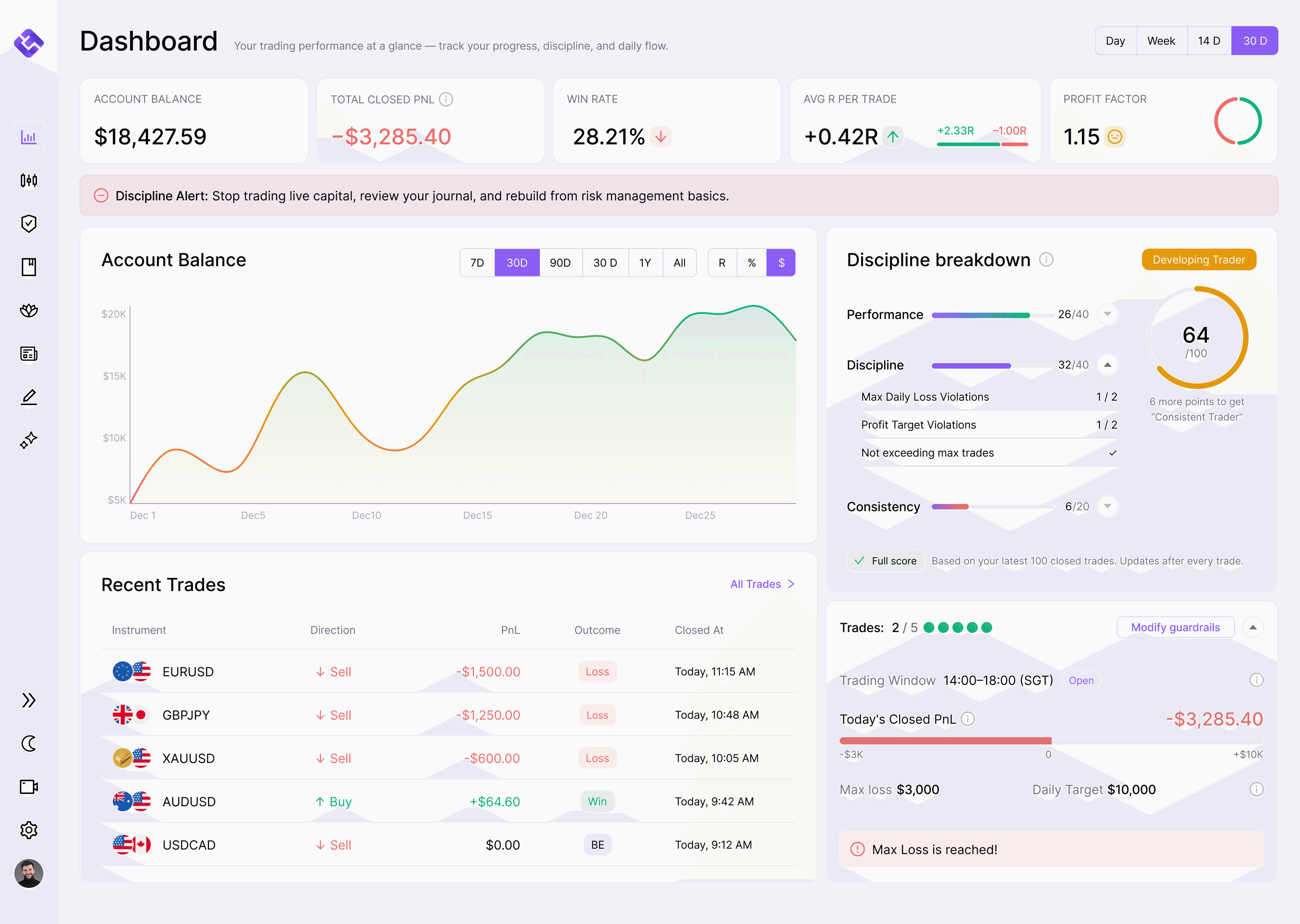
EdgeFlo is built around this exact problem. The trading dashboard shows your win rate, average R, discipline score, and equity curve in one view. You do not have to build spreadsheets or dig through broker statements. The data is already organized by the metrics that matter.
Your journal captures the input side automatically. Trade imports, emotion tags, and notes create a record of what you brought to each session. When you sit down for a weekly or monthly review, the raw material is already there. The Edge plan builder stores your process (your rules, your criteria, your invalidation levels) so you can compare what you planned against what you actually did. That comparison is where real accountability lives.
The formula says: input, process, output, feedback, repeat. EdgeFlo gives each step a place to live so none of them get skipped. You set goals, you execute against your plan, you review the output, and the feedback tells you exactly what to adjust. Then you backtest the adjustment and start the loop again.
The Edge Brief
Receive Insights on trading psychology, discipline, and the behavioral patterns that create consistent traders from our Founder and the EdgeFlo team, delivered to your inbox.
Think different. Trade different.
What is the trading success formula?
Why is feedback the most important part of the formula?
How long does the input-process-output loop take to show results?
Can the trading success formula work for scalpers and swing traders equally?

Turn discipline on.
Every session.
EdgeFlo is the environment serious traders operate inside.
Start 7-Day Free Trial
Cancel anytime.
No long-term commitment.

Think Different, Trade Different.