

Trading Accountability: How Solo Traders Stay Honest Without a Mentor
Solo traders lose accountability without a team or mentor. Build it back with dashboards, habit tracking, and daily reflection routines.
Trading accountability means building systems that keep you honest about your own rules when nobody else is watching. For solo traders, that is the core challenge. There is no mentor checking your journal, no prop firm flagging your risk violations, no teammate asking why you took that third revenge trade on a Friday afternoon.
The fix is not willpower. It is structure. A trading dashboard where your goals stay visible. A habit tracker where you check off process tasks daily. A reflection practice where you write three wins and one improvement every session. These three systems replace the external accountability most traders never had.
TL;DR
Solo traders lack external accountability, which is why rules get broken more often than in team or mentorship environments.
Three pillars replace a mentor: a visible dashboard (goals), a daily habit tracker (process), and a reflection journal (learning).
Track habits, not just P&L. Did you review your plan? Did you follow your risk rules? Did you journal? These matter more than today's profit.
Daily reflection takes two minutes: three wins, one improvement, one gratitude entry.
Weekly reviews catch patterns that daily logs miss, like consistently breaking rules on Fridays or after two consecutive losses.
The Accountability Problem for Solo Traders
Most traders operate alone. No office. No team. No one looking over their shoulder.
That sounds like freedom. In practice, it is a trap. When you break your own rules, nothing happens. No alarm goes off. No one sends you a message. You just move on to the next trade and quietly pretend the last one didn't count.
Ever blown through your daily loss limit and kept trading? Of course you have. Everyone has. The question is what happened next. For most solo traders, the answer is: nothing. No consequence, no correction, no system to flag it.
This is why revenge trading spirals happen. Not because traders are reckless. Because there is no friction between breaking a rule and taking the next trade. A mentor would stop you. A prop firm would lock your account. When you are alone, only your systems can stop you.
The uncomfortable truth: discipline is not a personality trait you either have or don't. It is a byproduct of environment design. Build the right structure, and discipline becomes the default.
Three Pillars: Dashboard, Habits, Reflection
Accountability for solo traders rests on three systems. Each one covers a different gap.
Pillar 1: The Dashboard (Visibility)
Your goals need to live somewhere you see them every day. Not in a note buried in your phone. Not in a document you last opened in January.
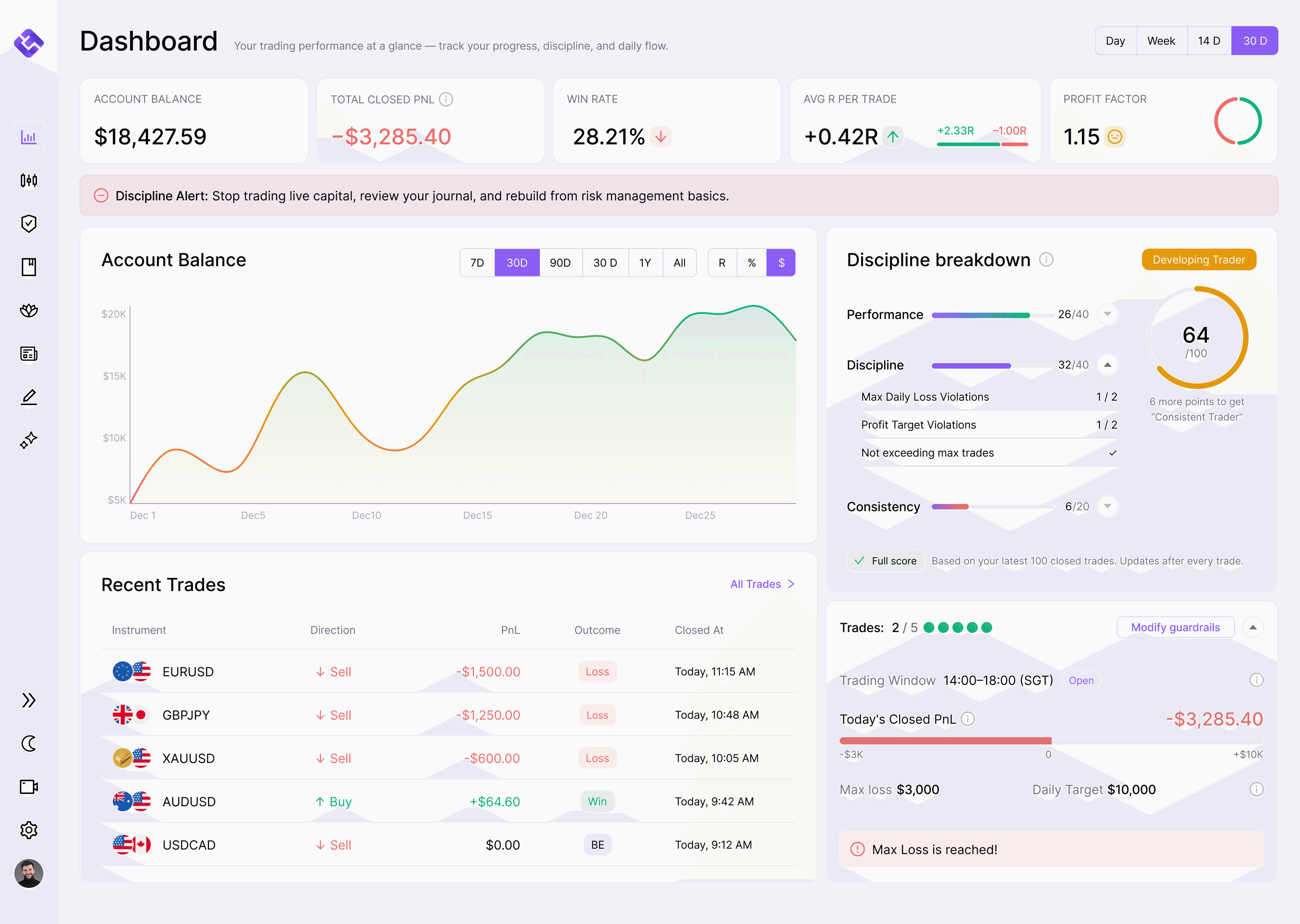
A trading dashboard puts your monthly targets, win rate goals, and risk limits in plain sight. Every morning, before your first chart, you see where you stand. Are you on track? Are you behind? Are you approaching your drawdown limit?
Visibility changes behavior. When your goals are visible, you make decisions with those goals in mind. When they are hidden, you make decisions based on whatever emotion is loudest.
What goes on the dashboard:
Monthly P&L target and current progress
Maximum drawdown limit and current drawdown
Win rate (rolling 20-trade average)
Number of trades taken this week vs. your planned maximum
Current streak (wins or losses)
Pillar 2: The Habit Tracker (Process)
P&L is an outcome. You cannot control outcomes. You can control process.
A habit tracker shifts your daily focus from "did I make money?" to "did I follow my process?" Those are very different questions. A trader can follow every rule perfectly and still have a losing day. A trader can break three rules and get lucky. The habit tracker cares about the rules, not the luck.
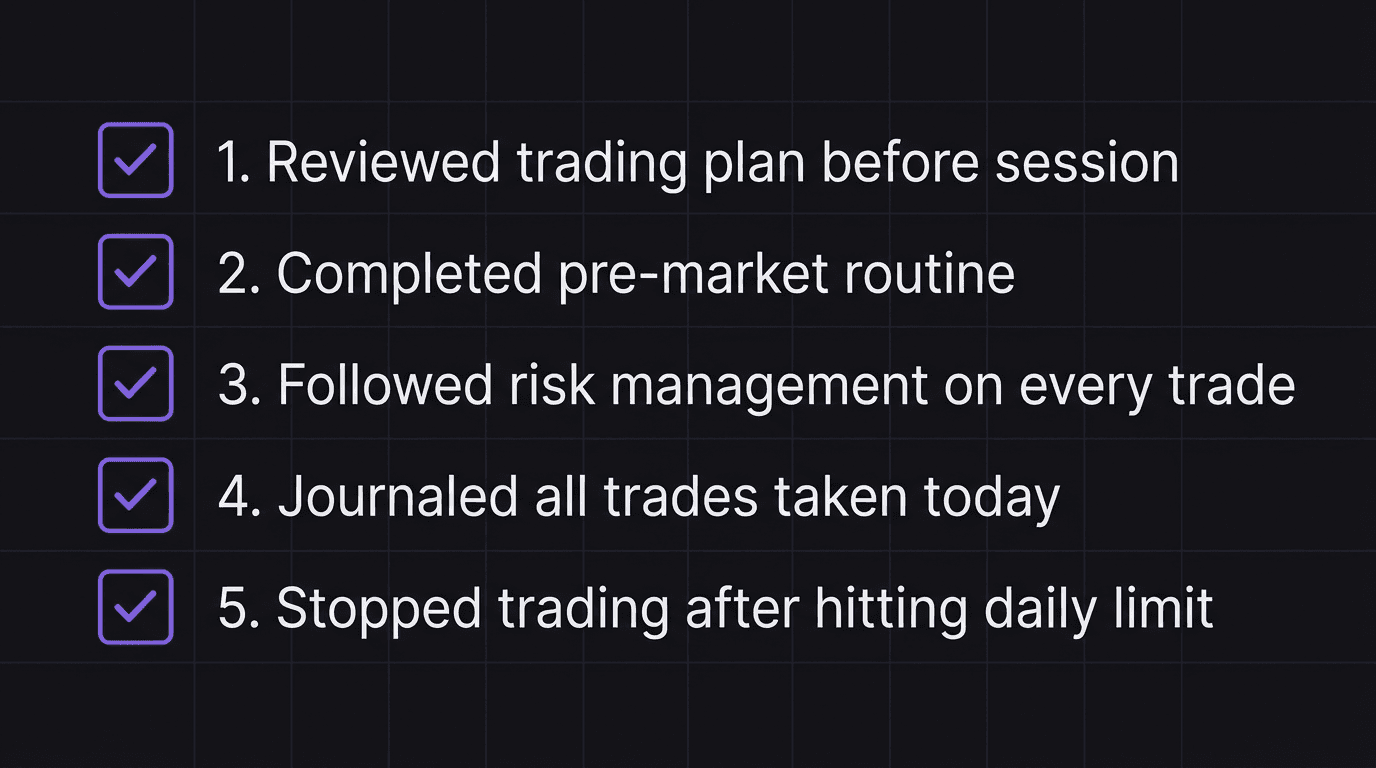
Daily habits to track:
[ ] Reviewed trading plan before session
[ ] Completed pre-market routine
[ ] Followed risk management on every trade
[ ] Journaled all trades taken today
[ ] Stopped trading after hitting daily limit
Check each one off at the end of the day. Five green checks on a losing day is a win. Two checks on a profitable day is a warning.
Pillar 3: Daily Reflection (Learning)
The habit tracker tells you what you did. Reflection tells you what you learned.
This takes two minutes. Not twenty. Not an hour-long deep analysis. Two minutes at the end of your session.
Write down three things:
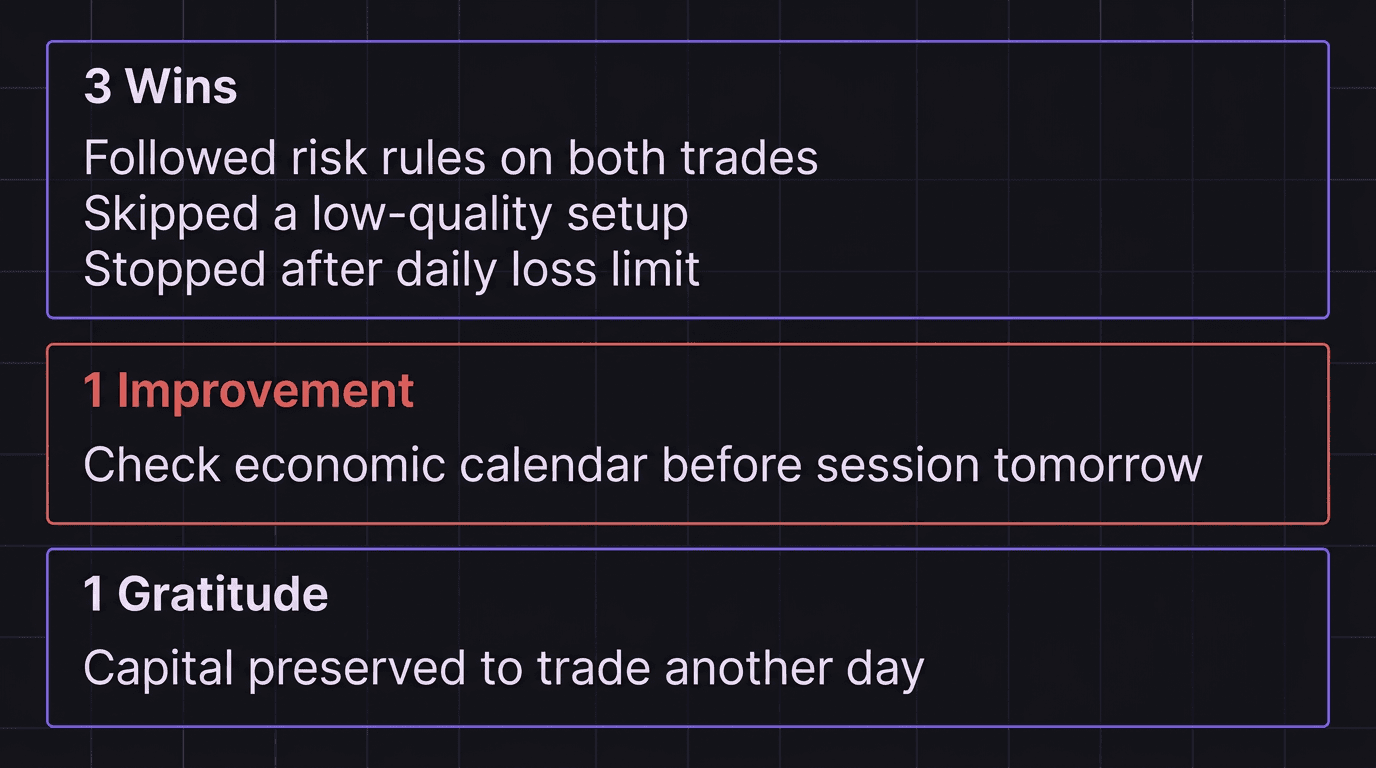
Three wins. These can be small. "I skipped a trade that didn't meet criteria." "I sized correctly." "I closed the charts after hitting my limit." Wins are about behavior, not profit.
One improvement. What is one specific thing you will do differently tomorrow? Not a vague goal. A concrete action: "I will wait for the 15-minute candle close before entering."
One gratitude. This sounds soft, but it works. More on that in the next section.
Daily Wins and Improvements Tracking
The "three wins" practice does something subtle but powerful: it trains you to notice what you did right.
Most traders fixate on mistakes. After a losing day, every thought centers on what went wrong. That is natural. It is also incomplete. If you only track failures, you lose sight of the process improvements you are making.
Walkthrough: A Bad Day That Was Actually Good (EUR/USD)
> Pair: EUR/USD, 15-minute chart > Session: London session, Tuesday morning. > What happened: The trader took two trades. Both hit stop loss. First trade: short at 1.0940 into a supply zone, stopped out at 1.0955 for a 15-pip loss. Second trade: long at 1.0910 off a demand zone, stopped out at 1.0895 for another 15-pip loss. > P&L: Down 30 pips. Losing day. > Reflection wins: (1) Both trades met all minimum criteria in the playbook. (2) Risk was exactly 0.5% per trade, matching the plan. (3) The trader stopped after the second loss instead of chasing a third trade. > Improvement: "Tomorrow I will check the economic calendar before session. Both losses happened around a surprise ECB speaker, which I would have seen on the calendar."
That is a losing day with three legitimate wins. The trader followed rules, sized correctly, and showed discipline by stopping. The improvement is specific and actionable.
Compare that to a trader who skips reflection and just writes "bad day, two losses" in their journal. No learning. No reinforcement of good behavior.
The Improvement Stack
One improvement per day sounds small. Over 20 trading days, that is 20 specific adjustments. Over three months, you have made 60 micro-improvements to your process.
This is how real progress works. Not a single breakthrough moment. Consistent, small, compounding changes. Your trading journal becomes the evidence that these changes are working.
How Gratitude Reframes Bad Trading Days
This is the part where most traders roll their eyes. Gratitude in a trading context sounds like something from a self-help book, not a performance tool.
But here is what it actually does: it breaks the negativity loop.
After a string of losses, your brain starts filtering for more losses. You see risk everywhere. You hesitate on valid setups. You start questioning your entire strategy because of three bad trades.
A gratitude entry forces a perspective shift. It does not have to be profound. "I'm grateful I have the capital to trade another day." "I'm grateful the market showed me this pattern." "I'm grateful I caught my mistake before it got worse."
The point is not positive thinking. The point is interrupting the spiral. One sentence that reminds you the losing streak is not the whole picture.
Does this actually work? Think about the last time you had a bad trading week. Did your decision-making get better or worse as the week went on? For most people, it gets worse. Negative momentum compounds just like positive momentum. Gratitude is one way to break the compound.
Building a Weekly Review Habit
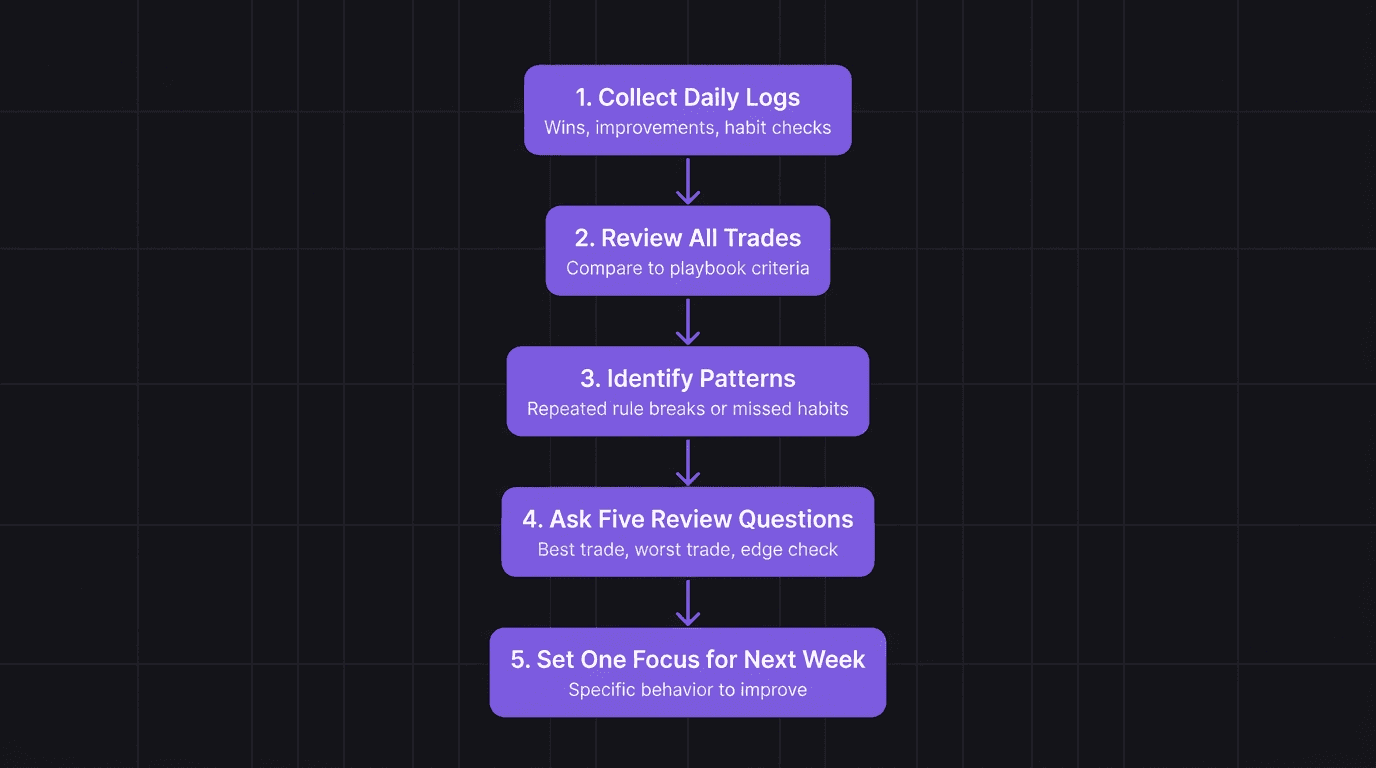
Daily reflection catches the details. Weekly review catches the patterns.
Set aside 15 to 30 minutes once a week, ideally on the weekend when markets are closed and emotions are neutral. Your weekly review answers different questions than daily reflection:
Weekly review questions:
Which habits did I miss most often this week? (Look at the tracker)
Did I break any rules more than once? (Pattern = problem)
What was my best trade this week, and why?
What was my worst trade this week, and why?
Is my edge still present in this week's data?
The weekly review connects to your journal. Pull up the trades, compare them to your playbook, and look for drift. Are you taking setups that used to be in your playbook but you quietly stopped following criteria for?
The Friday Rule Audit
One specific weekly practice that catches problems early: the Friday rule audit. At the end of each trading week, go through every trade you took and mark whether it met your minimum criteria.
If more than 20% of your trades this week failed minimum criteria, something is off. You are either improvising, or your criteria need updating. Either way, you have a clear signal to act on before Monday.
How EdgeFlo Creates Built-In Accountability
EdgeFlo provides accountability by design through routines, streaks, guardrails, and prompts. Instead of building these systems from scratch in spreadsheets and notebooks, the accountability structure is built into the platform.
Your dashboard keeps goals visible. Your habit tracker lives next to your charts, not in a separate app you forget to open. Daily reflection prompts appear after each session, asking for wins and improvements before you close the platform.
The result is that accountability stops being something you have to remember and becomes something your environment handles. You still do the work. But the system makes it harder to skip. And over time, the data you collect through daily and weekly tracking gives you real evidence of your process improvements, not just a feeling that things are getting better.
The Edge Brief
Receive Insights on trading psychology, discipline, and the behavioral patterns that create consistent traders from our Founder and the EdgeFlo team, delivered to your inbox.
Think different. Trade different.
How do I hold myself accountable as a solo trader?
What should a trading accountability tracker include?
Why do solo traders struggle with discipline?
How often should I review my trading performance?

Turn discipline on.
Every session.
EdgeFlo is the environment serious traders operate inside.
Start 7-Day Free Trial
Cancel anytime.
No long-term commitment.

Think Different, Trade Different.