

Stop Changing Your Trading Plan After Every Loss
Tweaking your rules after a losing trade destroys your edge. Learn why casinos never change their rules after a bad night and how to apply that to trading.
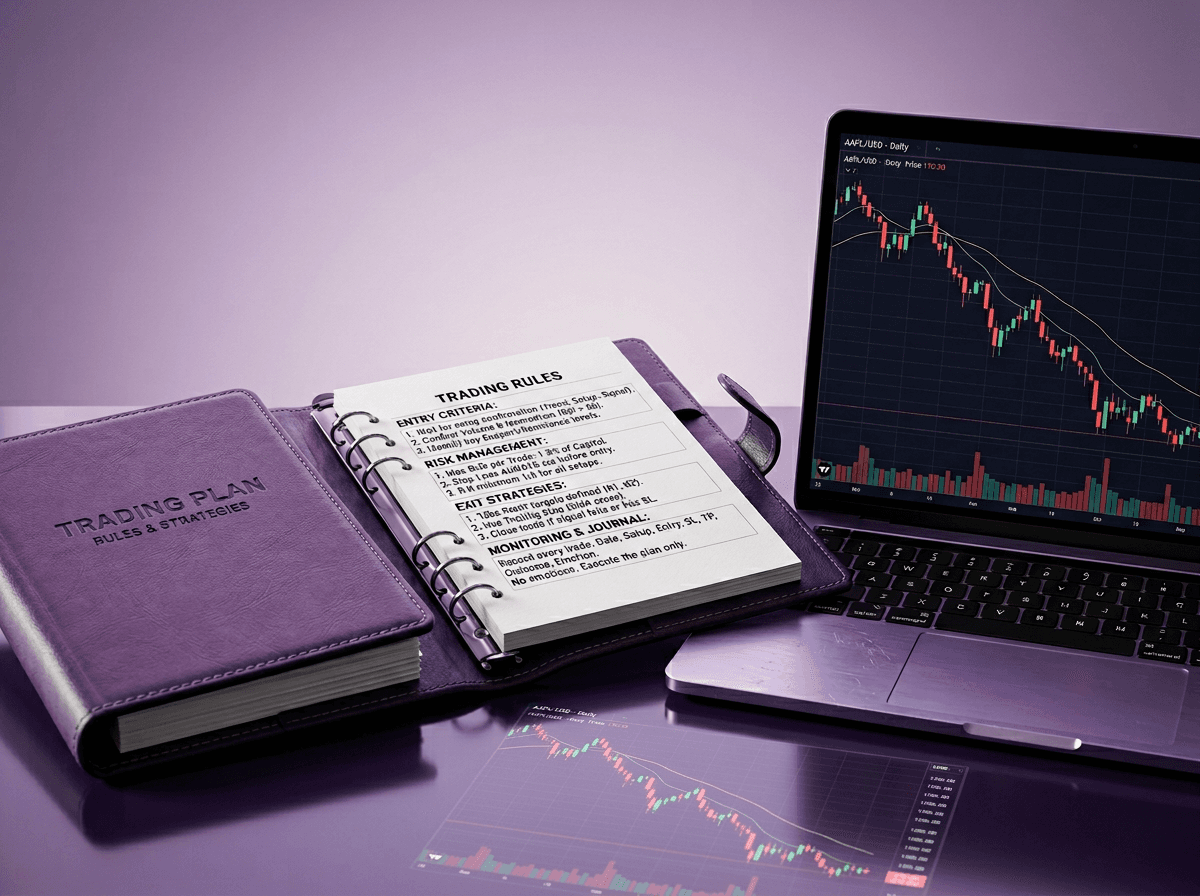
You took two losses in a row. Now you are staring at your trading plan, convinced that something needs to change. Maybe the stop loss is too tight. Maybe the entry criteria need another filter. Maybe you should switch to a different timeframe altogether.
Stop. That impulse is the single fastest way to destroy a strategy that actually works.
Changing your trading plan after a loss is not analysis. It is an emotional reaction disguised as problem-solving. And it is one of the most common reasons traders never find out whether their system has real edge.
TL;DR
Casinos never change the rules of roulette after a bad night because they know their 5.26% edge plays out over thousands of spins.
Changing your trading plan after every loss resets your sample size to zero and prevents your edge from compounding.
Strategy hopping is the same behavior with a different name: abandoning a system before you have enough data to evaluate it.
Schedule plan reviews quarterly, after at least 100 trades, and change only one variable at a time.
Your job between reviews is execution, not innovation.
Why Casinos Never Change the Rules After a Bad Night
Think about a roulette table. The casino's edge on every spin is 5.26%. That is a tiny margin. On any single spin, the house might lose. On ten spins, the house might be down.
But the casino does not panic. It does not replace the roulette wheel. It does not add a third green pocket. It does not fire the dealer.
Why? Because the casino knows something most traders refuse to accept: short-term results are noise. The edge only becomes visible over hundreds and thousands of repetitions. On 1,000 bets of $1,000 each, the math works out to roughly $54,000 in net profit for the house. Not from any single spin, but from the accumulated weight of a small advantage repeated again and again.
That patience is what separates the house from the gambler. The gambler reacts to every spin. The house trusts the process and counts on the law of large numbers.
Your trading edge works the same way. If you have a strategy with positive expectancy (even a small one), it will produce profit over a large enough sample. But only if you stop tinkering with it every time it produces a loss.
What Happens When You Change Your Plan After a Loss
Every time you tweak a rule after a losing trade, you do three things. All of them are destructive.
You Reset Your Sample Size
Your plan needs a minimum number of trades before you can judge it. That number is at least 100, and ideally more. When you change the stop loss distance after trade 14, you are not refining. You are starting over. Trade 15 now belongs to a different system. You are back at zero.
This is the trap. You never reach the sample size required to know whether the original plan worked, because you keep resetting the counter.
You Introduce Uncontrolled Variables
Suppose your plan has five rules: trend direction, zone entry, confirmation candle, stop loss placement, and target. If you change the stop loss rule after a loss, you now have a sixth variable in play. Was the next win caused by the new stop distance, or by a better setup? You cannot tell. The data is contaminated.
Professional traders change one variable at a time, during a scheduled review, with a clean data set. That is the only way to know what actually improved performance.
You Train Yourself to React Emotionally
This is the worst one. Every time you change your rules because a loss made you uncomfortable, you reinforce the habit of emotional decision-making. Your brain learns: "Loss equals action." That same wiring leads to strategy hopping, where you abandon entire systems every few weeks and never build conviction in anything.
The Casino Mindset for Traders
Here is what the casino mindset looks like when applied to your trading:
You build your plan. You backtest it. You forward-test it. You confirm it has positive expectancy over at least 100 trades. Then you execute it without modification for one full quarter.
During that quarter, you will take losses. Some weeks will be negative. You might hit a losing streak of five or six trades in a row. That is normal. Variance is real, and short-term results do not define long-term edge.
Your only job during the quarter is execution quality. Did you follow your entry criteria? Did you place the stop where the plan said? Did you take the target or manage the trade according to your rules? Those are the questions that matter between reviews. "Should I change the plan?" is not one of them.
Walkthrough: The Trader Who Kept Changing
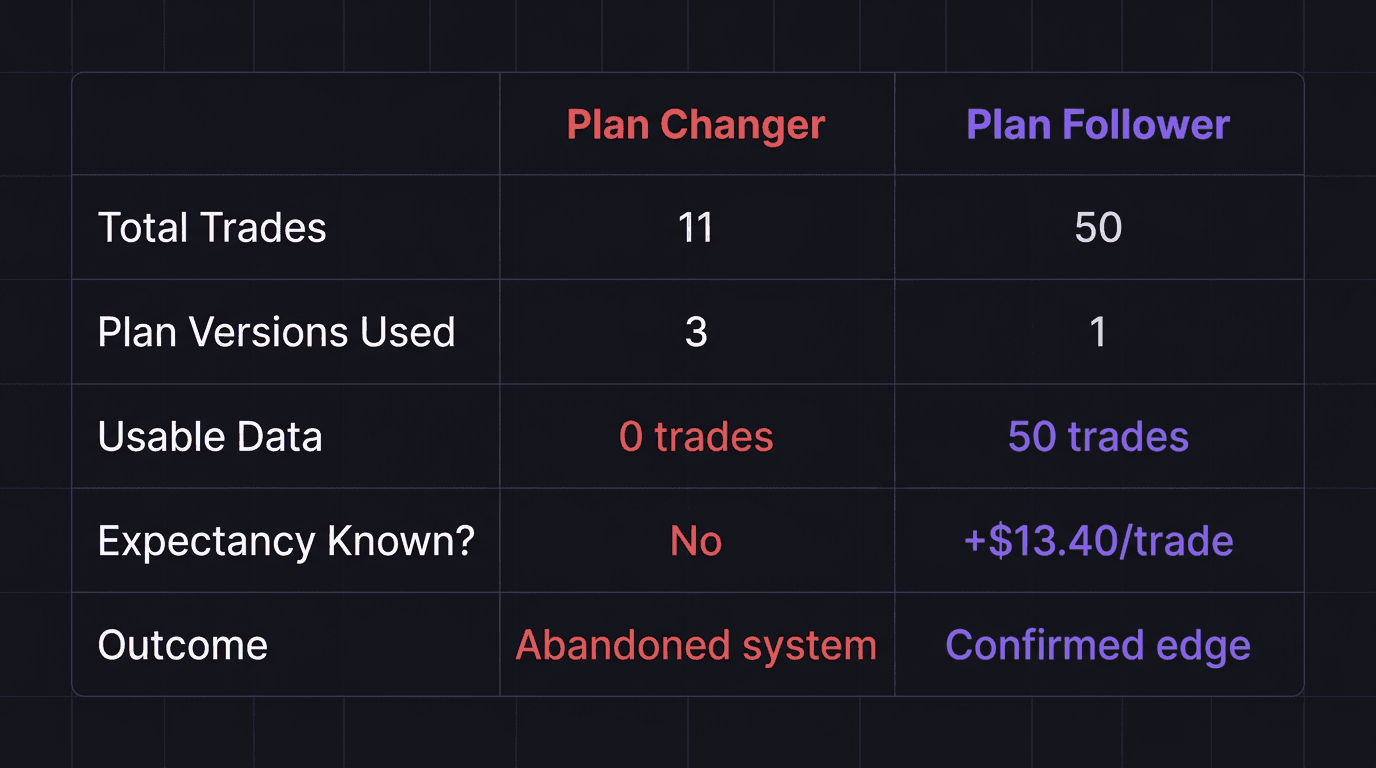
A trader builds a GBP/USD breakout plan. Entry on London session breaks above the Asian high, stop 15 pips below the breakout candle, target at the next daily resistance. Over the first two weeks, the plan produces 3 wins and 4 losses. The trader panics and widens the stop to 25 pips, thinking the original stop was too tight. The next two trades hit the wider stop for bigger losses. So the trader switches from breakout entries to pullback entries. Two more losses. The trader abandons the plan entirely and starts searching for a new strategy.
Total trades: 11. Total plan versions: 3. Usable data: zero. The trader never ran one system long enough to know if it worked.
Walkthrough: The Trader Who Stayed the Course
Another trader runs the same GBP/USD breakout plan. Same 3 wins and 4 losses in the first two weeks. Instead of changing anything, she logs each trade in her journal and notes that all 4 losses were valid setups that simply did not reach target. She continues executing. By trade 50, the plan shows a 38% win rate with a 2.8:1 reward-to-risk ratio. She checks the math.
Win rate: 38%. Average win: $280 (1 standard lot, 28-pip average winner at $10/pip). Average loss: $150 (15-pip stop at $10/pip).
Expectancy per trade: (0.38 x $280) minus (0.62 x $150) = $106.40 minus $93.00 = $13.40.
Positive expectancy. Over 100 trades, that is $1,340 in expected profit. She would never have discovered this if she changed the rules after trade 7.
The Quarterly Review: When You Actually Should Change Your Plan
Casinos do adjust. They retire games that lose edge, redesign floor layouts, and update odds. But they do it on a schedule, with data, after proper analysis.
Your version of this is the quarterly review. Here is how it works:
Trade your plan without changes for one full quarter (roughly 60 to 100 trades, depending on your frequency).
At the end of the quarter, pull your data: win rate, average win, average loss, expectancy, maximum drawdown, and discipline score (how often you followed the plan perfectly).
Identify the weakest variable. Maybe your win rate is fine but your average loss is too high. Maybe your entries are solid but you are exiting too early.
Change exactly one variable. Not three. Not five. One.
Run the next quarter with that single change and compare.
This is how professional system development works. It is slow, deliberate, and boring. But it produces real answers instead of emotional guesses.
If you do not have a mechanical trading plan written down, you cannot run this process. You need specific, measurable rules before you can isolate which one needs adjustment.
The Emotional Trigger You Need to Recognize
The urge to change your plan almost always hits at the same moment: right after a loss. Not after a full week of review. Not after analyzing 50 trades in a spreadsheet. Right after you close a trade in the red.
That timing is your signal that the urge is emotional, not analytical. Real analysis does not happen in the 30 seconds after a stop gets hit. It happens days or weeks later, when you have enough distance to look at the data without the sting of the loss clouding your judgment.
Here is a rule worth writing on a sticky note and putting next to your screen: "No plan changes on a trading day." If you want to evaluate your rules, do it on a non-trading day. If you want to change a variable, write it down and revisit it at the end of the quarter. Do not touch the plan while you are in the seat.
How EdgeFlo Helps You Stick to Your Plan
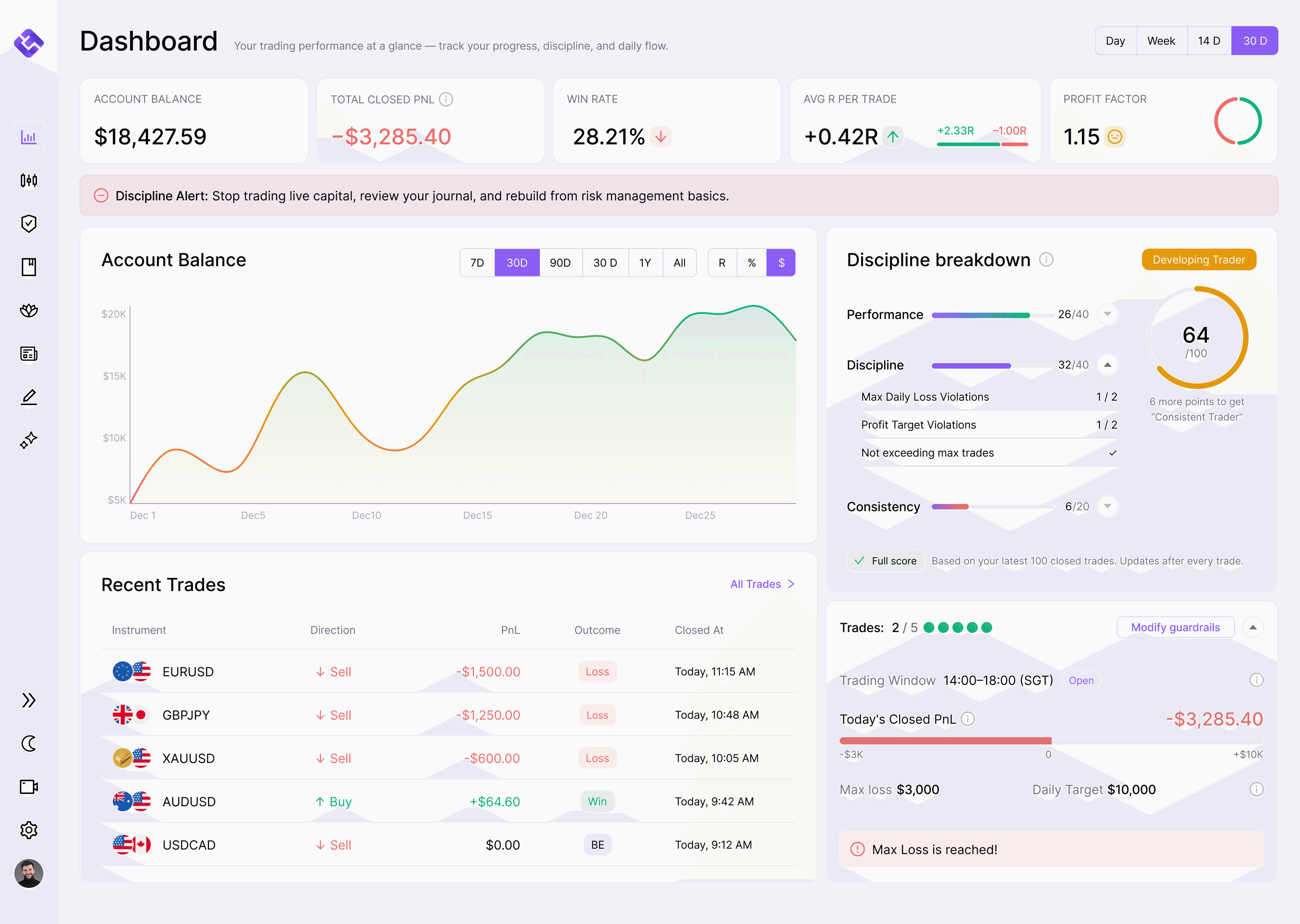
EdgeFlo's Edge feature lets you define and store your trading plan so it stays visible every session. Your rules sit next to your chart, not buried in a Google Doc you wrote three months ago and forgot about. When the urge to deviate hits, your plan is right there reminding you what you committed to.
The pre-market routine prompts reinforce your plan before you place a single trade. Instead of jumping straight into the charts and reacting, you review your strategy, your rules, and your session focus. That consistent reinforcement makes it harder to drift into impulsive rule changes, because you started the session with clarity about what the plan actually says.
The Edge Brief
Receive Insights on trading psychology, discipline, and the behavioral patterns that create consistent traders from our Founder and the EdgeFlo team, delivered to your inbox.
Think different. Trade different.
How often should I change my trading plan?
Why do I feel the urge to change my strategy after a loss?
What if my trading plan genuinely is not working?
Can I make small tweaks to my plan between reviews?

Turn discipline on.
Every session.
EdgeFlo is the environment serious traders operate inside.
Start 7-Day Free Trial
Cancel anytime.
No long-term commitment.

Think Different, Trade Different.