

Trading Ego: Why 'I've Figured It Out' Destroys You
Trading ego kills accounts after winning streaks. Learn the 5 signs ego is driving your trades and how to stay humble when the market turns.
Trading ego is the silent account killer that shows up right after your best streak. You string together a few winners, your sizing creeps up, you skip the checklist because you "feel" the setup, and within two weeks the market takes back everything you made (and then some). The moment you believe you have figured out the market is the moment it stops working for you.
Most traders don't lose to bad strategies. They lose to good streaks that convince them the rules no longer apply. Ego doesn't announce itself. It disguises itself as trading confidence, and by the time you recognize it, the damage is already on your statement.
TL;DR
Trading ego emerges after winning streaks and convinces you to abandon the process that created those wins.
The five clearest signs: increased sizing without analysis, skipping your checklist, refusing to take stops, dismissing new information, and blaming the market for losses.
Confidence is trusting your process. Ego is trusting yourself over your process.
The antidote is staying a student: review data weekly, track rule adherence, and treat every trade as one sample in a long series.
Objective performance data (not feelings) is the best defense against ego-driven decisions.
The Confidence Trap: When Winning Becomes Dangerous
Here is the trap nobody warns you about: winning is more dangerous than losing.
After a losing streak, you get cautious. You shrink your size, double-check your entries, maybe even take a day off. Losses force humility on you. But a winning streak? It does the opposite. It inflates your self-image. You start believing the wins came from your personal brilliance rather than from disciplined execution of a tested system.
This is exactly what the 1% Club calls the ego problem: "Most traders stop learning once they feel good enough. They let pride, they let ego get in the way." The pattern is predictable. Three good weeks, and suddenly the pre-trade checklist feels like a waste of time. Five good weeks, and you are sizing up because your "read" on the market is hot. Seven good weeks, and you stop journaling because what is there to learn?
The confidence trap works because it feels like growth. You think you are leveling up. But you are actually dismantling the structure that produced the results. Real trading confidence is calm. It says, "My system has a positive edge, and I will execute it the same way today as I did last week." Ego is loud. It says, "I know what this market is going to do."
One keeps you in the game. The other puts you on a timer.
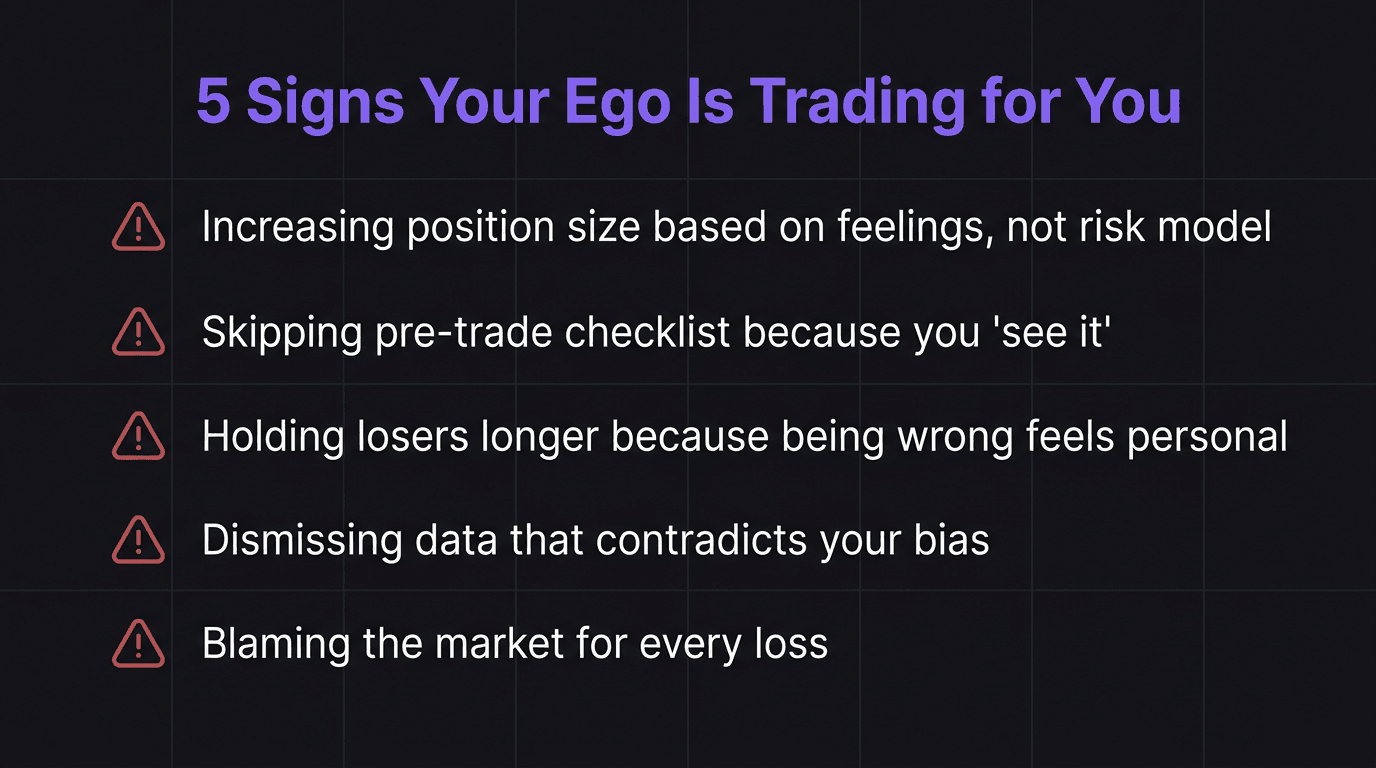
Five Signs Your Ego Is Trading for You
Ego rarely shows up as arrogance you can feel. It shows up as small behavioral shifts that seem reasonable in the moment. Here are five to watch for:
1. You increase position size based on how you feel, not what your risk model says. Your last four trades hit target. You bump from 1% risk to 2% because you are "on a roll." The math never changed. Your confidence did. That is ego sizing, and it is one of the most common trading mistakes in any account blowup.
2. You skip your pre-trade process. The checklist suddenly feels optional. You used to run seven checks before every entry. Now you glance at the chart and pull the trigger because you "see it." The trades that worked had the full process behind them. The trades you are taking now do not.
3. You hold losers longer because being wrong feels personal. A disciplined trader cuts at their stop. An ego-driven trader moves the stop, adds to the position, or just stares at the screen thinking "it has to come back." The trade is not about the setup anymore. It is about being right.
4. You dismiss information that contradicts your bias. Someone points out a bearish divergence on your long setup. You wave it off. Your journal shows your win rate dropped from 58% to 41% over the last two weeks. You ignore it. Ego filters out anything that threatens the "I've figured it out" narrative.
5. You blame the market when trades fail. "It was a stop hunt." "The news was unfair." "The market is manipulated." These might occasionally be true, but if every loss has an external excuse, your ego is protecting you from the actual problem: you broke your trading rules.
If two or more of these sound familiar right now, you are not broken. You are human. But you are also in a danger zone.
Why the Market Humbles Everyone Eventually
The market does not care about your streak. It does not know your name, your account size, or how many winners you just posted. And it has an infinite capacity to do the thing nobody expects.
"Instead of soaking all the information like a sponge, they think they know it all. That's arrogance, that's pride. And that's going to lead you into a downfall."
That downfall usually comes through a regime change. You spent three months trading a trending market. Your strategy worked beautifully because the environment fit your system. Then volatility compresses, or the trend reverses, or a macro event reshuffles every correlation. Your ego-inflated size meets a market that no longer behaves the way you "mastered."
Walkthrough: How Ego Turns a Winner Into a Blowup
A trader runs a momentum strategy on NAS100 during a strong uptrend. Over six weeks, they win 14 out of 18 trades risking 1% per trade. Their account is up 11.2%. They feel untouchable.
Week seven, they bump risk to 2.5% per trade because "the trend is obvious." They stop checking their daily bias checklist. On Monday, a surprise CPI print flips market direction. They take a long at the open because "this dip is a gift."
NAS100 drops 1.8% intraday. They do not cut because "it will bounce by close." It does not. They hold overnight. Tuesday opens with another 0.9% gap down. They finally close at a 6.2% account loss on one trade, wiping out four weeks of disciplined gains.
The strategy did not fail. The trader abandoned the strategy. The inflated size (2.5% vs 1%), the skipped checklist, the refusal to take the stop: those were ego decisions. The original 1% risk trade would have been a manageable loss. The ego-sized trade became a revenge trading trigger that led to two more impulsive trades that afternoon.
Sound familiar? Every experienced trader has a version of this story. "The moment you think you have mastered the market" is precisely when the market teaches the most expensive lesson.
Stay a Student: The Antidote to Ego
The fix is not self-flagellation. You do not need to feel bad about yourself to trade well. The fix is simpler: never stop being a student.
"Stay humble, stay sharp, study hard, even after we win."
That is not motivational fluff. It is a mechanical instruction. Here is what it looks like in practice:
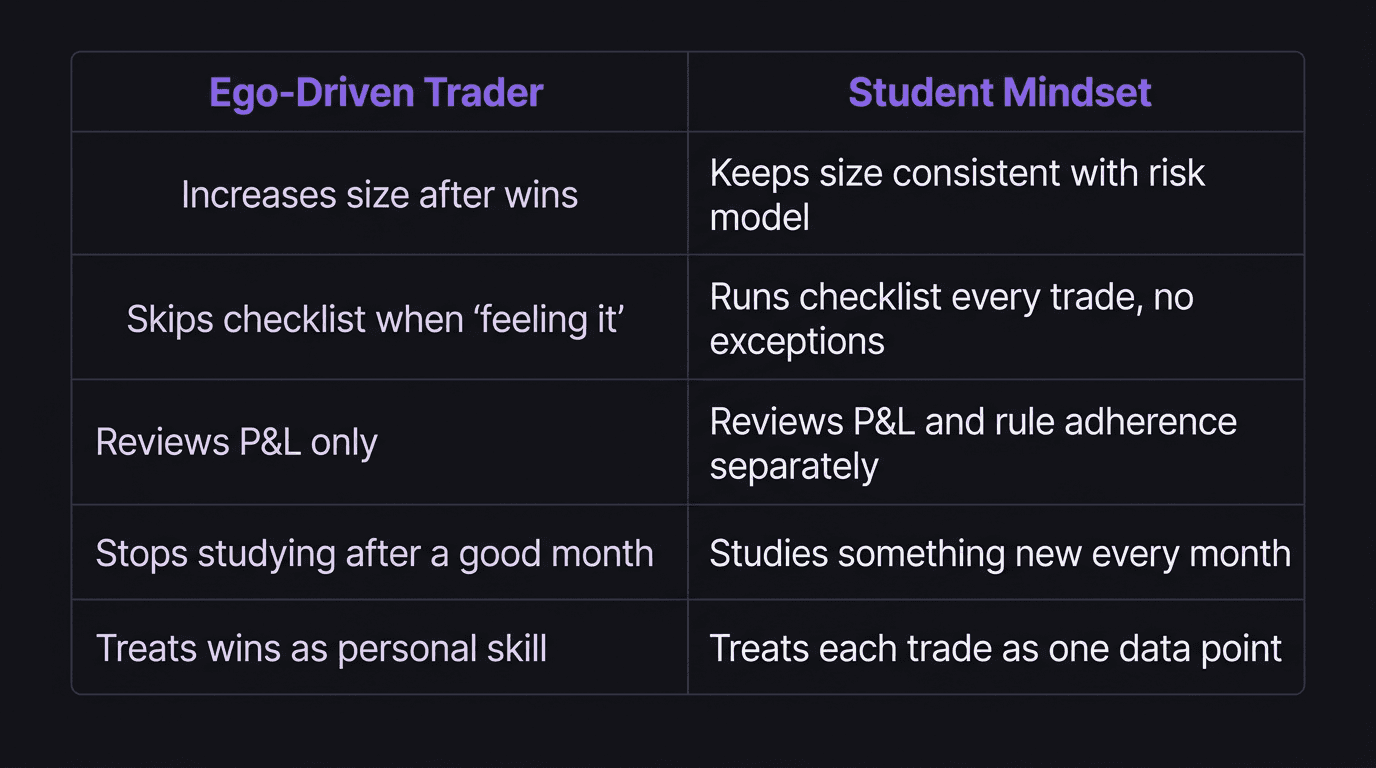
Review your data every week, especially after wins. Open your journal. Look at your win rate, average R, and rule adherence percentage. Did your wins come from process, or from lucky timing? If your best week had three trades where you deviated from your plan and happened to win, those are not evidence that your instincts are reliable. They are ticking time bombs.
Track rule adherence separately from P&L. Your P&L can be positive while your process is deteriorating. Winning despite broken rules is worse than losing while following them, because it teaches your brain that the rules do not matter. When you backtest your trading strategy, you test the rules, not your gut. Live trading should honor the same rules.
Study something new every month. Read a chapter. Watch a breakdown. Analyze a setup type you do not trade. The act of learning reminds your brain that there is always more to know. It keeps the "I've figured it out" voice quiet.
Treat every trade as one data point. Not proof of genius. Not proof of failure. One sample in a series of hundreds. This framing is the foundation of probabilistic thinking, and it is the single best defense against ego.
How EdgeFlo Keeps Data Between You and Your Ego
Ego thrives in the absence of data. When you are "feeling good" about your trading, you do not check the numbers. You do not need to, because your emotions are telling you a nice story. The problem is that the story is usually wrong.
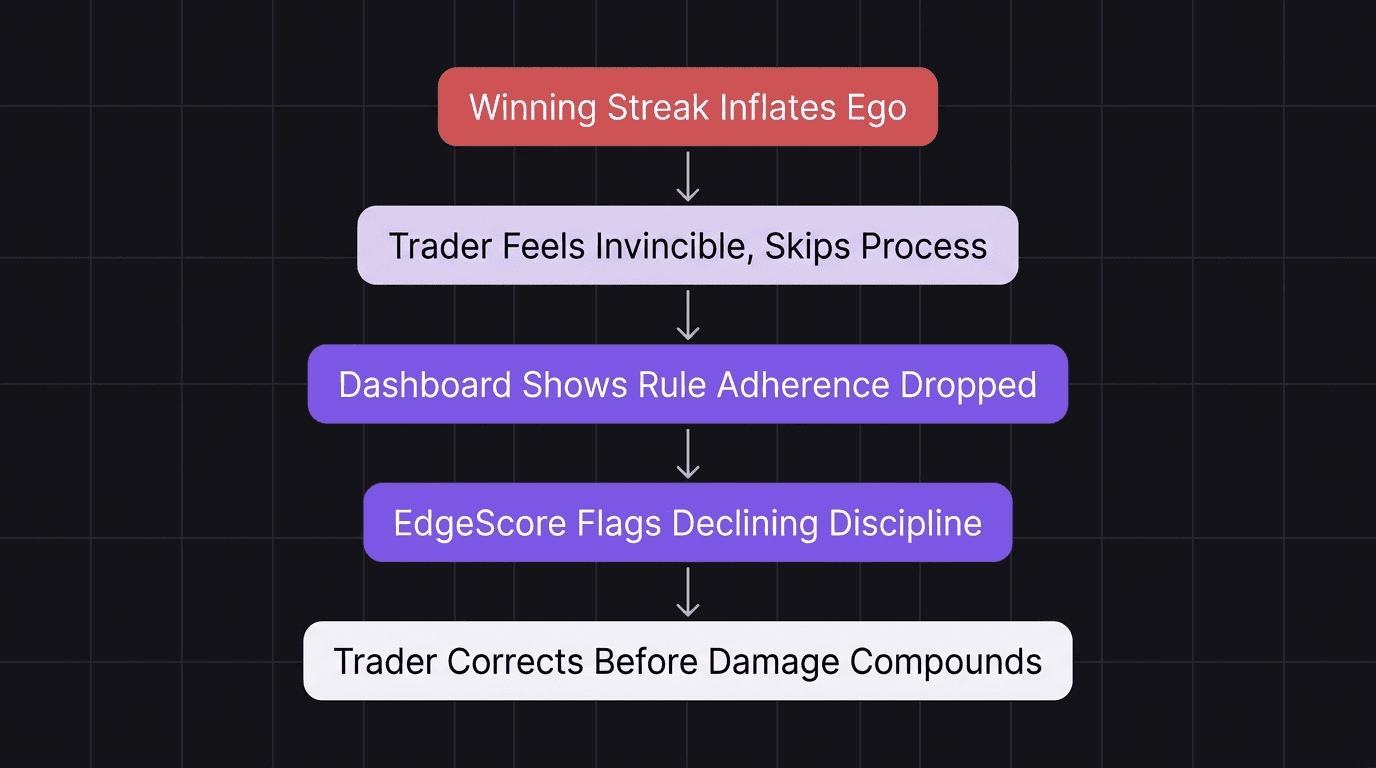
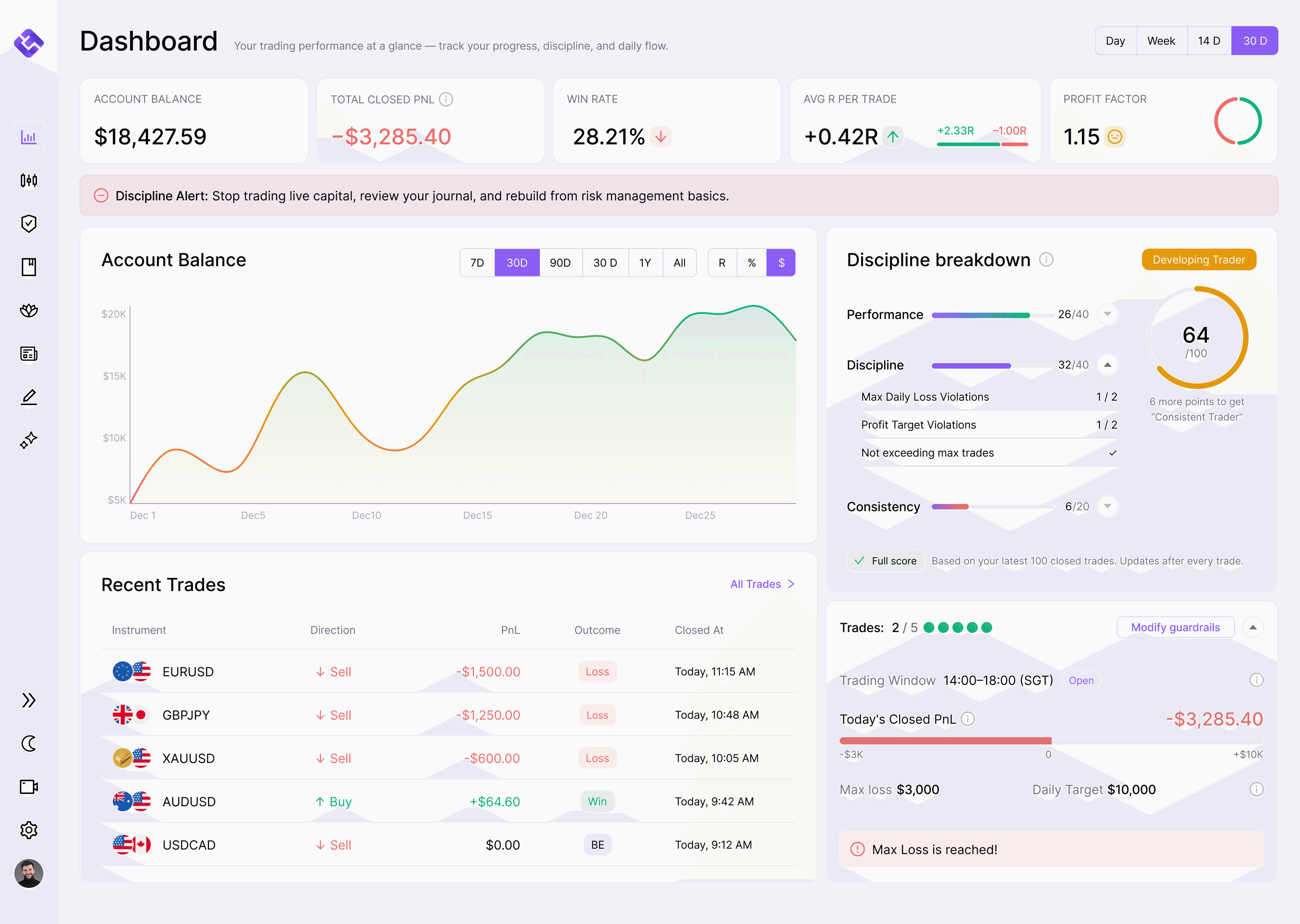
EdgeFlo's dashboard surfaces objective data whether you want to see it or not. Your win rate, average R, and EdgeScore are right there every time you open the app. You cannot pretend your last two weeks were flawless when the numbers show your rule adherence dropped from 89% to 64%. The data is a mirror, and ego does not survive mirrors.
The journal adds another layer. When you tag your emotional state on every trade, patterns emerge that feelings alone will not reveal. You might discover that your highest-confidence trades (the ones where ego is loudest) actually have a lower win rate than your standard-process trades. That is the kind of insight that keeps sizing honest and checklists intact.
EdgeScore is particularly useful here because it tracks discipline, not just profitability. A profitable week with poor discipline gets a lower score than a breakeven week with perfect execution. That reframing matters. It trains you to value the process over the outcome, which is exactly the mindset that keeps ego in check.
The Edge Brief
Receive Insights on trading psychology, discipline, and the behavioral patterns that create consistent traders from our Founder and the EdgeFlo team, delivered to your inbox.
Think different. Trade different.
What is trading ego?
How does ego cause trading losses?
What is the difference between confidence and ego in trading?
How do you stay humble as a trader?

Turn discipline on.
Every session.
EdgeFlo is the environment serious traders operate inside.
Start 7-Day Free Trial
Cancel anytime.
No long-term commitment.

Think Different, Trade Different.