

Trading Is a Probability Game, Not a Guessing Game
Trading is a probability game, not a game of certainty. Learn why accepting randomness on each trade frees your execution and builds long-term confidence.
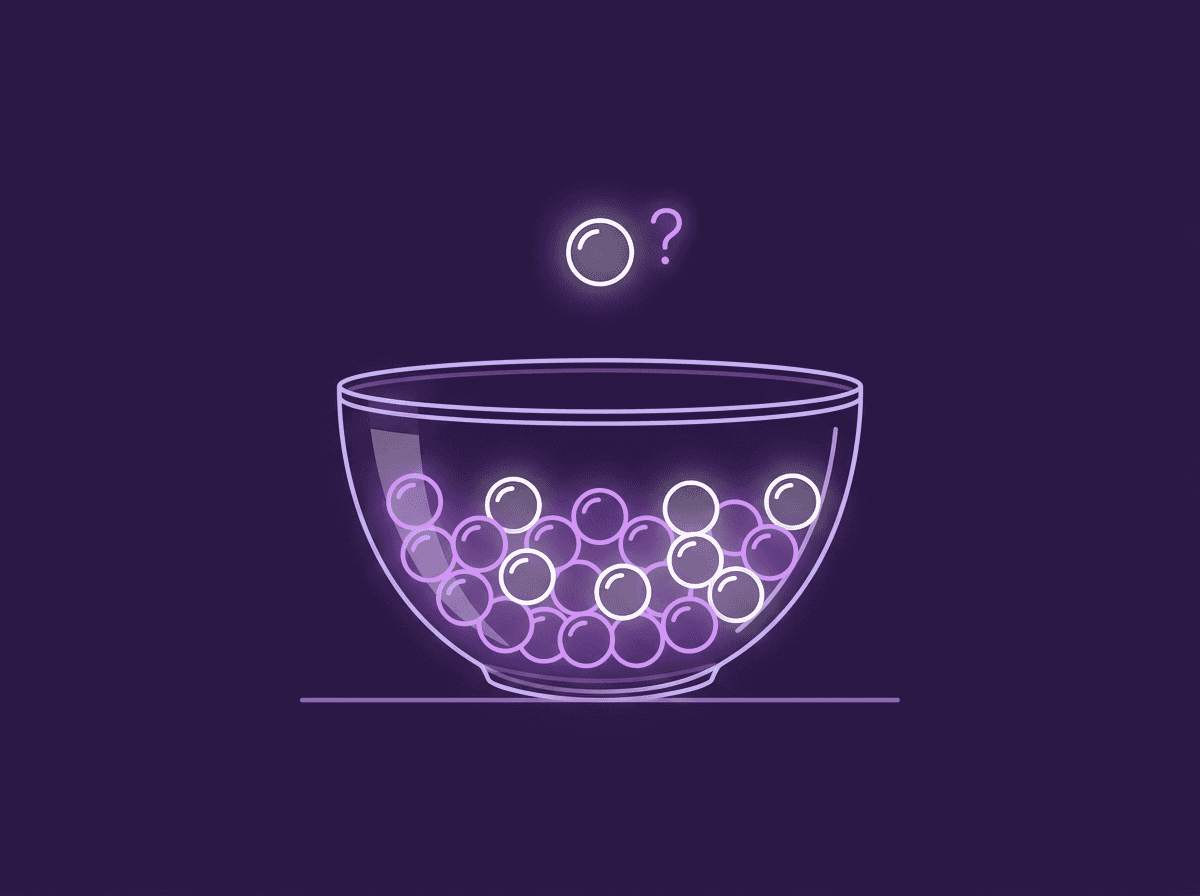
Trading is a probability game. Every single trade you take has an uncertain outcome, no matter how many confluences line up on your chart. Accepting this one truth changes everything about how you execute, how you handle losses, and how you build real confidence.
Most traders know this intellectually. Almost nobody trades like they believe it.
TL;DR
No setup, no indicator, and no amount of confluence guarantees the outcome of any single trade.
A trading edge does not remove uncertainty. It shifts the odds over a large sample of trades.
Treating each trade as one event in a series eliminates most emotional interference.
Probabilistic thinking is a skill you build through data, not a mindset you can adopt overnight.
Why Certainty Does Not Exist in Trading
Imagine a glass bowl filled with 50 black balls and 50 white balls. You reach in and grab one. Which color will it be?
You have no idea. And that is exactly what every trade feels like when you have no edge.
Now change the scenario. This time, the bowl has 70 black balls and 30 white balls. You reach in again. Which color?
Still uncertain. Even though black is statistically more likely, you could still grab a white ball. You could grab a white ball three times in a row and it would not change the fact that the bowl favors black.
This is trading with an edge. Your strategy shifts the distribution in your favor. Over 100 trades, you expect to win more than you lose (or win big enough when you do win to overcome the losses). But on any single trade, the outcome is effectively a coin flip with loaded odds.
The moment you internalize this, two things happen. First, you stop needing every trade to win. Second, you stop treating each loss as evidence that your strategy is broken.
Most traders never get here. They see three losses in a row and think something is wrong. They tinker with their setup, add another indicator, or switch strategies entirely. All because they confused a normal probabilistic outcome with a system failure.
The Coin Flip With Loaded Odds
Let me make this concrete.
Say you have a strategy with a 40% win rate and a 3:1 reward-to-risk ratio. You risk 1% per trade. On the surface, a 40% win rate sounds terrible. You lose more often than you win. How can that possibly be profitable?
Here is the math over 100 trades:
40 wins at 3% each (3:1 R:R on 1% risk) = 120% gained.
60 losses at 1% each = 60% lost.
Net result: +60% on your account.
That is a 0.6% expectancy per trade. Over 100 trades, it compounds into serious growth.
But here is the thing. Within those 100 trades, you will hit stretches where you lose five, six, even eight trades in a row. That is not your strategy failing. That is probability doing exactly what probability does. A 40% win rate means losing streaks of five to seven trades are mathematically normal.
Walkthrough: The Normal Losing Streak
A trader with a tested edge takes 10 trades on EUR/USD over two weeks. They lose the first six in a row. Each loss is 0.5% of their account. Total drawdown: 3%.
On trade seven, they win. 3:1 R:R. They gain 1.5%. Trade eight: win. Another 1.5%. Trade nine: loss. Minus 0.5%. Trade ten: win. Plus 1.5%.
Final result after 10 trades: minus 3% (six losses) plus 4.5% (three wins) minus 0.5% (one more loss) = +1%.
The trader who quit after loss number four never saw the recovery. The trader who understood probability kept executing. Same strategy. Completely different results based on belief.
Detaching From Individual Trade Outcomes
Here is the mindset shift that separates struggling traders from consistent ones: each trade is meaningless on its own. What matters is the aggregate.
Think about it this way. A casino does not care if a blackjack player wins one hand. They care about what happens over 10,000 hands. The house edge is small on each hand, but over thousands of hands, the math is unbeatable. The casino never panics after losing one hand. They do not fire the dealer. They do not change the rules. They let the edge play out.
You need to trade the same way.
That means:
After a win, you do not increase your lot size because you feel hot. The win was one data point. It does not mean the next trade will also win.
After a loss, you do not skip the next valid setup because you are scared. The loss was one data point. It does not mean your strategy is broken.
After a losing streak, you check your journal. If every trade followed your plan, the streak is statistical noise. If trades deviated from the plan, the problem is execution, not probability.
This is what outcome independence actually looks like in practice. You execute the same way on trade number one and trade number 97. The outcome of the previous trade has zero influence on the next entry.
Walkthrough: Emotion vs Probability
A trader takes a textbook short on GBP/USD at 1.2720 with a 25-pip stop and a 75-pip target. Price hits their stop at 1.2745. Loss: 25 pips.
Thirty minutes later, another identical setup forms at a supply zone near 1.2760. Same structure, same confirmation. But the trader hesitates. They just lost. They think, "What if I am wrong again?"
They skip the trade. Price drops from 1.2760 to 1.2685, a 75-pip move, exactly what their setup was designed to catch.
The first trade was a normal probability loss. The second trade was a missed win caused by letting the first outcome influence the next decision. Over 100 trades, those missed entries cost more than the losses.
Building Confidence in Uncertainty
Knowing that trading is a probability game is not enough. You have to feel it. And the only way to feel it is through data.
This is why backtesting and forward testing matter so much. When you have tested your strategy over 200 trades and seen the equity curve recover from every drawdown, losing streaks stop being terrifying. They become expected. You have seen them before in your data. You know what comes after.
Here is a practical confidence-building sequence:
Step 1: Backtest your strategy over 100 trades. Record every win, loss, and the R multiple of each trade. Calculate your expectancy.
Step 2: Forward test the same strategy over 50 live or demo trades. Compare the results to your backtest. If expectancy stays positive, your edge is real.
Step 3: Start live trading with small position sizes. Your first 50 live trades are data collection, not money-making. Treat them that way.
Step 4: After 100 live trades, review your equity curve. If it matches your backtest within a reasonable range, you have proof that your edge works in real conditions.
That proof is what confidence is built on. Not motivation videos. Not positive self-talk. Data. Proof. Repetition.
Every trade is a coin flip with slightly loaded odds. You cannot control whether this trade wins. You can control whether you show up and execute the same way every single time. Over enough flips, the edge takes care of the rest.
How EdgeFlo Helps You Think in Probabilities
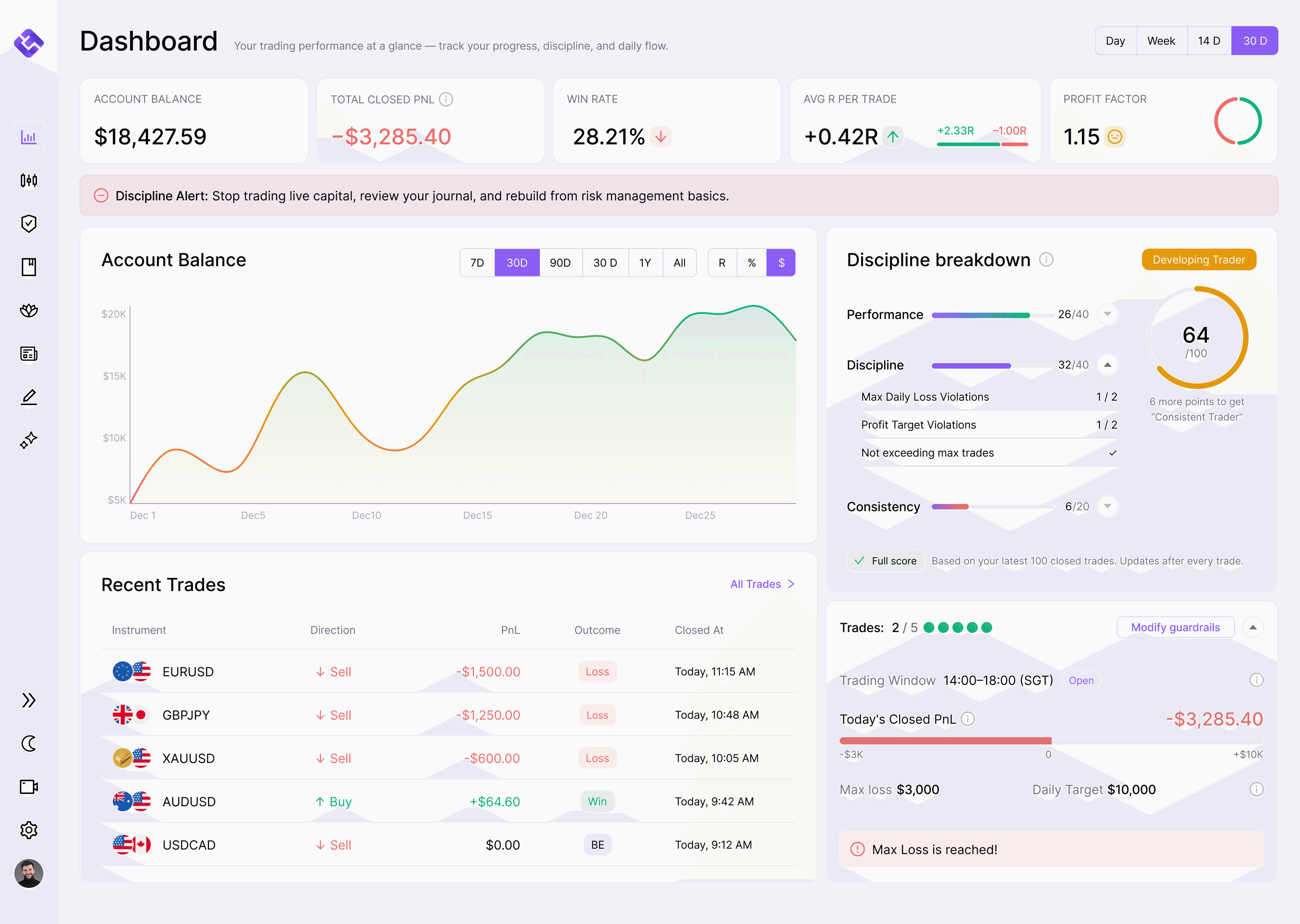
EdgeFlo's trading dashboard tracks your stats across every trade: win rate, average R, expectancy, and equity curve. When you hit a losing streak, you do not have to guess whether your edge is still intact. You pull up the dashboard and see it.
The AI-powered journal in EdgeFlo also flags patterns you might miss on your own. If your win rate drops during a specific session or on a specific pair, the weekly report surfaces it so you can investigate whether the data warrants a change or whether it is just short-term variance.
Probability only works if you let the sample size build. EdgeFlo gives you the visibility to trust your edge while the numbers accumulate.
The Edge Brief
Receive Insights on trading psychology, discipline, and the behavioral patterns that create consistent traders from our Founder and the EdgeFlo team, delivered to your inbox.
Think different. Trade different.
Does probability mean every trade is 50/50?
How do I know if my strategy has a real edge?
Why do I still feel anxious even when I know trading is probabilistic?
How many trades do I need before probability works in my favor?

Turn discipline on.
Every session.
EdgeFlo is the environment serious traders operate inside.
Start 7-Day Free Trial
Cancel anytime.
No long-term commitment.

Think Different, Trade Different.