

Trading Complacency: The $30K Tax on Winning
Winning streaks breed complacency that costs real money. Learn the 3 warning signs and how to reset before a hot streak turns into a $30K loss.
Complacency is the quiet tax on winning. It does not announce itself. It shows up as skipped plan reviews, faster entries, and a feeling that you have "earned" the right to trade on instinct. And then it costs you $30,000 in a single week.
A winning streak creates a psychological trap: you attribute the wins to your skill (partly true) and stop doing the boring work that produced those wins in the first place. The plan review gets shorter. The entry confirmation gets looser. The risk per trade creeps up. By the time you notice, you are already three losses deep.
TL;DR
Complacency after winning streaks causes traders to skip plan reviews and enter on impulse.
One trader lost $30,000 in three trades during the first week of June after a profitable month.
The first two losses were rule-breaking trades; the third was a good loss from variance.
Three warning signs: skipping pre-session review, entering before confirmation, and increasing lot size without a system reason.
A 7-day pause and full journal review reset the trader, who then made $58,000 in two trades.
How Winning Creates Complacency
Ever had a monster month and then walked into the next one feeling untouchable? That feeling is the problem.
After a profitable stretch, your brain builds a shortcut. It says: "You know what you are doing. You do not need the checklist today." The plan review that used to take 15 minutes gets cut to 5. Then to zero. You start trusting your read of the chart more than your documented entry criteria.
This is how ego quietly replaces process. You stop following the mechanical steps that got you the wins and start trading on vibes. The market does not care about your last month. Every session starts at zero.
The dangerous part is that complacency feels like confidence. Confidence follows the plan faster. Complacency skips the plan entirely.
The $30K Complacency Tax
Here is what complacency looks like in real numbers. A trader came off a strong month and entered June without reviewing his plan on day one. He knew what he was looking for on GBP/JPY, but the urge to make money overwhelmed his discipline.
Walkthrough: Three Losses in Five Days
Trade 1 (June 3, GBP/JPY, 1H timeframe): The plan called for waiting until price liquidated a strong low before entering long. Instead of waiting for confirmation, the trader entered early on impulse. Price was at 3.5K unrealized profit before reversing and hitting the stop loss. Loss: $10,000 (1R). The trader admitted afterward: "I wasn't patient enough. I was acting on impulse."
The second trade was worse. After losing $10,000, the trader felt a subconscious need to prove he was still a good trader. He entered a short on GBP/JPY, saw signs that price was shifting bullish, and refused to accept the evidence. His ego would not let him be wrong twice. He held, and price ripped against him. Another $10,000 gone.
The third trade was different. He followed his plan, found the fractal market shift, waited for the liquidation. Price still went against him. Loss: $10,000. But this was a good loss. He executed correctly and variance took the trade.
Three losses, $30,000 down in one week. Two of those losses were pure complacency: skipping the plan, entering on impulse, trading for revenge. The third was just trading.
Three Warning Signs You Are Getting Complacent
Complacency is hard to spot because it feels good. You are not stressed, not anxious, not overthinking. You are just... coasting. Here is how to catch it before it costs you money.
1. You skip your pre-session review. If you have a pre-market routine and you start shortening it or skipping it entirely after wins, that is complacency. The plan review is not optional on good weeks. It is especially important on good weeks, because that is when your guard drops.
2. You enter before your setup fully forms. This is the clearest signal. Your entry model requires a specific confirmation (a break of structure, a liquidity sweep, a candle close), and you jump in before it happens because you "feel" the move. That feeling is not skill. It is overconfidence borrowing against future losses.
3. You increase lot size without a system reason. Your risk calculator says 0.5 lots. You enter with 0.8 because "this one looks really good." That is not conviction. That is your winning streak talking. A systematic position size comes from the calculator, not from how confident you feel about the chart.
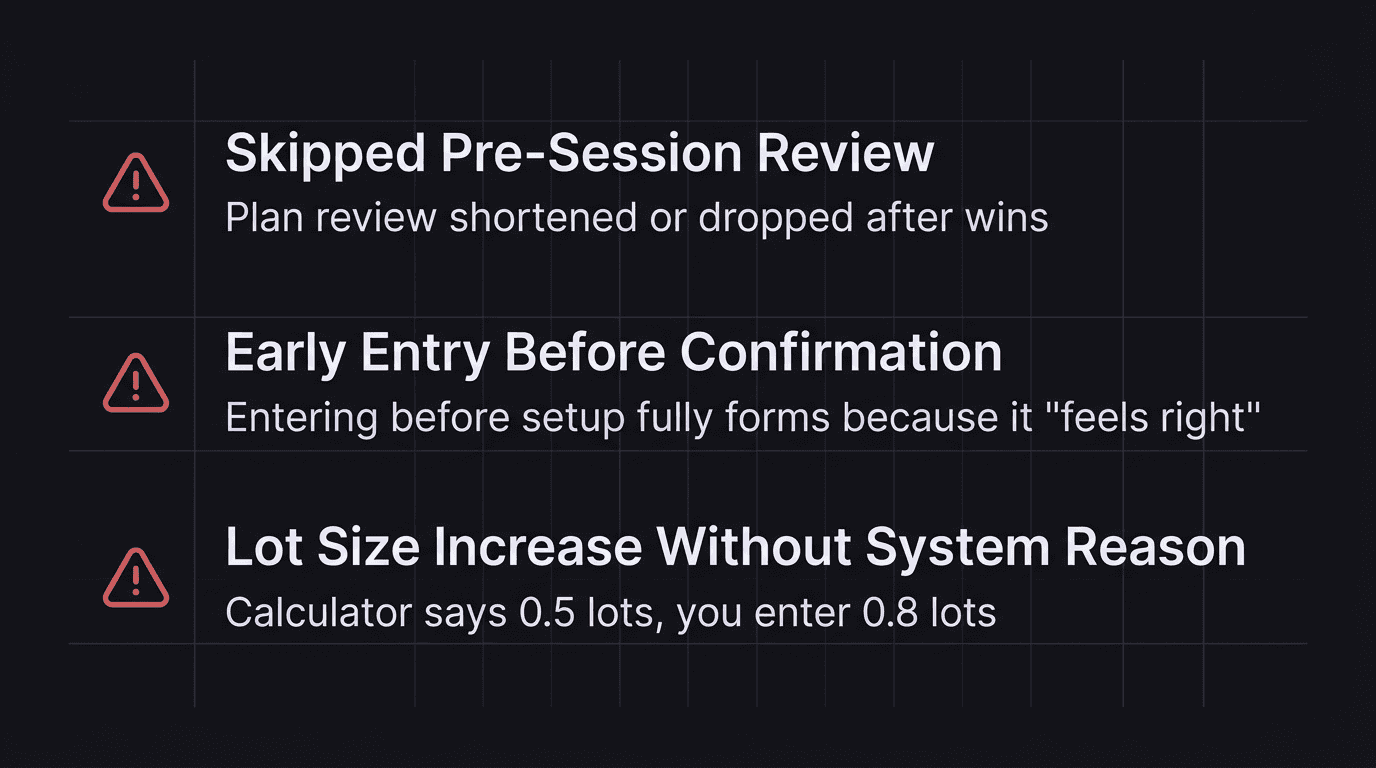
Sound familiar? Most traders can identify at least one of these in their recent history. The fix is not willpower. It is structure.
Reset After a Hot Streak
After the third loss, the trader faced a fork. He could keep trading, try to claw back the $30,000, and risk spiraling further. Or he could stop.
He stopped. For seven full days, he did not enter or exit a single trade.
During that week, he reviewed every loss in his journal. He asked three questions about each trade: Did I follow my plan? What emotional state was I in when I entered? What would I do differently with the same chart?
The first two trades failed the plan test. He entered on impulse, traded on ego, and let the need to prove something override his entry criteria. The third trade passed the plan test but lost to market conditions. That distinction matters. Good losses do not require a fix. Bad losses require a root cause analysis.
When he returned to the charts after seven days, he took one trade on GBP/JPY. Higher timeframe was bullish, internal order flow was bullish, and price swept a strong low before creating a fractal market shift. He entered at the demand zone with his full A+ criteria met. The trade hit 2.2R and he closed at $22,000 profit.
The next week, he waited again. Found another A+ setup on GBP/JPY. Entered after liquidity swept equal highs at a key supply zone. Closed at 2.4R for $36,000.
Two trades. $58,000. Five total trades for the month. Net profit after the $30,000 drawdown: $27,000.
The difference between the losing week and the winning weeks was not strategy. It was preparation. He stopped overtrading, returned to his plan, and waited for only A+ setups.
Here is how to build a post-streak reset into your routine:
After 3+ consecutive wins, run a full plan review before your next session. Re-read your entry criteria as if it were your first day using the system.
Tag your emotional state in your journal after every trade. "Confident" and "complacent" feel identical in the moment, but the journal catches the pattern over weeks.
Use your accountability system. A weekly review that forces you to compare your plan to your actual entries keeps complacency visible.
Reduce frequency after a hot streak, not increase it. The best trades come from selectivity, not volume. Five trades for $58,000 beat fifty trades for a net loss.
How EdgeFlo Helps You Catch Complacency Early
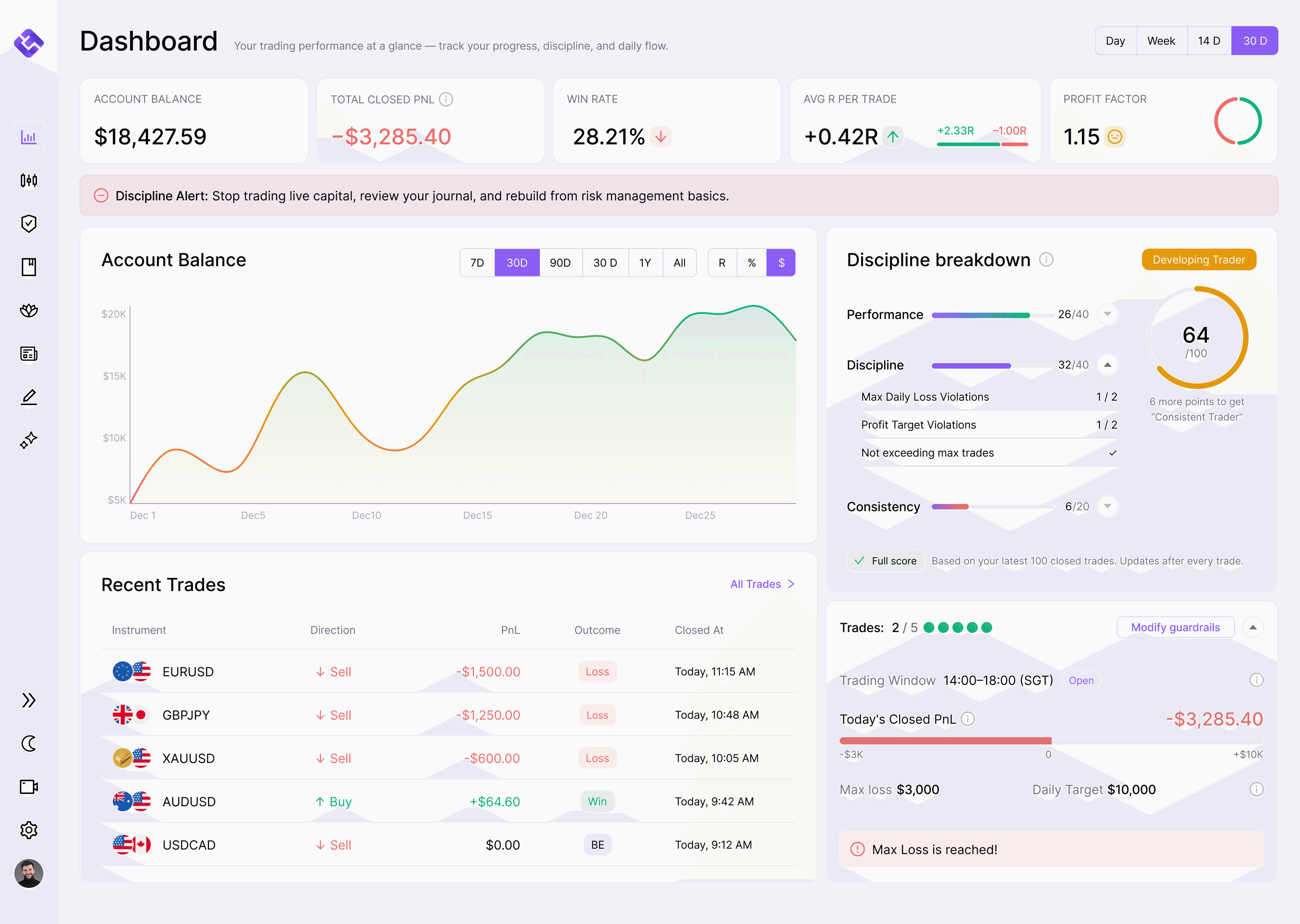
EdgeFlo's pre-market routine prompts you to review your plan before each trading session. It is not enforced (you can skip it and still trade), but it puts the checklist in front of you at the moment when complacency is most likely to make you rush past it.
After each trade, EdgeFlo's journal supports emotion tagging, so you can track whether your entries correlate with overconfidence after winning streaks. Over time, that data shows you exactly when your discipline slips and what triggers it.
The pattern usually becomes obvious within a few weeks of consistent tagging. You do not need a coach to tell you. Your own data tells you.
The Edge Brief
Receive Insights on trading psychology, discipline, and the behavioral patterns that create consistent traders from our Founder and the EdgeFlo team, delivered to your inbox.
Think different. Trade different.
What is trading complacency?
How do winning streaks lead to losses?
How do you stay disciplined after a winning streak?
What is the difference between confidence and complacency?

Turn discipline on.
Every session.
EdgeFlo is the environment serious traders operate inside.
Start 7-Day Free Trial
Cancel anytime.
No long-term commitment.

Think Different, Trade Different.