

Identity Alignment: Become the Trader You Want to Be
You do not become your best self. You settle into the worst version you will accept. Learn how aligning your trading identity with higher standards changes behavior.
You do not become the best version of yourself. Not in trading, and not in anything else. You become the worst version of yourself that you are willing to accept.
That sounds harsh, but it explains everything. It explains why traders who know what to do still blow accounts. It explains why motivation after a bad stretch fades within days. And it explains why the traders who actually break through are the ones who redefined what they refuse to tolerate, not the ones who set bigger goals.
TL;DR
You settle into the worst behavior you find acceptable, not your aspirational best.
Willpower is temporary; identity is persistent. Behavior follows identity, not intentions.
Trading identity shifts happen when your minimum standard rises, not when you aim higher.
Small daily actions that match your target identity build evidence that reshapes your self-concept.
Standards enforced through structure (not willpower) accelerate the identity shift.
Your Worst Acceptable Version Defines Your Results
Here is an experiment. Think about your trading behavior at its absolute worst. Not a catastrophic blow-up, but the baseline low. The version of you that takes trades without checking the plan. The version that skips the journal for 3 days straight. The version that risks 3% instead of 1% "just this once."
That version is your floor identity. And your floor identity determines your results far more than your ceiling identity (the best version of you on your most disciplined day).
Why? Because you cannot sustain your ceiling identity. It takes enormous effort to be at your absolute best every single session. Eventually, fatigue, stress, boredom, or a losing streak will push you back down. Where you land is your floor.
If your floor includes "risking 3% per trade when frustrated" and "taking 6 trades in a day after losses," then those behaviors will define your actual outcomes over time, regardless of how well you trade on your best days.
The math is simple. If your best weeks produce +3% and your worst weeks produce -5%, your average is negative. The floor is eating everything the ceiling builds.
Why Willpower Fails but Identity Sticks
Willpower works like a battery. You start the day with a charge. Every decision, every temptation you resist, every rule you force yourself to follow, drains the battery. By the end of a tough session, the battery is empty. And when the battery is empty, you do not fall back to your goals. You fall back to your identity.
Identity is different. It does not drain. It is the default state your brain returns to without effort. When "I am a trader who journals every trade" is your identity, you do not need willpower to journal. You do it because not doing it would feel wrong, like leaving the house without locking the door.
The trading discipline transformation that separates struggling traders from consistent ones is not about finding more willpower. It is about changing the identity so that the disciplined behaviors are the default, not the exception.
Think about how this works in other areas. You do not need willpower to shower in the morning. It is part of your identity as a person who maintains basic hygiene. You would feel wrong skipping it. Trading standards can reach the same level of automatic behavior when they become part of who you are, not just what you try to do.
How to Redefine Your Trading Identity
Changing identity is not about affirmations or visualization. It is about evidence. Your brain builds identity from accumulated proof of who you are. Every action that matches the target identity strengthens it. Every action that contradicts it weakens it.
Here is the practical framework:
Step 1: Define the identity in behavioral terms. Not "I am a disciplined trader" (vague). Instead: "I am a trader who follows a pre-trade checklist before every entry, journals every trade, and never risks more than 1% per position." Specific. Verifiable. Binary (you either did it or did not).
Step 2: Set it as a standard, not a goal. A goal says "I want to journal 90% of my trades this month." A standard says "I journal every trade. Period. Missing one means the next trade cannot happen." The standard creates a hard floor. The goal creates a soft suggestion.
Step 3: Start with one standard. Do not overhaul everything at once. Pick the single behavior that, if consistently followed, would have the biggest impact on your results. For most traders, that is either position sizing or journaling.
Step 4: Build the evidence chain. Every day you keep the standard is a vote for the new identity. Day 1: "I am trying to be a trader who journals every trade." Day 7: "I have been journaling every trade for a week." Day 30: "I journal every trade. That is what I do." The identity hardens with repetition.
Walkthrough: The Identity Shift in Action
A trader has blown 3 accounts in the past year. Her pattern: grow to $2,000, get overconfident, increase size, blow up, deposit again. Floor identity: "I am a trader who increases risk when things go well."
She sets one standard: "I am a trader who uses 0.1 lots on every trade, regardless of account balance, until I have 3 consecutive profitable months." That is the target identity.
Week 1: Account at $1,000. She sticks to 0.1 lots on EUR/USD with a 50-pip stop.
Math check: 0.1 lots = $1/pip. $1 times 50 pips = $50 risk per trade = 5% of $1,000. Higher percentage than ideal, but the fixed lot size is the standard she is building.
Her account grows to $1,200. The old identity whispers: "Increase to 0.2 lots." She does not. The standard holds. Evidence: 1 vote for new identity.
Week 3: Account at $1,500. The temptation is stronger. She has "earned" a lot size increase. But the standard says 3 profitable months, not 3 profitable weeks. She stays at 0.1 lots. Evidence: 15 more votes for new identity.
Month 2: Account at $1,800. A losing week drops it to $1,600. The old identity says: "You are back to where you started this is not working." But the math disagrees: she is up $600 from her initial $1,000, and no blow-up happened. The standard held.
Month 3: Account at $2,100. Three profitable months in a row. Now she can evaluate a lot size increase based on her plan, not on excitement. The identity has shifted. She is no longer "a trader who increases risk when things go well." She is "a trader who follows fixed lot sizes until planned milestones."
Daily Proof: Small Actions That Reinforce the New Identity
Identity shifts happen in the small moments, not the dramatic ones. Every time you follow the standard when it would be easier to skip it, you add a vote for the new identity. Every time you skip it, you add a vote for the old one.
Here are the high-impact daily actions:
Pre-session: Complete your trading journal habit check. Before opening charts, confirm: plan reviewed, risk parameters set, journal open and ready. This takes 5 minutes. It is a vote.
At trade entry: Follow the checklist. Does this setup meet all criteria? Is the lot size correct? Is the stop placed according to the plan? Checking these items is a vote.
At trade exit: Log immediately. Write the P&L, the emotion tag, and one sentence about what happened. Do this before looking for the next setup. It is a vote.
Post-session: Score yourself. Rate plan compliance for the session on a scale of 1 to 5. This is not about whether you won or lost. It is about whether you followed the process. A losing day with perfect compliance is a 5. A winning day where you broke rules is a 2.
Weekly: Review the votes. How many days did you keep every standard? If you kept all standards 5 out of 5 days, the identity is solidifying. If you kept them 3 out of 5, identify what caused the breaks and address the trigger.
The key insight from process-oriented trading is that the process IS the identity. You are not building a process to reach a goal. You are building a process that defines who you are as a trader.
How EdgeFlo Reinforces Your Trading Identity
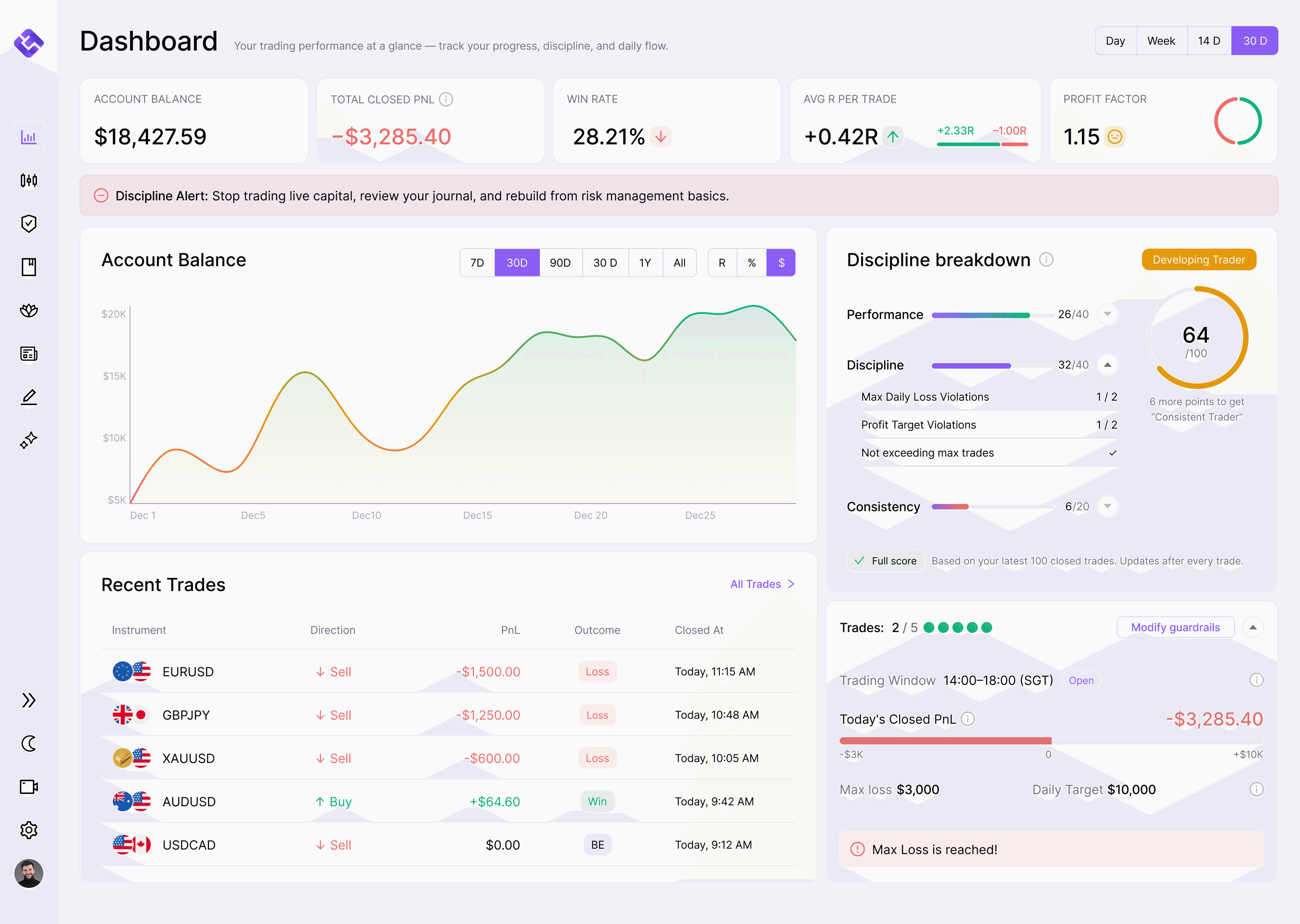
EdgeFlo is designed around the principle that environment shapes behavior more reliably than willpower does. The pre-market checklist prompts you to confirm your plan and standards before the session, reinforcing the identity through daily repetition.
The AI-powered trading journal with emotion tagging creates a running record of your compliance. Every logged trade with an emotion tag is evidence of the new identity in action. Over weeks and months, the accumulated evidence becomes undeniable: you are the trader who journals. You are the trader who tags emotions. You are the trader who follows the checklist.
When the old identity tries to resurface during a losing streak or a winning streak, the evidence is right there in your data. The person who has 60 consecutive journal entries is not the same person who skipped journaling for a week and blew an account. The identity has shifted, and the platform holds the proof.
The Edge Brief
Receive Insights on trading psychology, discipline, and the behavioral patterns that create consistent traders from our Founder and the EdgeFlo team, delivered to your inbox.
Think different. Trade different.
What is identity alignment in trading?
Why does willpower fail in trading?
How long does it take to shift a trading identity?
What is the fastest way to start an identity shift?

Turn discipline on.
Every session.
EdgeFlo is the environment serious traders operate inside.
Start 7-Day Free Trial
Cancel anytime.
No long-term commitment.

Think Different, Trade Different.