

I Failed 4 Funded Challenges: What Finally Worked
Most traders fail their first funded challenge. Many fail four or five. Learn the common failure patterns and what changes on the attempt that finally passes.
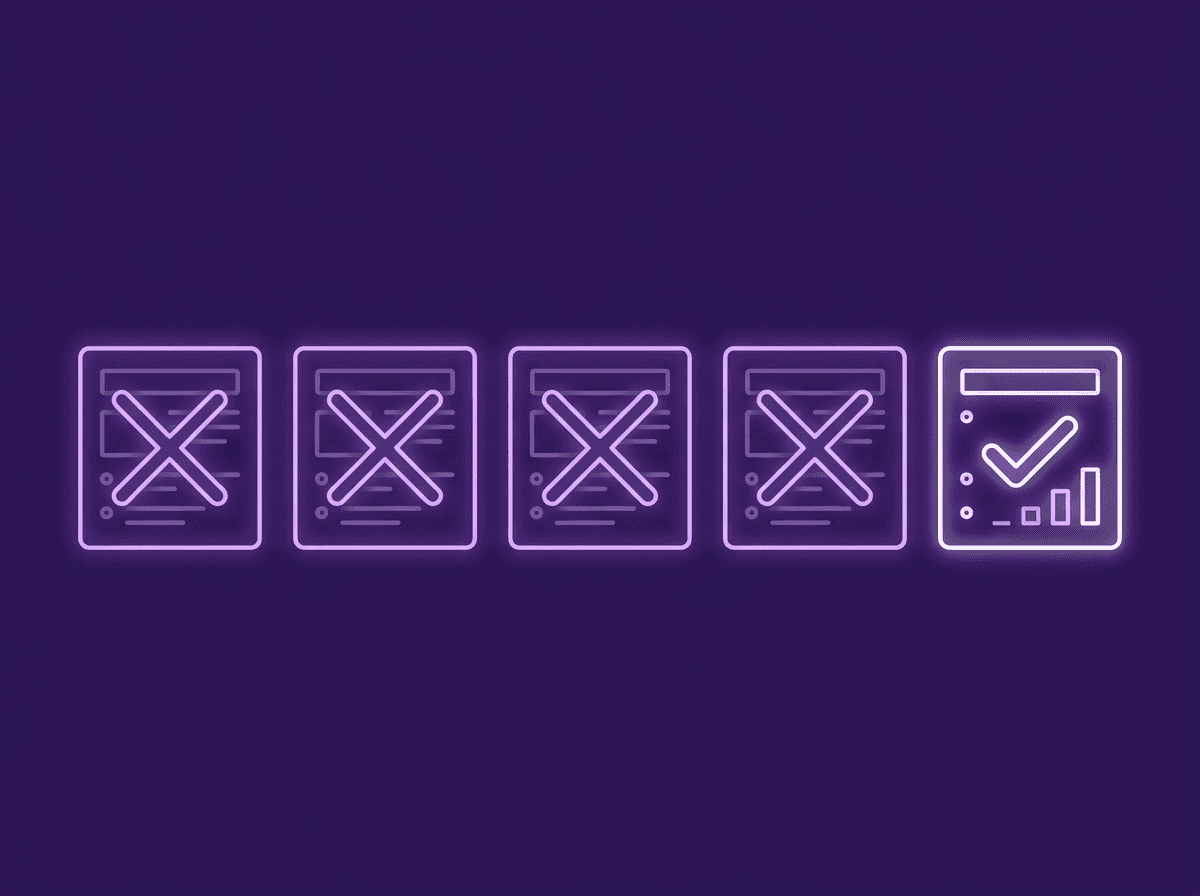
Failing a funded challenge feels personal. You paid the fee, you studied the rules, you thought you were ready. And then in week one, your daily loss limit gets breached and the account is gone.
Here is the uncomfortable truth: most traders fail their first challenge. Many fail two, three, or four before they pass. The difference between the traders who eventually get funded and the traders who give up is not talent. It is whether they learn something specific from each failure.
If you have failed one or more funded challenges, you are not behind. You are in the majority. But only if you stop repeating the same pattern.
TL;DR
Failing funded challenges is normal. Most traders fail multiple times before passing.
Each failure has a specific, diagnosable cause. Generic "I need to be better" is not a diagnosis.
The most common failure patterns are overtrading, ignoring drawdown rules, forcing trades under pressure, and skipping preparation.
The attempt that passes usually looks boring: fewer trades, smaller risk, more patience.
Journal every challenge attempt so you can pinpoint exactly what changed on the one that worked.
Failure 1: Rushing In Without Enough Reps
The first challenge attempt usually fails before the market even gets involved. The trader signs up after a few weeks of demo trading, maybe a couple of months. They know their strategy "works" because they made money last week on a demo.
But a demo week is not enough data. Sound familiar? A few green days and suddenly you are ready for a $100,000 account with real rules and real consequences.
The funded challenge environment introduces something demo never can: performance pressure with a countdown. Your strategy might work on demo. But can you execute it when the fee is gone, the clock is ticking, and you need to hit a profit target without blowing a daily limit?
For most traders, the honest answer on attempt one is no. Not because the strategy is bad, but because the reps are not there. You have not seen enough live setups, felt enough real drawdowns, or practiced enough patience under constraint.
What changes after this failure: You go back to demo or small live for three to six more months. You stop treating the challenge as a test of strategy and start treating it as a test of discipline and execution. You build a genuine track record before paying the fee again.
Failure 2: Overtrading to Hit the Profit Target
By the second attempt, you have more screen time. Your strategy is better tested. You feel more prepared.
But you make a new mistake: you trade too much. The profit target (usually 8% to 10% for Phase 1) creates a mental countdown. You want to hit the target as fast as possible, so you take every setup that remotely qualifies. Three trades a day becomes five. Five becomes eight.
More trades means more exposure to your daily loss limit. If your win rate is 45%, taking eight trades means roughly four losses per day. At 1% risk per trade, four losses consume 80% of your 5% daily limit. One more loss and you breach.
Overtrading under challenge pressure is the second most common failure pattern. The fix is counterintuitive: trade less, not more. The profit target has a 30-day window on most platforms. You do not need to hit 10% in a week.
What changes after this failure: You set a hard cap of two to three trades per day. You accept that the challenge might take the full 30 days. You stop treating speed as a metric and start treating survival as the priority.
Failure 3: Not Respecting Funded Drawdown Rules
By the third attempt, you are trading less and picking better setups. But you still get caught by the drawdown rules.
The trap: you take a trade that goes into a floating loss. On a personal account, you would hold it. The zone is valid, the setup is fine, it just needs time. But on a funded account, that floating loss counts toward your daily drawdown in real time.
You hold the position, take a second trade, and now you have two open positions both floating against you. Your equity drops to 4.2% below your starting balance for the day. One more tick and the platform closes everything.
The reason traders fail funded challenges often comes down to this: they trade funded accounts like personal accounts. They forget that equity-based drawdown is fundamentally different from balance-based thinking.
What changes after this failure: You calculate your maximum open risk before every session. You limit simultaneous open positions. You check equity after every trade, not just at end of day. The drawdown rules become the first thing you review in your pre-market routine, not an afterthought.
Failure 4: Forcing Trades When the Market Gives Nothing
By now you have the strategy, the position sizing, the drawdown awareness. Challenge four fails for a subtler reason: you cannot sit still.
Day three of the challenge. You have been patient for two sessions and only taken one trade (a small winner). The profit target feels miles away. The market is ranging on every pair you watch. Nothing meets your criteria.
So you lower your standards. You enter a setup that is B-grade at best. It loses. Now you are negative, which creates urgency. You take another marginal setup. Another loss. By mid-session, you have burned three trades and 2.5% of your daily limit on entries that did not meet your plan.
The funded challenge rewards patience more than any other skill. The traders who pass are comfortable going two or three days without a trade. The ones who fail cannot tolerate inactivity when money is on the line.
What changes after this failure: You create a "no trade" rule. If no A-grade setup appears within your session, you close the platform. You accept that zero trades is a valid trading day. You stop equating screen time with productivity.
The Attempt That Passes: What Is Different
The passing attempt almost never feels exciting. It is usually the most boring challenge you have taken.
You trade one to two times per day, sometimes zero. You only enter setups that pass every filter in your plan. You check your drawdown before and after every trade. You journal every entry, win or loss.
Some weeks, you make no progress toward the profit target. You do not panic. You know from your backtested data that your strategy produces results over 30 or more trades, and the 30-day window gives you time.
The passing attempt differs from the failed ones in four specific ways:
Fewer trades. Half the volume of your earlier challenges.
Smaller risk per trade. You drop from 1% to 0.5% in the early days to build a buffer before sizing up.
More "no trade" days. You accept inactivity as protection.
Daily drawdown awareness. You know your exact equity and remaining daily budget before every entry.
None of those changes require a new strategy. They require a different relationship with the challenge itself. You stop trying to beat it fast and start trying to survive it.
Walkthrough: Challenge 5, the One That Worked
$100,000 funded account. Phase 1 profit target: 10% ($10,000). Daily loss limit: 5%. Max drawdown: 10%. Time limit: 30 days. Risk per trade: 0.5% ($500).
Week 1: 3 trades. 2 wins at 2R ($1,000 each), 1 loss at 1R ($500). Net: +$1,500. Balance: $101,500.
Week 2: 4 trades. 2 wins at 2.5R ($1,250 each), 2 losses at 1R ($500 each). Net: +$1,500. Balance: $103,000.
Week 3: 5 trades. Risk increased to 0.75% ($750) with the buffer. 3 wins at 2R ($1,500 each), 2 losses at 1R ($750 each). Net: +$3,000. Balance: $106,000.
Week 4: 4 trades. Risk back to 0.5% ($500). 2 wins at 3R ($1,500 each), 2 losses at 1R ($500 each). Net: +$2,000. Balance: $108,000.
After 4 weeks and 16 trades: $8,000 profit. Short of the $10,000 target.
Week 5 (days 29-30): 2 more trades. Both wins at 2R ($1,000 each). Gains: $2,000. Final balance: $110,000. Target hit.
Eighteen trades over 30 days. A 61% win rate on plan-compliant setups. No daily limit breach, no drawdown scare, no panic trading.
Boring. Effective. Funded.
The Lesson Behind Every Failed Challenge
Every failed attempt teaches you something specific if you bother to look. "I failed" is not a lesson. "I failed because I took six trades on day four when nothing met my criteria" is a lesson you can act on.
Before retaking any challenge, write down the exact cause of each previous failure. Not vague reasons like "bad discipline." Specific triggers:
"Breached daily limit on March 5 because I held two trades overnight and the gap moved against me."
"Hit max drawdown on March 12 because I sized up to 2% after a winning streak and then took three consecutive losses."
"Failed Phase 2 because I rushed to hit the target in week one instead of pacing over the full 30 days."
Those specific diagnoses become the rules for your next attempt. Fix one failure pattern per attempt and the odds compound in your favor.
How EdgeFlo Supports Challenge Preparation
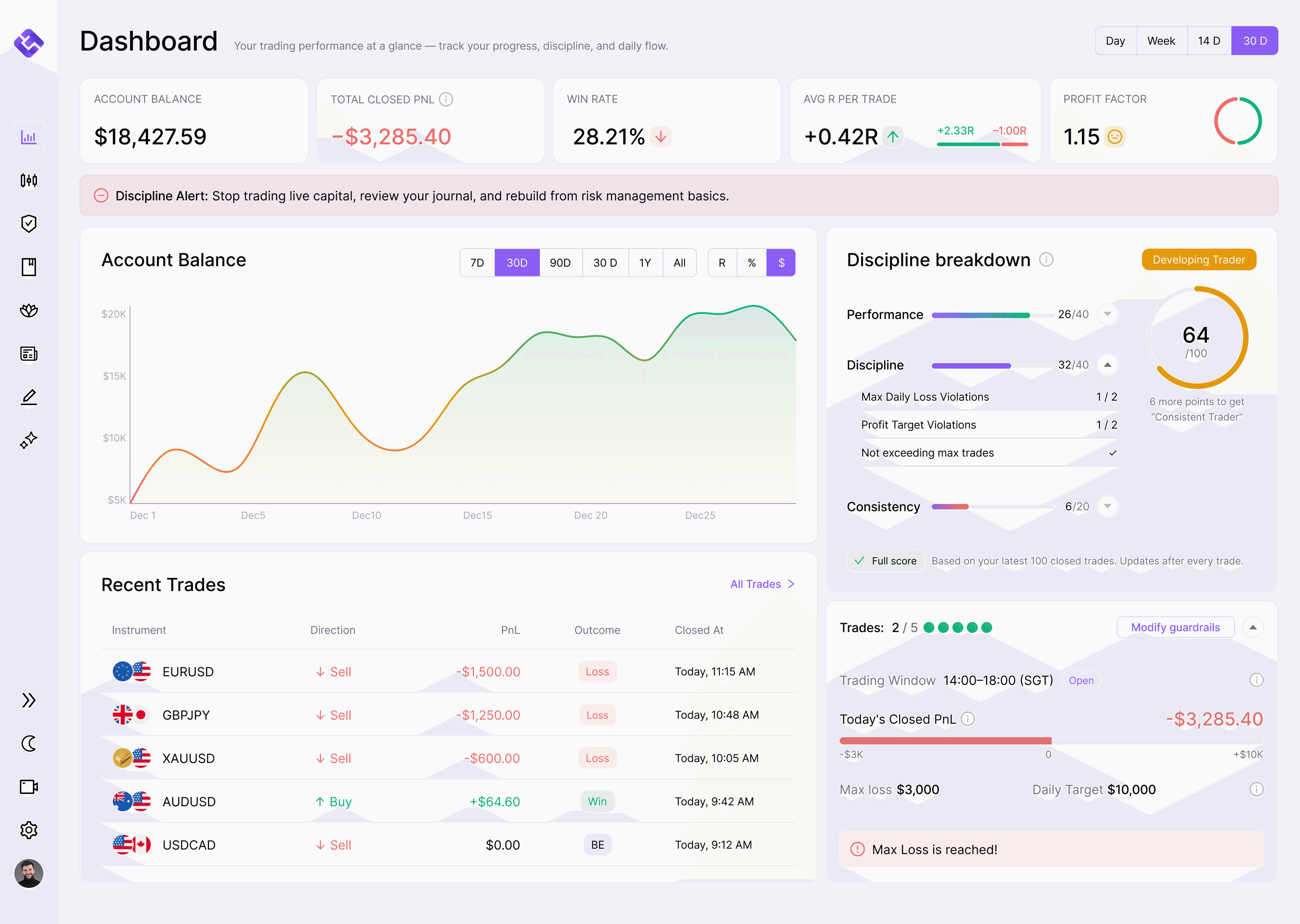
EdgeFlo's dashboard tracks your performance history across sessions, giving you the data you need to diagnose failure patterns. If your worst losses cluster on certain days, pairs, or times, the dashboard shows it.
The journal captures the qualitative side: emotion tags, plan compliance, and session notes. When you review a failed challenge attempt, you can see not just what you lost but why. "Frustrated, broke rule, Friday afternoon" appearing three times in your journal is a clear signal to stop trading Friday afternoons on your next challenge.
And the Edge feature keeps your trading plan visible during every session. When challenge pressure pushes you toward a marginal setup, your written rules are right there, reminding you that the plan says no. That simple visibility is often the difference between attempt four and attempt five.
The Edge Brief
Receive Insights on trading psychology, discipline, and the behavioral patterns that create consistent traders from our Founder and the EdgeFlo team, delivered to your inbox.
Think different. Trade different.
How many funded challenges do most traders fail before passing?
Is it normal to fail a funded challenge on the first try?
What is the most common reason funded challenges fail?
Should I try again after failing a funded challenge?

Turn discipline on.
Every session.
EdgeFlo is the environment serious traders operate inside.
Start 7-Day Free Trial
Cancel anytime.
No long-term commitment.

Think Different, Trade Different.