

Process Oriented Trading: Detach from Outcomes
Process oriented trading means judging yourself on execution, not P&L. Detach from outcomes and the results take care of themselves.
Process oriented trading means you judge every session by how well you followed your plan, not by how much money you made. You grade execution quality: did you wait for your setup, use correct position sizing, manage the trade according to your rules, and journal the result? If the answer is yes, it was a good day, even if the trade lost. The money follows execution over time. When you flip the scorecard from dollars to discipline, you stop chasing, stop overleveraging, and stop abandoning your system after two red days. The process is the edge. The outcome is a byproduct.
TL;DR
Process oriented trading scores you on execution (plan adherence, risk management, patience), not on P&L.
Outcome focus causes overleveraging, rushing, and strategy abandonment after normal losses.
The daily process includes pre-market prep, setup criteria checks, correct sizing, and post-trade journaling.
Over 20 trades, the process trader with a lower win rate can outperform the outcome trader who self-destructs.
Shifting requires replacing "did I make money?" with "did I follow my rules?" as your primary metric.
Outcome Focus vs Process Focus
Every trader wants to make money. That part is obvious. The question is what you measure on a daily basis, because that measurement drives your behavior.
An outcome-focused trader opens the P&L column first. Green day? Good. Red day? Bad. The entire self-assessment is binary, tied to something they cannot fully control. Market conditions, news events, and random variance all influence whether a single trade wins. Judging yourself on something you cannot control is a recipe for emotional instability.
A process-focused trader opens the checklist first. Did I do my pre-market prep and set goals for the session? Did I wait for a setup that matched my criteria? Did I size the position correctly? Did I manage the trade without interference? Four yeses make a good day, regardless of the P&L.
Sound like a small difference? It changes everything. When your scorecard is execution, you stop needing every trade to win. You stop revenge trading after a loss. You stop doubling size to "make back" what the market took. The emotional charge around individual outcomes drops, and what replaces it is a focus on the thing that actually compounds: consistent behavior.
Why Outcome Focus Leads to Bad Decisions
Here is the chain reaction. You set a monetary target, say $10,000 per month. That number sits in your head every session. When you are behind target, urgency kicks in. You start forcing setups, cranking up lot sizes, and skipping your pre-market routine because "there is no time." When you are ahead of target, overconfidence kicks in. You take low-quality trades because you feel invincible.
One trader who failed six funded challenges puts it plainly: "You want the payout, not the process." His $10,000-per-month dream led to overleveraging, rushing past backtesting, and treating every losing trade as a personal failure rather than normal variance.
Where your attention goes, your energy follows. If attention is locked on a dollar figure, every action bends toward that figure, even when the action violates your own rules.
Three specific ways outcome focus destroys execution:
Overleveraging. You increase lot size to hit the target faster. One bad trade takes out days of progress.
Rushing the learning curve. You skip forward testing, ignore journal reviews, and go live before the data supports it. The timeline becomes the enemy.
Abandoning systems after losses. Two or three red trades feel like proof the strategy is broken. You hop to a new system, starting the cycle over.
The irony is that every one of these behaviors pushes the $10,000 target further away. You cannot rush compounding. You cannot force a market to pay you on your schedule.
What Process Oriented Trading Looks Like Daily
Process oriented trading is not abstract philosophy. It is a set of specific actions you repeat every trading day, in the same order, with the same criteria.
Before the session:
Complete your pre-market checklist (bias, key levels, news calendar)
Review your trade plan and confirm which setups you are looking for today
Set your maximum risk for the day and stick to it
During the session:
Wait for a setup that matches every criterion in your plan
Size the position based on your predetermined risk percentage
Enter, set stops and targets, and manage according to your rules
If no setup appears, do nothing. Doing nothing is a process win.
After the session:
Journal every trade (outcome and process compliance)
Score yourself: did you follow the plan? Rate each trade on execution, not profit.
Review what you did well and what drifted
The key shift is in the post-session question. Instead of "how much did I make?" you ask "how well did I execute?" That single question changes which behaviors you reinforce.
A trader who journaled his funded challenge failures noticed something: the days he lost money but followed his plan were the days he felt calm afterward. The days he made money but broke rules were the days anxiety crept in. The P&L lied about the quality of his trading. The process journal told the truth.
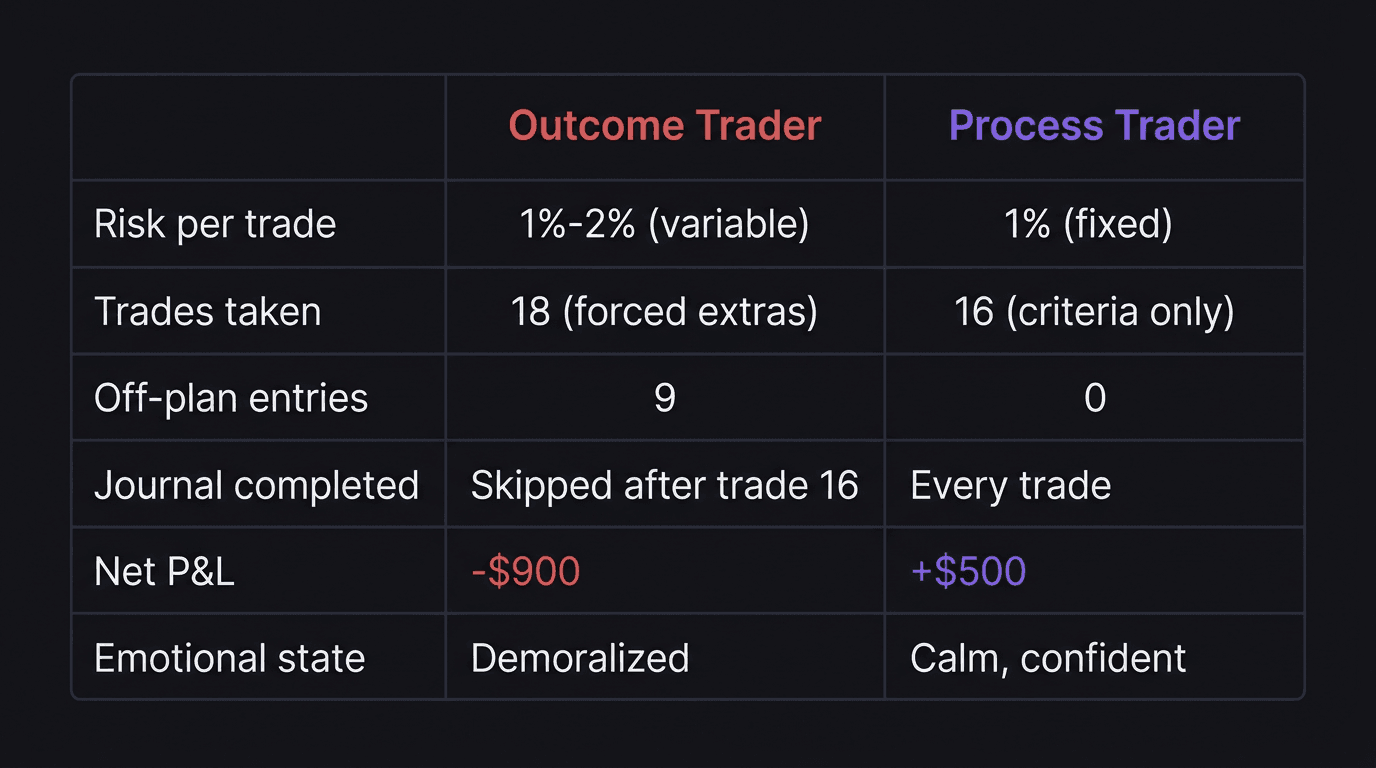
Walkthrough: Outcome Trader vs Process Trader Over 20 Trades
Same strategy. Same pair (EUR/USD, London session). Same 2:1 reward-to-risk setup. Same 1% risk per trade on a $10,000 account. The only difference is mindset and behavior.
The Outcome Trader
Trades 1 through 5: One win, four losses. Net result: down $200 (one win at $200, four losses at $100). Feels frustrated and behind schedule on his monthly target.
Trades 6 through 8: Increases lot size to 1.5% to recover faster. Wins trade 6 ($300 profit at 2:1). Feels vindicated. Loses trades 7 and 8 ($150 each). Running total: down $200.
Trades 9 through 12: Takes every marginal setup at 1% risk to "make up ground." Wins one ($200), loses three ($300). Running total: down $300.
Trades 13 through 16: Frustrated, bumps risk to 2% ($200 per loss). Loses three, wins one ($400 win, $600 in losses). Running total: down $500.
Trades 17 through 20: Skips journal entirely. Takes two trades at 2% risk, loses both ($400). Sits out the last two days feeling defeated. Final total: down $900.
The Process Trader
Trades 1 through 4: Two wins, two losses. Net result: up $200 (two wins at $200 each, two losses at $100 each). Scores all four trades as process wins because every entry matched the plan and sizing was correct.
Trade 5: Sees a marginal setup. Checks the criteria. Two of five conditions are missing. Sits out. Scores the session as a process win.
Trades 6 through 10: Takes only setups that match all criteria. Wins two, loses three. Net gain of $100 (two wins at $200 each, three losses at $100 each, with 2:1 R:R). All five trades score as process compliant.
Trades 11 through 20: Continues the same pattern. Sits out on three days with no qualifying setup. Takes seven trades total. Wins three, loses four. Net gain from these seven: $200 (three wins at $200, four losses at $100).
End result after 20 trades:
Outcome trader: down $900. Demoralized. Considering switching strategies.
Process trader: up $500. Calm. Confidence building because the system is working as expected.
Same strategy. Same market. The difference was not skill or knowledge. It was what each trader measured and optimized for.
How to Shift from Outcome to Process
The shift does not happen because you decide it should. It happens because you build structures that make process focus the default.
1. Build a process scorecard.
Create a simple checklist with five to seven items that define "good execution" for you. Examples: followed pre-market routine, waited for A+ setup, used correct lot size, managed trade per rules, journaled within 30 minutes. Score yourself daily. Your goal is a process compliance percentage, not a dollar amount.
2. Remove P&L from your daily view.
Some platforms let you hide the P&L column during the session. Use that feature. Check your equity curve weekly or monthly, not after every trade. The less frequently you look at dollars, the less power dollars have over your decisions.
3. Redefine what a good loss looks like.
A loss where you followed every rule is a process win. Mark it green in your journal. A win where you broke rules (wrong size, early entry, moved your stop) is a process failure. Mark it red. This rewires how your brain classifies outcomes.
4. Set process goals instead of profit goals.
Instead of "make $2,000 this week," try "complete my pre-market routine every session" or "take zero off-plan trades." Process goals are fully within your control. Profit goals are not.
5. Use accountability structures.
Share your process scorecard with a trading partner or record yourself reviewing the day. When someone else can see whether you followed your rules, the incentive to stay disciplined gets stronger.
That same trader said it took seven years of work before he could pay for his dream apartment from trading profits. The turning point was not a new strategy. It was the shift from chasing the $10,000 monthly payout to chasing mastery of the daily process. "Chase mastery instead of money," he said, "and the money follows."
Think about that with probabilities in mind. A positive-expectancy system only needs consistent execution to produce results over a large enough sample. Every process win is a data point feeding that sample. Every outcome-driven deviation contaminates it.
How EdgeFlo Keeps You Process-Focused
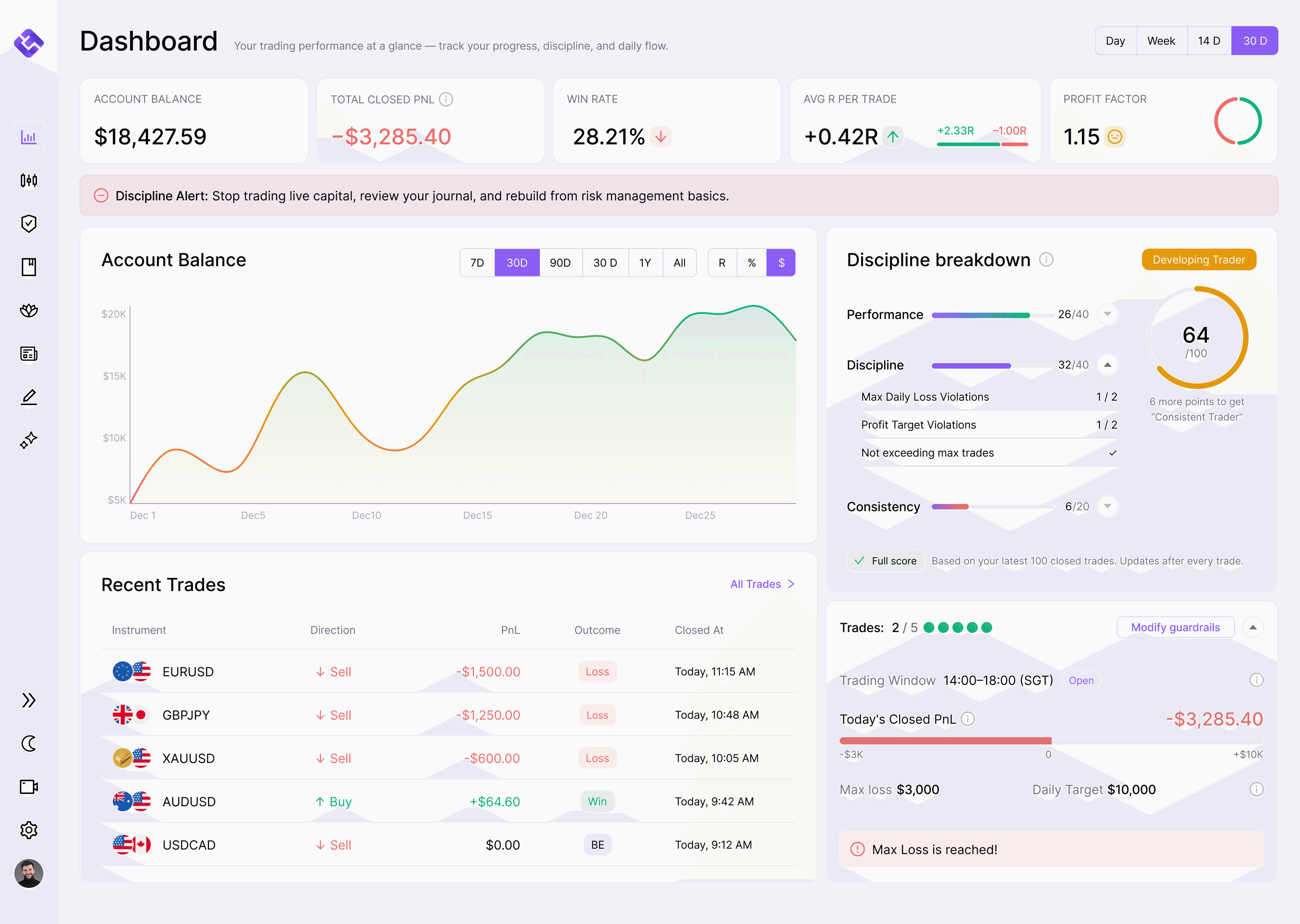
EdgeFlo's Edge plan tracks process execution alongside P&L. You define your trading rules, and after each trade, the post-trade self-reporting system asks whether you followed them. It does not just ask "did you win?" It asks "did you execute according to your plan?" That score builds over time into a discipline metric that sits right next to your returns on the dashboard.
The dashboard shows discipline metrics alongside financial returns. You can see your process compliance rate trending over weeks. If your compliance drops but your P&L is up, you know the profits are fragile. If your compliance is high but P&L dips, you know to trust the process and let variance play out.
Post-trade self-reporting scores process compliance per trade. Each entry captures whether the setup met your criteria, whether sizing was correct, and whether management followed the plan. Over 50 or 100 trades, these scores reveal whether your edge is real or whether you have been getting lucky with undisciplined entries.
The Edge Brief
Receive Insights on trading psychology, discipline, and the behavioral patterns that create consistent traders from our Founder and the EdgeFlo team, delivered to your inbox.
Think different. Trade different.
What is process oriented trading?
How do I stop focusing on P&L after every trade?
Can process oriented trading work with a low win rate?
How long does it take to become process focused?

Turn discipline on.
Every session.
EdgeFlo is the environment serious traders operate inside.
Start 7-Day Free Trial
Cancel anytime.
No long-term commitment.

Think Different, Trade Different.