
Trading and Dopamine: Why You Chase the Rush
Trading dopamine addiction keeps you chasing excitement instead of building wealth. Learn why the rush feels good and how to break the cycle.
Trading dopamine addiction is what keeps you stuck in a cycle of excitement, loss, and regret. You are not chasing money. You are chasing the feeling that comes right before the outcome, that spike of adrenaline when you click buy or sell without a plan. Dopamine rewards anticipation, not results. So every time you enter a trade on impulse, your brain gets exactly what it wanted, whether the trade wins or loses. The market becomes a slot machine. The fix is not more discipline through willpower. It is building a structure that removes the trigger entirely, so you stop feeding the cycle and start trading like a professional: boring, methodical, and profitable.
TL;DR
Dopamine rewards the anticipation of a trade, not the profit, which is why losing traders keep clicking.
Overtrading and revenge trading are dopamine-seeking behaviors disguised as strategy.
Professional traders are boring on purpose because excitement is the enemy of consistency.
Breaking the cycle requires changing your environment, not just your mindset.
Structure (trade caps, checklists, forced pauses) beats willpower every time.
The Dopamine Trap: Excitement Feels Like Progress
Ever taken a trade you knew was bad, felt the rush anyway, and then wondered why you did it? That is dopamine doing its job.
Your brain does not care whether a trade is profitable. It cares about novelty, risk, and the possibility of reward. The moment you spot a setup (or what looks like one), dopamine spikes. You feel alert, focused, certain. It feels like conviction. It is not. It is chemistry.
Here is the problem: that spike feels identical to real confidence. You cannot tell the difference in the moment. A trader who enters on impulse and a trader who enters after a full checklist both feel "sure" about their trade. But one of them built that feeling from evidence. The other got it for free from brain chemistry.
Think of it like this. You know the feeling when you add something to your online shopping cart and your finger hovers over "buy now"? That little buzz is not about the product. It is about the act of buying. Trading works the same way. The click is the reward, not the result.
One trader who failed six funded challenges puts it bluntly: "You don't actually want freedom. You want excitement." He watched himself blow challenge after challenge, not because his strategy was broken, but because he was addicted to the feeling of being in a trade. The rush of winning after a losing streak. The adrenaline of risking money he could not afford to lose.
That is the trap. Progress feels like excitement. But real progress in trading feels like nothing at all.
How Dopamine Drives Overtrading and Revenge Trades
Once you understand the dopamine mechanism, overtrading stops being a mystery. It is not a discipline problem. It is a craving problem.
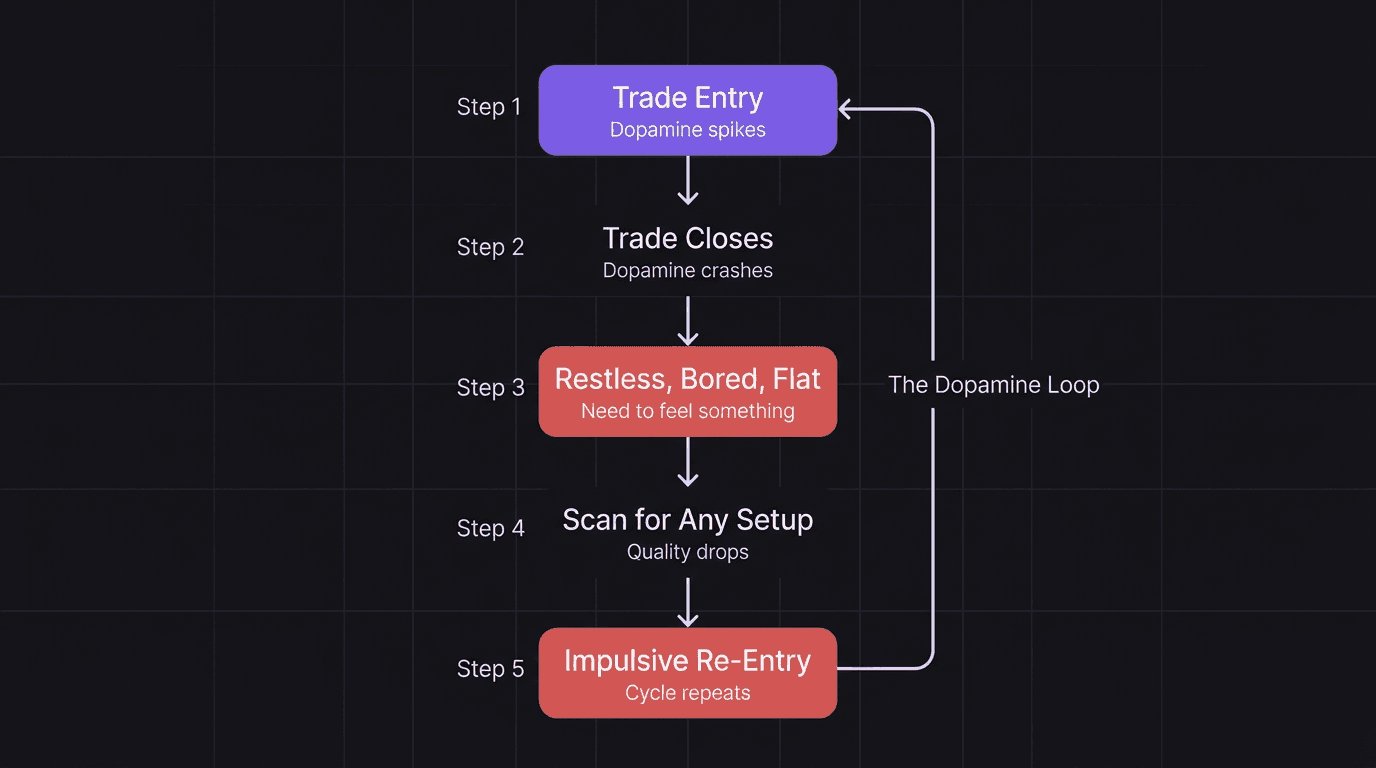
Here is what the cycle looks like:
You take a trade. Win or lose, dopamine fires during the anticipation.
After the trade closes, dopamine drops. You feel flat, bored, restless.
To get the feeling back, you scan for another setup. Anything will do.
You enter again. The spike returns. The quality of the trade does not matter.
Sound familiar? That is the same loop that drives revenge trading. A loss creates a dopamine crash. The fastest way to restore the feeling is to take another trade immediately. Not to review what went wrong. Not to step away. Just to click and feel something again.
The trader who lost six funded challenges described being "addicted to misery and suffering" and "self-sabotaging" his profits. He would build up an account, then give it all back. Not because he forgot his rules. Because the discomfort of doing nothing was worse than the discomfort of losing.
This is why telling yourself "just follow the plan" does not work when dopamine is driving. The plan says wait. Your brain says act. Your brain wins, because the neurochemical reward for acting is immediate and the reward for waiting is invisible.
Professional Trading Is Boring (By Design)
Here is the part nobody wants to hear: the traders who actually make money are, in the words of one funded trader, "extremely boring and methodical."
They execute their plan. They wait for a setup that checks every criterion. If nothing lines up, they stay out. That is it. No thrill. No adrenaline. No stories to tell at the end of the day.
Why does boring work? Because boring means the dopamine system has nothing to latch onto. When every trade looks the same (same checklist, same risk, same execution), there is no novelty. No novelty means no spike. No spike means no crash. No crash means no desperate re-entry.
"The ability to do nothing when everyone else is chasing" is what separates professionals from the other 99%. Not better indicators. Not a secret strategy. The willingness to sit still.
This is hard to accept when you are new. You started trading because it seemed exciting. Fast money, big moves, beating the market. The idea that profitability requires you to feel almost nothing while trading sounds wrong. But think about any other skilled profession. A surgeon does not get an adrenaline rush during a routine procedure. A pilot does not feel excitement during a normal landing. Consistency requires calm.
If your trading sessions feel exciting, that is a red flag. Not a green one.
Walkthrough: Dopamine-Driven Day vs Process-Driven Day
The Dopamine Day
A trader wakes up, checks GBP/USD on the 15-minute chart at 7:45 AM, 30 minutes before London open. No pre-market routine. No plan review. He sees price pulled back to a level that "looks like support" around 1.2640 and enters long with 1% risk. Within 10 minutes, the trade is down 15 pips. He feels the drop in his stomach. The trade hits his stop at 1.2610 for a full 1% loss.
Now the dopamine crash hits. He immediately scans EUR/USD, sees a bearish engulfing candle on the 5-minute chart, and shorts with 1.5% risk (he bumped it up to "make back the loss faster"). EUR/USD moves against him. Another loss, this time 1.5%. He is down 2.5% in 25 minutes.
By 9:00 AM, he has taken four trades. Three losses, one small win. Net result: down 3.2%. Every trade after the first one was taken to chase the feeling of recovery, not because the setup was in his plan. He took impulsive trades dressed up as analysis.
The Process Day
Same trader, different structure. He follows a pre-market routine: reviews his plan, marks key levels on GBP/USD and EUR/USD, checks the economic calendar, and writes down his session rules. Maximum 2 trades today. Only A+ setups from his playbook.
At 8:30 AM London open, GBP/USD sweeps the 1.2640 level and snaps back above it. This matches his playbook entry. He enters long at 1.2648 with 0.75% risk and a stop below 1.2620. Target is 1.2700 (roughly 1.8R).
At 9:15 AM, price is at 1.2665. He is in profit but not at target. He does nothing. No adjusting. No checking the trade every 30 seconds. At 10:40 AM, price hits 1.2698. He closes at 1.2695 for 1.3% gain. He journals the trade, notes what he did well, and closes the platform.
One trade. One win. Session over by 11:00 AM. The rest of his day is free. It felt boring. That is the point.
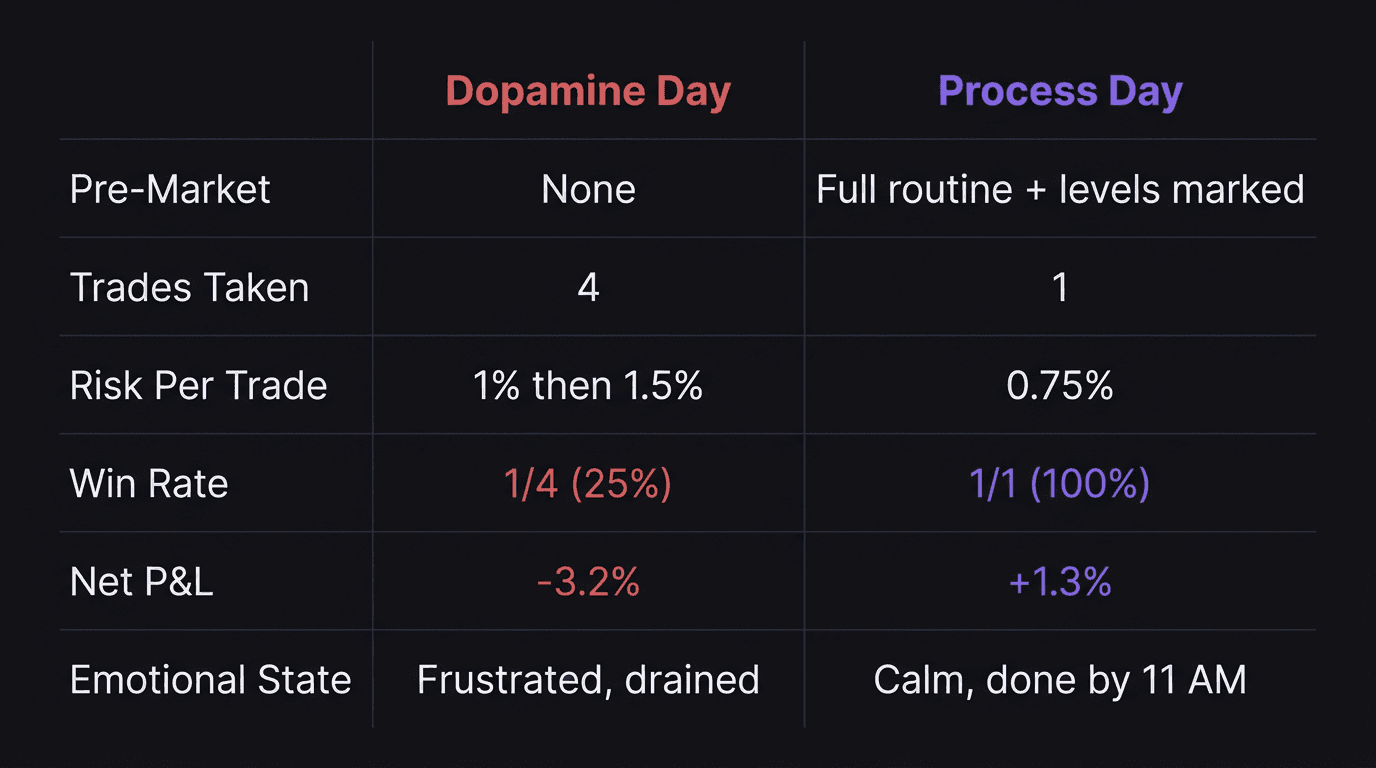
The difference is not skill. Both versions of this trader know how to read a chart. The difference is which version is trading for edge and which is trading for feeling.
Breaking the Addiction with Structure
You cannot willpower your way out of a dopamine loop. The craving is faster than the thought. By the time you think "I should not take this trade," you have already clicked.
The fix is environmental. Change the structure so the trigger never fires.
Cap Your Trade Count
Set a hard maximum: 2 trades per session, or 3 per day. Write it on a sticky note next to your screen. When you hit the cap, close the platform. This removes the option to chase. You cannot overtrade if you physically cannot enter another trade.
Add a Forced Pause Between Trades
After every trade (win or lose), wait 15 minutes before scanning again. Set a timer. During those 15 minutes, journal what just happened. Write down why you took the trade, whether it matched your plan, and how you feel right now.
That 15-minute gap kills the revenge cycle. The dopamine crash happens immediately after a loss. If you force yourself to wait, the craving fades before you can act on it.
Remove Price Alerts for Pairs You Are Not Trading
Every notification is a potential trigger. If you have alerts set for 12 currency pairs but only trade 2, you are giving your brain 10 opportunities per day to feel the urge. Delete every alert that does not match your current plan.
Follow Your Trading Rules Like a Checklist
Before every entry, run through your criteria out loud or in writing. Not in your head. Physically. If any criterion is missing, the trade is disqualified. No exceptions, no "close enough." This creates friction between impulse and action. Friction is the antidote to dopamine.
Track Your Emotional State in Your Journal
After each session, rate your emotional state: calm, anxious, frustrated, excited. Over time, you will see patterns. "Every time I trade excited, I lose" is the kind of insight that changes behavior. But you will not see it without the data.
Trading consistency is not a personality trait. It is an output of a well-designed environment. You do not need to become a different person. You need to build a system that makes the wrong action harder than the right one.
How EdgeFlo Reduces the Dopamine Trigger
EdgeFlo is built around the idea that traders do not fail because of bad analysis. They fail because their environment makes it too easy to act on impulse.
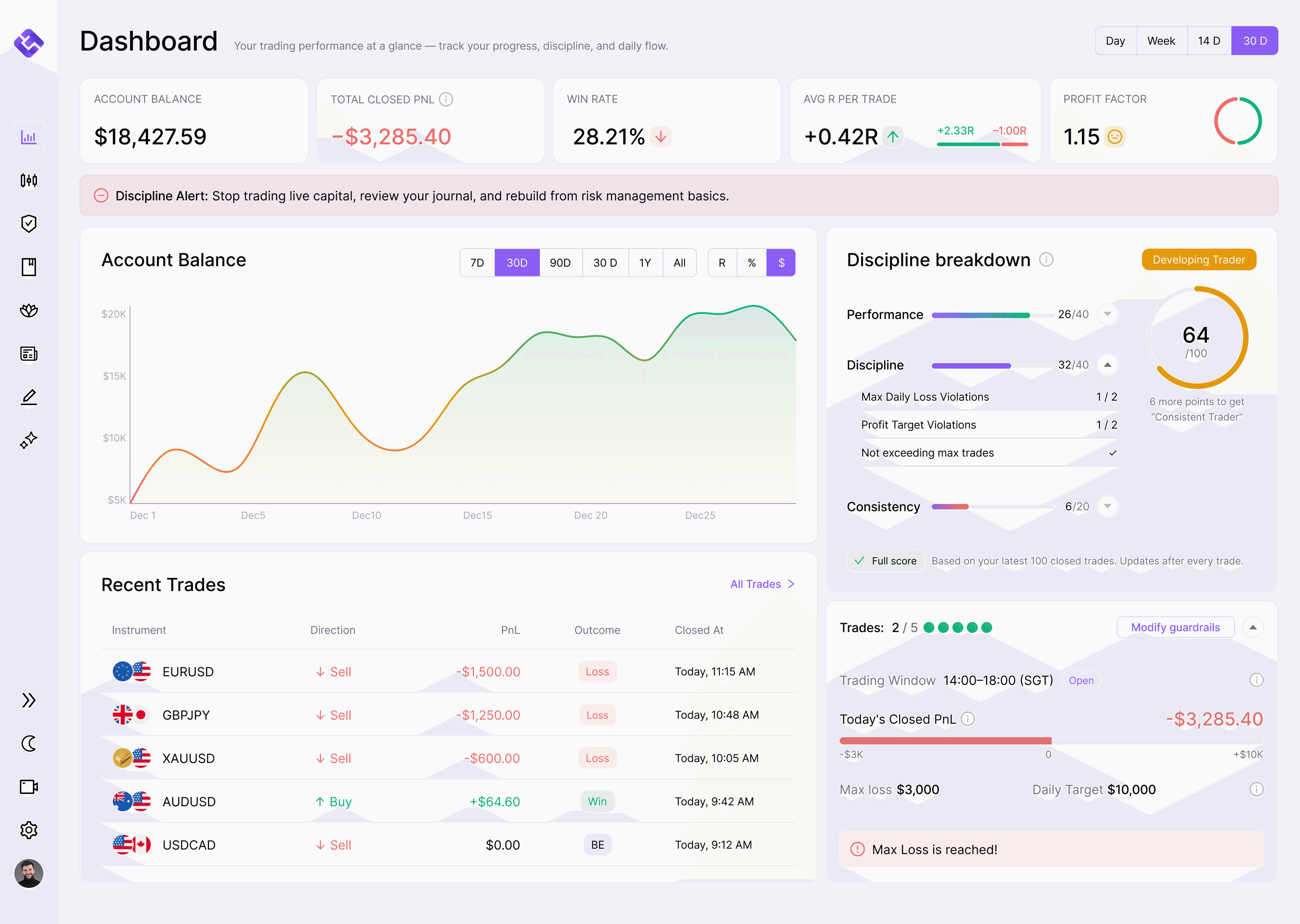
Guardrails restrict impulsive trades by flagging when you exceed your preset daily loss limit or trade count. You can override them (they are not a lock), but the override forces a conscious choice. That pause is the difference between a dopamine-driven click and a deliberate decision. Sanctuary guides recovery after emotional spikes by walking you through a structured reset before your next trade. Instead of jumping straight back in after a loss, you get a guided cooldown that breaks the revenge cycle.
The journal's emotion tagging builds pattern awareness over time. Tag each trade with how you felt at entry (calm, anxious, excited, frustrated) and the data reveals which emotional states correlate with your worst trades. You stop guessing and start seeing the pattern in black and white.
The Edge Brief
Receive Insights on trading psychology, discipline, and the behavioral patterns that create consistent traders from our Founder and the EdgeFlo team, delivered to your inbox.
Think different. Trade different.
Is trading addiction the same as gambling addiction?
How do I know if I am addicted to trading?
Can you trade profitably and still be addicted?
What is the fastest way to break the dopamine cycle in trading?
Turn discipline on.
Every session.
EdgeFlo is the environment serious traders operate inside.
Start 7-Day Free Trial
Cancel anytime.
No long-term commitment.

Think Different, Trade Different.