

Consistency Starts Before the Charts: Daily Habits of Profitable Traders
Trading consistency comes from daily habits, not chart skills. Build the off-chart routine that drives on-chart discipline and stops reactive trading.
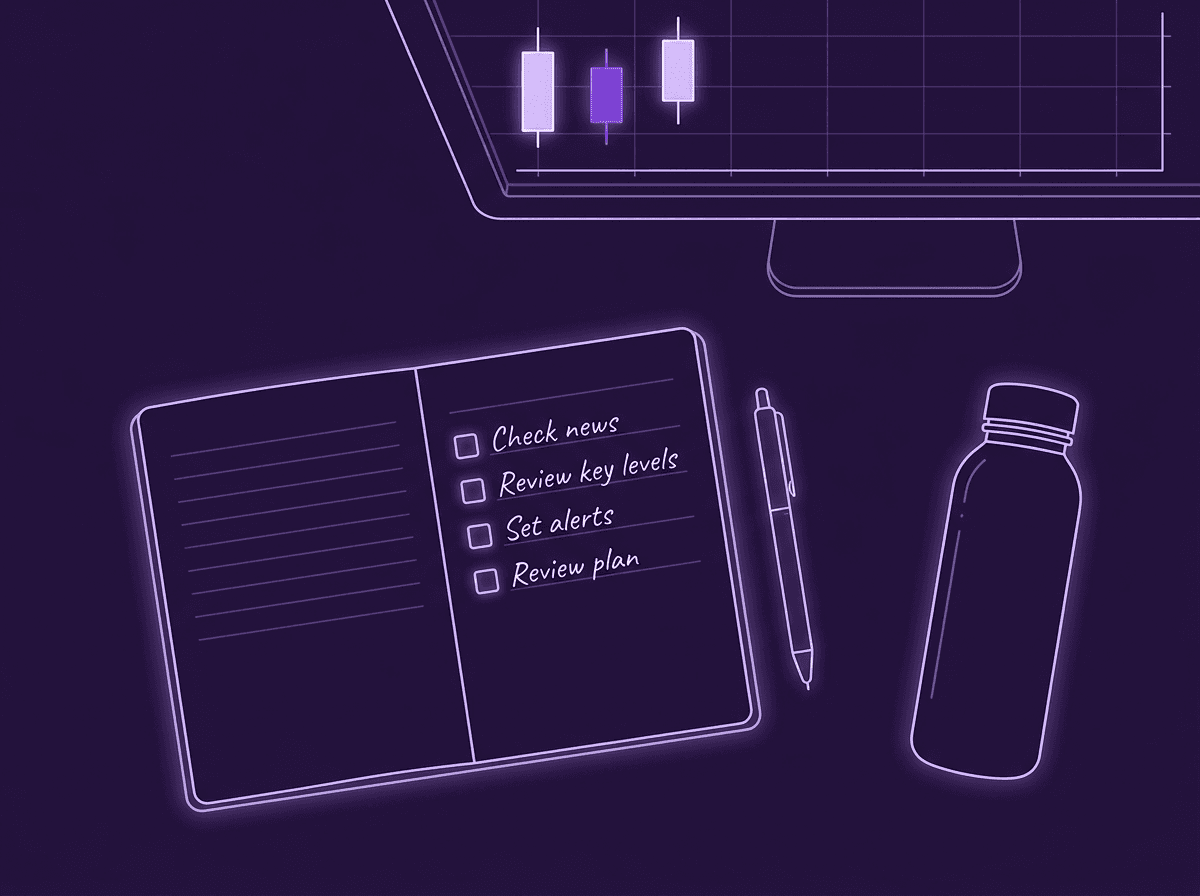
You know the setups. You have studied the charts. You can identify supply and demand zones, mark structure, and build a daily bias. And yet, you still take emotional trades, break your rules, and give back profits on days when you feel off.
The issue is not your chart skills. The issue is everything that happens before you open the chart.
Profitable traders are consistent because their daily habits are consistent. Sleep, exercise, nutrition, and mental preparation all feed into the decision-making engine that runs during live market hours. If that engine is running on 4 hours of sleep and a caffeine crash, no amount of technical knowledge will save you from impulsive entries.
TL;DR
Chart skills mean nothing if your mental state is compromised by poor sleep, stress, or no routine.
Physical discipline (sleep, exercise, nutrition) directly transfers to trading discipline.
A non-negotiable daily routine removes decision fatigue before you reach the charts.
Consistency in your off-chart habits drives consistency in your on-chart execution.
Track your daily habits alongside your trading results to find the connection.
Why Chart Skills Are Not Enough
Every trader who has been at this for more than a few months has had this experience: you take the exact same setup on two different days. One day you execute perfectly, hold to target, walk away clean. The next day you second-guess the entry, move your stop, close early, then re-enter impulsively.
Same setup. Same rules. Completely different execution.
The variable was not the chart. The variable was you. Specifically, the version of you that showed up that day. Were you rested or exhausted? Stressed about something outside of trading? Did you skip your pre-market routine and jump straight to the charts?
Your execution quality is a mirror of your mental state. And your mental state is a product of what you did in the 12 hours before you sat down to trade.
This is not motivational fluff. It is observable. Track your sleep, your exercise, and your mood for 30 days alongside your trading results. The correlation will surprise you.
The Off-Chart Habits That Drive On-Chart Results
These are not suggestions. For traders who are serious about consistency, these are requirements.
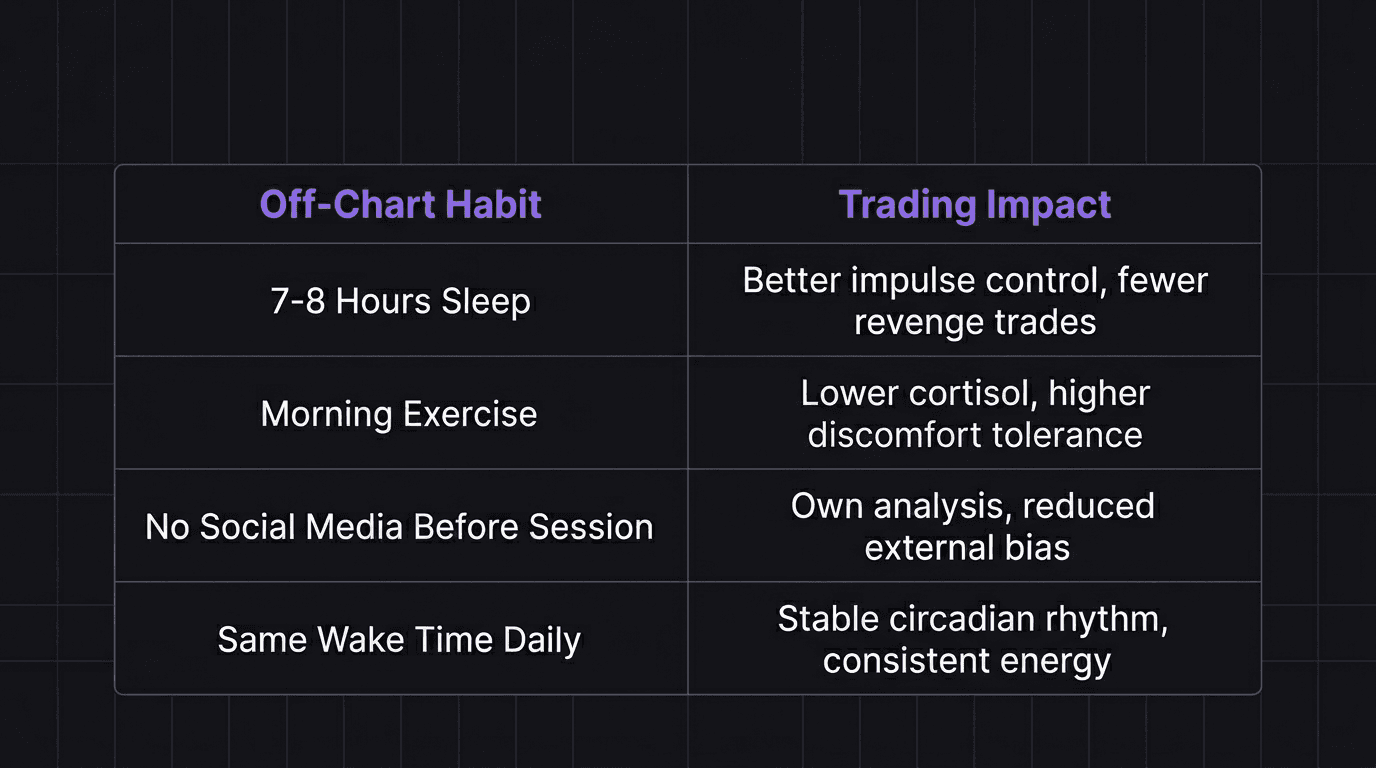
Sleep: 7 to 8 hours, same time every night. Your prefrontal cortex, the part of your brain responsible for impulse control and rational decision-making, degrades rapidly with sleep deprivation. After one night of poor sleep, your risk tolerance increases, your patience decreases, and you become more likely to chase trades you would normally skip.
Sound familiar? That Friday afternoon where you took three off-plan trades and lost $400? Check what time you went to bed Thursday night.
Exercise: 30 to 60 minutes, before your trading session. Physical training does two things. It reduces cortisol (the stress hormone that makes you reactive) and it builds the habit of voluntary discomfort. You choose to struggle in the gym so that when the market makes you uncomfortable, your nervous system already knows how to sit with that feeling instead of reacting to it.
Nutrition: Steady energy, no crashes. Trading on a sugar spike and caffeine crash is trading with a ticking clock. At some point during the session, your blood sugar drops, your focus fragments, and you start making decisions that the version of you from two hours ago would never approve.
No screens for the first 30 minutes. Social media, news, and market commentary before your session prime your brain for reactivity. You start the day absorbing other people's opinions instead of forming your own analysis. By the time you open your charts, you are already biased by someone else's bias.
Walkthrough: The Morning That Goes Wrong
A trader wakes up at 8:45 AM for a 9:30 AM session. No time for exercise. Skips breakfast, grabs coffee. Checks Twitter while brushing teeth, sees someone calling GBP/USD a "clear short." Opens charts at 9:25, sees price at 1.2650, immediately looks for bearish setups because of the tweet.
Enters short at 1.2645 with a 10-pip stop. Gets stopped out at 1.2655. Re-enters short at 1.2640. Gets stopped out again at 1.2650. Two losses, $200 down, session barely started.
Now compare: same trader, different morning. Wakes up at 7 AM. Works out for 40 minutes. Eats a proper meal. Sits down at 8:30, runs through the pre-market routine, marks structure on the daily and 4-hour charts. Identifies a demand zone at 1.2620 that aligns with the weekly range low. Decides to wait for price to reach 1.2620 before considering a long. Does not check social media.
At 10 AM, price sweeps 1.2618, reacts with a bullish engulfing candle. Enters long at 1.2625 with a 15-pip stop at 1.2610. Target at 1.2685.
Same person. Same pair. The only difference was the morning.
Building a Non-Negotiable Daily Routine
The word "non-negotiable" matters. If your routine is optional, it will not survive a bad week. The moment you feel stressed or tired, optional activities are the first things you cut. And those are exactly the moments when you need the routine most.
Here is a structure that works. Adjust the timing to your session, but keep the sequence.
Wake up at the same time every day. No negotiation.
30 to 60 minutes of physical exercise.
Eat a meal with protein, fats, and complex carbs. No sugar bombs.
Sit down. No phone, no social media.
Open your trading rules document. Read them. Every day.
Run your pre-market routine: mark structure, identify key levels, build your daily bias.
Write down your plan for the session. Which pairs, which direction, which zones.
Execute from the plan. If the setup is not there, do nothing.
After each trade, log emotion and outcome.
Close the charts. No more trading.
10-minute review: what did you follow? What did you break?
Update your habit tracker.
The routine is not complicated. The hard part is doing it on the days when you do not feel like it. Those are the days that define your results.
How Physical Discipline Transfers to Trading Discipline
The gym builds more than muscle. It builds the capacity to choose discomfort over comfort, which is exactly what trading demands.
Every profitable trading behavior is uncomfortable in the moment. Sitting out when there is no setup. Holding through a pullback. Taking a loss and walking away instead of revenge trading. Keeping your lot size the same after three wins in a row.
When you train yourself to push through physical discomfort daily, your tolerance for psychological discomfort increases. You build what some call "discipline endurance," the ability to make the hard choice repeatedly without burning out.
This is not abstract. Traders who exercise regularly report fewer instances of revenge trading, lower emotional reactivity, and better adherence to their trading plans. The gym does not teach you where to place your stop loss. But it teaches you to leave it there once it is placed.
How EdgeFlo Enforces Pre-Market Routines
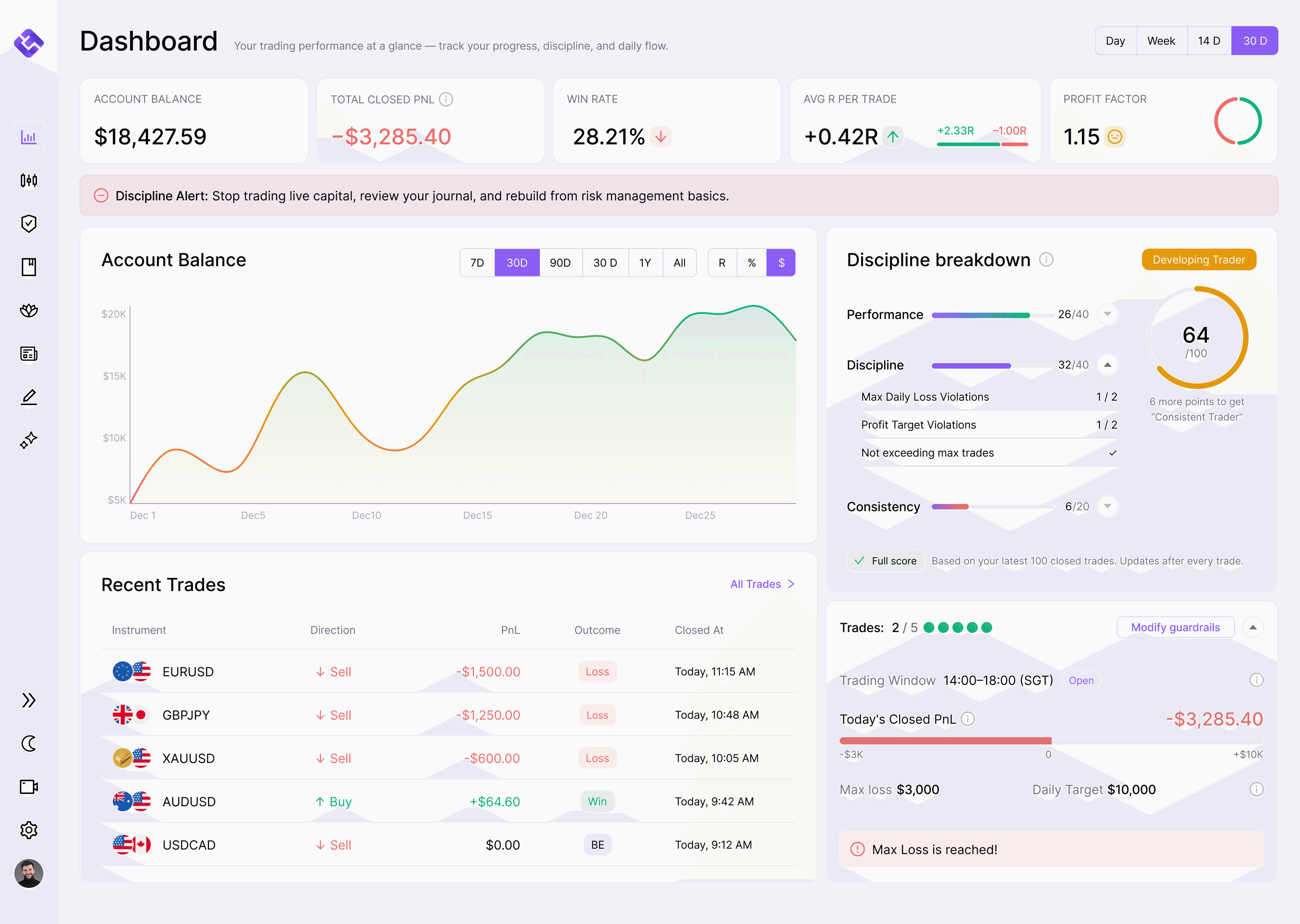
EdgeFlo prompts you to complete your pre-market checklist before the trading interface activates. Each step of your routine appears as a checkpoint. You can customize which steps to include (marking structure, reviewing your plan, checking the economic calendar), but you cannot skip the sequence without deliberately choosing to override it.
This matters because it turns your routine from a self-enforced discipline into an environment-enforced discipline. On the days when you would normally skip your preparation and jump straight to the charts, EdgeFlo makes skipping a conscious decision rather than an unconscious default.
The pre-market routine is not enforced, meaning you can override it. But having to choose to skip creates a moment of awareness that catches most impulsive sessions before they start.
The Edge Brief
Receive Insights on trading psychology, discipline, and the behavioral patterns that create consistent traders from our Founder and the EdgeFlo team, delivered to your inbox.
Think different. Trade different.
Why do daily habits matter more than chart skills for trading?
What is the most important off-chart habit for traders?
How long does it take to build a consistent trading routine?
Can physical exercise actually improve trading results?

Turn discipline on.
Every session.
EdgeFlo is the environment serious traders operate inside.
Start 7-Day Free Trial
Cancel anytime.
No long-term commitment.

Think Different, Trade Different.