

Trading Confidence From Data, Not Motivation
Real trading confidence comes from data, not willpower. Learn how tracking your win rate, R multiples, and equity curve builds the conviction to execute without hesitation.
Real trading confidence does not come from motivation, affirmations, or watching someone else's success story. It comes from your own data. A track record of 50, 100, or 200 trades executed under the same rules, with numbers that prove your strategy actually works.
If you have ever hesitated to pull the trigger on a valid setup, or skipped a trade because your last three were losers, the problem is not willpower. The problem is that you do not have enough data to believe in your own edge. Fix the data problem, and the confidence follows.
TL;DR
Confidence based on willpower collapses during losing streaks. Data-based confidence survives them.
The metrics that matter: win rate, average R, expectancy, and equity curve shape.
A dashboard makes your edge visible, turning raw numbers into conviction.
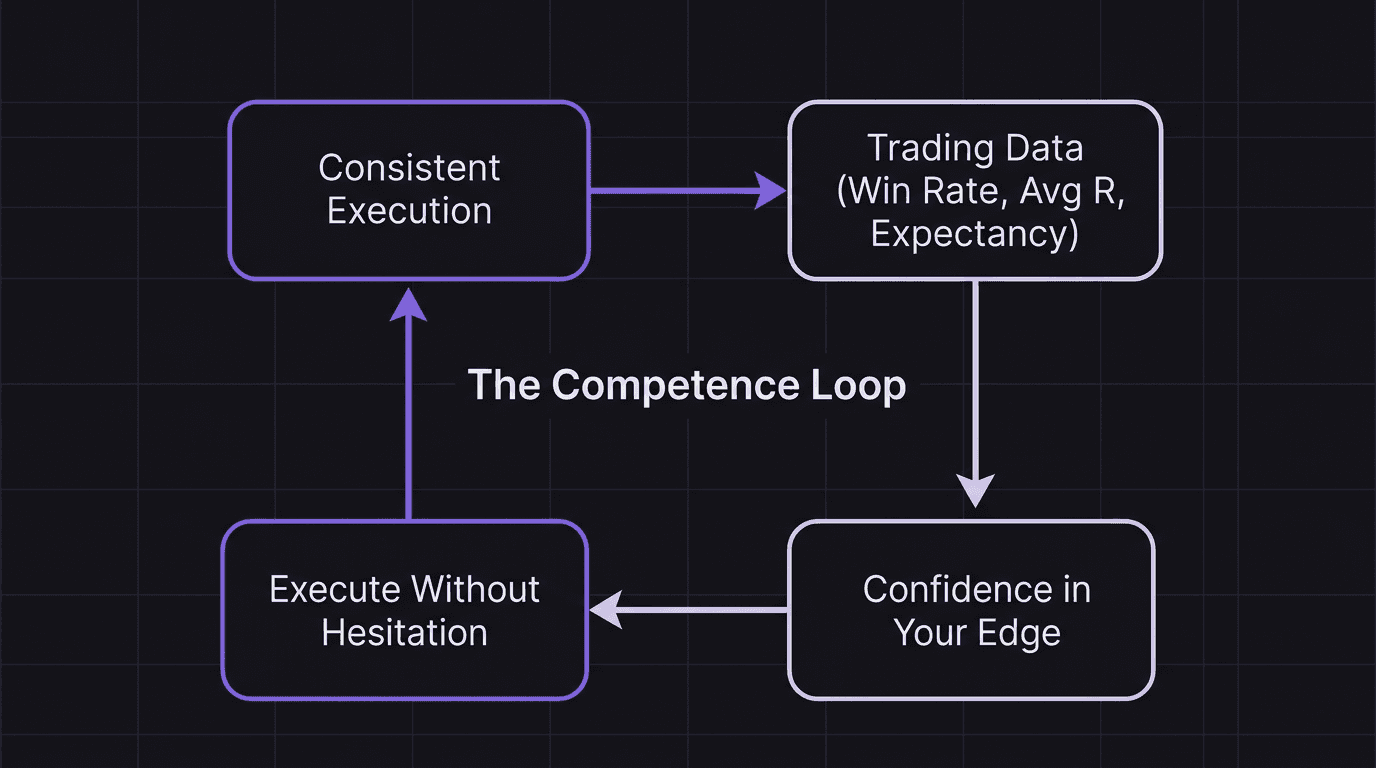
The competence loop: consistent execution produces data, data builds confidence, confidence improves execution.
You need at least 50 trades under the same rules before your data means anything.
Why Confidence Cannot Come From Willpower
You know the pattern. You read a motivational post, feel fired up, and tell yourself tomorrow will be different. Then you take two losses in a row, and all that motivation evaporates. You hesitate on the third setup. Skip the fourth. By the end of the week, you are right back to doubting everything.
This is not a discipline problem. This is a belief problem. And beliefs do not change because you want them to. They change because of evidence.
Think about it this way: if someone told you a coin lands heads 60% of the time, would you believe them? Maybe. But if you flipped that coin 100 times and counted 62 heads yourself, you would believe it without question. That is the difference between willpower-based confidence and data-based confidence.
The same principle applies to your trading. Telling yourself "my strategy works" after three losses means nothing. Seeing 127 trades in your journal with a 58% win rate and 1.4R average winner means everything. You do not need to believe anymore. You know.
If you have been struggling with trading confidence after losses, the fix is almost always more data, not more motivation.
The Data That Builds Real Confidence
Not all trading data is equal. Some metrics tell you whether your strategy has an edge. Others just make you feel good (or bad) without telling you anything useful.
Here are the four metrics that actually build confidence:
Win rate. The percentage of trades that hit your take profit. By itself, win rate means nothing (a 30% win rate with 5:1 reward-to-risk is excellent). Combined with your average R, it tells you whether your strategy makes money over time.
Average R (winner vs. loser). How large are your winners compared to your losers? If your average winner is 2.1R and your average loser is 1R, you know your wins are more than double your losses in dollar terms.
Expectancy. This is the number that matters most. Expectancy tells you how much you make per trade on average, across all winners and losers. A positive expectancy means your strategy makes money over a large sample.
Equity curve. The visual proof. An upward-trending equity curve over 50 or more trades is the clearest evidence that your edge is real. It also shows you where your drawdown periods happen, so you know what to expect during the rough stretches.
Calculate your own trading expectancy and look at it before every session. That single number does more for execution confidence than any pep talk.
Walkthrough: What the Numbers Look Like
A trader executes 80 trades over two months, all following the same mechanical plan. The results: 47 winners, 33 losers. Win rate: 58.75%. Average winner: 1.8R. Average loser: 1R. Expectancy: (0.5875 x 1.8) minus (0.4125 x 1.0) = 1.0575 minus 0.4125 = 0.645R per trade.
That means every trade this trader takes, on average, returns 0.645R. At 1% risk per trade, that is 0.645% account growth per trade. Over 80 trades, that is approximately 51.6% account growth before compounding.
When this trader faces three losses in a row, they do not panic. They have seen losing streaks in their data before, and the overall curve still trends upward. That is data-based confidence.
How a Dashboard Makes Your Edge Visible
Raw journal entries are useful, but they require effort to interpret. You have to calculate averages, count trades, and build your own equity curve. Most traders just... do not do that consistently enough.
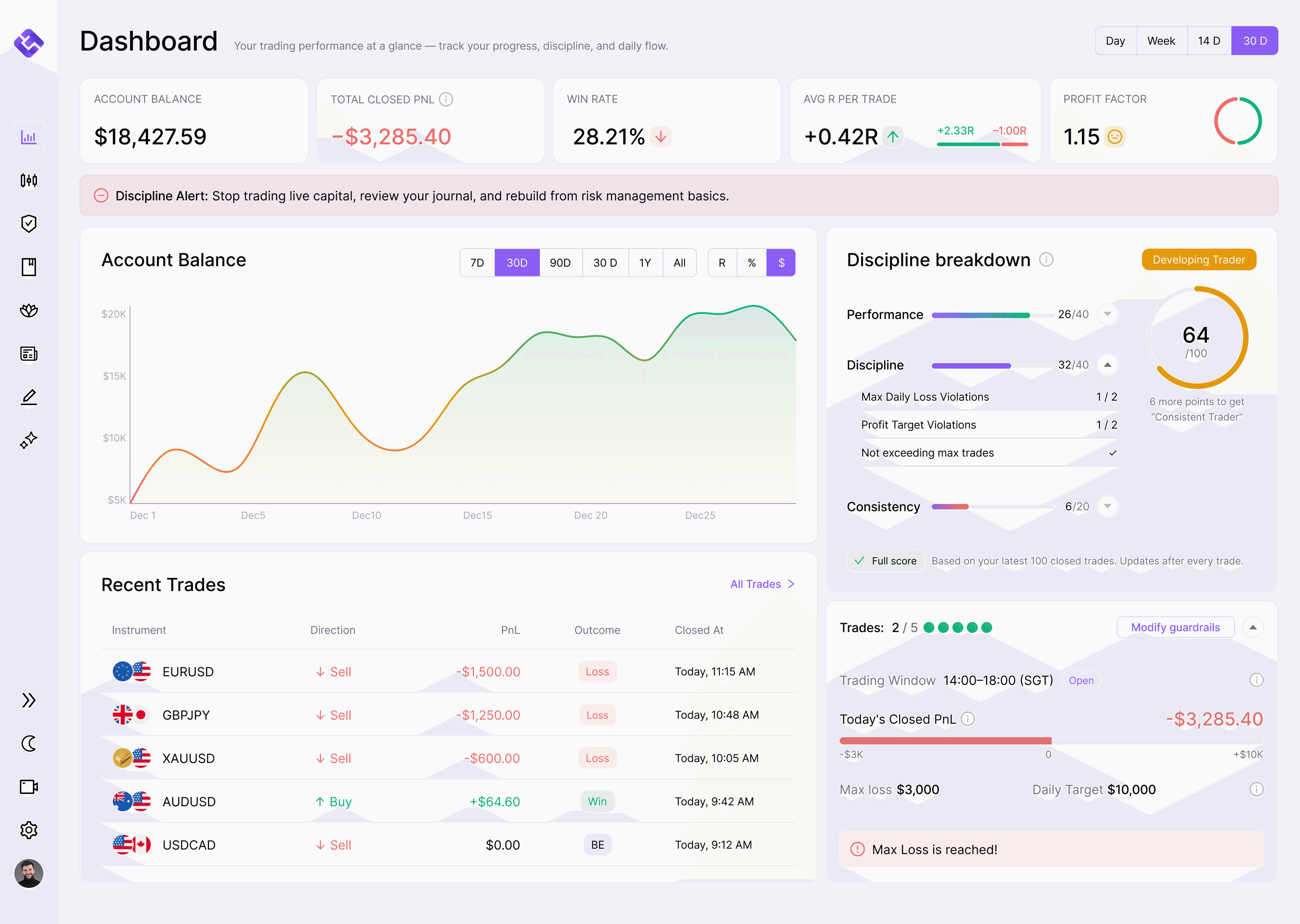
A trading dashboard solves this by turning your journal data into visual metrics automatically. You open your dashboard and see your win rate, your expectancy, your equity curve, and your discipline score without doing any math.
This matters because visibility creates conviction. When your edge is buried in a spreadsheet you update once a month, it feels abstract. When it is on your screen every morning before you trade, it feels real.
The best time to look at your dashboard is right before you start trading. Not during (that leads to PnL watching). Before. It reminds you: "Your strategy works over a large sample. The next trade might win or lose, but the edge is real."
Your equity curve is especially powerful during drawdowns. A downward dip in the context of an overall uptrend looks very different from a downward dip with no context. One is a normal pullback. The other is terrifying. The dashboard gives you that context.
From Doubt to Conviction: The Competence Loop
Confidence is not a personality trait. It is a feedback loop. And like any loop, it can spiral upward or downward depending on the input.
The downward loop works like this: you trade without data, doubt creeps in after losses, you hesitate or skip setups, your results get worse, and doubt increases. Each cycle reinforces the one before it.
The upward loop (the competence loop) works the opposite way: you execute your plan consistently, you collect data from those trades, the data shows a positive edge, you gain confidence from that proof, and confidence makes it easier to execute the next trade without hesitation. Each cycle reinforces the one before it.
The key to entering the upward loop is simple, but not easy. You need a minimum sample size of trades, all taken under the same set of rules. Fifty trades is the bare minimum. One hundred is better. Below that, random variance makes your numbers unreliable, and you cannot draw real conclusions.
This is also why journaling your trades is not optional busywork. The journal is the raw material that feeds the dashboard, which feeds the confidence loop. Without it, you are guessing about your edge instead of knowing it.
Here is the uncomfortable truth: if you have been trading for months and you still do not have enough data to calculate your win rate and expectancy, the problem is not the market. The problem is inconsistency in either your strategy or your tracking. Fix that, and the conviction comes.
How EdgeFlo Connects Your Data to Confidence
EdgeFlo's trading dashboard calculates your win rate, average R, and expectancy automatically from your journal entries. Every trade you log feeds directly into the metrics you need to see.
Your equity curve updates in real time, so you can see where you stand after every session. During a drawdown, you can zoom out and see the full picture rather than getting trapped in the pain of the last three trades.
The weekly AI report (available on Plus) highlights patterns in your recent performance, including whether your edge is holding steady or drifting. That kind of automated feedback keeps the competence loop turning without requiring you to do the analysis yourself.
The Edge Brief
Receive Insights on trading psychology, discipline, and the behavioral patterns that create consistent traders from our Founder and the EdgeFlo team, delivered to your inbox.
Think different. Trade different.
How do I build confidence in trading?
What data should I track to build trading confidence?
Why does willpower not work for trading confidence?
How many trades do I need before I can trust my trading data?

Turn discipline on.
Every session.
EdgeFlo is the environment serious traders operate inside.
Start 7-Day Free Trial
Cancel anytime.
No long-term commitment.

Think Different, Trade Different.