

Trading Burnout: Why Screen Time Kills Performance
More screen time does not mean more profit. Learn why overexposure to charts drains your edge and how to structure focused, limited trading sessions.
You traded for 7 hours yesterday. Your first two trades were clean: planned entries, proper stops, calm management. By trade five, you were forcing setups that were not there. By trade seven, you were revenge trading a loss that happened because you were too tired to follow your own rules.
More screen time does not produce more profit. Past a threshold, it actively destroys your edge. This is trading burnout, and it does not arrive with a dramatic crash. It sneaks in through accumulated fatigue, one extra hour at a time.
TL;DR
Decision fatigue from extended chart watching degrades execution quality before you consciously feel tired.
Most traders produce their best results in a 2 to 3 hour focused window. Hours 4 through 8 generate the majority of avoidable losses.
Burnout is not just emotional exhaustion. It changes how your brain processes risk, pattern recognition, and impulse control.
The fix is structural: pick one session, set a hard close time, and treat time away from screens as part of your edge.
Recovery from accumulated burnout requires full days off, not just lighter trading.
The Decision Fatigue Problem
Every candle on your chart is a decision point. Enter or wait? Hold or exit? Is that a setup or noise? Adjust the stop or leave it? These micro-decisions run continuously while the chart is open, whether you are actively trading or just watching.
Research on decision fatigue shows a consistent pattern: the quality of decisions degrades as the number of decisions increases. It does not matter how motivated you are or how much caffeine you drink. Your prefrontal cortex, the part of the brain responsible for discipline and impulse control, has a finite capacity per day. When that capacity runs out, you default to the path of least resistance: impulsive entries, emotional exits, and abandoned rules.
This is why your first trade of the session is usually your best. You are fresh. Your pattern recognition is sharp. Your risk discipline is intact. By hour four, the same brain is running on fumes. The setup that you would have skipped at 8 AM looks "good enough" at 2 PM because your quality filter has degraded.
Sound familiar? That afternoon trade you keep taking, the one that never seems to work, probably is not a strategy problem. It is a fatigue problem.
What Burnout Actually Looks Like
Trading burnout does not show up as dramatic collapse. It shows up as a slow performance leak. Here are the real symptoms:
You start taking B and C setups. Your backtest is built on A-grade entries. But after 3 hours of watching, the boredom and frustration of not seeing your setup push you into trades that "sort of" meet your criteria. You tell yourself they are good enough. They are not.
Your patience disappears. Trading patience is a depletable resource, not a character trait. At the start of your session, you can sit through 45 minutes of choppy price action without blinking. By hour five, a 10-minute consolidation feels unbearable, and you enter early to end the waiting.
You overtrade. Not because you see more setups, but because inaction feels worse than action. The screen is right there. The button is right there. Sitting still requires more willpower than clicking, and your willpower is spent. This is the engine behind most overtrading episodes.
You stop journaling mid-session. The first two trades get detailed notes. Trade four gets a quick line. Trade six gets nothing. The journaling drops because the mental energy required to reflect is gone, which means you lose the feedback loop at exactly the moment you need it most.
Your mood shifts. You started the session calm and focused. Now you are irritable. Not because something bad happened, but because 5 hours of micro-decisions has drained the part of your brain that regulates emotional response. This is when a normal loss turns into revenge trading, because you no longer have the executive function to respond rationally.
Walkthrough: The 7-Hour Session
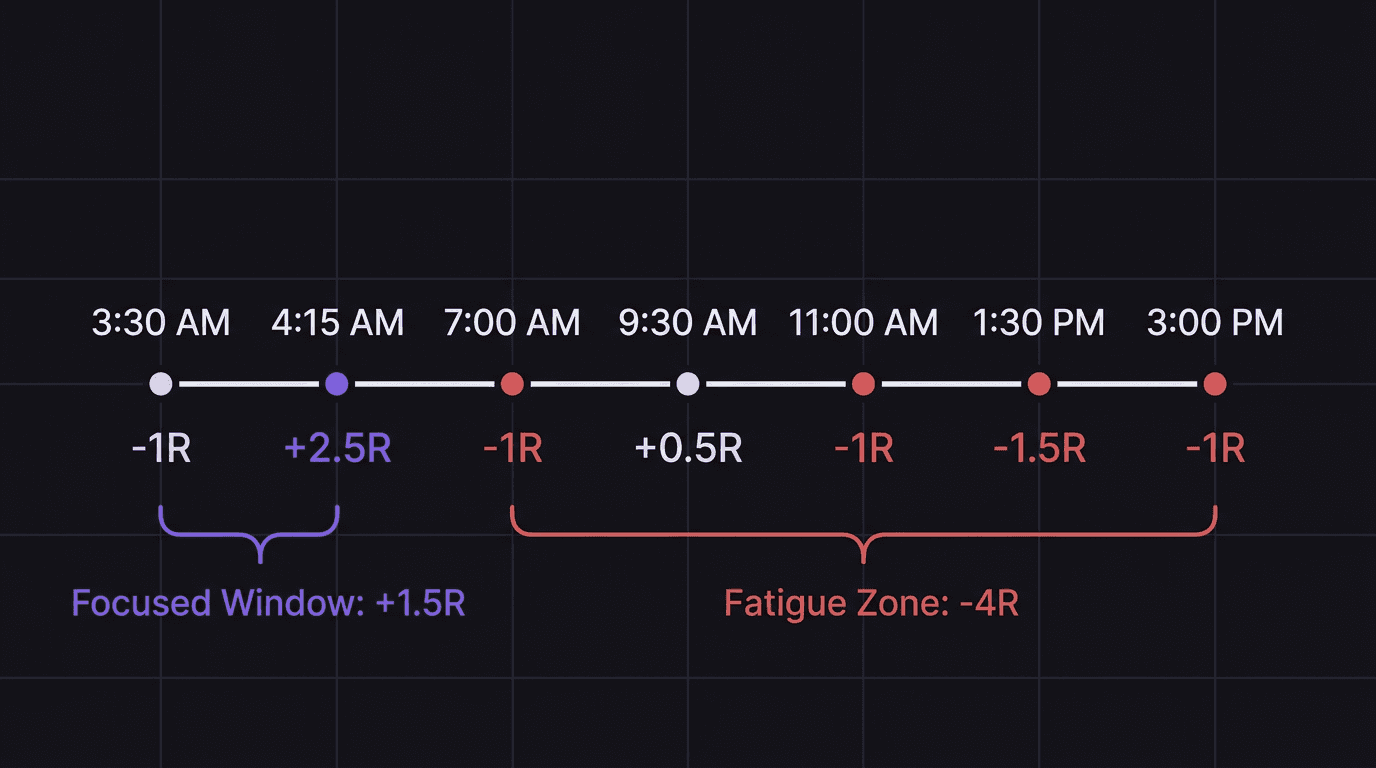
A trader watches EUR/USD from London open at 3:00 AM EST through the end of New York session at 4:00 PM EST. He takes the following trades:
Trade 1 (3:30 AM): A-grade setup. Long from a demand zone. 1R loss at stop. Clean exit. Proper execution.
Trade 2 (4:15 AM): A-grade setup. Short after a liquidity sweep. Runs to 2.5R. He takes profit per plan.
Trade 3 (7:00 AM): B-grade setup. "Close enough" to his entry criteria. 1R loss. He would not have taken this in a backtest.
Trade 4 (9:30 AM): B-grade setup. Another "close enough" entry. 0.5R partial win. He moves his stop to breakeven too early because he is feeling uneasy.
Trade 5 (11:00 AM): No real setup. He enters because he has been watching for 2 hours without a trade and wants to "do something." 1R loss.
Trade 6 (1:30 PM): Revenge entry after trade 5. No plan, no structure. 1.5R loss.
Trade 7 (3:00 PM): Desperation trade to recover the day. 1R loss.
Session result: 2.5R win, 5R in losses. Net: negative 2.5R. Trades 1 and 2 produced +1.5R net (2.5R win minus 1R loss). Trades 3 through 7 produced negative 4R.
Trade 1: negative 1R.
Trade 2: positive 2.5R.
Trade 3: negative 1R.
Trade 4: positive 0.5R.
Trade 5: negative 1R.
Trade 6: negative 1.5R.
Trade 7: negative 1R.
Total: 2.5R plus 0.5R minus 1R minus 1R minus 1R minus 1.5R minus 1R = negative 2.5R.
Trades 1 and 2 combined: negative 1R plus 2.5R = positive 1.5R.
Trades 3 through 7 combined: negative 1R plus 0.5R minus 1R minus 1.5R minus 1R = negative 4R.
If he had closed his charts after trade 2, he would be up 1.5R. The extra 5 hours cost him 4R. The screen time did not create opportunities. It created mistakes.
The One-Session Fix
The most effective cure for trading burnout is also the simplest: trade one session and walk away.
Pick London or New York. Not both. Trade your 2 to 3 hour window, take whatever setups appear, and close the platform when the window ends. No "just checking" the charts later. No peeking at the Asian session because you cannot sleep.
This is not about laziness. It is about engineering a constraint that protects you from your own fatigue. The market offers setups continuously. Your ability to evaluate them well does not last continuously. Matching your exposure to your capacity is a performance optimization, not a limitation.
Traders who resist this idea usually argue that more screen time means more opportunities. The data says otherwise. More screen time means more noise, more marginal setups, and more decisions made on depleted willpower. The A-grade opportunities that drive your edge tend to cluster in specific session windows. The hours between those windows are where burnout lives.
Recovery Is Not Optional
If you have been running 6 to 8 hour sessions for weeks or months, cutting to 3 hours tomorrow will help but will not fully fix the accumulated fatigue. You need actual time off.
Minimum recovery: 3 full days away from charts. Not lighter trading. Not just checking. Fully off. Do something that has nothing to do with screens or markets. Your brain needs time to restore the executive function that weeks of overexposure depleted.
Ideal recovery for chronic burnout: 5 to 7 days. Take a week off trading. Your edge will still be there when you come back. Your funded account will still be there. The only thing that expires during a break is the fatigue, and that is exactly the point.
When you return, start with your pre-market routine and a single focused session. Log your energy and focus scores. Compare them to your pre-break scores. Most traders report a measurable improvement in execution quality after just 3 to 5 days off.
Building a Sustainable Screen Schedule
Sustainability matters more than intensity. A trader who trades 3 focused hours per day for 10 years will dramatically outperform one who trades 8 frantic hours per day for 18 months before burning out.
Here is a structure that works:
Pre-session (30 minutes): Review levels, mark zones, write your if-then plan for the day. This is not screen time. This is prep time. No trades, no live charts.
Active session (2 to 3 hours): Charts open, full focus. Execute qualifying setups. Journal each trade immediately.
Post-session (15 minutes): Review the trades you took. Note what you did well and what you want to improve. Close the charts.
Rest of day: No charts. No market analysis. No "just looking." The market does not need you. You need recovery time to be sharp tomorrow.
This schedule keeps your total screen exposure under 4 hours. It concentrates your best decision-making capacity into the window that matters most. And it builds in the recovery time that prevents the slow leak of accumulated fatigue.
How EdgeFlo Prevents the Burnout Cycle
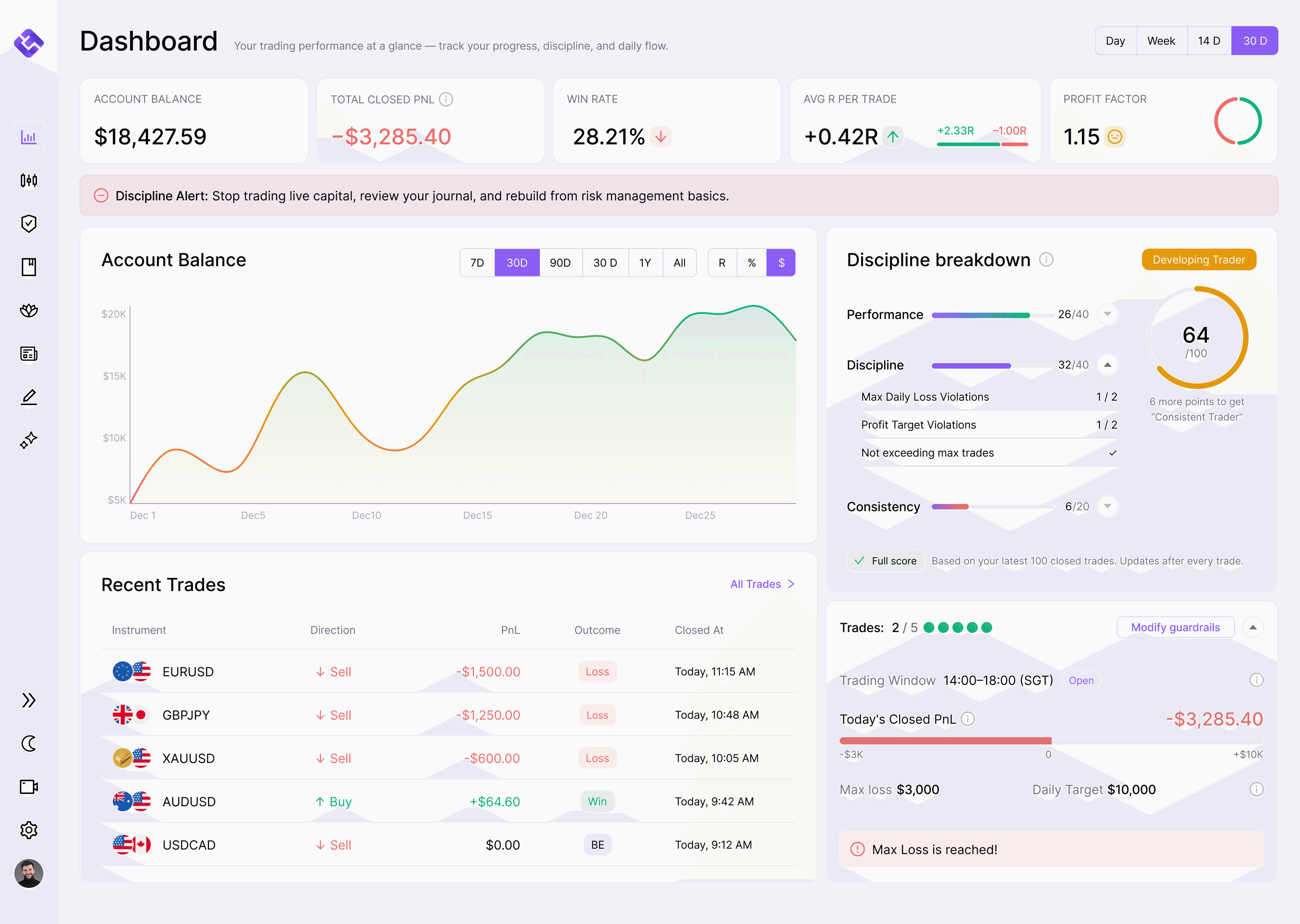
EdgeFlo's guardrails let you set a maximum trade count per day. When you hit the limit, the system restricts new entries (with override available if you genuinely need it). For burnout-prone traders, this is the structural equivalent of a hard close time. You decide your limit when you are fresh, and the system holds you to it when you are fatigued.
The daily loss limit works the same way. If accumulated losses for the day reach your pre-set threshold, EdgeFlo flags it before you can add to the damage. You chose that threshold during planning, not during an emotional spiral at hour six.
The journal's emotion tagging reveals burnout patterns over time. When you see that your focus scores drop below 3 after the third hour consistently, and that 80% of your below-3 trades are losers, the argument for a shorter session makes itself. The data replaces willpower. You are not forcing yourself to trade less. You are responding to evidence that trading less is trading better.
The Edge Brief
Receive Insights on trading psychology, discipline, and the behavioral patterns that create consistent traders from our Founder and the EdgeFlo team, delivered to your inbox.
Think different. Trade different.
What causes trading burnout?
How many hours should a trader spend on charts per day?
Can you recover from trading burnout without stopping?
Does trading fewer hours mean fewer opportunities?

Turn discipline on.
Every session.
EdgeFlo is the environment serious traders operate inside.
Start 7-Day Free Trial
Cancel anytime.
No long-term commitment.

Think Different, Trade Different.