

Your Trading Ceiling and Floor: Find Both
Every trader oscillates between a personal ceiling and floor. Learn to find both numbers in your data and track real progress instead of chasing peaks.

Traders love to talk about their best month. The peak. The personal record. But the number that actually predicts where your account is headed is not your ceiling. It is your floor.
Every trader has a personal range: a ceiling (the best stretch you can sustain before things unravel) and a floor (the worst drawdown you hit before disgust forces you back on track). Understanding both numbers, and tracking how they change over time, is more useful than any single equity high-water mark.
TL;DR
Your ceiling is the peak performance you reach before complacency kicks in.
Your floor is the worst drawdown you tolerate before you reset and start doing the right things again.
The gap between them defines your current consistency range.
Narrowing that gap by raising the floor is the fastest path to stable results.
Tracking both numbers over time shows real progress, not just lucky months.
What Your Ceiling and Floor Actually Measure
Your ceiling is not your potential. It is the level where your current identity, habits, and discipline top out. When you hit your ceiling, something shifts. Complacency creeps in. You stop doing the things that got you there. The decline begins.
Think about it this way: if your best month is +8% and you consistently fall apart after hitting that level, your ceiling is +8%. It does not matter that you believe you could make 15%. Your actual behavior tells a different story.
Your floor works the same way in reverse. It is the worst performance level you tolerate before the pain gets bad enough to force change. Maybe you can stomach a 5% drawdown, but at 10% you feel disgusted enough to buckle down and restart your process. That 10% drawdown point is your floor.
The average state, where you spend most of your trading days, sits somewhere between these two extremes. And here is the insight that changes everything: if you can raise your average state, your overall results improve. The fastest way to raise your average is not to chase a higher ceiling; it is to raise the floor.
How to Find Your Numbers in Your Trade History
Finding your ceiling and floor requires honest data. If you are not journaling, you are guessing. If you are journaling, the numbers are already there.
Here is how to extract them:
Step 1: Pull 3 to 6 months of equity data. Look at your equity curve. If you do not have one, plot your account balance at the end of each week.
Step 2: Mark the peaks. Identify the 2 to 3 highest points on the curve. These are the moments where your account hit its best before declining. Note what your return was at each peak (percentage or dollar amount).
Step 3: Mark the troughs. Identify the 2 to 3 lowest points following each peak. These are the drawdown bottoms where you finally turned things around.
Step 4: Calculate the range. Your ceiling is the average of your peaks. Your floor is the average of your troughs.
Walkthrough: Finding the Numbers
A trader reviews 6 months of data on his $10,000 account. His equity curve shows three clear cycles:
Cycle 1: Account grew to $11,200 (peak: +12%), then dropped to $9,500 (trough: -5%). Cycle 2: Account recovered to $10,800 (peak: +8%), then dropped to $9,200 (trough: -8%). Cycle 3: Account recovered to $11,000 (peak: +10%), then dropped to $9,400 (trough: -6%).
Ceiling: average of +12%, +8%, +10% = +10%. Floor: average of -5%, -8%, -6% = -6.3%. Range: 16.3 percentage points.
His average state sits around +2% (roughly halfway between his ceiling and floor). That means on a typical month, this trader is barely positive. The oscillation between +10% peaks and -6% troughs is eating all the potential growth.
This exercise works for any timeframe. Weekly, monthly, quarterly. The pattern will be there.
Why the Gap Between Them Matters More Than Either One
Most traders focus exclusively on the ceiling. They want higher peaks, bigger months, more impressive numbers. But a trader with a +20% ceiling and a -15% floor is worse off than a trader with a +8% ceiling and a -2% floor.
The second trader's average is much higher. Their worst weeks barely dent the account. Their equity curve climbs steadily instead of oscillating wildly. Their consistency metrics tell a story of reliability, not drama.
The gap between ceiling and floor reveals something critical: how much of your progress you keep. A wide gap means you are giving back most of what you earn. A narrow gap means your bad weeks look almost like your good weeks.
Walkthrough: Two Traders, Same Ceiling, Different Floors
Trader A and Trader B both have a monthly ceiling of +6% ($600 on a $10,000 account).
Trader A's floor: -8% ($800 drawdown). Average monthly return: roughly -1%. Over 12 months, this trader is net negative despite hitting +6% multiple times.
Trader B's floor: -2% ($200 drawdown). Average monthly return: roughly +2%. Over 12 months, this trader compounds steadily.
Math check on Trader B's year: 12 months at an average +2% monthly. Starting at $10,000. Month 1: $10,200. Month 6: approximately $11,262. Month 12: approximately $12,682. That is a 26.8% annual return from a modest +2% average, simply because the floor is close to the ceiling.
Trader A, with the same ceiling but a deep floor, likely ends the year around $9,000 to $9,500 after the drawdown cycles consume the gains.
The lesson: your trading dashboard should show you the gap, not just the peaks.
Narrowing the Range Over Time
Raising the floor is the highest-leverage improvement you can make. Here is how to do it systematically:
Track your trading expectancy during drawdowns. What does your expectancy look like in your worst weeks compared to your best? If it drops below zero during drawdowns, you are taking off-plan trades or oversizing.
Identify the behavioral triggers that precede floor episodes. Review your post-trade notes from the weeks leading into each trough. You will almost certainly find a pattern: skipped journals, increased lot sizes, more trades per day, different pairs, different sessions.
Set a "floor alarm." Define the drawdown percentage that triggers a mandatory rules review. For example: "If I am down 3% from my peak this month, I stop trading for the day, review my last 10 trades, and confirm I am following my plan."
Raise the floor incrementally. If your floor is -8%, set a new standard at -5%. Make that your new "unacceptable" level. When you reach the point where -5% feels genuinely intolerable, you will naturally fight harder to stay above it.
Over time, the gap narrows. Your floor rises, your average rises, and your equity curve smooths out from a jagged oscillation into a steady climb.
How EdgeFlo Tracks Your Ceiling and Floor Automatically
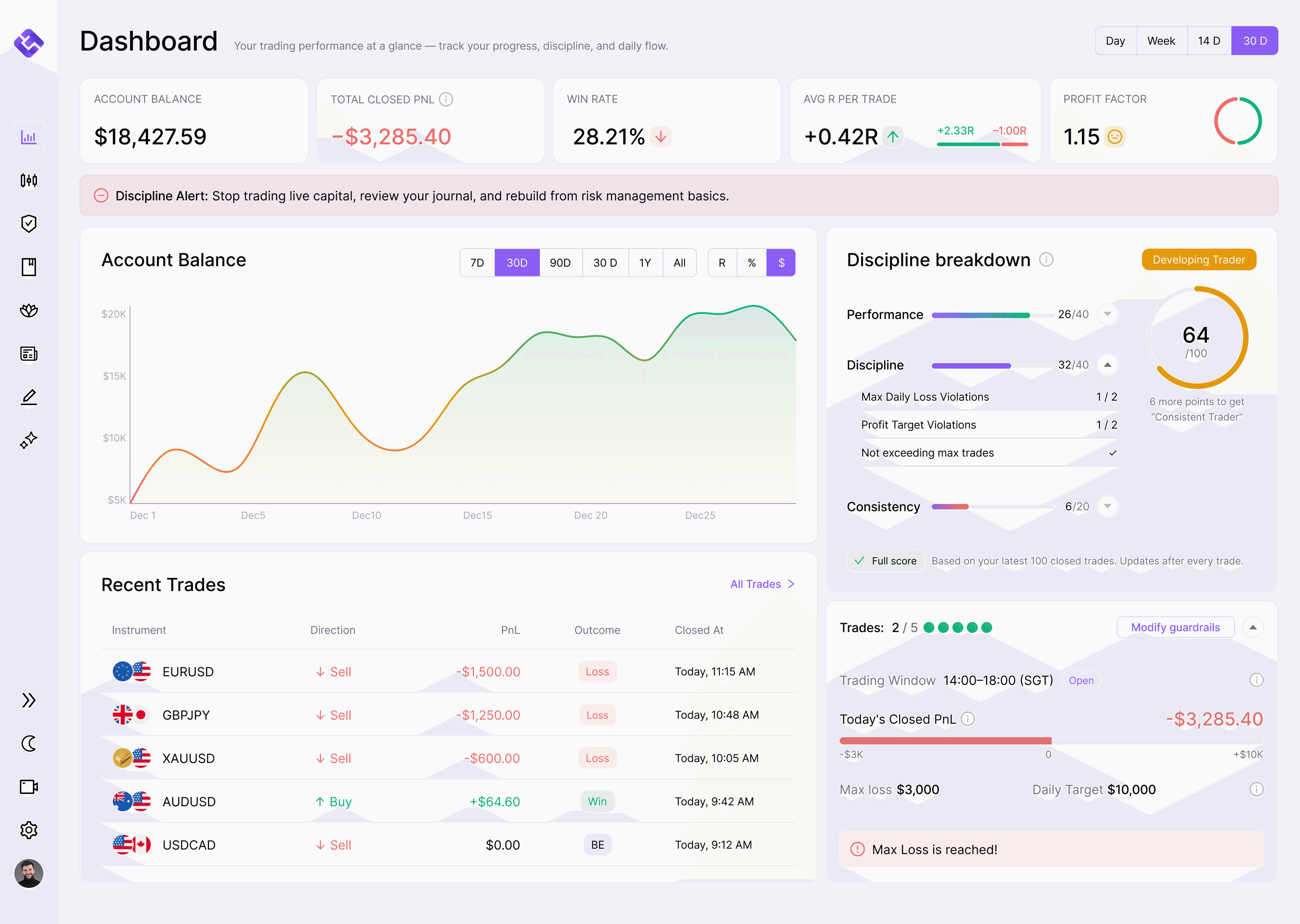
EdgeFlo's trading dashboard calculates your performance metrics continuously, including win rate, profit factor, and edge score. These metrics surface your operating range without you having to build spreadsheets or manually plot equity curves.
The AI-powered trading journal with auto-import captures every trade, including the emotional context you tag at entry. When you review your dashboard over 3 to 6 month windows, the ceiling and floor become visible in the data. You can see exactly which emotional states, which sessions, and which behavioral patterns correspond to your peaks and troughs.
That visibility turns a vague sense of "I keep cycling" into concrete numbers you can act on. And once you can see the floor, you can set about raising it.
The Edge Brief
Receive Insights on trading psychology, discipline, and the behavioral patterns that create consistent traders from our Founder and the EdgeFlo team, delivered to your inbox.
Think different. Trade different.
What is a trading ceiling and floor?
How do I find my personal ceiling and floor?
Why does the gap between ceiling and floor matter?
Can my ceiling and floor change over time?

Turn discipline on.
Every session.
EdgeFlo is the environment serious traders operate inside.
Start 7-Day Free Trial
Cancel anytime.
No long-term commitment.

Think Different, Trade Different.