

Your Trading Reflects Your Weaknesses: Use That
The market is a mirror. FOMO, greed, impatience, and control issues all show up in your trades. Learn how to use your journal to diagnose and fix them.

Most struggling traders think their problem is strategy. They switch indicators, change timeframes, buy courses, and hunt for the perfect setup. But after multiple blown accounts, a pattern emerges that has nothing to do with charts. The real problem is the person sitting at the screen. The market acts like a mirror. It reflects your FOMO, your greed, your impatience, and your need for control right back at you in the form of losing trades. Once you understand this, your trading journal becomes the most powerful diagnostic tool you own.
TL;DR
The market exposes personal weaknesses through specific trade patterns: chasing, overleveraging, overtrading, and holding losers.
Your journal reveals which weakness costs you the most money when you tag trades with emotion data.
FOMO shows up as late entries, greed as blown stops, impatience as too many trades, and control issues as refusing to cut losses.
Fix one weakness at a time by creating a specific rule and tracking compliance for 30 days.
Stop blaming the market or the strategy. The answer is usually in the mirror.
The Market Does Not Care About Your Strategy
You can have the best entry criteria in the world. Clean demand zone, structure-aligned, multi-timeframe confirmation, everything checks out. But if your mindset is working against you, none of that matters.
Here is why. Fear of missing out makes you chase trades and enter at the worst possible time, long after the optimal entry has passed. Greed makes you overleverage, take unnecessary risk, and eventually blow up. A need for control makes you hold losing trades just to avoid admitting you were wrong. Impatience makes you overtrade, forcing setups that are not there.
The market does not punish you for having a bad strategy. It punishes you for not knowing yourself. And it will keep punishing the same weaknesses until you either fix them or quit.
The Four Mirrors
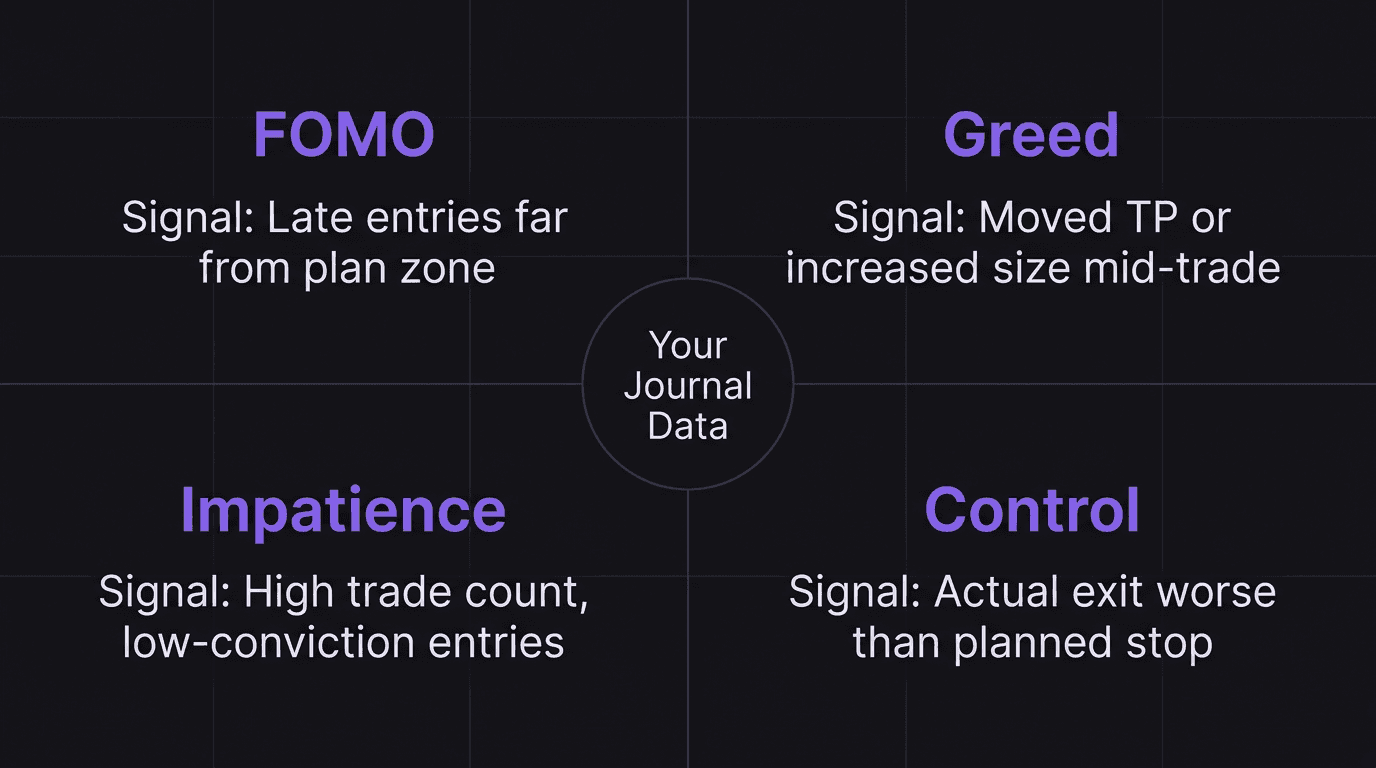
Each weakness creates a specific pattern in your trade data. Here is how to spot them:
Mirror 1: FOMO (Fear of Missing Out)
What it looks like in your journal: Entries that occur after the setup has already moved significantly. You see a candle spike, panic that you are missing the move, and enter without waiting for your criteria to be met. The entry price is far from the optimal zone.
What it costs you: Wider stops (because you entered late, the stop needs to be farther away), worse risk-to-reward ratios, and a lower win rate because you are entering in the middle of a move instead of at the beginning.
The tell: Filter your journal for trades where the actual entry price was more than 15 pips away from your planned entry zone. If a large percentage of your losing trades share this pattern, FOMO is your mirror.
Mirror 2: Greed
What it looks like in your journal: Moving your take-profit target farther after you are already in profit, adding to a winning position without a plan to do so, or increasing lot size after a winning streak because you feel invincible.
What it costs you: Trades that were profitable but turned into losses because you refused to take the planned exit. Or accounts that blow up because the increased lot size coincided with a losing streak.
The tell: Check your journal for trades where you moved the target or increased size mid-trade. Compare the outcome of those trades to the ones where you stuck to the original plan.
Mirror 3: Impatience
What it looks like in your journal: High trade frequency with no plan justification. Taking B and C-grade setups because the A-grade setup has not appeared yet. Dropping to lower timeframes to "find something" during slow markets.
What it costs you: Commission drag, mental fatigue, and a diluted win rate because half your trades were low-conviction entries taken out of boredom.
The tell: Count your trades per week. Compare weeks with high trade counts to weeks with low trade counts. If your high-count weeks are consistently less profitable, impatience is the issue.
Mirror 4: Control Issues
What it looks like in your journal: Refusing to close losing trades at the planned stop loss. Widening stops to "give it room." Holding overnight when the plan says intraday only. Averaging down without a plan to do so.
What it costs you: Small planned losses that become large unplanned losses. One bad hold can wipe out five good trades.
The tell: Compare your planned stop loss to your actual exit price on losing trades. If you consistently exit worse than planned, you have a control problem, and taking losses is a skill you need to develop.
Walkthrough: The FOMO Trader
A trader reviews 40 journal entries from the past month on EUR/USD. They tag each entry with an emotion: "calm," "anxious," "rushed," or "frustrated." Then they sort the data.
Calm entries: 14 trades, 57% win rate, average 1.8R winner. Rushed entries: 12 trades, 25% win rate, average 0.9R winner.
The calm trades netted about 8.4R. The rushed trades lost about 6.3R. Combined, the month netted only 2.1R. If the trader had simply not taken the rushed entries, the month would have been 8.4R. FOMO cost this trader 6.3R in a single month.
That is not a strategy problem. That is a self-knowledge problem. And the journal made it visible.
Fix One Thing at a Time
Once you identify your most expensive weakness, resist the urge to fix everything at once. Pick the one pattern that costs you the most money and create a single rule to address it.
If FOMO is your biggest leak, the rule might be: "I will not enter any trade where price has moved more than 10 pips past my planned entry zone." Track compliance with this one rule for 30 sessions.
If impatience is the issue, the rule might be: "Maximum 2 trades per session. If I want a third, I must close the platform and write in my journal why."
If control is the problem: "If price hits my stop level, I close the trade. No exceptions, no widening."
One rule. 30 days. Review the data. Then move to the next weakness. Trying to fix four things at once is itself a form of impatience, and the market will reflect that right back at you.
Walkthrough: The One-Rule Month
A trader identified from their post-trade review data that 60% of their losing trades involved widening the stop loss. They created one rule: "Stop loss does not move wider after entry. It can move to breakeven or tighter, never wider."
Month before the rule: 22 trades, 11 wins, 11 losses. Average winner: 1.6R. Average loser: 1.4R (inflated by the widened stops).
Net: positive 2.2R. Barely profitable because the oversized losses ate into the wins.
Month after the rule: 20 trades, 10 wins, 10 losses. Average winner: 1.5R. Average loser: 1R (stops honored cleanly).
Net: positive 5R. Same win rate, lower average winner (because some trades that would have eventually recovered after the wider stop now just hit the original stop). But the average loser dropped significantly. Result: more than double the previous month's profit.
One rule. One fix. The strategy did not change. The person executing it changed.
How EdgeFlo Turns the Mirror Into a Tool
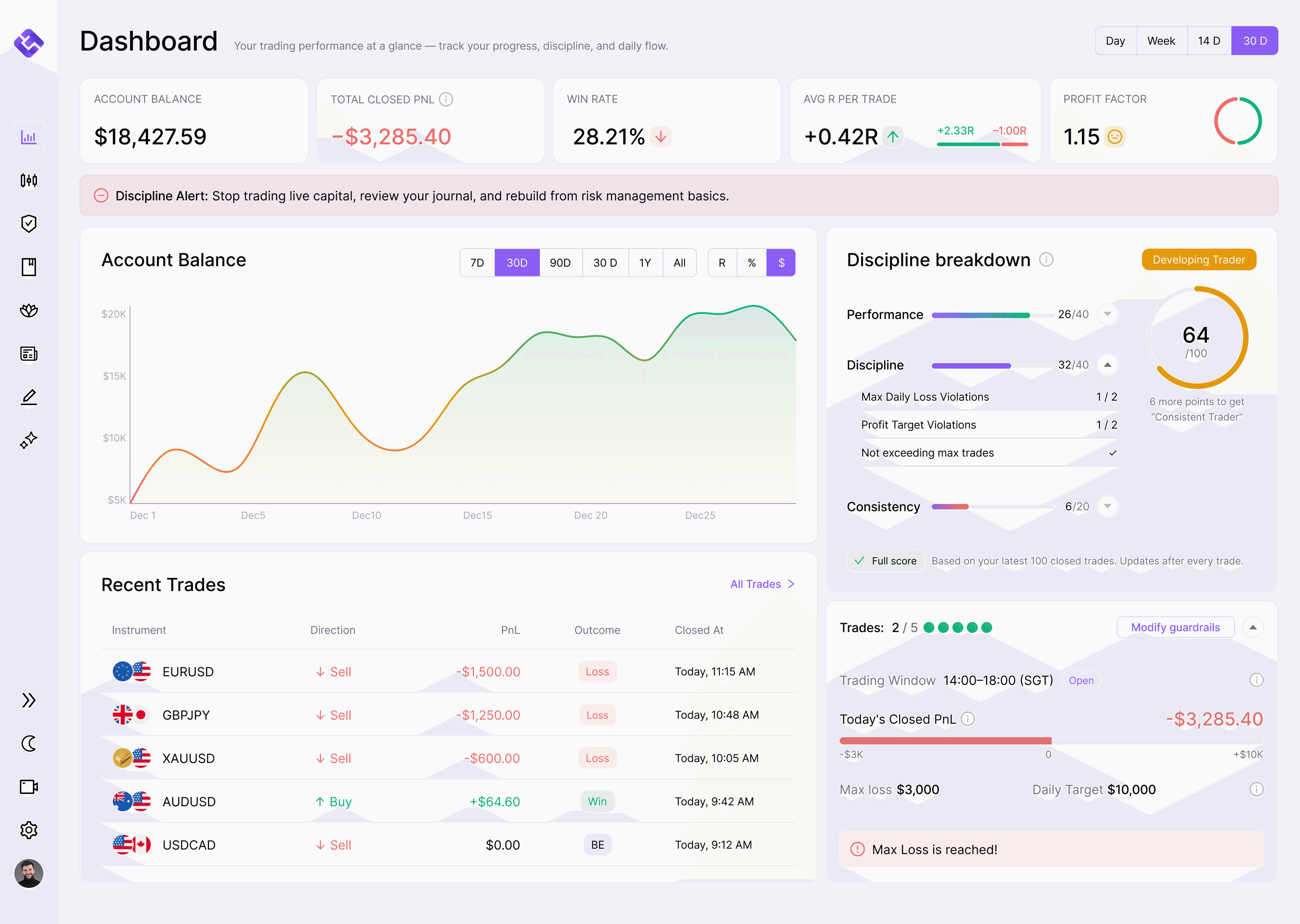
EdgeFlo's journal includes emotion tagging on every trade, so you can filter your history by emotional state and see exactly which feelings cost you money. The weekly AI report (Plus) surfaces recurring patterns like "your revenge trades after losses account for 40% of total losses this month."
The Edge plan builder keeps your rules visible during execution, so the gap between "knowing" what to do and "doing" it gets smaller. Post-trade self-reporting asks whether you followed the plan, making the data available for exactly the kind of weakness diagnosis described above.
The market will always reflect who you are. EdgeFlo makes sure that reflection is captured in data you can actually use.
The Edge Brief
Receive Insights on trading psychology, discipline, and the behavioral patterns that create consistent traders from our Founder and the EdgeFlo team, delivered to your inbox.
Think different. Trade different.
How does the market reflect my personal weaknesses?
Can journaling really help me find my trading weaknesses?
What are the most common trading weaknesses?
How do I fix weaknesses I find in my journal?

Turn discipline on.
Every session.
EdgeFlo is the environment serious traders operate inside.
Start 7-Day Free Trial
Cancel anytime.
No long-term commitment.

Think Different, Trade Different.