

Trading as a Business: Build Systems First
Treat trading as a business with defined systems, tracked metrics, and repeatable processes. Here is the framework that separates hobbyists from professionals.
Treating trading as a business means building defined systems (your plan, your strategy, your style) and repeatable processes (testing, journaling, routine reviews) before you risk real capital. The traders who stay profitable long term are not the ones with the best chart reads. They are the ones who operate like a business: documented rules, tracked metrics, and a feedback loop that forces improvement. If your trading has no written plan, no journal, and no review schedule, you are running a hobby with a brokerage account.
TL;DR
A trading system is the set of rules that tells you what to trade and when. A process is the recurring action (testing, journaling, reviewing) that improves that system over time.
Define your trading style, write a mechanical plan, and test it before risking live capital.
Journal every trade so you can replicate wins and cut recurring mistakes.
Build a daily routine that forces consistent execution, not just consistent motivation.
Track your metrics weekly and monthly so you catch leaks before they drain your account.
Why Most Traders Run a Hobby, Not a Business
Here is the cycle. You string together a few winners, confidence spikes, and you start taking trades outside your plan. The profits evaporate. Then losses stack up, doubt creeps in, and you freeze on setups that match your criteria perfectly. You watch them play out without you. That is called being a hindsight trader.
Sound familiar? It gets worse. After more losses you get angry. Revenge trades follow, each one bigger or sloppier than the last. You lose more than you lost at the start. The whole thing loops.
This is not a discipline problem. It is a systems problem. Every profitable business has documented processes that employees follow regardless of how they feel on a given Tuesday. A restaurant does not let the line cook improvise the recipe because he is in a good mood. Trading is no different.
The root cause is emotions. You will never eliminate them (you are human, not a robot). But you can build a mechanical framework that tells you exactly what to do so emotions do not get a vote. That is what separates a business from a hobby.
Walkthrough: The Confidence Spiral
Imagine you swing trade GBP/USD. You catch three clean setups during London open, each hitting 2R. Your account is up 6% for the week by Wednesday. You feel untouchable.
Thursday morning you see a setup that almost fits your plan. The demand zone is slightly wide, the higher timeframe trend is ambiguous. Old you would skip it. Confident you takes it anyway with a full position. It stops out. You take another "almost" setup an hour later. Also stops out. By Friday you have given back 4% of the 6% gain.
No journal entry. No review. No process that flagged the deviation. If you had a written plan with clear entry criteria and a post-session review habit, you would have caught the rule break on Thursday and stopped before the second loss. That is the difference between a system and a feeling.
The Business Framework: Systems, Processes, Metrics
Think of it like the formula: Inputs + Systems/Processes = Outputs.
Your inputs are time, energy, focus, and capital. Systems are the rules that channel those inputs (what you trade, when, how much). Processes are the recurring actions that refine and improve those systems (testing, journaling, reviewing). Outputs are consistent results, not just profits but small wins, small losses, and never a catastrophic drawdown.
The feedback loop is the part most traders skip. After each cycle of input and output, you review the data. What worked? What did you repeat that failed? Where did you deviate from the plan? That review feeds back into your inputs, and you improve. Miss this loop and your strategy stays stagnant while the market evolves.
This is a lifelong operation. Whether your account is $1,000 or $100,000, the feedback cycle does not stop.
Systems You Need Before Going Live
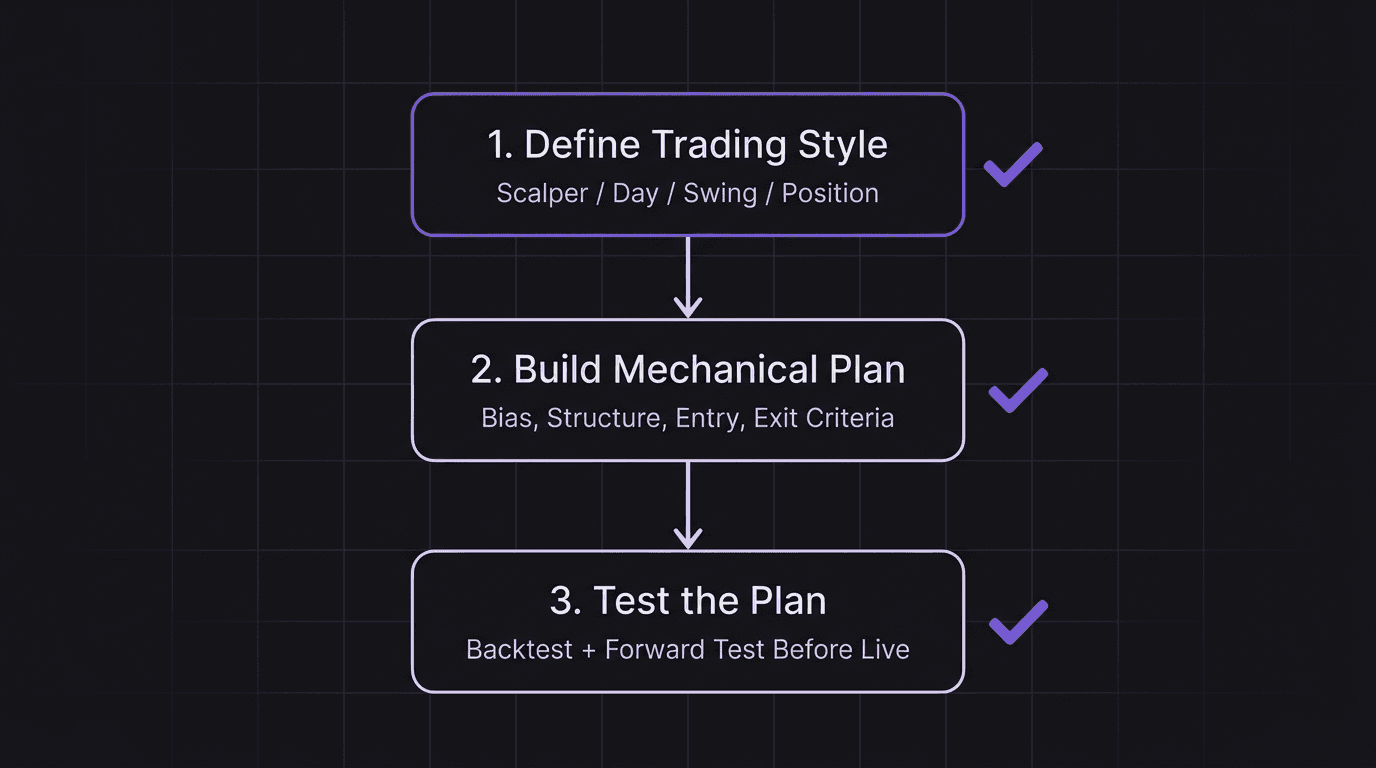
You need three things locked down before you trade real money.
1. Trading Style
Pick one: scalper, day trader, swing trader, or position trader. Each style uses different timeframes, different session windows, and different hold durations. You cannot build a plan without first choosing your style because the plan's rules depend on it.
This is like choosing your character in a game before the round starts. You would not try to play all four at once.
2. Mechanical Trade Plan
Your plan documents every decision point so there is zero guesswork at execution time. It covers:
Bias determination: how you read the higher timeframe direction
Structure mapping: how you mark key highs, lows, and zones
Point of interest: supply/demand zones, order blocks, or whatever your edge relies on
Timeframes: which frames for bias, which for entry
Entry criteria: the exact conditions that must be true before you click buy or sell
Exit criteria: where your stop goes, how your target is set, and whether you scale out
If you see the setup, you take the trade. If you do not see the setup, you stay out. That simplicity is the whole point of a mechanical trading plan.
3. Tested Proof
Before you trade live, backtest and forward test your plan. This is how you know the rules actually produce an edge over a sample of trades, not just over the last three winners. Testing turns "I think this works" into "I have data showing this works over 100 trades."
Processes That Keep the Business Running
Systems tell you what to do. Processes tell you how to keep doing it well.
Testing (Before and Ongoing)
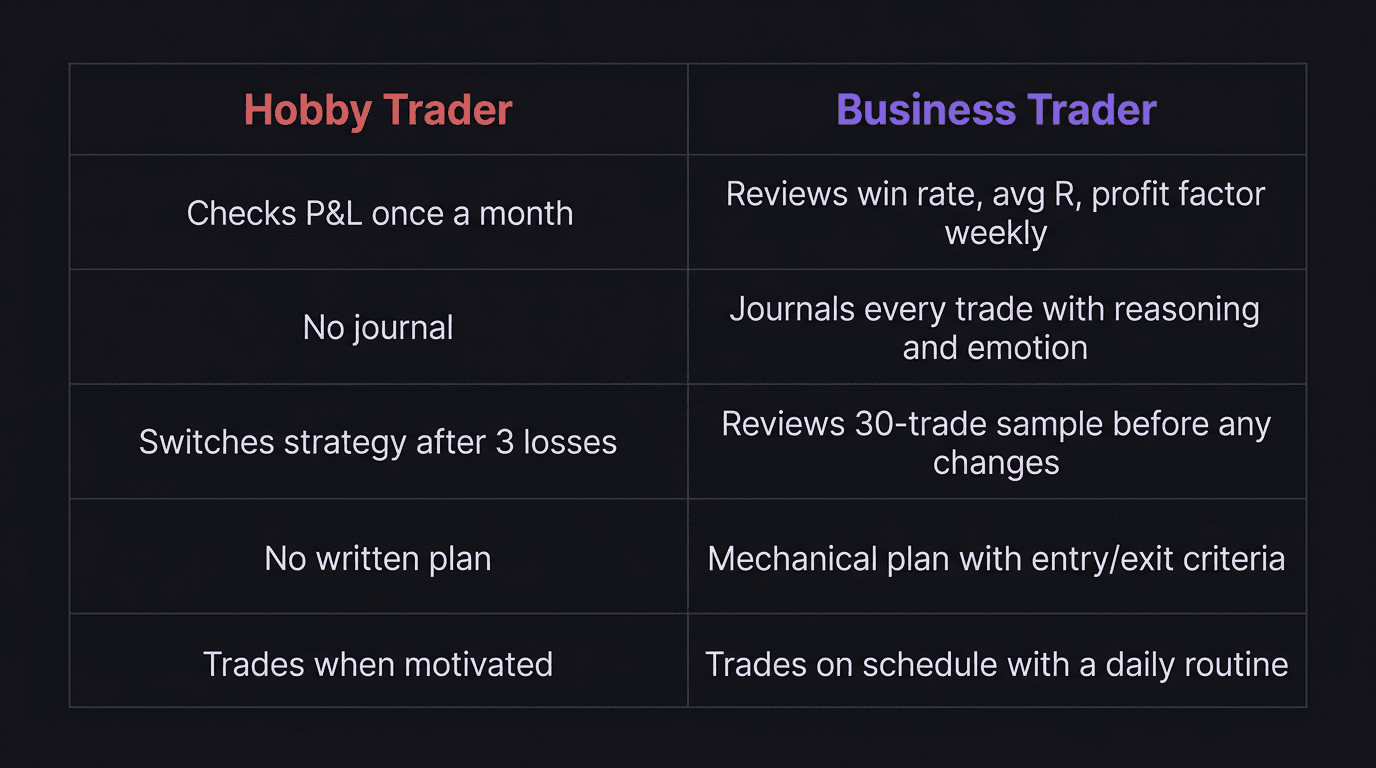
Testing is not a one-time event. You backtest to validate, forward test to confirm in live conditions, and then periodically retest as markets shift. If your win rate drops over 30 trades, that is a signal to re-examine, not to panic and switch strategies.
Journaling
Every trade gets logged. Not just the ticker and the result. Log your reasoning, your emotional state, whether you followed your plan, and what you would do differently. This is how you replicate wins and stop repeating mistakes.
A journal without a review is just a diary. The value comes from reading it back and extracting patterns. Do more of what works. Do less of what does not.
Walkthrough: The Missing Journal
A day trader runs 15 trades in a week. Eight are winners, seven are losers. He checks his P&L: slightly positive. "Good week," he says, and moves on.
If he had journaled, he would notice that five of the seven losers were all taken during the first 30 minutes of New York open, all in the same pair, all counter-trend. That is not bad luck. That is a pattern he keeps feeding.
Without a journal, he repeats the same five losing trades next week. With a journal and a monthly performance review, he catches the pattern, sets a rule (no counter-trend entries in the first 30 minutes), and eliminates a recurring leak. That one process change could flip the week from breakeven to solid green.
Daily Routine
What you do before, during, and after your session matters. A professional routine includes:
Pre-session: review your plan, mark key levels, check the economic calendar, set your bias
During session: execute according to the plan, log trades in real time
Post-session: review the day, journal, note any deviations, update your metrics
Consistent action leads to consistent results. Not sometimes. Every day. That is the universal rule for any business.
Measuring Business Health with a Dashboard
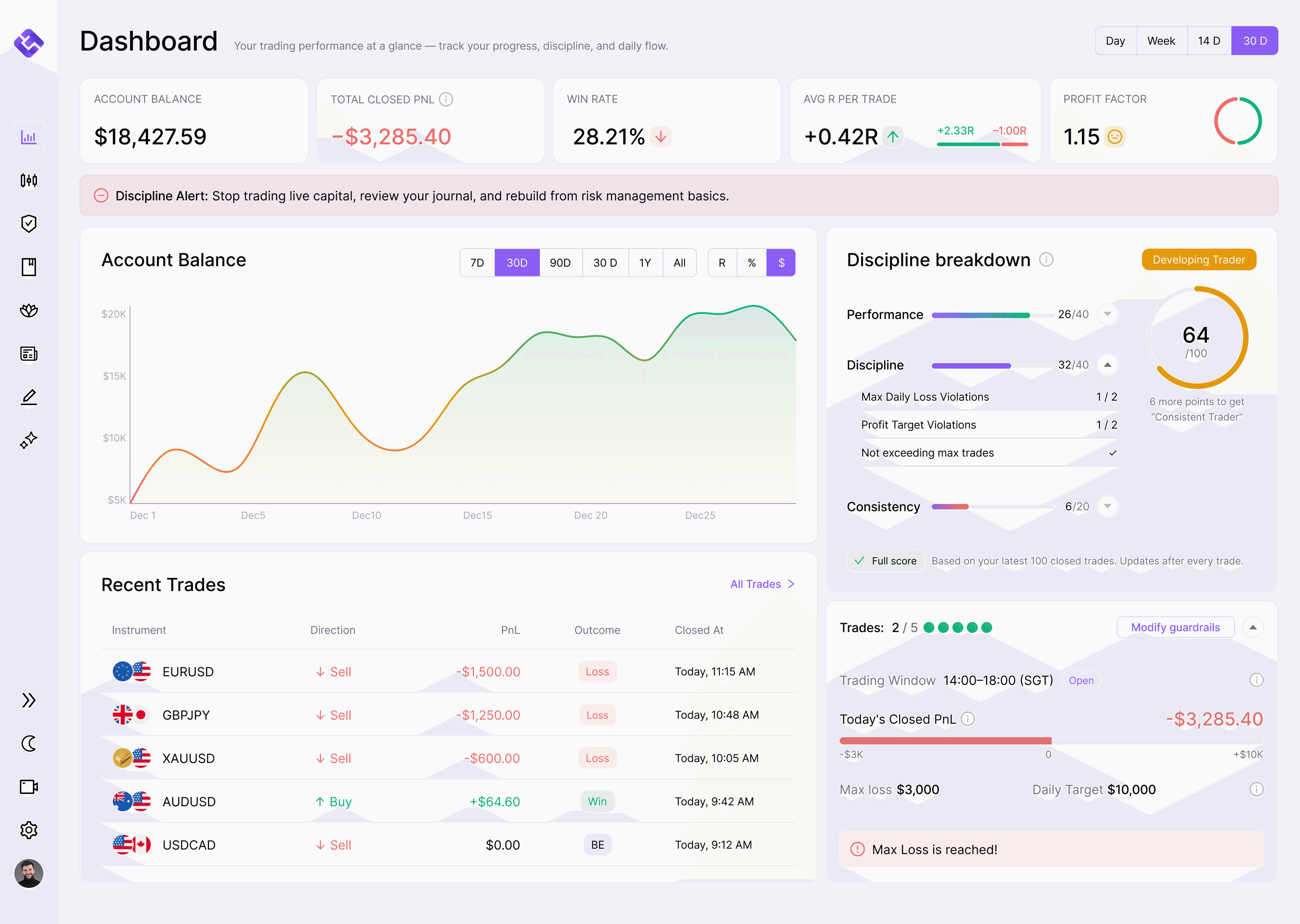
A business without financial statements is flying blind. A trading business without a dashboard is the same thing.
You need visibility into at least these metrics:
Win rate: what percentage of your trades are winners
Average R: how many R multiples you capture per trade on average
Profit factor: gross profit divided by gross loss (above 1.5 is solid)
EdgeScore or discipline score: how consistently you followed your plan
Expectancy: your average gain per trade over a large sample
The weekly spot check is simple: glance at win rate and average R. Are they in line with your backtest? If yes, keep going. If not, flag it for deeper investigation.
The monthly review is the full audit. Pull up your trading dashboard, compare this month to last month, check whether you followed your plan, and identify one or two specific things to improve. Set process goals for the next month based on what the data shows, not what you feel like working on.
This is the feedback loop. Input, process, output, review, adjust, repeat. A business that does this grows. One that skips it stagnates.
How EdgeFlo Gives You the Business Infrastructure
EdgeFlo is built around this exact framework. The Edge plan builder lets you document your mechanical trading plan, set it as your active plan, and reference it during every trade. Your rules stay visible at execution time, not buried in a PDF you opened three months ago.
The trading dashboard tracks win rate, profit factor, EdgeScore, and other key metrics in one screen. You do not need to export data to a spreadsheet or bounce between five apps. Your journal, your plan, and your performance data all live in the same platform, which means the feedback loop actually happens instead of getting lost between tools.
The weekly AI report (Plus plan) surfaces patterns from your journal that you might miss on your own. It is not telling you what to trade. It is showing you what your data says about how you are trading, so the review process catches what your eyes skip.
The Edge Brief
Receive Insights on trading psychology, discipline, and the behavioral patterns that create consistent traders from our Founder and the EdgeFlo team, delivered to your inbox.
Think different. Trade different.
What does it mean to treat trading as a business?
What systems does a trading business need before going live?
How often should I review my trading business metrics?
Can I run a trading business without journaling?

Turn discipline on.
Every session.
EdgeFlo is the environment serious traders operate inside.
Start 7-Day Free Trial
Cancel anytime.
No long-term commitment.

Think Different, Trade Different.