

Tight vs Wide Stop Loss: How to Test and Pick the Right Width
A 2-pip stop and a 15-pip stop produce completely different results on the same setup. Learn how to test stop widths, account for spread, and find your buffer.
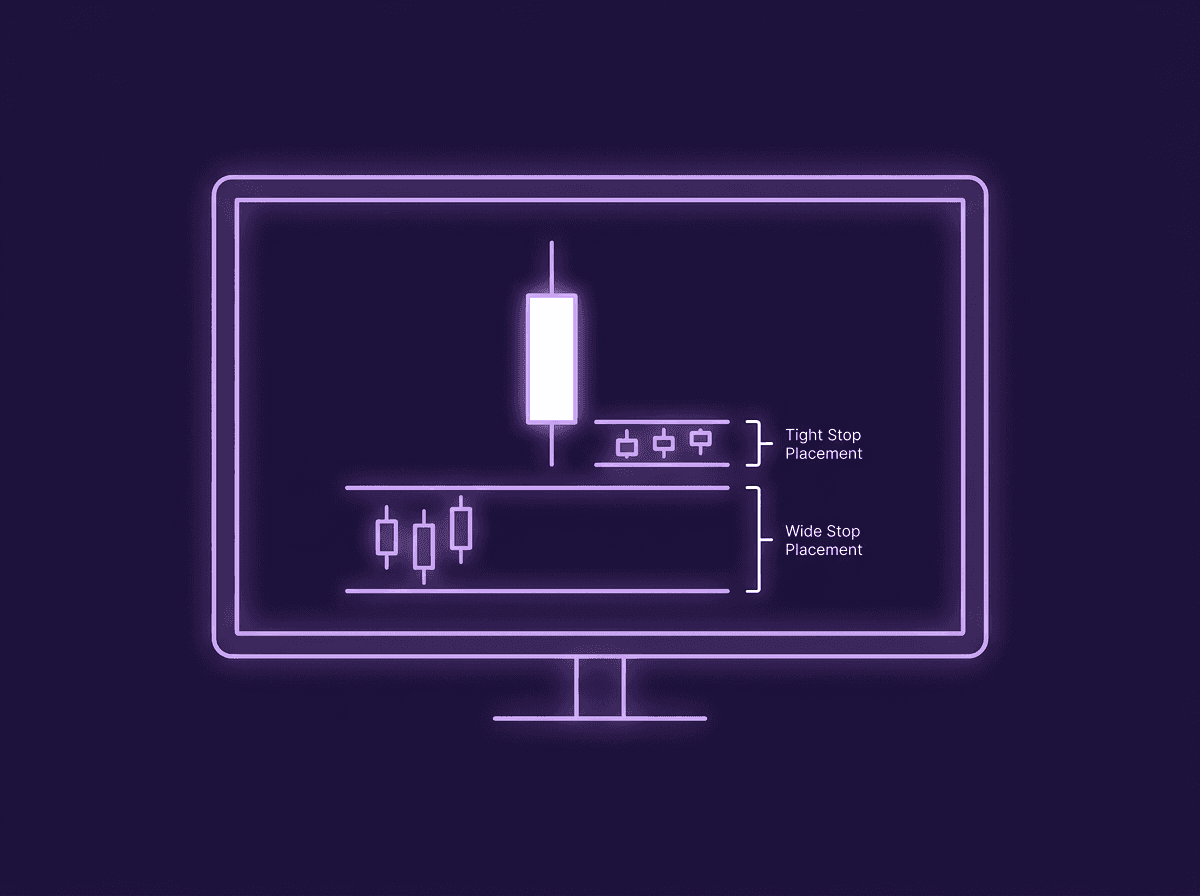
A 2-pip stop loss and a 15-pip stop loss on the same setup produce completely different results. The tight stop gets triggered by spread and wicks, turning a winning idea into a loss. The wide stop survives the noise but cuts your risk-to-reward ratio. Somewhere between the two is a buffer zone that keeps you in good trades without overexposing your account. Finding that zone requires testing, not guessing.
TL;DR
Ultra-tight stops (2 to 3 pips) get clipped by spread, slippage, and normal market wicks.
Wide stops survive more noise but reduce your risk-to-reward ratio on every trade.
Your stop must clear the zone boundary, the spread, and a small buffer for wicks.
Test at least three stop widths over 100 trades each and compare expectancy.
The right width is the one that produces the highest expectancy, not the highest win rate or the tightest risk.
Why Stop-Loss Width Changes Everything
Your stop-loss width is one of the most powerful variables in your trade plan. Change it by 5 pips and you change your win rate, your average R, your expectancy, and your emotional experience of every trade.
A tighter stop means smaller risk per trade. That sounds good. But it also means you get stopped out by noise that has nothing to do with your analysis being wrong. Price dips 3 pips below your demand zone, hits your stop, then rallies 80 pips in your direction. Sound familiar?
A wider stop means you survive those wicks. But now your risk per trade in dollar terms is larger (unless you reduce your position size to compensate). And your risk-to-reward ratio shrinks because your target stays the same while your stop gets farther away.
This is not a comfort question. It is a math question. And the only way to answer it is with data.
The Problem With Ultra-Tight Stops
A 2-pip stop on a forex pair with a 1.5-pip spread is almost guaranteed to fail. Here is why.
When you enter a buy on EUR/USD at 1.0850 with a 2-pip stop at 1.0848, your actual fill might be at 1.08505 (half a pip of slippage). Your stop is now effectively 1.5 pips away. The spread alone is 1.2 pips. So price only needs to move 0.3 pips against you, and your stop triggers.
That is not the market proving your analysis wrong. That is execution mechanics eating your stop.
Even on a tight-spread pair, normal price action includes wicks. A candle might dip 3 to 5 pips below a demand zone before buyers step in. If your stop sits inside that wick range, you get taken out on every setup, even the ones that would have hit your target.
Walkthrough: The 2-Pip Stop Problem
You identify a demand zone on EUR/USD between 1.0840 and 1.0850. You enter long at 1.0850 (edge of the zone) with a 2-pip stop at 1.0848. Your target is 1.0900 (50 pips away).
Price dips to 1.0847 (a 3-pip wick below the zone edge), hits your stop, then reverses and reaches 1.0905.
Math check: 1 standard lot on EUR/USD = $10/pip. 2 pips risk = $20 loss (plus slippage). 50 pips potential target = $500 missed gain.
The analysis was correct. The stop width was the problem. A 5-pip stop at 1.0845 would have survived that wick with room to spare.
This happens constantly with tight stops. You take five trades, get stopped out on four of them by 1 to 3 pips, and the one that works does not cover the four losses. Your win rate drops to 20%, your expectancy goes negative, and you start thinking your strategy is broken. It is not. Your stop is too tight.
How to Test Different Stop Widths on the Same Setup
Testing stop widths follows the same isolation method you use for any variable. Change only the stop width. Keep your entry, target, session, and confirmation trigger identical.
Option A: Tight (Structure-Based) Place your stop just below the candle low of the order block or the exact boundary of the demand zone. This gives you the tightest risk and the highest R-multiple on winners, but the lowest survival rate.
Option B: Moderate (Zone Plus Buffer) Place your stop 3 to 5 pips below the zone extreme. This accounts for spread and normal wicks. It reduces your R-multiple slightly but significantly improves your survival rate.
Option C: Wide (Below Liquidity) Place your stop below the nearest liquidity level (equal lows, previous swing low). This gives the trade maximum room to work. Your R-multiple drops further, but your win rate usually jumps because price would need a genuine structural break to reach your stop.
Walkthrough: Testing Three Stop Widths on EUR/USD
You trade the same demand zone setup 100 times with each stop width. Entry at 1.0850 every time. Target at 1.0900 (50 pips) every time.
Tight stop at 1.0848 (2 pips): Win rate: 25%. Average winner: 25R. Average loser: 1R. Expectancy: (0.25 x 25R) + (0.75 x -1R) = 6.25R + (-0.75R) = 5.5R.
Math check: 50 pips target / 2 pips risk = 25R per winner. Correct. 0.25 times 25R = 6.25R. Correct. 0.75 times 1R = 0.75R. Correct. 6.25R minus 0.75R = 5.5R. Correct.
Moderate stop at 1.0845 (5 pips): Win rate: 48%. Average winner: 10R. Average loser: 1R. Expectancy: (0.48 x 10R) + (0.52 x -1R) = 4.8R + (-0.52R) = 4.28R.
Math check: 50 pips target / 5 pips risk = 10R per winner. Correct. 0.48 times 10R = 4.8R. Correct. 0.52 times 1R = 0.52R. Correct. 4.8R minus 0.52R = 4.28R. Correct.
Wide stop at 1.0835 (15 pips): Win rate: 58%. Average winner: 3.33R. Average loser: 1R. Expectancy: (0.58 x 3.33R) + (0.42 x -1R) = 1.931R + (-0.42R) = 1.511R.
Math check: 50 pips target / 15 pips risk = 3.33R per winner. Correct. 0.58 times 3.33R = 1.931R. Correct. 0.42 times 1R = 0.42R. Correct. 1.931R minus 0.42R = 1.511R. Correct.
In this hypothetical example, the tight stop has the highest expectancy per R, but the highest emotional cost (75% of trades lose). The moderate stop balances win rate and R-multiple. The wide stop has the best win rate but the lowest expectancy per R.
Your choice depends on whether you size your position to match the wider stop. If you keep dollar risk constant by reducing lot size as the stop widens, the moderate stop might deliver the most consistent dollar returns for your account.
This is why you test. The "obvious" best choice (tightest stop, highest R) is not always the best choice in practice.
Finding Your Buffer Zone
The buffer zone is the extra space between your zone boundary and your stop loss. It accounts for three things:
Spread: On EUR/USD, spread is typically 0.8 to 1.5 pips. On GBP/JPY, it can be 2 to 4 pips. Your stop must sit beyond the spread or you are effectively entering the trade already stopped out.
Slippage: During volatile moments (news releases, session opens), your fill can slip 1 to 2 pips. Your stop must survive this.
Normal wicks: Candles routinely wick 2 to 5 pips beyond a zone on most major pairs. These wicks represent institutional stop hunts or simple noise. Your stop needs to clear them.
A practical buffer formula: zone boundary + spread + 2 to 3 pips for wicks. On EUR/USD, that is roughly 4 to 5 pips below the zone. On GBP/JPY, it might be 6 to 8 pips.
This is not a fixed rule. It is a starting point. Backtest your setups with different buffer sizes and let the data tell you the right number for your specific strategy.
Adjusting for Volatility
High-volatility sessions need wider buffers. If you trade London open on GBP/USD, wicks are larger than during Asian consolidation. Your buffer should reflect that.
One approach: measure the average wick size on your trading timeframe during your session over the last 30 candles. Set your buffer to clear that average wick. This is a dynamic approach that adjusts to current conditions instead of using a fixed number.
How EdgeFlo Tracks Stop-Loss Width vs Outcome
The hardest part of testing stop widths is tracking the data consistently. You need to record the exact stop distance on every trade, tag whether it was hit or not, and calculate performance across 100 or more trades.
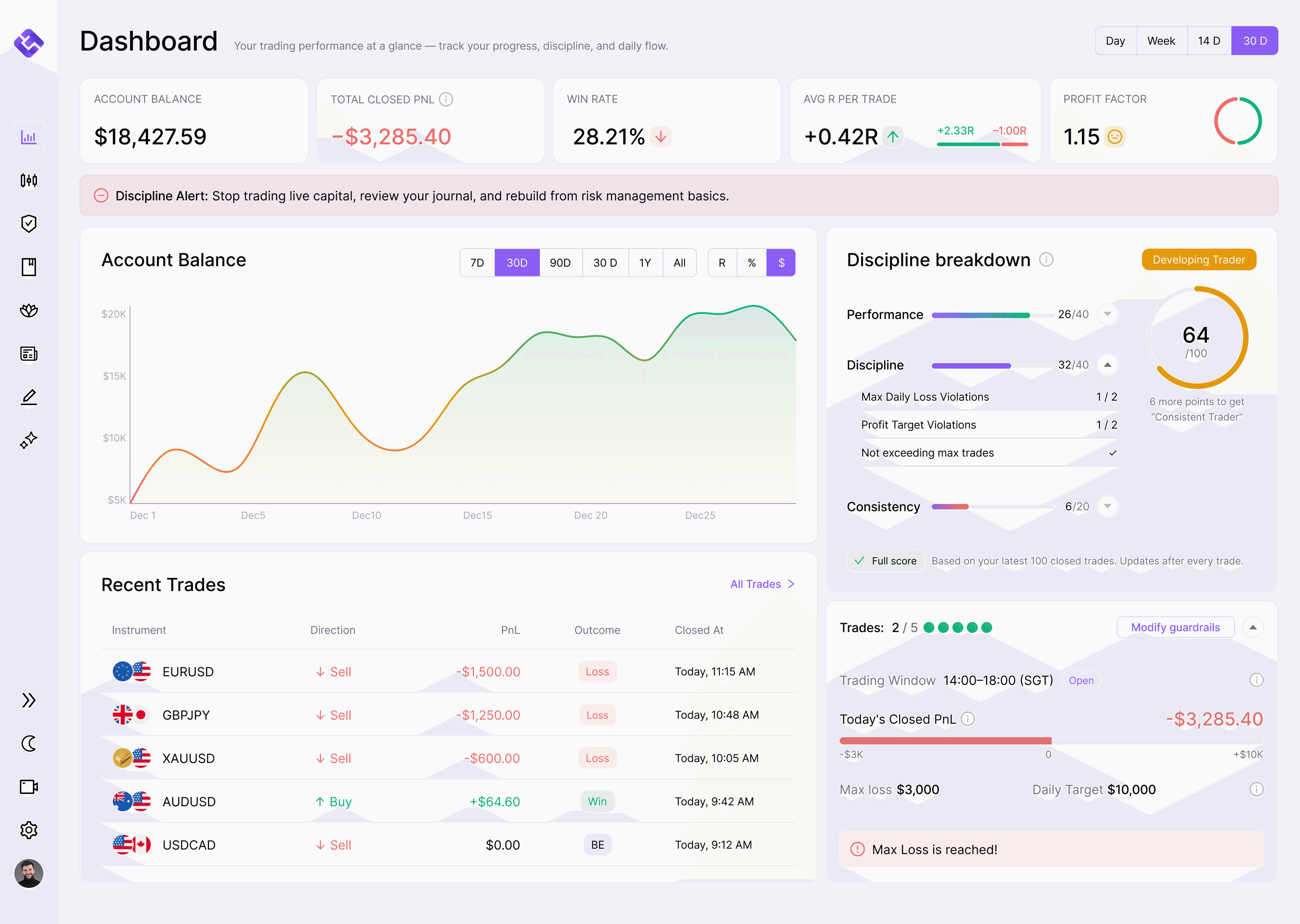
EdgeFlo's journal records your stop-loss distance automatically when you log a trade. Over time, you can filter your results by stop width and see whether tighter or wider stops produced better outcomes for your specific setups.
This feedback loop turns stop-loss width from a guess into a data-driven decision. Instead of arguing on forums about whether 5 pips or 15 pips is "better," you look at your own results and let the numbers answer.
The right stop width is personal. It depends on your strategy, your pairs, and your session. But the process for finding it is universal: test, measure, compare, and stop moving your stop loss once you know the right width. Trading without a stop loss is never the answer.
The Edge Brief
Receive Insights on trading psychology, discipline, and the behavioral patterns that create consistent traders from our Founder and the EdgeFlo team, delivered to your inbox.
Think different. Trade different.
What is the best stop-loss width for forex?
Why do tight stops get hit so often?
How do I adjust stop width for different currency pairs?
Should I always use a stop loss?

Turn discipline on.
Every session.
EdgeFlo is the environment serious traders operate inside.
Start 7-Day Free Trial
Cancel anytime.
No long-term commitment.

Think Different, Trade Different.