

Three Ms of Trading: Method, Money, Mind
Methodology, money management, and mindset are the three legs of trading. Remove one and the whole thing collapses. Here is how to build all three.
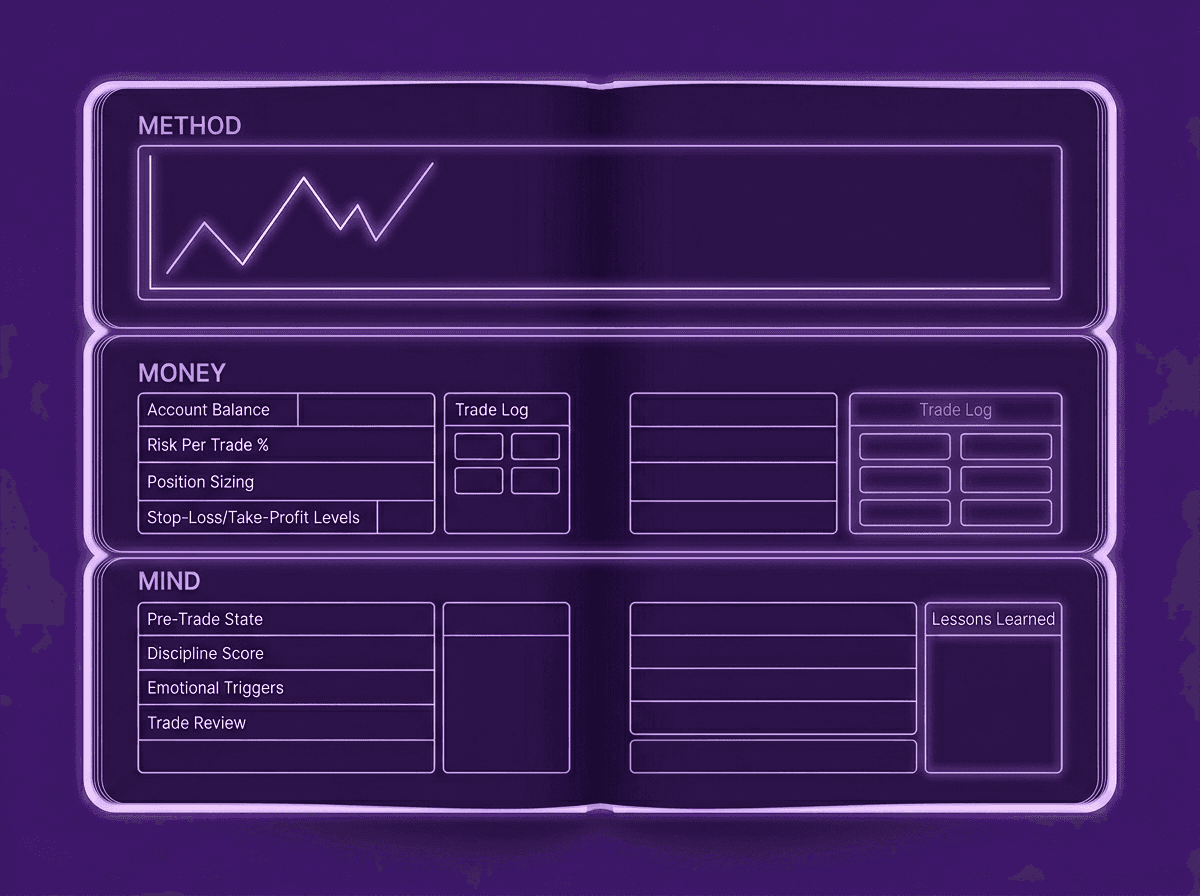
The three Ms of trading are methodology, money management, and mindset. Think of them as the three legs of a stool. Pull one away and the whole thing tips over. You can have the sharpest chart-reading skills on the planet, but without rules for protecting capital and the discipline to follow them, you will give back everything you earn.
Most traders fixate on methodology. They spend months learning candlestick patterns, drawing zones, and testing setups. That work matters. But it covers roughly one third of what actually keeps you profitable. The other two thirds, managing your money and managing yourself, are where accounts survive or die.
TL;DR
The three Ms are methodology (your trading system), money management (your capital protection rules), and mindset (your emotional discipline).
A proven strategy means nothing if you risk too much per trade or abandon your rules under pressure.
Money management keeps you in the game long enough for your edge to play out over hundreds of trades.
Mindset is the hardest M because your brain is not wired to sit calmly while money fluctuates on a screen.
Building all three into a documented trading plan turns the three Ms from theory into daily practice.
Methodology: How You Read the Market
Methodology is your answer to one question: what am I looking for on the chart?
Without a clear methodology, every setup looks tempting. A pin bar here, a breakout there, a moving average cross on a pair you have never traded. The hard part is not spotting opportunities. The hard part is ignoring everything that does not match your criteria.
A solid methodology covers three things:
Trend identification. Are you trading with the higher timeframe direction or against it? If you cannot identify whether the market is making higher highs and higher lows, lower highs and lower lows, or consolidating, you are guessing.
Zone marking. Where do you expect price to react? Supply and demand zones, order blocks, or whatever framework you use. The point is having a specific price area mapped before you enter.
Entry confirmation. What has to happen at your zone before you pull the trigger? A market structure shift? A liquidity sweep? A specific candle pattern in context?
If you cannot write these three things down in a single paragraph for your strategy, your methodology is not clear enough. And if it is not clear, you will take every setup that looks shiny.
Walkthrough: Trading Without a Method
Imagine you open GBP/USD on a Monday morning. The 4-hour chart shows lower highs and lower lows, a clear downtrend. But on the 15-minute chart, price just bounced off a round number and printed a bullish engulfing candle. You buy because the candle "looks strong."
Price pops 15 pips in your favor. Then it reverses. The 4-hour downtrend resumes, and you are stopped out for a 25-pip loss. That is 0.25 standard lots at $10 per pip, so you lose $62.50.
The mistake was not the candle. The mistake was ignoring the higher timeframe context. A methodology would have filtered that trade out before you ever placed it.
Money Management: How You Protect Capital
Money management is the love letter you send to your future self. Every dollar you protect today is a dollar available for the next opportunity.
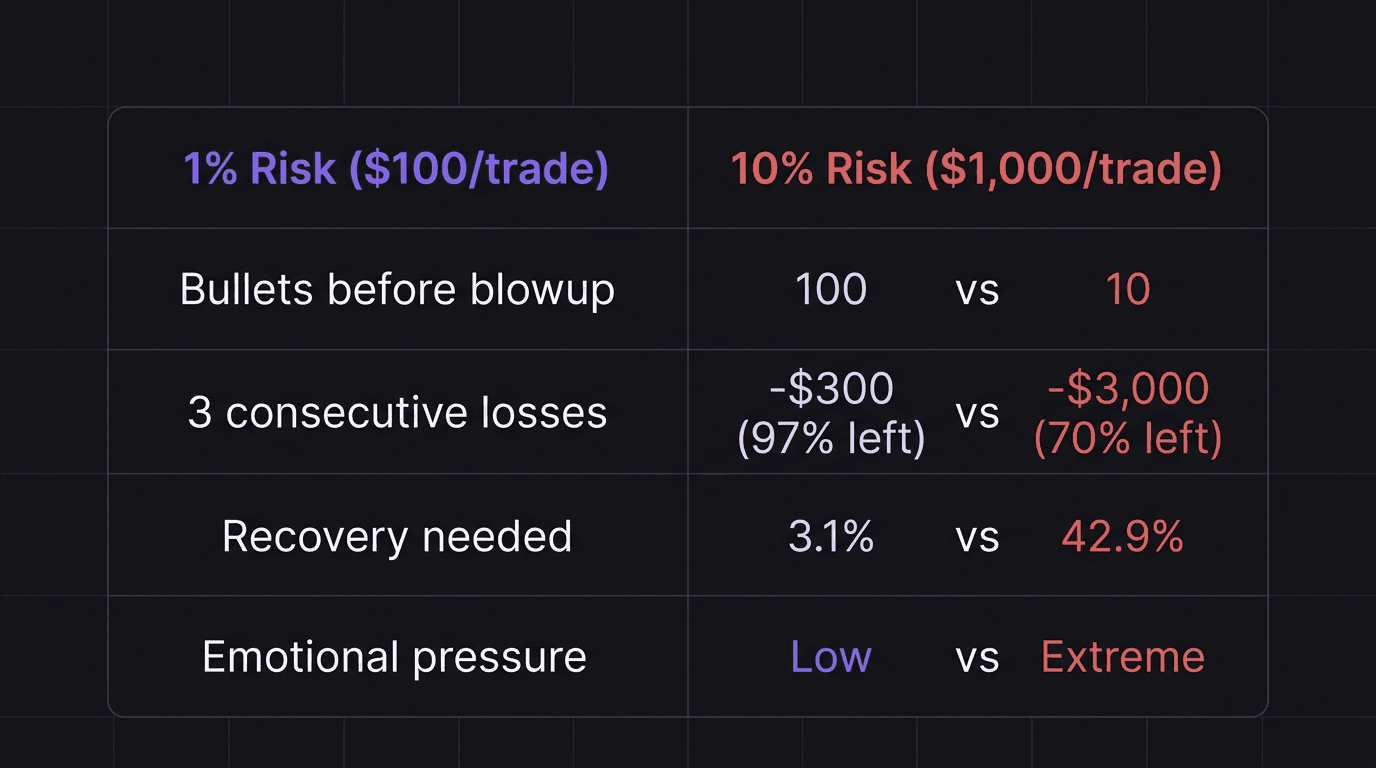
The core rule is simple: risk a fixed percentage of your account on every trade. For most traders, that is 1% or less. On a $10,000 account, 1% risk means you can lose $100 on a single trade. That gives you 100 bullets before you are out.
Compare that to risking 10% per trade. Now you only get 10 bullets. Three bad trades in a row and you have lost nearly a third of your account. The math is not forgiving.
Here is why this matters beyond survival: consistent risk per trade turns your results into usable data. If every trade risks $100, you can compare outcomes directly. But if one trade risks $50 and the next risks $500, your journal becomes noise.
The Minimum 2R Rule
Every trade should offer at least twice the potential reward compared to the risk. If you are risking $100, your take profit should be at least $200. This is called a 2R trade.
Why 2R minimum? Because even with a 40% win rate, you come out ahead.
Take 10 trades at 1% risk on a $10,000 account. You win 4 and lose 6.
6 losses at $100 each = $600 lost
4 wins at $200 each (2R) = $800 gained
Net result: +$200
You lost more trades than you won, and you still made money. That is the power of asymmetric risk to reward.
Mindset: How You Manage Yourself
Here is the uncomfortable truth. You are not biologically wired to trade. Your brain evolved to run from predators and hoard resources, not to sit in front of a screen watching numbers move while money is on the line.
Mindset is the M that most traders acknowledge but few actually train. They read one book about trading psychology and assume they have it handled. Then the first losing streak hits and they double their lot size to "make it back."
Sound familiar?
Being great at technical analysis but neglecting mindset is like assembling a rifle perfectly and then missing every shot because you never learned how to aim. The mechanics are useless without the control.
Mindset problems show up in predictable ways:
Revenge trading. You take a loss, and instead of walking away, you immediately enter another trade to win it back. The second trade has no setup. It is pure emotion.
FOMO entries. Price moves without you, and you chase it at a terrible price because you cannot stand missing the move.
Moving your stop loss. The trade is going against you, so you widen your stop "just a little" to give it more room. This is your money management M breaking because your mindset M failed.
Walkthrough: What Mindset Failure Looks Like
A trader opens a buy on EUR/USD with 1% risk on a $10,000 account. The trade hits stop loss for a $100 loss. She feels frustrated, certain the market "hunted her stop." Without reviewing the setup, she immediately enters another buy on the same pair, this time risking 3% ($300) because she "knows" it will bounce.
The second trade also loses. Now she is down $400 in two trades instead of $100 in one. One disciplined loss became a 4% drawdown because mindset broke first, and money management broke second.
The fix is not willpower. It is structure. Set a daily loss limit. Set a maximum number of trades. Use those limits as hard boundaries so that when emotions spike, the rules catch you before you spiral.
How the Three Ms Reinforce Each Other
The three Ms are not separate skills you develop in isolation. They form a feedback loop.
Your methodology tells you when to trade. Your money management tells you how much to risk. Your mindset keeps you following both rules when the trade is open and your stomach is churning.
Break the chain at any point and the whole system fails. A trader with perfect methodology and flawless risk rules will still blow up if they abandon both systems every time they feel fear or greed. A trader with iron discipline and great capital management will still lose if their strategy has no real edge.
The most common failure pattern looks like this: a trader spends all their energy on methodology (learning setups, backtesting patterns) and almost no time on money management or mindset. They find a good strategy, trade it profitably for a few weeks, then hit a losing streak. Without strong money management rules, they increase risk. Without mindset training, they chase losses. The strategy was fine. The other two Ms were missing.
How EdgeFlo Helps You Build All Three
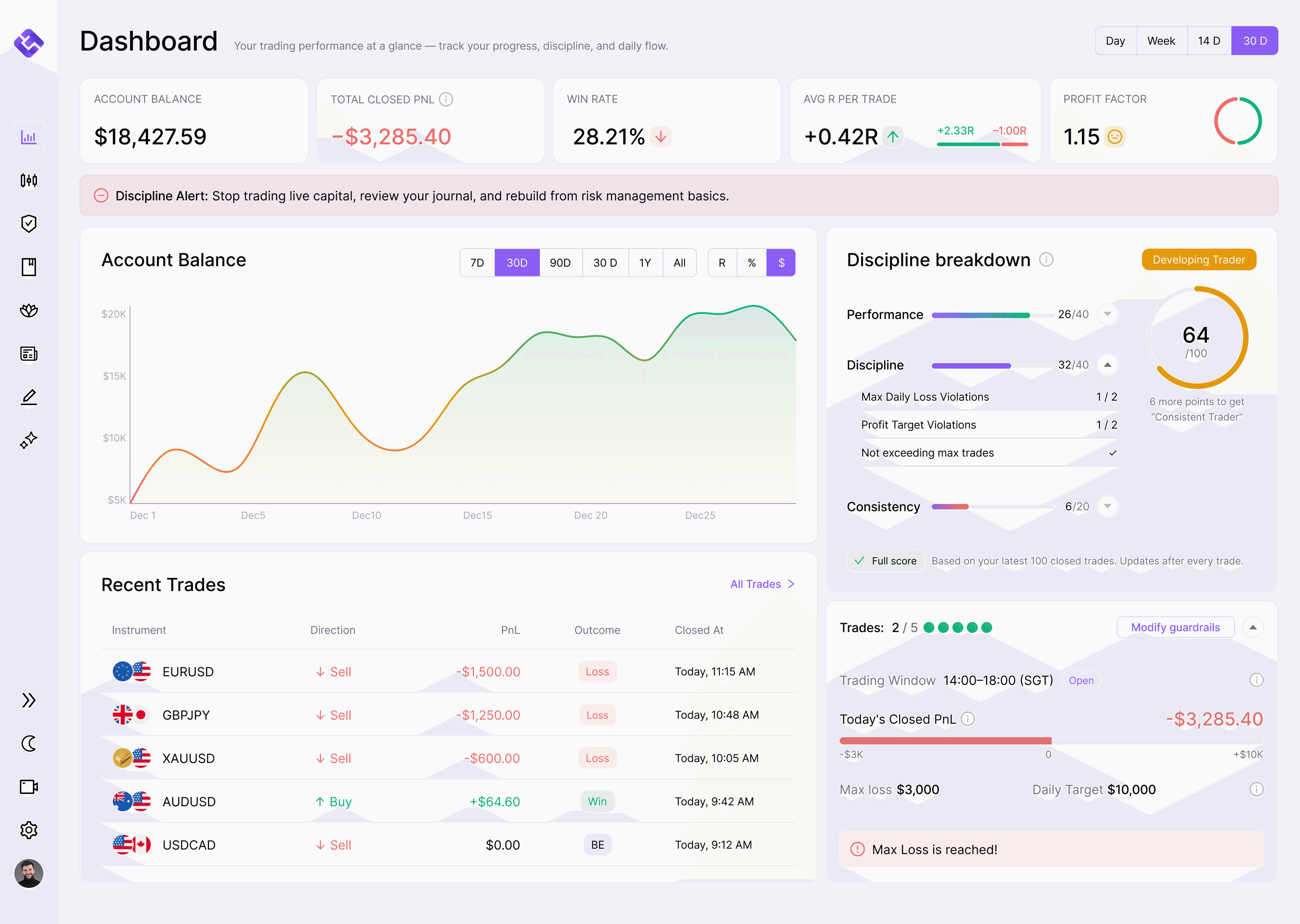
EdgeFlo's Edge feature lets you document your trading plan and keep it visible during every session. That is your methodology M, written down and accessible, not floating in your head where it gets edited by emotions.
For money management, EdgeFlo's auto risk calculator sizes your position based on your predefined risk percentage and stop loss distance. You do not have to do the math under pressure. The number is already there.
For mindset, EdgeFlo's guardrails restrict trading when you hit your daily loss limit or maximum trade count. You can override them, but you have to make a conscious choice to do so. That pause is the difference between a reactive revenge trade and a deliberate decision. Combined with the confidence that comes from following a structured process, the three Ms stop being theory and start being your daily operating system.
The Edge Brief
Receive Insights on trading psychology, discipline, and the behavioral patterns that create consistent traders from our Founder and the EdgeFlo team, delivered to your inbox.
Think different. Trade different.
What are the three Ms of trading?
Which of the three Ms is most important?
Can I succeed with just a good trading strategy?
How do the three Ms work together?

Turn discipline on.
Every session.
EdgeFlo is the environment serious traders operate inside.
Start 7-Day Free Trial
Cancel anytime.
No long-term commitment.

Think Different, Trade Different.