
Three Instruments Is All You Need to Trade Profitably
Watching 20 pairs means understanding none. Three instruments maximum gives you deep familiarity, better pattern recognition, and fewer costly mistakes.
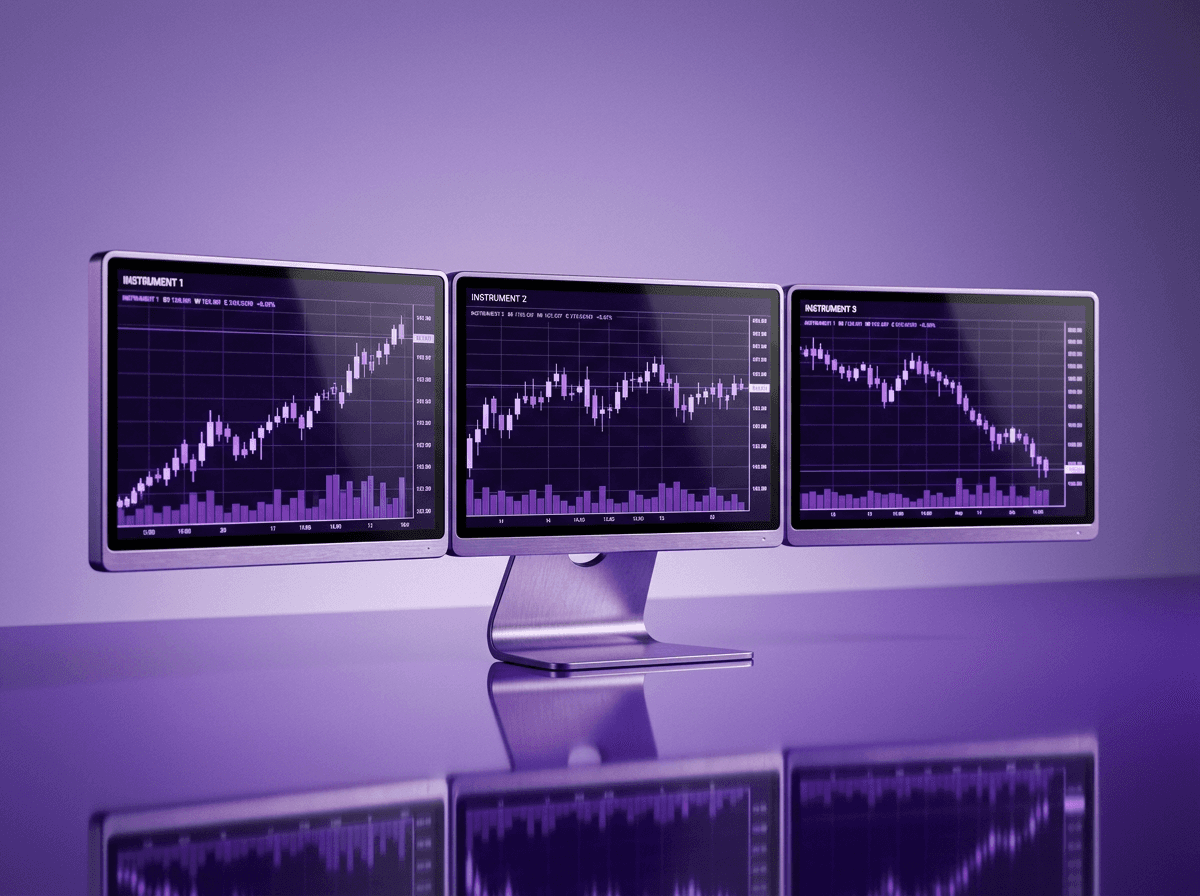
Pick three instruments. That is the upper limit for most traders, and it is generous. Watching 20 pairs at once feels productive. In reality, it means you understand none of them deeply enough to trade with conviction. The traders who reach consistency almost always get there by narrowing their focus, not widening it.
TL;DR
Trading too many instruments splits attention and kills pattern recognition.
Three instruments maximum gives you enough variety for daily setups without overwhelming your focus.
Deep familiarity with fewer instruments builds the kind of pattern recognition that surface scanning never provides.
Choose instruments that fit your strategy, your session, and your risk tolerance.
Once you have 50 or more trades of data on your current instruments, then consider adding one more.
The 20-Pair Trap That Kills Focus
Every new trader goes through the same phase. You open your platform, add every major pair, a handful of crosses, gold, oil, maybe a stock index or two. Twenty instruments on your watchlist. You scan through them looking for setups, jumping from one chart to the next.
The problem is not that these instruments are bad. The problem is that you cannot know all of them well enough to trade them intelligently. GBP/JPY behaves differently from EUR/USD. Gold has different volatility patterns than the S&P 500. Each instrument has its own personality: typical daily range, reaction to news, spread behavior during different sessions, and liquidity patterns.
When you scan 20 charts, you are operating at the surface level on all of them. You see a pattern that looks like a setup, but you do not know whether that pattern is typical or unusual for that instrument at that time of day. That uncertainty leads to hesitation, or worse, overconfidence in a setup you do not truly understand.
Simplicity scales. Complexity kills.
Why Three Instruments Is the Upper Limit
Three instruments gives you enough variety that you will not go days without a setup. But it is few enough that you can develop genuine familiarity with each one.
Think about what "knowing" an instrument actually means. You know its average daily range. You know which sessions it moves most. You know how it reacts to specific economic releases. You know where liquidity tends to pool. You know what a normal pullback looks like versus a structural shift.
That knowledge takes hundreds of hours of screen time on a single instrument. Trying to develop it across 10 or 20 pairs at the same time is like trying to become fluent in five languages simultaneously. You end up conversational in none of them.
Walkthrough: The Focused Trader vs. the Scanner
Trader A watches three instruments: EUR/USD, GBP/USD, and gold. Over three months, Trader A takes 60 trades total, roughly 20 per instrument. After reviewing the journal, Trader A discovers that EUR/USD London session breakouts produce a 55% win rate with an average 2.5R. That is a clear, tradeable edge.
Trader B watches 15 instruments. Over the same three months, Trader B takes 60 trades spread across all 15. That is four trades per instrument. There is not enough data on any single instrument to identify what actually works.
Trader A has an A-plus setup dialed in on one pair. Trader B has a scattered collection of trades that look like noise. Same effort, opposite outcomes. The only difference is focus.
Deep Familiarity Beats Wide Scanning
Pattern recognition is not something you learn from a textbook. It builds through repetition on the same instrument over time. After watching EUR/USD for 500 hours, you start to notice things that no indicator can show you: the way price behaves differently at 1.0800 round numbers versus 1.0850, the way London open fakeouts look slightly different from genuine breakouts, the way the pair tends to stall before US CPI releases.
That familiarity is your edge. It is not transferable to a pair you have watched for 10 hours. And it compounds over time, meaning the longer you stay focused, the sharper your reads become.
This is exactly the kind of depth a mechanical trading plan supports. When your plan specifies which instruments to trade, there is no temptation to jump to a random pair because it "looks like it is about to move."
How to Choose Your Three
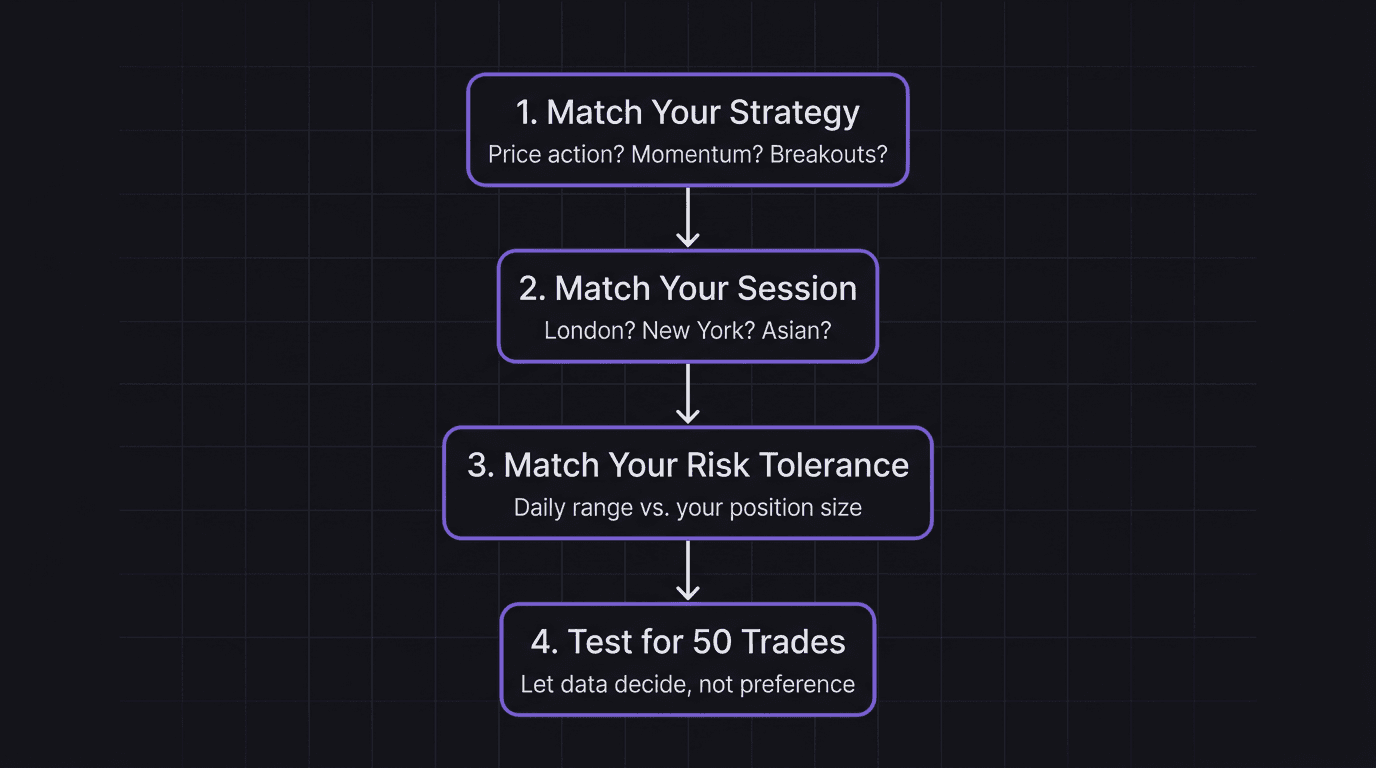
The selection process is simpler than most traders make it.
1. Match your strategy. If you trade price action on higher timeframes, you need instruments with clean structure and sufficient daily range. Major forex pairs work well. If you trade momentum, you might prefer an index or a commodity with bigger intraday swings.
2. Match your session. If you trade London open, EUR/USD and GBP/USD make sense. If you trade New York, consider USD/JPY or gold. Do not pick an instrument that is asleep during your trading hours.
3. Match your risk tolerance. Gold moves $20 to $40 per day. EUR/USD moves 50 to 80 pips. Understand what those moves mean in dollar terms at your position size before you add an instrument to your watchlist.
4. Test for 50 trades. Do not commit permanently to your first three picks. Trade them for at least 50 trades, journal the results, and then decide. If one instrument consistently produces losing trades despite following your plan, replace it. Let the data decide, not your preference.
Build your trading playbook around these instruments. Document the setups that work on each one, the sessions you trade them, and the average R per trade. That playbook becomes the foundation of your edge.
Walkthrough: When the Data Says Drop an Instrument
A trader starts with EUR/USD, GBP/USD, and AUD/USD. After 60 trades (20 per pair), the journal reveals:
EUR/USD: 55% win rate, 2.2R average winner. Expectancy: +0.77R per trade.
GBP/USD: 50% win rate, 2.0R average winner. Expectancy: +0.50R per trade.
AUD/USD: 35% win rate, 1.8R average winner. Expectancy: negative 0.02R per trade.
AUD/USD is not working. The data is clear. Drop it, and either focus on two instruments or test a replacement with a separate 50-trade sample. Do not hold onto a pair because you "like it" or because it was your first pick. Follow the data, use multi-timeframe analysis to confirm, and adjust.
How EdgeFlo Watchlist Keeps Your Focus Narrow
One of the underrated features for instrument discipline is a watchlist-aware economic calendar. When your watchlist contains only three instruments, EdgeFlo's calendar filters to show only the news events that matter for those pairs.
That eliminates a major distraction source. You do not need to scan through 30 economic releases to figure out which ones affect your positions. If you trade EUR/USD, GBP/USD, and gold, you see ECB, BOE, and FOMC events. Everything else is filtered out.
The result is a cleaner information environment. Less noise, fewer reasons to jump to a random pair "just because there is a news release," and more time spent studying the instruments you actually trade. Narrow focus, applied consistently, compounds into the kind of deep familiarity that no wide-scanning approach can match.
The Edge Brief
Receive Insights on trading psychology, discipline, and the behavioral patterns that create consistent traders from our Founder and the EdgeFlo team, delivered to your inbox.
Think different. Trade different.
How many currency pairs should a beginner trade?
Does trading more pairs increase profit?
Which instruments are best for new forex traders?
When should I add a new instrument to my watchlist?

Turn discipline on.
Every session.
EdgeFlo is the environment serious traders operate inside.
Start 7-Day Free Trial
Cancel anytime.
No long-term commitment.

Think Different, Trade Different.