

Thinking Ahead in Trading: If-Then Maps
Thinking ahead in trading means building if-then maps before every session. Learn pre-session scenario planning that makes you proactive, not reactive.

Reactive traders lose money. They enter a trade, watch price move against them, and scramble for a plan they should have built before the session started. Thinking ahead in trading means mapping out what you will do before price tells you what happened. It is the difference between operating like a chess player and operating like a gambler.
The best traders do not predict the market. They prepare for it.
TL;DR
Thinking ahead means building if-then maps before every session so you have a pre-planned response for each scenario.
Reactive trading leads to emotional decisions because you are creating plans under pressure.
Pre-session scenario planning takes 10 to 15 minutes and eliminates most in-session hesitation.
Map at least three outcomes for every setup: price moves in your favor, price moves against you, and price does nothing.
What Thinking Ahead Means in Trading
Most beginner traders think one move ahead. They see a buy signal and expect price to go straight up. When it does not, they panic. They move their stop, widen their target, or close the trade early because they never considered the alternative.
Professional traders operate differently. They think five moves ahead. Before entering any trade, they have already accepted that dozens of scenarios can play out. Price might hit their target. Price might stop them out. Price might consolidate for hours and do absolutely nothing. Price might sweep their stop, then reverse and hit where their target was.
Each of those outcomes demands a different response. And the time to decide your response is before the market opens, not when you are staring at a red P&L.
Thinking ahead is not prediction. It is preparation. You are not trying to guess where price will go. You are building a decision framework so that when price does something, you already know what to do next.
This is directly connected to how if-then trading rules work. If this happens, then I do that. No thinking required in the moment. Just execution.
Pre-Session Scenario Planning
Pre-session scenario planning is a concrete practice you can add to your pre-market routine today. It takes about 10 to 15 minutes and completely changes how you experience the trading session.
Here is the process:
1. Mark your key levels. Before the session opens, mark the significant levels on your chart. The previous day's high and low, any unfilled demand or supply zones, and the nearest liquidity resting above and below current price.
2. Identify potential setups. Based on those levels, ask yourself: where could a valid setup form today? You are not forcing a trade. You are identifying the locations where your setup could appear if price reaches them.
Price reaches the zone and gives your entry signal (you enter with your pre-defined stop and target).
Price reaches the zone but does not give a clean signal (you do nothing and wait).
Price never reaches the zone at all (you do nothing and close your charts at the end of the session).
4. Define your invalidation. For each scenario, define the specific price level or condition that would invalidate your thesis entirely. If price breaks above a certain level, your sell scenario is dead. Cross it out and move on.
Walkthrough: Scenario Planning in Action
A trader is preparing for the London session on EUR/USD. The 1-hour chart shows price trending bearish with lower highs and lower lows. There is a supply zone at 1.0880 where the most recent lower high formed, and the Asian session low sits at 1.0840.
The trader builds three scenarios:
Scenario A: Price pushes up to the 1.0880 supply zone during early London, sweeps the Asian session high at 1.0870, and prints a bearish break of structure on the 15-minute chart. If this happens, the trader enters short at 1.0870 with a stop at 1.0895 (25 pips) and a target at 1.0795 (75 pips).
Scenario B: Price pushes up to 1.0880 but never breaks structure on the 15-minute. The trader does nothing and waits.
Scenario C: Price drops straight from the open without ever reaching 1.0880. The trader does nothing because the setup never formed.
Price opens London and pushes up to 1.0878, taps the supply zone, sweeps the Asian high at 1.0870, and breaks the 15-minute structure to the downside. Scenario A plays out. The trader enters short at 1.0870. The trade hits the 1.0795 target during the New York overlap. That is a 3R winner, executed calmly because the entire trade was pre-planned.
Notice what happened with scenarios B and C. They were not failures. They were pre-planned outcomes that required no emotional response. The trader had already decided what to do in each case.
If-Then Maps for Every Setup
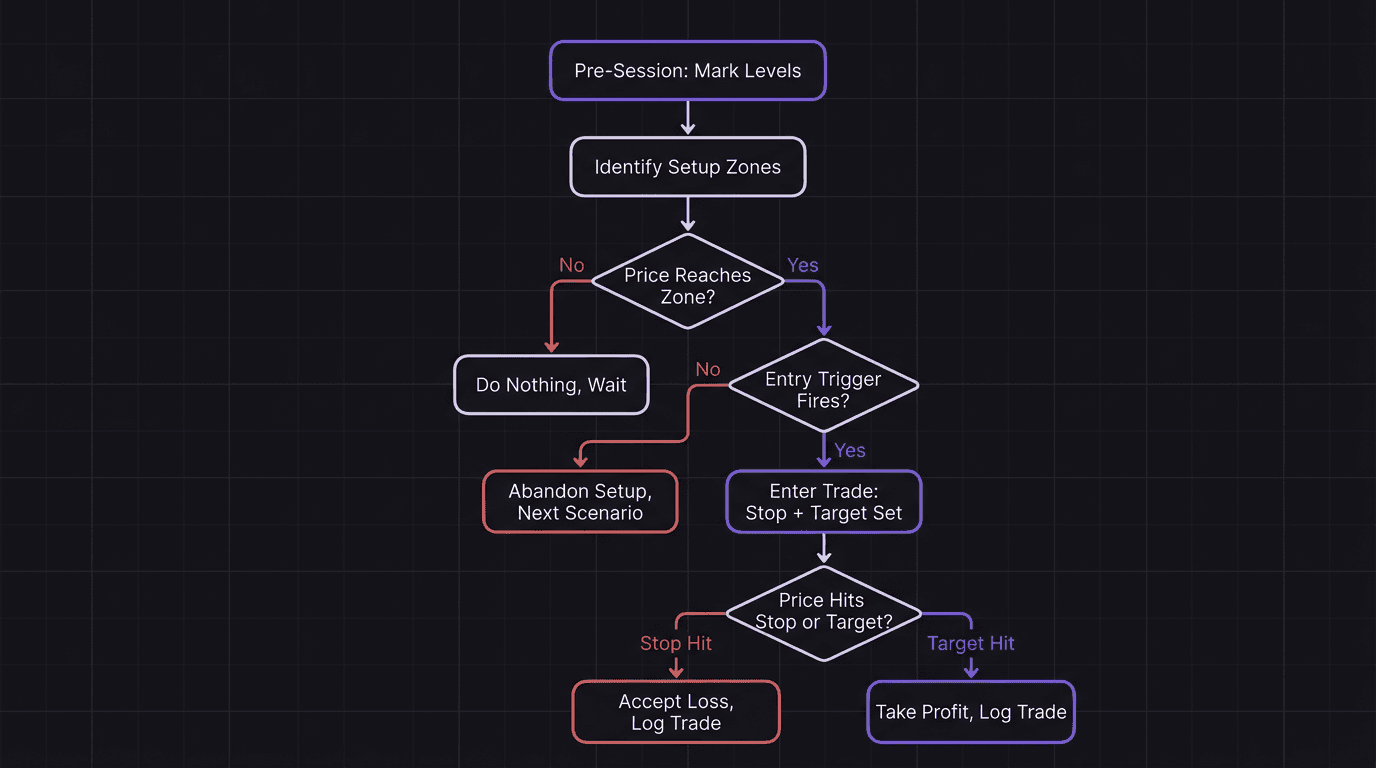
An if-then map is a visual decision tree that removes all in-session thinking. You build it before the market opens and follow it mechanically during the session.
Here is what a basic if-then map looks like:
If price reaches my setup zone, then I watch for my entry trigger.
If the entry trigger fires, then I enter with my pre-defined stop and target.
If price reaches my stop, then I accept the loss and record the trade.
If price reaches 1R profit, then I move my stop to break even (or follow whatever trade management rule I have defined in my plan).
If the entry trigger does not fire within 30 minutes of reaching the zone, then I abandon the setup and look for the next scenario.
If none of my scenarios play out by the end of my session, then I close my charts and review my markup.
Each "if" has exactly one "then." There is no room for interpretation. No room for "well, maybe I should hold a little longer" or "the candle looks close enough." The map decides. You execute.
Walkthrough: The Cost of Not Thinking Ahead
A trader enters a buy on GBP/USD at 1.2700 during the London session because price bounced off a support level. They did not build an if-then map. Price moves up 20 pips to 1.2720 and the trader feels good. Then price reverses and drops back to 1.2700 (entry). The trader has no plan for this scenario. They think, "it bounced here before, it will bounce again." Price drops to 1.2680. Now they are down 20 pips and hoping. Price drops to 1.2660. They are down 40 pips. They finally close at 1.2650 for a 50-pip loss because fear took over.
If they had built a scenario map, they would have written: "If price breaks below 1.2690, my thesis is invalid and I exit immediately." That exit would have been a 10-pip loss instead of a 50-pip loss.
That 40-pip difference is the cost of reactive trading.
From Reactive to Proactive Trading
The shift from reactive to proactive trading is not a strategy change. It is a habits change. You are moving from "I will figure it out when it happens" to "I already know what I will do when it happens."
This shift has three immediate benefits:
1. You eliminate emotional decisions. When price moves against you and you already have a plan for it, there is nothing to panic about. You execute the plan. That is it.
2. You stop overtrading. When none of your scenarios play out, the map says "do nothing." Proactive traders are comfortable with zero-trade days because they know inaction was the correct response according to their checklist.
3. You improve faster. When you review a losing trade and your if-then map was followed correctly, you know the loss was a process loss, not a discipline failure. That distinction is critical for refining your edge without second-guessing your entire approach.
The traders who survive the long game are not the ones with the best predictions. They are the ones who prepared for every outcome before the session started. Think five moves ahead. Write it down. Follow the map.
How EdgeFlo Helps You Plan Ahead
EdgeFlo's Edge plan builder is designed for exactly this kind of pre-session preparation. You can document your if-then rules directly in your trade plan and keep them visible on screen while you trade. No switching tabs. No trying to remember what you decided at 7 AM.
After the session, EdgeFlo's journal auto-imports your trades so you can compare what actually happened against the scenarios you mapped. Over time, you see which scenarios play out most often and which ones you can safely deprioritize.
The pre-market prompts in EdgeFlo encourage you to review your plan and mark your levels before the session opens. It is a small habit that compounds into a completely different trading experience.
The Edge Brief
Receive Insights on trading psychology, discipline, and the behavioral patterns that create consistent traders from our Founder and the EdgeFlo team, delivered to your inbox.
Think different. Trade different.
How many scenarios should I plan for before a trade?
When should I do pre-session scenario planning?
Does thinking ahead mean predicting the market?
Can I use if-then maps for swing trades?

Turn discipline on.
Every session.
EdgeFlo is the environment serious traders operate inside.
Start 7-Day Free Trial
Cancel anytime.
No long-term commitment.

Think Different, Trade Different.