

Set and Forget vs Active Trade Management
Compare set-and-forget, trailing stops, and partial profits as trade management methods. Includes Forex examples and guidance on choosing the right approach.
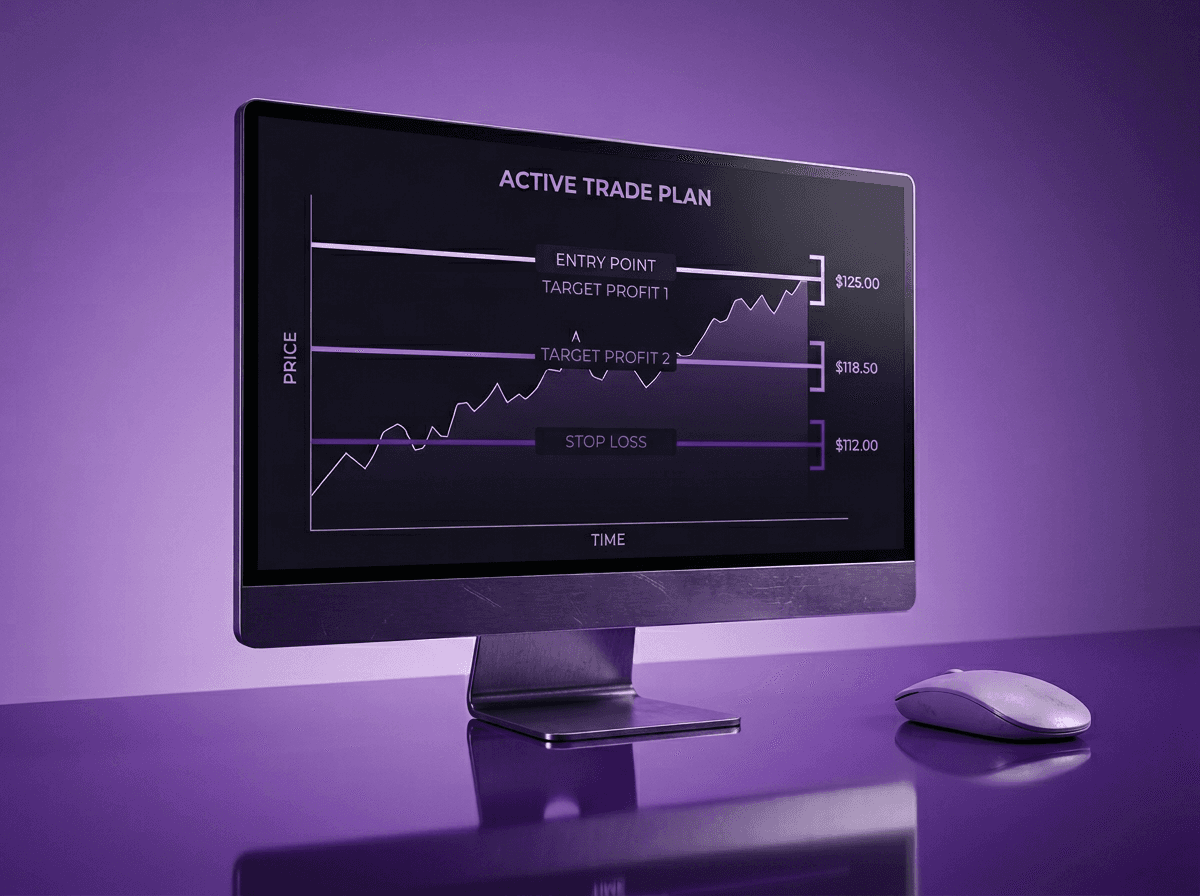
Once you enter a trade, how you manage it determines your actual results more than your entry ever will. Two traders can enter the exact same setup on EUR/USD and walk away with completely different outcomes, not because the setup was different, but because one used set-and-forget while the other trailed their stop and got clipped during a pullback.
There are three core trade management methods: set-and-forget, trailing stops, and partial profits. Each one has real advantages, real drawbacks, and a specific type of trader it fits best. The goal is not to find the "best" method. It is to pick one, define your rules, and stick with it.
TL;DR
Set-and-forget removes all post-entry decisions. You set your stop and target, then walk away.
Trailing stops follow price as it moves in your favor, protecting gains but risking early exits during pullbacks.
Partial profits lock in some gains at a defined level while letting the rest of the position run.
The best method depends on your strategy, your schedule, and how well you handle watching open trades.
Pick one method, write it into your plan, and use it the same way every time.
Three Trade Management Methods
Every trade management decision you make after entry falls into one of three categories. Understanding what each method does (and what it costs you) is the first step to choosing the right one for your plan.
Set-and-forget: Place your stop loss and take profit at entry. Do not touch the trade again. Either the stop gets hit or the target gets hit. No adjustments.
Trailing stop loss: Move your stop loss in the direction of profit as price creates new structure (new swing highs in a long trade, new swing lows in a short). The goal is to protect accumulated gains while staying in the trade as long as the trend holds.
Partial profits: Close part of your position at a predefined level (commonly at 1:1 R or 1:2 R), then let the remaining position run toward a larger target. Some traders trail the stop on the remaining portion.
Each method produces different equity curve shapes, different average R multiples, and different psychological experiences. None of them is universally better. For a deeper look at how trade management fits into your overall plan, start there.
Set-and-Forget: How It Works
Set-and-forget is the simplest method. You enter the trade, set your stop loss and take profit, and close your platform. When you come back, the trade is either a winner or a loser. No decisions to make in between.
This works best for traders who struggle with interfering in open trades, like closing trades too early because price pulls back temporarily. It also works well for people who cannot watch charts all day (swing traders, part-time traders, or anyone with a day job).
Walkthrough: Set-and-Forget on GBP/USD
You enter a long position on GBP/USD at 1.2700. Your stop loss is 30 pips below at 1.2670. Your take profit is 3:1 R, which is 90 pips above at 1.2790. Risk is 0.5 lots.
Pip value for GBP/USD at 0.5 lots: $5 per pip. Risk: $5 times 30 pips = $150. Target: $5 times 90 pips = $450. R multiple at target: $450 / $150 = 3.0R.
Price dips to 1.2685 (15 pips against you), then rallies through your target at 1.2790. Full 3:1 R captured. You did not need to touch the trade, and the temporary pullback did not matter because your stop was placed with enough room.
The main downside of set-and-forget is that if price runs well past your take profit, you miss the extended move. You traded 3:1 R but price moved 6:1 R. The trade was good, but the method capped your upside. For a deeper look, read about set-and-forget trading.
Trailing Stops and Partial Profits
Trailing stops aim to capture more of a trending move by following price as it creates new structure. Instead of a fixed take profit, you let price run and only exit when the market pulls back far enough to hit your adjusted stop.
Walkthrough: Trailing Stop on EUR/USD
You enter long on EUR/USD at 1.0850 with a 25-pip stop at 1.0825. Risk is 0.3 lots. Pip value: $3 per pip. Risk: $3 times 25 pips = $75.
Price pushes to 1.0900 (50 pips in profit). You trail your stop to 1.0870, which is 5 pips below the most recent swing low. Price continues to 1.0940, and you trail again to 1.0910. Eventually, price pulls back and hits your trailing stop at 1.0910. Result: 60 pips captured.
Profit: $3 times 60 pips = $180, or 2.4R. A fixed 2:1 R target would have captured 50 pips ($150). The trail gained an extra 10 pips. But if price had reversed from 1.0900 to 1.0870 and triggered the first trail, you would have captured only 20 pips instead of 50.
That is the tradeoff. Trailing stops give you bigger winners when trends extend, but they also clip you out during normal pullbacks. The method works best on pairs and timeframes with strong directional moves.
Read more about trailing stop loss strategy for specific rules on where to place your trail.
Partial profits split the difference. You lock in guaranteed profit at a defined level, then let the rest of the position run.
Walkthrough: Partial Profits on EUR/USD
Same entry: long EUR/USD at 1.0850, stop at 1.0825 (25 pips), 0.3 lots. At 1:1 R (25 pips, price at 1.0875), you close half the position (0.15 lots). Locked profit: $1.50 times 25 pips = $37.50.
You move your stop to breakeven on the remaining 0.15 lots. Price runs to your 3:1 R target at 1.0925 (75 pips from entry). Remaining profit: $1.50 times 75 pips = $112.50. Total profit: $37.50 + $112.50 = $150.
Total: $150, or 2.0R. Full set-and-forget at 3:1 R would have been $225 (3.0R). You gave up 1R of potential profit in exchange for reduced risk after the partial.
This is the core tension with partial profits trading: you always leave money on the table if the full target hits, but you also protect yourself if price reverses after your partial level.
Choosing the Right Method for Your Style
There is no objectively best method. The right one depends on three things: your trading style, your schedule, and your personality.
You trade part-time and cannot monitor charts during the session.
You tend to interfere with open trades (moving stops, closing early).
Your strategy targets fixed R multiples (2:1, 3:1) with clearly defined levels.
You trade full-time and can monitor price structure as it develops.
Your strategy targets trends that can extend beyond initial expectations.
You are comfortable with smaller wins on trades that reverse before trending.
You want guaranteed income from each winning trade plus upside on runners.
You struggle psychologically with watching open profit disappear during pullbacks.
Your strategy has a moderate win rate (40% to 55%) and benefits from locking gains.
The most important thing is consistency. Pick one method and use it the same way on every trade. Do not set-and-forget on Monday, trail on Tuesday, and take partials on Wednesday. That is not a plan. That is discretionary management dressed up as structure.
Write your management rules into your mechanical trading plan. Define exactly when you trail, where you take partials, and what triggers an adjustment. If you cannot write the rule down, you are making the decision emotionally, and emotional management is how good entries turn into mediocre results.
How EdgeFlo Supports Your Trade Management Rules
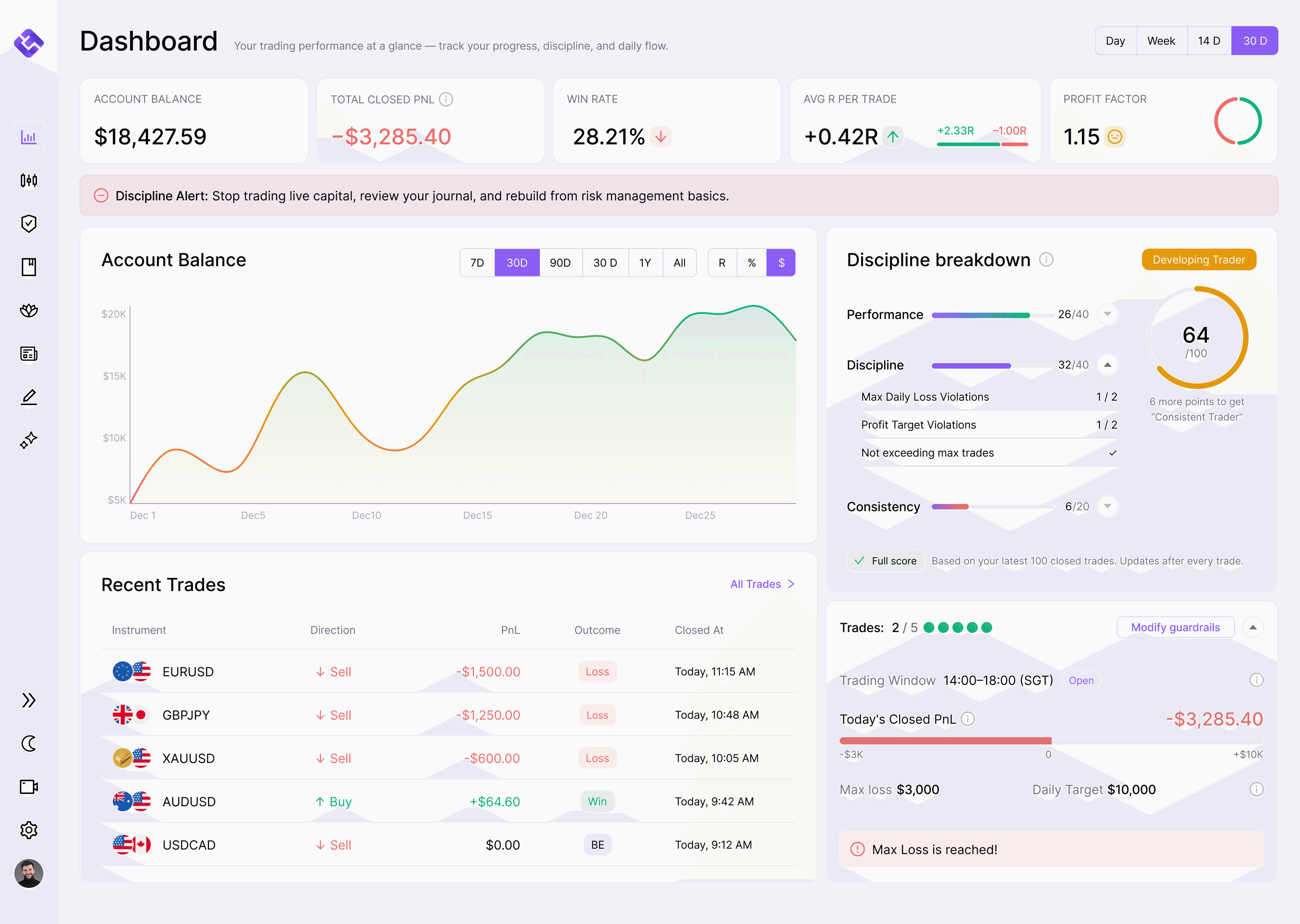
EdgeFlo's Edge plan builder lets you document your trade management method alongside your entry and exit rules. When you open a trade, your management rules are visible on the same screen, so you do not have to remember whether you are trailing at 1:1 or taking partials at 50 pips.
Post-trade self-reporting asks whether you followed your management plan. Over time, your journal data shows the difference between trades where you stuck to the method and trades where you deviated. That feedback is how you prove which method actually produces the best results for your specific strategy.
The Edge Brief
Receive Insights on trading psychology, discipline, and the behavioral patterns that create consistent traders from our Founder and the EdgeFlo team, delivered to your inbox.
Think different. Trade different.
What is set-and-forget trading?
Is trailing your stop loss better than set-and-forget?
How do partial profits work in trade management?
Can I combine trade management methods?

Turn discipline on.
Every session.
EdgeFlo is the environment serious traders operate inside.
Start 7-Day Free Trial
Cancel anytime.
No long-term commitment.

Think Different, Trade Different.