

Partial Profits: The Break-Even Math
Learn how partial profit taking works in trading. Compare 50/50 and 20/80 splits with real break-even math on partial closes.

Partial profits means closing part of your position before it reaches the final target. You lock in realized gains on one portion and let the rest run. This gives you the psychological relief of "paying yourself" while keeping upside potential on the remaining position.
The concept is simple. The math is where it gets interesting, because partial profits change your break-even point, your average winner, and your overall expectancy.
TL;DR
Partial profits close a portion of your trade early and let the rest run.
A 50/50 split at 1.5R locks in profit but cuts your full-target payout in half.
A 20/80 split at 4R can make your worst-case outcome break even instead of a 1R loss.
Partial profits reduce your maximum gain on winning trades. That is the trade-off.
Decide your split before entry, not while the trade is live.
What Partial Profits Mean
When you open a trade, your full position rides from entry to either your stop loss or your take profit. Partial profits change that by creating two (or more) exit points for different chunks of the same position.
The simplest version: you open 0.2 lots. When price hits an intermediate target, you close 0.1 lots (half). The remaining 0.1 lots stays open with the original stop loss and rides to the final take profit.
You are essentially turning one trade into two trades with different exits. The first half exits early for a smaller gain. The second half either hits the big target or gets stopped out.
Most platforms (cTrader/ TradeLocker) allow you to close a specific percentage of an open position. You do not need to open two separate orders.
The key question is: where do you take the partial, and how much do you close? That is where the split ratios come in.
The Break-Even Math on Partial Closes
The math behind partial profits is what separates a smart partial-profit plan from a fear-driven one. Here are the two most common splits and exactly what they do to your numbers.
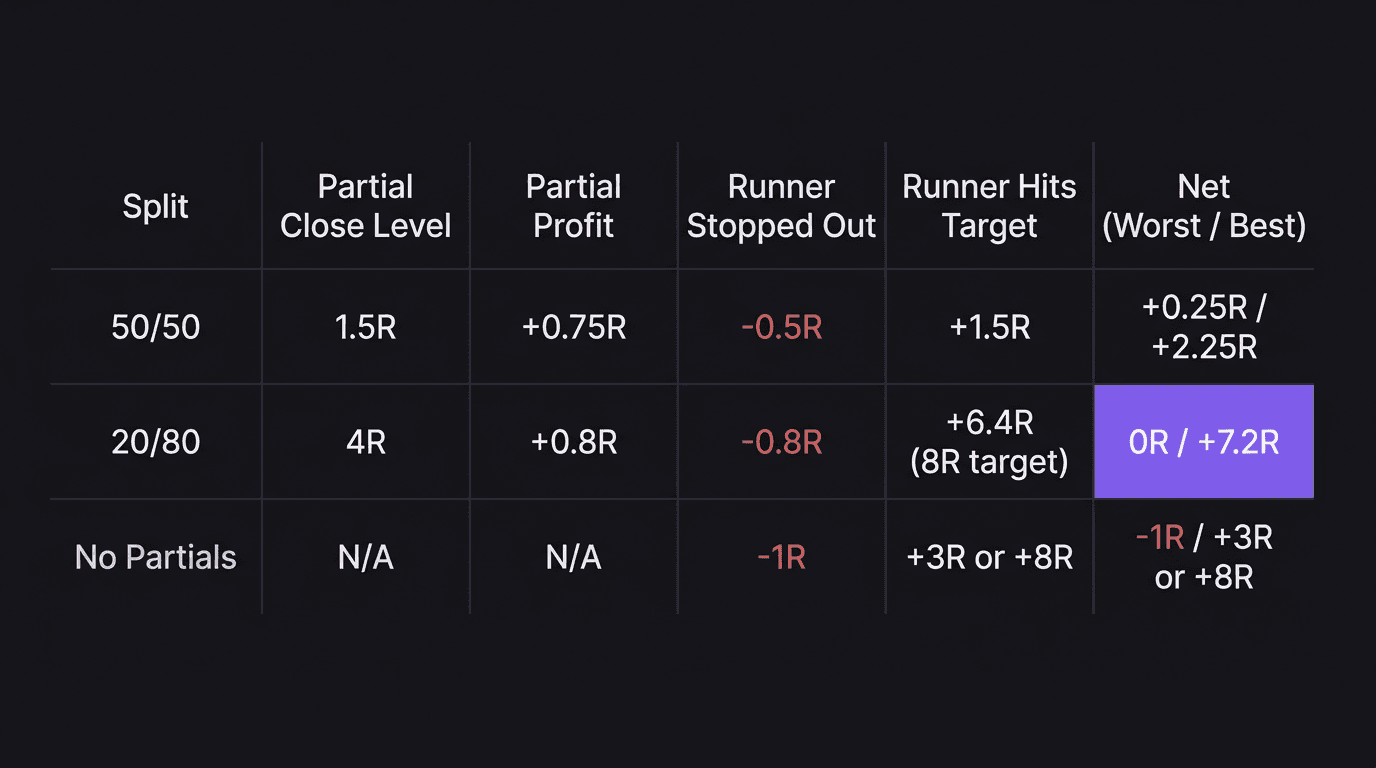
50/50 Split at 1.5R
You enter with 1R of risk. When price reaches 1.5R in profit, you close half. The first half earns 1.5R x 50% = 0.75R. The remaining half either hits your full target (say, 3R x 50% = 1.5R) or gets stopped out (1R x 50% = 0.5R loss).
Best case: 0.75R + 1.5R = 2.25R total (vs 3R with no partials). Worst case: 0.75R minus 0.5R = 0.25R profit (vs 1R loss with no partials).
The 50/50 split turns a potential 1R loss into a 0.25R profit. But it turns a potential 3R winner into a 2.25R winner. You give up 0.75R on the upside to protect 1.25R on the downside.
20/80 Split at 4R
You enter with 1R of risk. When price reaches 4R in profit, you close 20%. The first piece earns 4R x 20% = 0.8R. The remaining 80% either hits your full target or gets stopped out for 1R x 80% = 0.8R loss.
Best case (if target is 8R): 0.8R + (8R x 80%) = 0.8R + 6.4R = 7.2R total. Worst case: 0.8R minus 0.8R = 0R. Break even.
The 20/80 split at 4R is the "break-even-proof" setup from the transcript. Your worst outcome after taking the partial is zero, not a loss. The trade cannot lose you money once you close that 20%.
The catch: price has to reach 4R before you take any profit. Many trades will get stopped out at 1R before ever reaching that level.
50/50 vs 20/80 Split
The choice between these splits comes down to what you are optimizing for.
50/50 is for capital preservation. You get money off the table quickly. Every trade that reaches 1.5R gives you realized profit. If your strategy produces a lot of trades that reach 1.5R but not 3R, the 50/50 split captures gains that set-and-forget would give back.
Beginners who need the psychological win of paying themselves
Strategies with moderate win rates (40-50%) and modest R targets (2R to 3R)
Traders with smaller accounts who feel every dollar of unrealized profit
20/80 is for runners. You keep most of your position in play for the big move. The 20% partial is just insurance, not the main profit source. You sacrifice very little upside to eliminate the possibility of a full-position loss after reaching 4R.
Swing traders who target 5R or higher
Strategies with lower win rates (25-35%) that rely on big winners
Traders who can handle watching the 80% runner get stopped out occasionally
Walkthrough: Both Splits on the Same EUR/USD Trade
You enter long on EUR/USD at 1.0850. Stop loss at 1.0820 (30 pips, 1R = $60 on 0.2 lots). Take profit at 1.0940 (90 pips, 3R).
50/50 Split at 1.5R (1.0895): Price reaches 1.0895. You close 0.1 lots for 45 pips = $45 profit. The remaining 0.1 lots ride. Price then reverses and hits your stop at 1.0820. The runner loses 30 pips = $30. Net: $45 minus $30 = $15 profit.
20/80 Split at 4R (price must reach 1.0970, beyond your 3R TP): With a 3R target, price never reaches 4R. The 20/80 split is not triggered. You collect the full 3R on 0.2 lots = $180. Or you get stopped for a full $60 loss. The 20/80 split only applies to strategies targeting high R multiples.
For a 3R strategy, the 50/50 split makes more sense because 4R is above your take profit. Adjust your split level to match your actual target.
The lesson: match your partial profit level to your strategy's R target. A 50/50 split at half your target (1.5R of a 3R target) is a practical starting point. A 20/80 split makes sense when your target is 8R or higher.
When Partial Profits Make Sense
Partial profits are not always the right move. They make sense when:
Your strategy targets 3R or higher (partial at 1.5R gives meaningful realized profit)
You struggle emotionally with watching unrealized gains evaporate
Your win rate is moderate and you need to capture gains on trades that reverse before target
You trade supply and demand zones where intermediate levels offer natural partial targets
Partial profits may hurt your results when:
Your targets are small (2R or less). Closing half at 1R means your partial is barely worth the spread.
Your win rate is high (60%+). Most trades hit the full target, so partials just reduce your average winner.
You use it as fear management instead of strategy. If you are taking partials at random levels because you are scared, the numbers will not work.
Position sizing does not change with partials. Your initial risk per trade is still determined by your stop loss and account percentage. The partial only affects how much of that position exits at each level.
Write your split rule into your trading playbook before you start. "Close 50% at 1.5R, let remaining ride to 3R" is a plan. "Close some when I feel nervous" is gambling.
Track every partial profit trade separately in your journal: what was the partial level, what happened to the runner, and what the total outcome was. After 30+ trades, compare your actual average R with partials versus what you would have earned with set and forget. The data will tell you whether partials are helping your strategy or costing you.
How EdgeFlo Supports Partial Profit Tracking
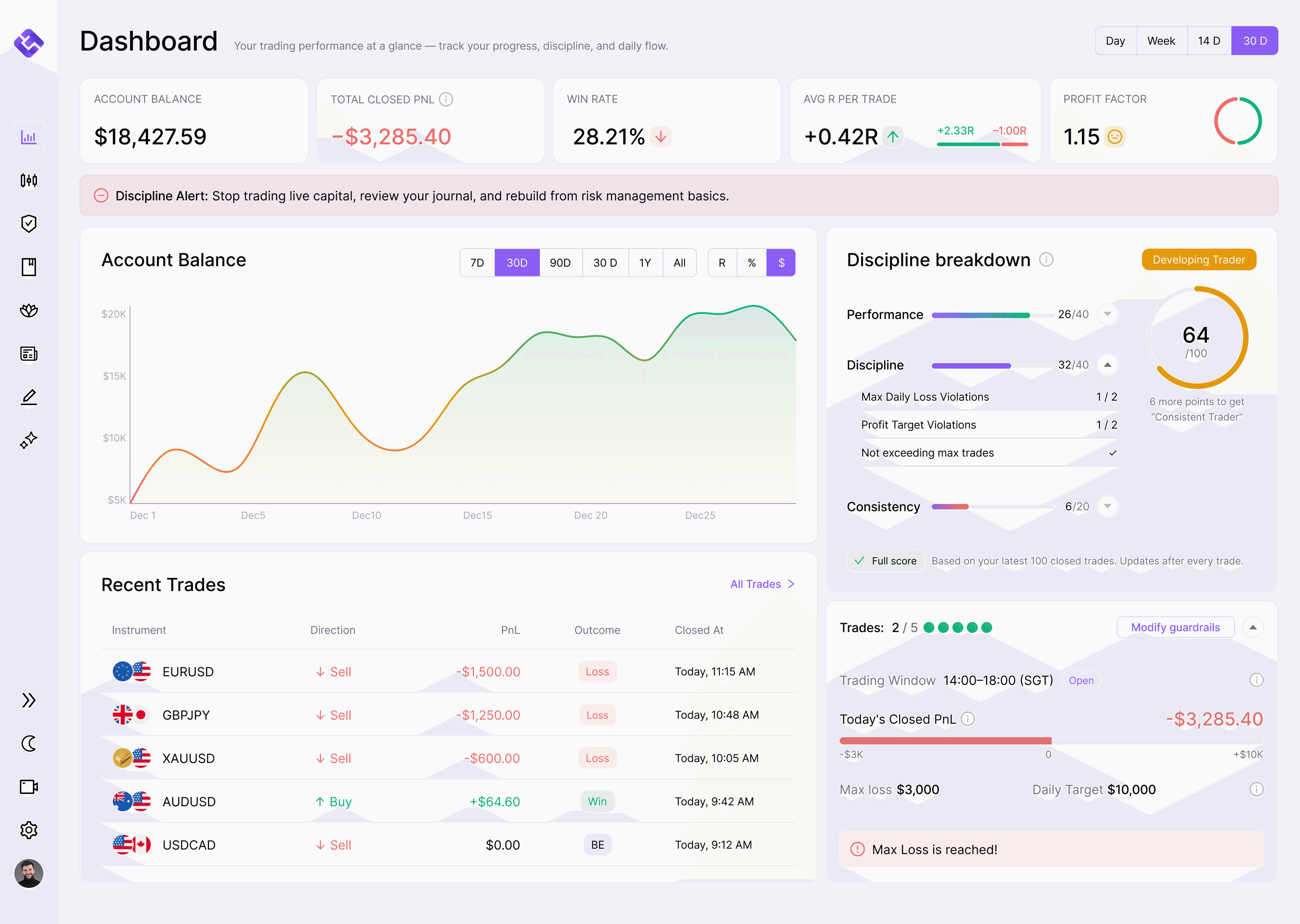
EdgeFlo's auto risk calculator computes your position size before every entry. When you plan a partial profit trade, the calculator shows your exact dollar risk on the full position, so you know exactly how much each partial close will realize.
After the trade closes, EdgeFlo's journal auto-imports both the partial and the remaining exit. You can review every partial profit trade as a unit: partial level, runner outcome, and total R earned. Over time, this reveals whether your split ratio is actually improving your average R or just providing false comfort.
The data answers the real question: are your partials a strategic edge, or are they a coping mechanism? Only the numbers can tell you.
The Edge Brief
Receive Insights on trading psychology, discipline, and the behavioral patterns that create consistent traders from our Founder and the EdgeFlo team, delivered to your inbox.
Think different. Trade different.
What does taking partial profits mean?
What is the best partial profit split?
Does taking partial profits reduce your overall gains?
When should you take partial profits?

Turn discipline on.
Every session.
EdgeFlo is the environment serious traders operate inside.
Start 7-Day Free Trial
Cancel anytime.
No long-term commitment.

Think Different, Trade Different.