

Self Sabotage in Trading: Why You Give Profits Back
Self sabotage in trading makes you give back profits right after winning. The cause is an identity gap, not a strategy flaw. Here is how to fix it.

Self sabotage in trading is when you destroy your own profits, not because your strategy failed, but because your identity has not caught up with your success. You make money, then you give it back. You pass a challenge, then you blow the funded account. The pattern repeats because the problem is not on your chart. It is inside your self-image. Your personality still matches the broke, overleveraged, impulsive version of yourself, and until that changes, every winning streak ends the same way: back to zero.
TL;DR
Self sabotage in trading is an identity problem, not a strategy problem. Your old self-image pulls you back to familiar financial territory.
Success amplifies your habits. If you overtrade when broke, you will overtrade harder when profitable.
Lottery winners, rappers, and traders all blow sudden wealth for the same reason: their internal identity did not shift with their bank balance.
Closing the gap requires building self-esteem through process (journaling, following rules, doing hard things), not through profit targets.
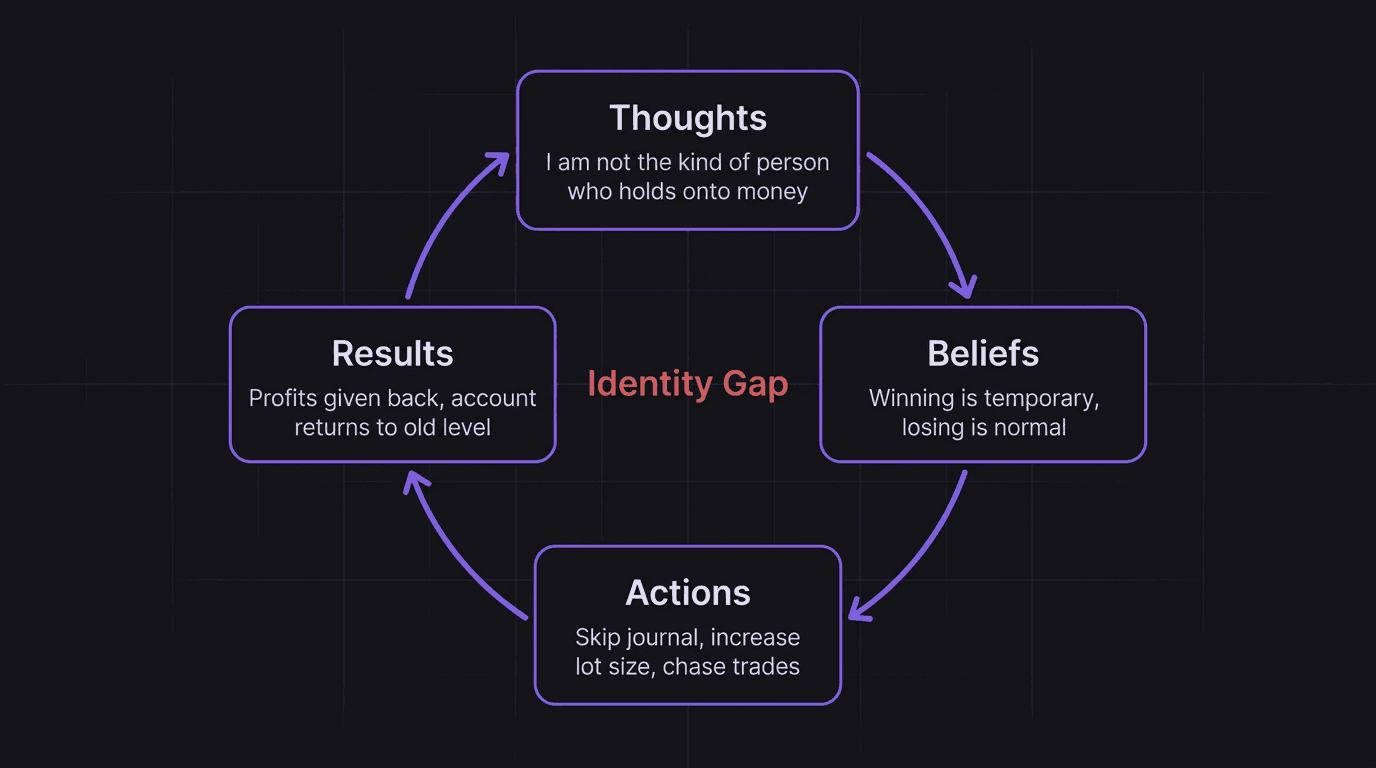
Your thoughts shape your beliefs, your beliefs shape your actions, and your actions shape your results. Change starts at the thought level.
What Self Sabotage Looks Like in Trading
You know the pattern. You string together a solid week. Your account is up 4%, maybe 5%. You followed your plan, took clean setups, managed risk properly. Then something shifts.
Maybe you bump up your lot size because you feel invincible. Maybe you take a trade outside your plan because you are "on a roll." Maybe you skip your pre-market routine because, well, you have been winning. Why bother?
Within days, the 5% gain is gone. Sometimes it is worse than gone. You are deeper in the red than before the winning streak started.
Sound familiar?
This is not a one-off mistake. It is a pattern. And the most frustrating part is that you can see it happening in real time, yet you still do it. You watch yourself take the bad trade. You feel the recklessness building. You know you should stop. But you do not stop.
That is self sabotage. It is not random. It is not bad luck. It is your internal programming doing exactly what it was designed to do: return you to the financial state that matches your self-image.
The Identity Gap That Causes It
Think about lottery winners. Someone goes from $20 in their bank account to a million dollars overnight. What happens next? They spend it. Cars, parties, watches, mansions. Within a few years (sometimes months), they are broke again.
It is the same pattern with traders. The problem is not the money. The problem is that their identity is still the old self: the broke self, the insecure self, the overleveraged self. They have not developed the capacity to handle a large amount of wealth because their internal identity never shifted.
Here is how the loop works. Your thoughts create your beliefs. Your beliefs drive your actions. Your actions produce your results. And your results reinforce your thoughts.
If your deepest belief is "I am not the kind of person who holds onto money," then no strategy in the world will save you. You will find a way to give it back. You will crank up your lot size. You will chase revenge trades after one red day. You will skip your journal. You will stop doing the exact things that made you profitable in the first place.
Your personality dictates your personal reality. That is not a motivational quote. It is a mechanical description of how self sabotage works.
Why Success Amplifies Your Old Habits
Here is what nobody tells you about making money in trading: success does not fix your bad habits. It scales them.
When you were trading a $500 account, overleveraging cost you $50. Annoying, but survivable. When you are trading a $50,000 funded account, the same habit costs you $5,000. Same percentage, same impulse, but the dollar damage is catastrophic.
Your habits do not go away when you level up. They follow you. Just like brushing your teeth in the morning or brewing coffee at the same time every day, your trading habits (good and bad) are automatic. They do not care whether your account has $500 or $50,000 in it.
This is why trading ego is so dangerous after a win streak. You start believing you have "figured it out." That confidence is not earned through process. It is a dopamine spike from seeing green numbers. And dopamine-driven confidence leads to the same place every time: bigger risk, sloppier execution, and a blown account.
The traders who succeed at the highest level are boring. Methodical. They execute the same plan every single day, whether they are up 10% or down 3%. There is no celebration trade. There is no "I earned a bigger position." There is just the process.
Walkthrough: $5,000 Profit to $0 in One Week
The Setup
A trader passes Phase 1 of a funded challenge. Their $50,000 account is up $5,000 after three weeks of disciplined execution. Risk per trade: 1% ($500). They took 15 trades, won 9, lost 6. Clean stats. Every trade matched their plan.
The Unraveling
Monday morning, they skip their pre-market routine. They feel sharp. They already proved they can trade. They spot a GBP/USD setup that does not fully meet their criteria, but it "looks good enough." They enter with 2% risk ($1,000) instead of 1%.
The trade loses. Down $1,000.
Now the identity gap kicks in. That familiar feeling creeps in: "I knew it. I always give it back." Instead of journaling the loss and resetting, they take another trade immediately. Same pair, same direction, same inflated lot size.
That one loses too. Down $2,000 in a single morning.
By Wednesday, they are revenge trading. Three more unplanned trades, two more losses. The $5,000 profit is gone. By Friday, they have breached the drawdown limit and lost the account entirely.
What Actually Happened
The strategy did not fail. The strategy was not even present for most of those trades. What failed was the trader's identity. After proving they could win, their self-image could not sustain it. The old programming kicked in: "I am not a $55,000 trader. I am a $50,000 trader." And the account corrected to match the belief.
Every bad decision in that sequence, the skipped routine, the inflated lot size, the revenge entries, traced back to one root cause: success arrived before the identity was ready for it.
Closing the Identity Gap
You cannot think your way out of this. You cannot read one article and fix your self-image overnight. But you can start the shift today, and the process is simpler than most traders expect.
Build Self-Esteem Through Hard Things
Self-esteem comes from doing hard things, not from winning trades. It comes from journaling a painful loss when every part of you wants to close the laptop. It comes from sitting out a session because there is no clean setup, even though you feel the itch to trade.
Every time you keep a promise to yourself (follow the plan, respect the daily loss limit, complete your review), you deposit a small amount of trust into your identity account. Over time, those deposits compound.
Treat Wins Like You Treat Losses
Most traders have a post-loss routine. They slow down, reduce size, get careful. But they have no post-win routine. After a green week, they accelerate instead of staying steady.
Build symmetry into your process. After a winning week, run the same review. Check for overconfidence signals. Ask: "Did I follow my plan, or did I get lucky?" If the answer is "I got lucky on two of those trades," adjust before the next session.
Change the Thought, Change the Loop
Remember the cycle: thoughts, beliefs, actions, results. The intervention point is at the top. You cannot control results directly. But you can notice the thought "I always give it back" when it appears, and you can replace it with a factual statement: "My last 15 planned trades had a 60% win rate and positive expectancy."
That is not affirmation nonsense. That is data. And data rewires the thought loop faster than anything else.
Set Process Goals, Not Dollar Goals
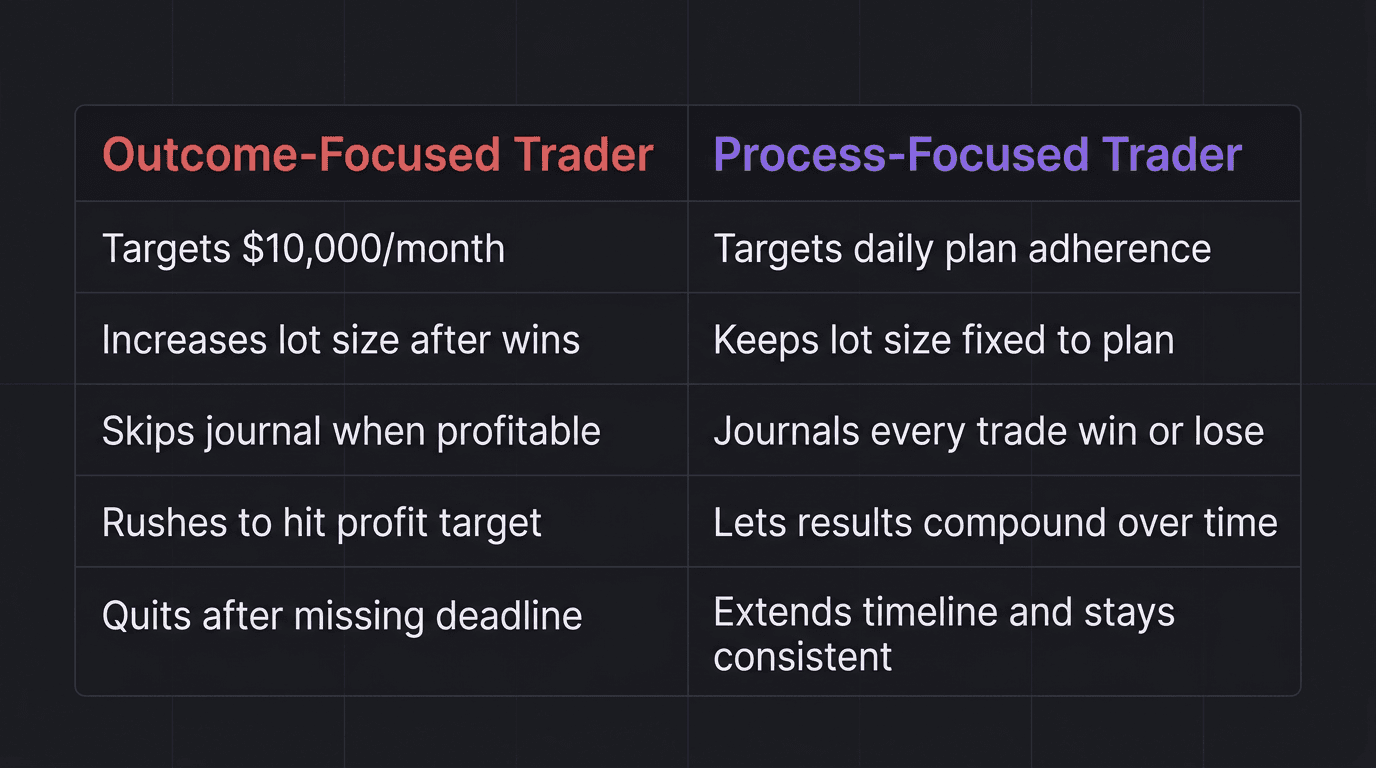
Experienced traders confirm this pattern: traders who chase a $10,000/month target end up overleveraging, rushing, and blowing up. Traders who chase consistency, clean execution, and daily improvement end up hitting the dollar goal as a side effect.
Your attention determines your actions. Focus on the number, and you will cut corners to get there. Focus on the process, and the number takes care of itself.
How EdgeFlo Protects Gains Structurally
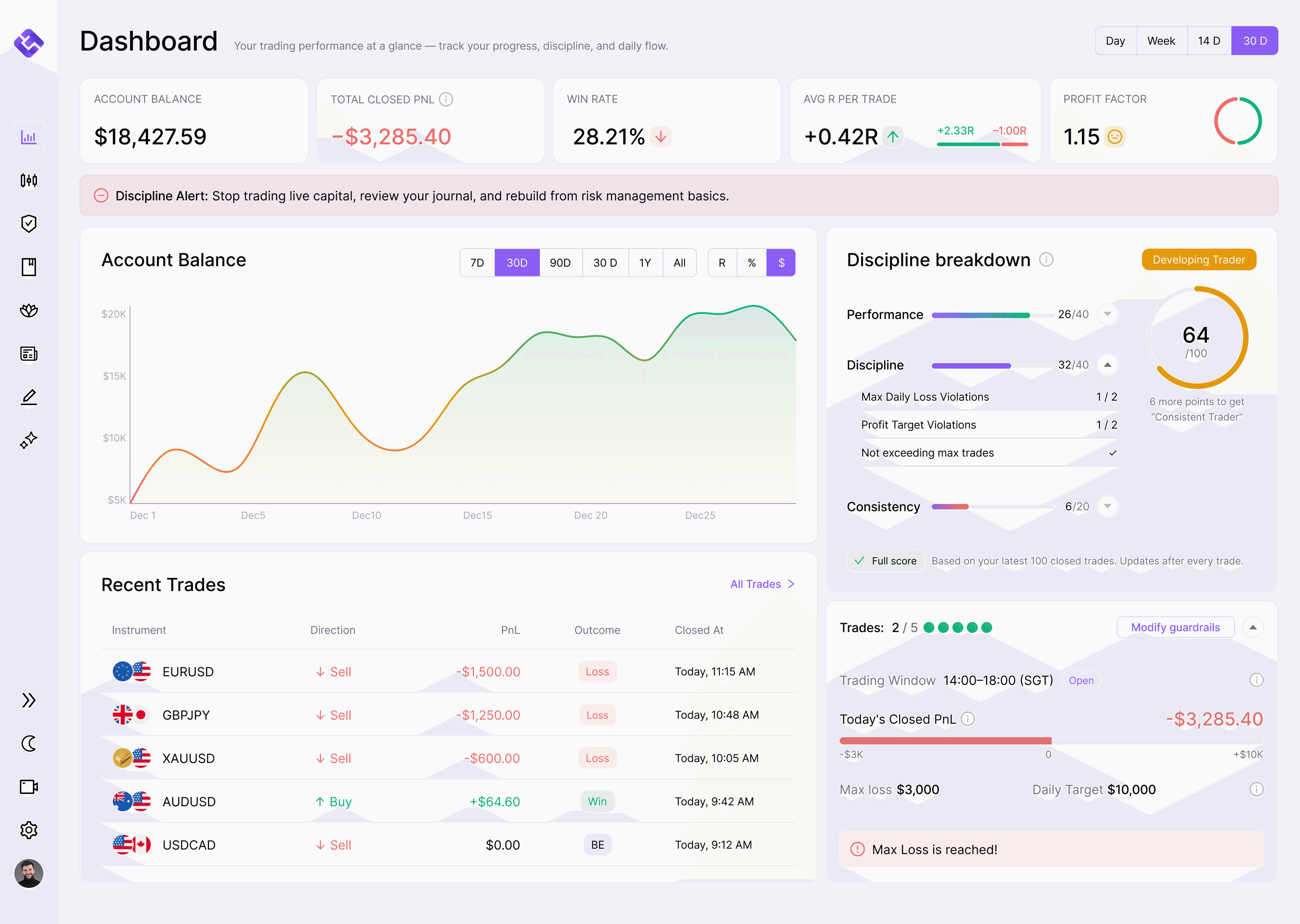
Self sabotage thrives in environments with no guardrails. When nothing stops you from doubling your lot size after a win, the identity gap does the rest. EdgeFlo changes the environment so that impulsive decisions require a conscious choice.
Guardrails cap your daily losses even during winning streaks, so a single bad morning cannot erase a week of clean trading. You can override them if you choose, but the override is deliberate. It forces you to pause and decide rather than react on autopilot.
The journal tracks emotional patterns after winning streaks, not just losing ones. When you review a week where you made $3,000, the journal shows you whether those trades matched your plan or whether you drifted. That visibility is what closes the gap between "I feel profitable" and "I am actually trading well." Sanctuary supports reset routines that work after wins too. Sitting with a profitable week is harder than most traders admit. A structured cooldown before your next session keeps the old identity from hijacking your execution.
The Edge Brief
Receive Insights on trading psychology, discipline, and the behavioral patterns that create consistent traders from our Founder and the EdgeFlo team, delivered to your inbox.
Think different. Trade different.
What causes self sabotage in trading?
Why do traders give back profits after a winning streak?
How do you stop self sabotaging trades?
Is self sabotage in trading a mindset or strategy problem?

Turn discipline on.
Every session.
EdgeFlo is the environment serious traders operate inside.
Start 7-Day Free Trial
Cancel anytime.
No long-term commitment.

Think Different, Trade Different.