

How to Review Losing Trades in Your Journal
Most traders skip their loss reviews. Use this 3-question framework to find emotional patterns in losing trades and turn journal data into better rules.
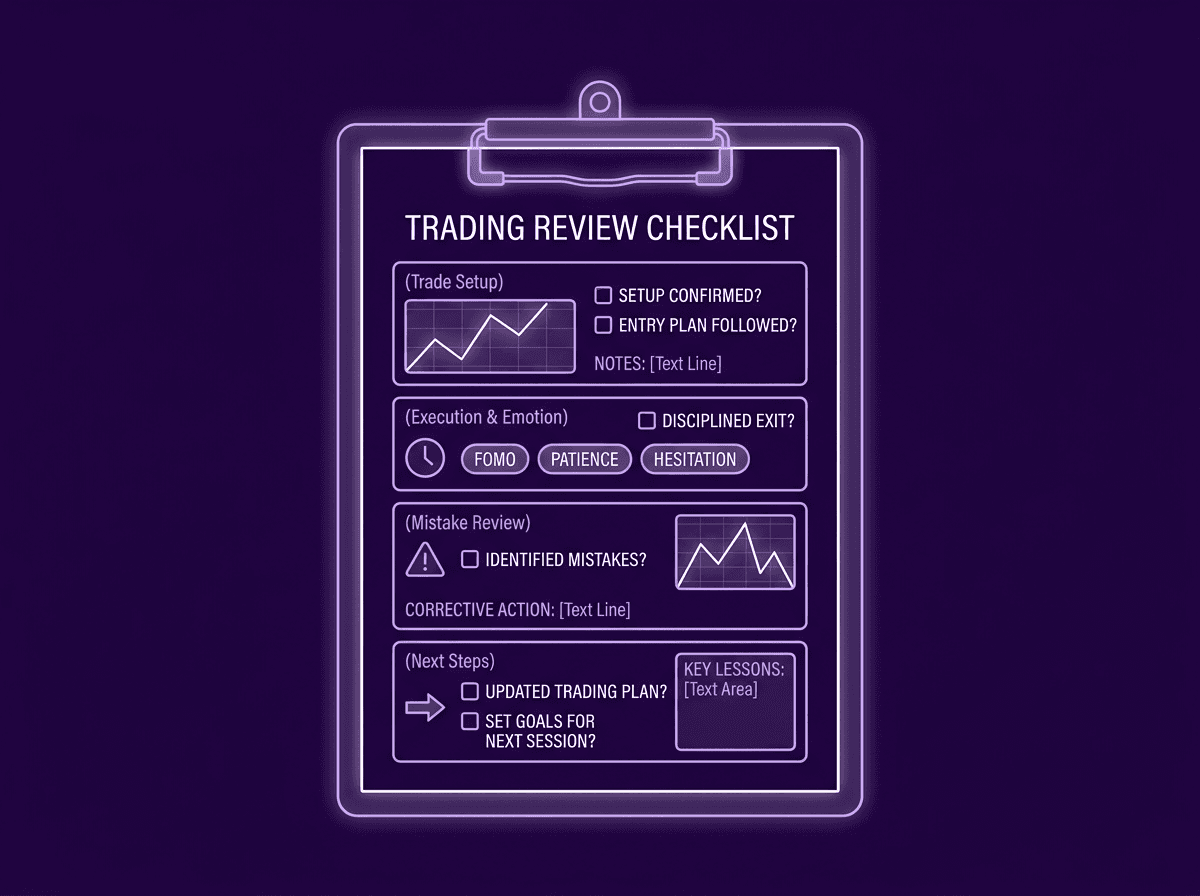
After a losing trade, most traders do one of two things. They close the chart and pretend it did not happen. Or they stare at the chart for an hour, replaying the trade in their head without writing anything down.
Neither approach helps. The loss still happened. The money is still gone. And the pattern that caused it is still sitting in your process, waiting to fire again next week.
Reviewing losing trades is how you stop repeating the same mistakes. Not by feeling bad about them, but by pulling the trade apart with honest questions and finding the root cause. One trader lost $30,000 across three trades in a single week. When he finally sat down and reviewed each loss, he discovered that two of the three were driven by the same emotional pattern. That insight changed how he traded for the rest of the month.
TL;DR
Most traders avoid loss reviews because confronting mistakes is uncomfortable.
Use a 3-question framework: did you follow your plan, what emotion drove the entry, and would you take this trade again?
Categorize every loss as "good" (plan-following) or "bad" (rule-breaking) before drawing conclusions.
Bad losses reveal emotional patterns; good losses confirm your system works and variance is normal.
Turn repeated patterns into specific new rules in your trading plan.
Why Most Traders Skip Loss Reviews
The reason is simple. It hurts.
Opening your journal after a loss means admitting you were wrong. Maybe you broke a rule. Maybe you traded on emotion. Maybe your ego pushed you into a position you knew was weak. Writing that down forces you to see it clearly, and most people would rather move on than face it.
But moving on without reviewing is the most expensive thing you can do. Because the loss is not the real cost. The real cost is taking the same loss again next week, and the week after that, because you never identified what caused it.
One trader described it this way: after losing $10,000 on an impulse entry, he did not review the trade. He jumped straight into another setup the next day, driven by a subconscious need to prove he was still a good trader. That second trade was a revenge trade, and it cost him another $10,000.
It was not until the third loss ($30,000 total in one week) that he finally stopped and opened his journal. When he reviewed all three trades together, the pattern was obvious. Two of the three losses came from entering before his setup confirmed. One was a legitimate plan-following loss that happened due to choppy market conditions.
That distinction changed everything.
The 3-Question Loss Review Framework
Every time you take a loss, open your journal and answer these three questions. Do not skip any of them. Do not answer from memory hours later. Do it within 24 hours while the details are still sharp.
Question 1: Did I follow my plan on this trade?
This is a yes or no question. Not "mostly" or "kind of." Compare what your plan required against what you actually did.
Your plan might say: wait for price to sweep the strong low, then enter after the fractal market shift confirms. If you entered before the sweep happened, the answer is no. You did not follow the plan.
If the answer is yes, this was a good loss. Your system worked. The market just did not cooperate this time. Variance happens.
If the answer is no, this was a bad loss. Something caused you to deviate. Question 2 finds out what.
Question 2: What emotion was I feeling before I clicked the button?
This is the question most traders cannot answer honestly. But it is the most important one.
Common emotional drivers include:
Urgency: "Price is moving, I need to get in now"
Revenge: "I need to make back what I lost yesterday"
Ego: "I already told people I am in this trade"
Boredom: "I have been watching charts for three hours and need something to happen"
Complacency: "I have been winning, I do not need to check the plan today"
The trader who lost $30,000 discovered that his first loss was driven by complacency (he skipped his plan review after a profitable month), his second loss was driven by ego and revenge (he wanted to prove himself after the public first loss), and his third loss was actually clean. He followed the plan. The market was choppy.
Without labeling the emotion, he would have lumped all three losses together as "bad month." With the labels, he could see that only one loss was real variance. The other two were self-inflicted.
Question 3: Would I take this exact trade again tomorrow?
If the answer is yes because the setup was clean and you followed your rules, this loss needs no correction. Just move on.
If the answer is "yes, but I would do X differently," write down that specific change. That change becomes a candidate for a new rule.
If the answer is no, ask yourself what rule would have kept you out. Write that rule down. This is how your plan evolves.
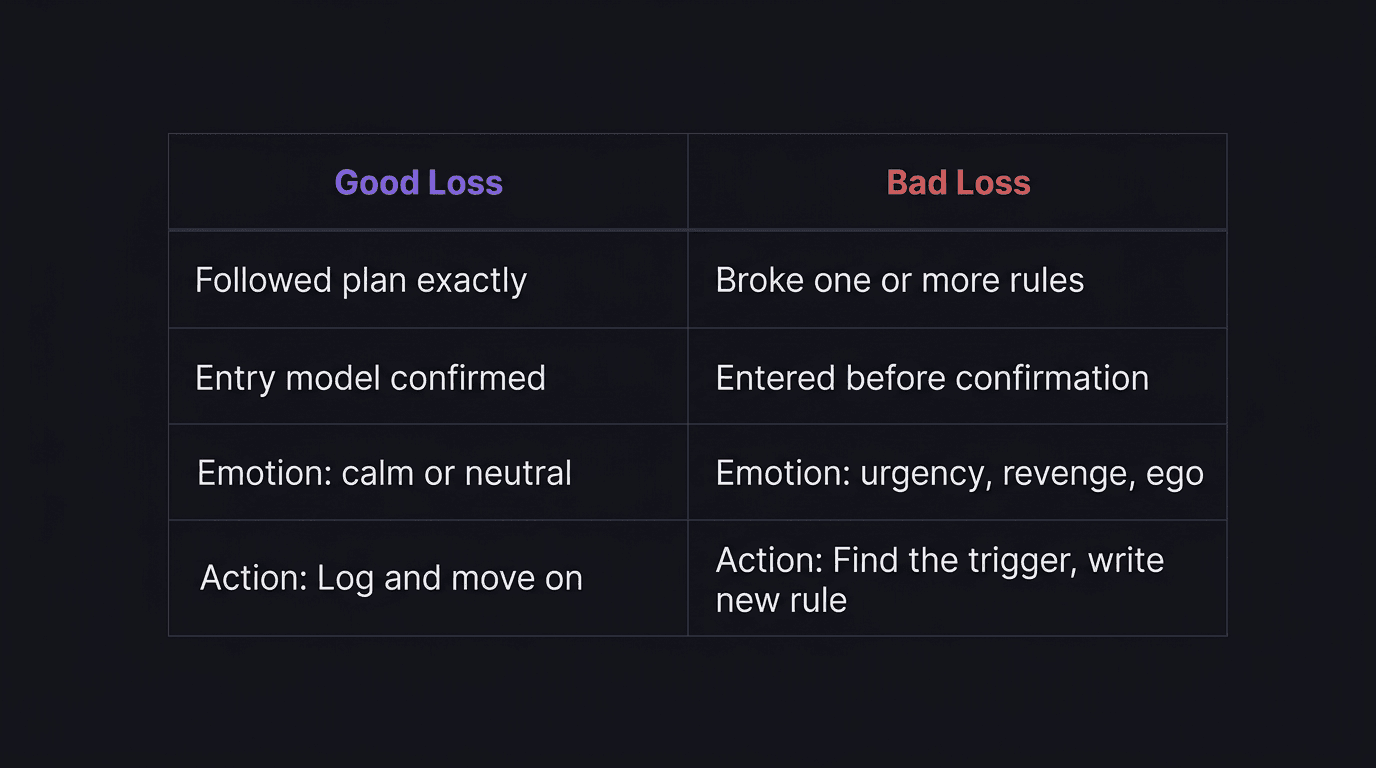
Find the Emotional Pattern
A single loss review tells you what happened on one trade. But the real value comes from stacking multiple reviews and looking for repeating patterns.
After you have reviewed five or more losing trades using the 3-question framework, pull up your journal entries side by side and ask:
Which emotion shows up most often?
Do your bad losses cluster on certain days (Monday? Friday? After a win?)?
Is there a specific market condition where you consistently break your rules?
The trader who reviewed his three June losses found that complacency was the common thread. He had been profitable the previous month and did not review his plan on the first day. That single missed step led to two impulse entries that cost $20,000.
The pattern was not "I take bad trades." The pattern was "I skip plan review after profitable months." That is specific enough to fix.
When you track this data over time in a trading journal, patterns that feel random start to look predictable. You might discover that every time you trade during the first hour of London session without completing your morning routine, you lose. Or that your worst losses always follow a day when you took more than three trades.
These patterns are invisible until you write them down and review them together. The journal is not a diary. It is a diagnostic tool.
Build accountability into your process by scheduling a weekly review. Pick one day per week where you re-read every loss from that week, tag the emotion, and look for the repeating thread.
Turn Loss Data Into Better Rules
The point of reviewing losses is not to feel bad about them. It is to extract a specific, actionable change that prevents the same loss from happening again.
Here is how to convert a pattern into a rule:
Pattern: "I enter before my setup confirms when I feel urgent about missing a move."
New rule: "If I feel urgency, I must wait 60 seconds and re-check my entry model. If the model has not confirmed, I do not enter."
Pattern: "I take revenge trades after a loss, usually within the same session."
New rule: "After any loss, I close the chart for 30 minutes before taking another trade. No exceptions."
Pattern: "I skip my post-trade review on winning days, which means I have no data when a losing streak starts."
New rule: "Review every trade, win or loss, within 24 hours. No review means no next trade."
Walkthrough: Turning 3 Losses Into 2 New Rules
A trader lost three trades in one week on GBP/JPY. Total damage: $30,000.
After reviewing all three trades:
Trade 1 (June 3): Entered long before price swept the strong low at 159.500. Emotion: complacency from profitable previous month. Did not review plan that morning. Result: -$10,000.
Trade 2 (June 4): Entered short based on a supply zone but ignored a bullish market shift on the lower timeframe. Emotion: ego and revenge after the public first loss. Refused to accept the market was turning bullish. Result: -$10,000.
Trade 3 (June 5): Followed the plan. Found the fractal market shift, waited for liquidation. Market was choppy (typical June conditions). Result: -$10,000. This was a good loss.
Two new rules came from this review:
"Review my trade plan every morning before the first trade, regardless of last month's results."
"After a loss, I do not take another trade for 24 hours unless my review process is complete."
Those two rules addressed the root cause of $20,000 in losses. The third loss required no correction because the plan was followed correctly.
How EdgeFlo Supports Your Loss Reviews
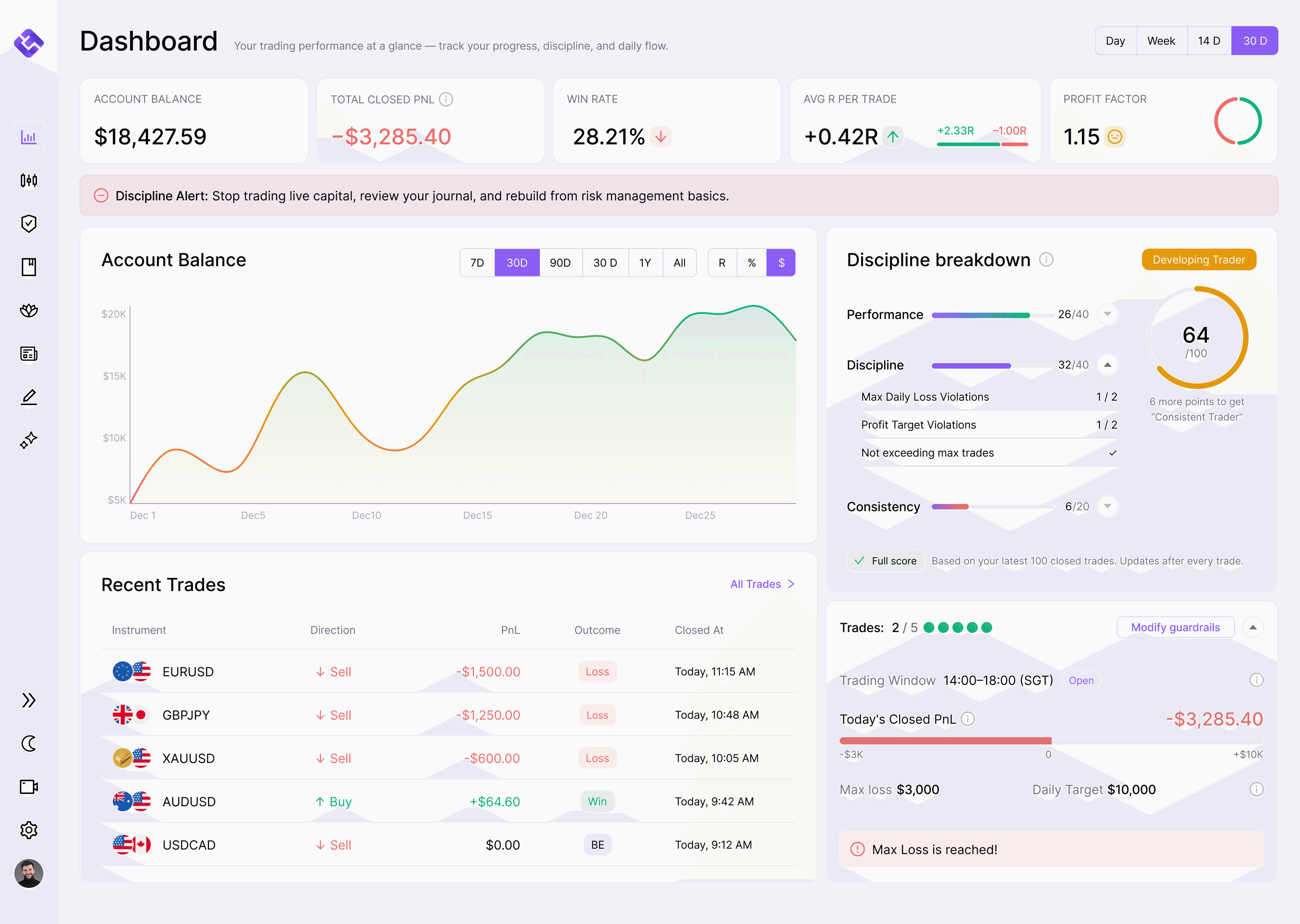
EdgeFlo's journal auto-imports your trades so you never have to manually enter the details. Every trade is already there with the pair, entry, exit, and result.
What you add is the context: the emotion tag (calm, urgent, frustrated, overconfident), whether you followed the plan, and what you would do differently. EdgeFlo's emotion tagging makes this a quick selection rather than a blank page.
Over time, your tagged entries stack into a searchable data set. You can filter by emotion, by outcome, and by rule compliance. The patterns that take weeks to see in a notebook become visible in minutes when the data is structured and searchable.
The Edge Brief
Receive Insights on trading psychology, discipline, and the behavioral patterns that create consistent traders from our Founder and the EdgeFlo team, delivered to your inbox.
Think different. Trade different.
How often should I review losing trades?
What should I write in my journal after a loss?
How do I tell the difference between a good loss and a bad loss?
Can reviewing losses actually improve my win rate?

Turn discipline on.
Every session.
EdgeFlo is the environment serious traders operate inside.
Start 7-Day Free Trial
Cancel anytime.
No long-term commitment.

Think Different, Trade Different.