

Retail Thinking vs Market Mechanics: The Shift
Retail concepts keep you in the illusion. Market mechanics reveal what actually moves price. Learn the mindset shift from victim to aligned trader.
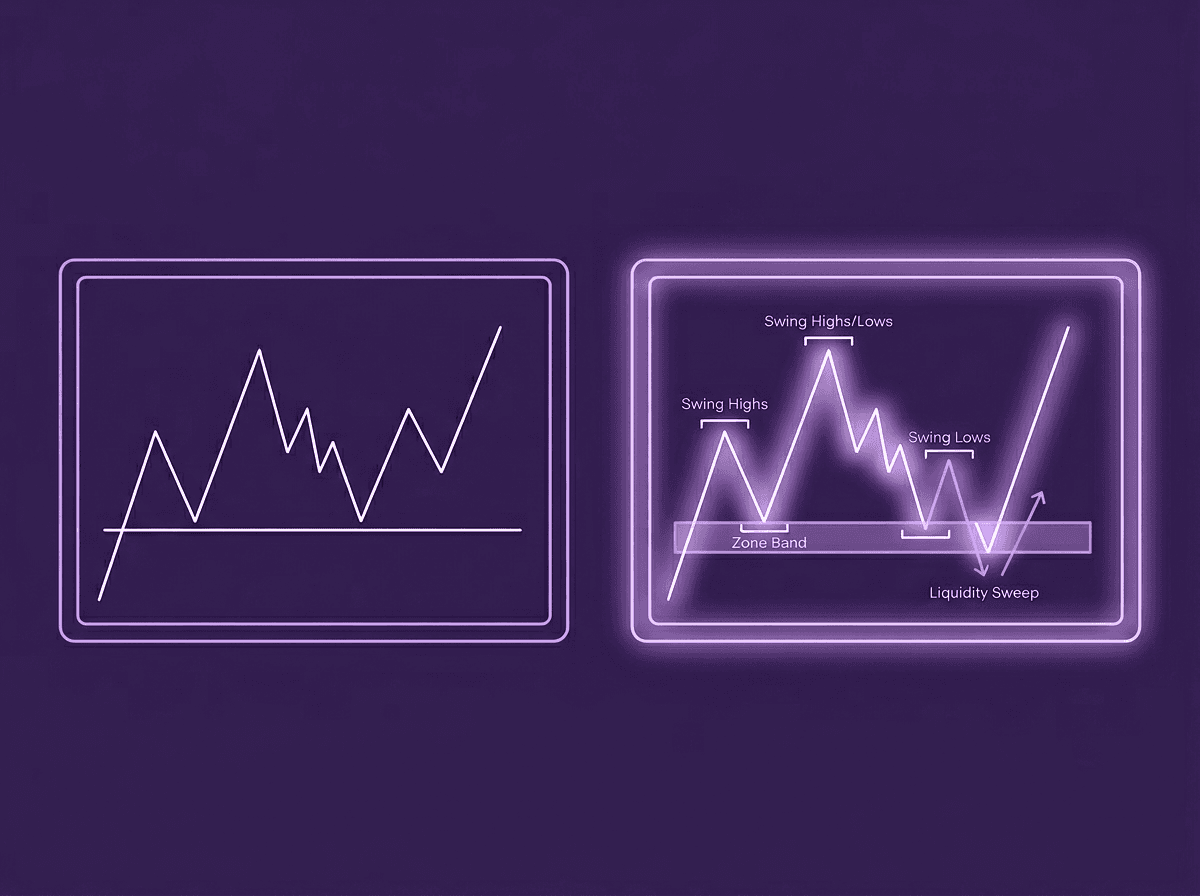
Retail thinking treats the market as a pattern-matching exercise: buy at support, sell at resistance, follow the indicator signal. Market mechanics reveals what is actually happening behind those patterns: who is buying, who is selling, where the orders are sitting, and why price moves to specific levels before reversing. Once you see this layer, every chart looks different. Your old stop loss placements start looking like liquidity targets. "Random" wicks start looking like institutional sweeps. And the feeling of being "hunted by the market" starts making mechanical sense.
Retail concepts treat charts as surface patterns (support, resistance, indicators) without asking why.
Market mechanics explains the order flow behind every move: who needs liquidity and where they source it.
Your old stop losses below swing lows were not "wrong" by retail standards. They were predictable targets by market mechanics standards.
The shift from retail to mechanics is permanent. Once you see the sweep cycle, you cannot unsee it.
This shift does not guarantee profits. It gives your analysis depth that pattern matching alone cannot provide.
The Illusion Retail Traders Live In
Most traders start with the same set of ideas. Support and resistance levels. Candlestick patterns. Maybe an RSI or MACD overlay. They learn to buy when price bounces off a line and sell when it reaches another line. It works sometimes. It fails mysteriously other times.
The mystery is the illusion. When a trade "randomly" stops you out at the exact low before reversing, the retail explanation is bad luck or market manipulation. The mechanics explanation is straightforward: your stop was in the liquidity cluster, institutions sourced their orders there, and price reversed because the fuel was consumed.
Retail concepts do not explain why price moves to certain levels. They just tell you what to do when it gets there. "If price touches the 200 EMA, buy." Okay, but why does price sometimes blow through the 200 EMA and keep going? Because the moving average is not what moves price. Liquidity is what moves price. The 200 EMA just happens to sit near a level where resting orders cluster, sometimes.
Walkthrough: The retail illusion in action. A trader draws a support line at 1.0800 on EUR/USD because price has bounced there twice. They buy at 1.0805 with a stop at 1.0790. Price drops to 1.0785, stops them out, and then rallies to 1.0880. Retail explanation: "My support failed." Mechanics explanation: equal lows at 1.0800 created a sell-side liquidity pool. Institutions pushed price below 1.0800 to trigger those stops, absorbed the sell orders, and used that liquidity to launch the rally. The support did not fail. It was always the target.
What Market Mechanics Actually Shows You
Market mechanics is not a secret strategy. It is a lens. When you look through it, the same chart shows you different information.
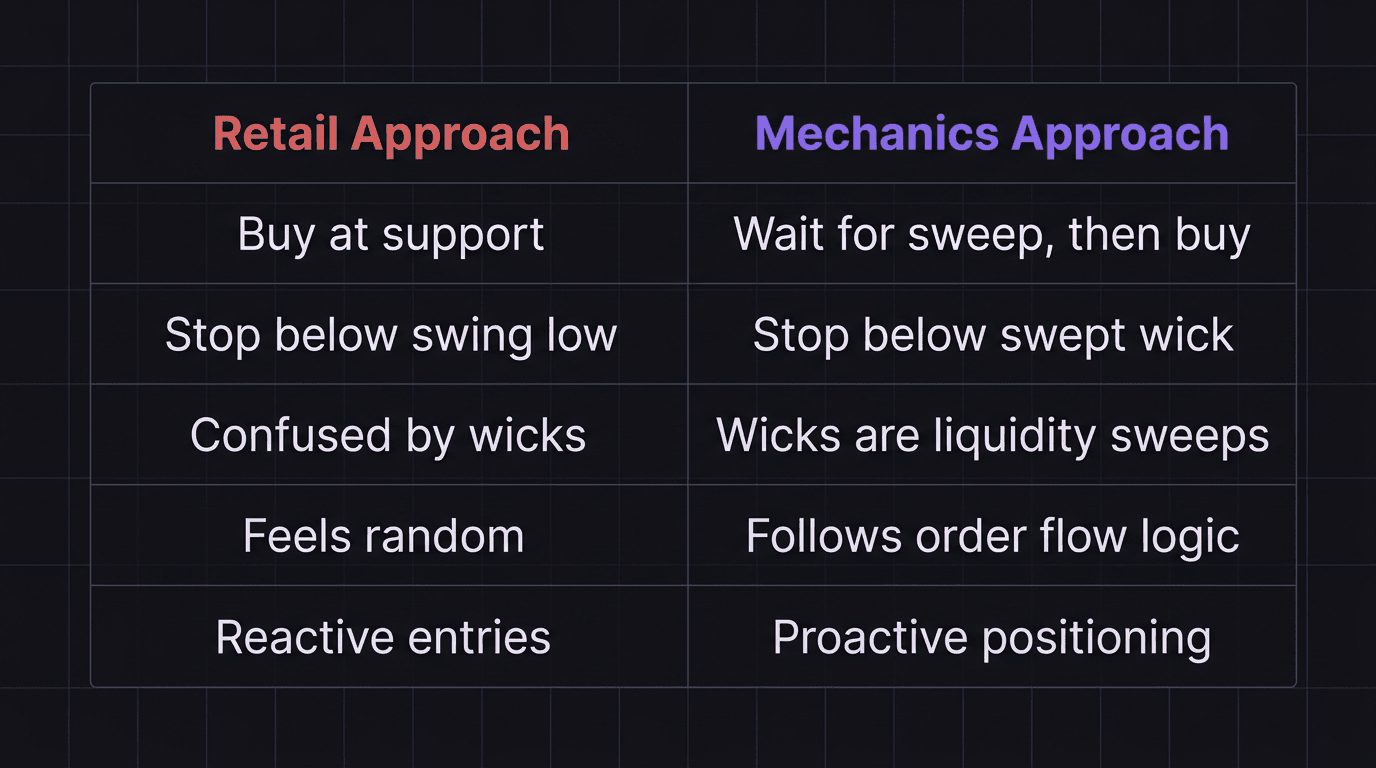
Retail lens: "Price is approaching support at 1.0800. I should buy."
Mechanics lens: "There are equal lows at 1.0800 creating a sell-side liquidity pool. Smart money might push price below to sweep those stops before buying. I should wait for the sweep, then look for a reversal confirmation before entering."
Same chart. Same candles. Completely different analysis.
The mechanics lens adds three questions to every setup:
Where is the liquidity? Which side of the market has more resting orders? Are there obvious stop clusters below swing lows or above swing highs?
Who benefits from a move to that level? If price drops to sweep the lows, does that create sell liquidity for institutional buying? Is that consistent with the higher timeframe structure?
What happens after the liquidity is taken? Once the pool is drained, what is the expected path? Does price continue in the direction of the sweep, or does it reverse?
These questions transform a reactive, pattern-based approach into a proactive, flow-based one. You stop reacting to what price does and start anticipating what it needs to do.
Your Old Stop Losses Were Liquidity Targets
This is the uncomfortable realization that makes the shift permanent. Go back through your trade journal (or your memory) and look at the trades that stopped you out right before a major reversal.
In almost every case, your stop was placed just below a swing low or just above a swing high. Exactly where every other retail trader placed theirs. You were not being singled out. You were part of a predictable crowd, and your stop placement was visible to anyone who understands where retail orders cluster.
That is not a criticism. Every trader starts there. The textbooks teach it. The courses recommend it. "Place your stop below the most recent swing low" is the default advice for a reason: it is a logical structural level. The problem is that it is the same logical level for millions of traders simultaneously, which turns it into a target.
Walkthrough: Revisiting a past loss with new eyes. Six months ago, you shorted GBP/USD at 1.2750 with a stop at 1.2785 (above the recent swing high at 1.2780). Price wicked to 1.2790, stopped you out, and then dropped 100 pips to 1.2650. At the time, you thought: "I was right about the direction but wrong about the timing." With mechanics eyes: the swing high at 1.2780 had buy-stop liquidity above it. Institutions pushed price to 1.2790 to trigger those stops (your buy stop was one of them), absorbed the buy orders to fill their short positions, and then pushed price down. You were not wrong about timing. Your stop was in the liquidity cluster.
Trading With the Institutions, Not Against Them
The shift from retail thinking to mechanics thinking changes your behavior in concrete ways:
Before the shift: You enter at a zone and place a tight stop below the obvious level. You get swept and stopped out. You re-enter emotionally. You might even revenge trade. This cycle repeats, and self-sabotage becomes a pattern.
After the shift: You identify the zone. You identify the liquidity pool below the zone. You wait for the sweep. You enter after price sweeps the pool and shows reversal confirmation on a lower timeframe. Your stop goes below the swept wick, not above the pool. Your risk-to-reward is better because your entry is at a discount. And you no longer feel "hunted" because you understand the mechanic.
The hardest part of this shift is patience. Waiting for the sweep means watching price move away from your zone and resisting the urge to enter early. It means accepting that sometimes the sweep does not happen and you miss the trade. That is okay. The trades you take with mechanics alignment have higher probability and better R:R than the ones you force without it.
This is not about being right more often. It is about being right in a way that makes mechanical sense, where your entry, stop, and target are all positioned relative to the actual order flow instead of relative to a line you drew on the chart.
How EdgeFlo Reinforces the Mechanics Mindset
The shift from retail to mechanics is not a one-time event. It is a practice that needs reinforcement. Under live-market pressure, old habits resurface. You see a "support bounce" and the retail instinct says enter now. The mechanics filter says wait for the sweep.
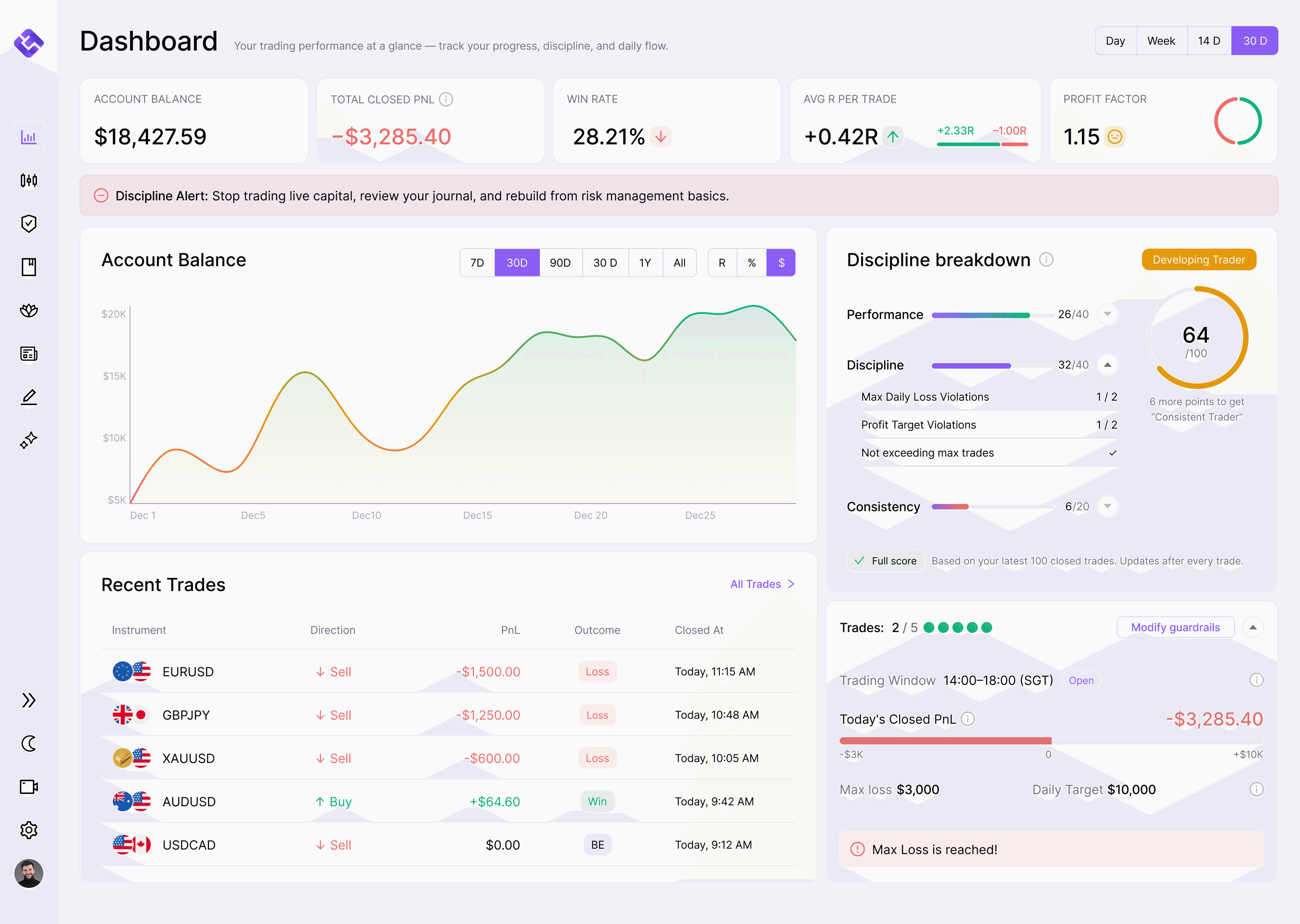
EdgeFlo's trading journal creates the feedback loop that reinforces the shift. After every trade, you tag whether you entered with mechanics alignment (waited for sweep, checked structure, identified liquidity) or reverted to retail mode (bought at support, placed stop at the obvious level). The weekly AI report (Plus) surfaces the pattern: mechanics-aligned trades average 2.8R, retail-mode trades average 0.6R.
That data makes the shift stick. Not because someone told you mechanics is better, but because your own results prove it. The journal turns a conceptual shift into a measurable habit, and measurable habits are the ones that survive the pressure of live trading.
The Edge Brief
Receive Insights on trading psychology, discipline, and the behavioral patterns that create consistent traders from our Founder and the EdgeFlo team, delivered to your inbox.
Think different. Trade different.
What is the difference between retail concepts and market mechanics?
Can you go back to retail thinking after learning market mechanics?
Does market mechanics make trading easier?
Is market mechanics the same as smart money concepts?

Turn discipline on.
Every session.
EdgeFlo is the environment serious traders operate inside.
Start 7-Day Free Trial
Cancel anytime.
No long-term commitment.

Think Different, Trade Different.