

Reframe Losses as a Cost of Business
Losses are not failure. They are the cost of doing business in a probabilistic game. Learn the mindset shift that separates profitable traders from everyone else.
A losing trade does not mean you are a bad trader. A losing streak does not mean your strategy is broken. Losses are the cost of doing business in a game that runs on probability, and until you genuinely believe that (not just understand it intellectually), every loss will trigger an emotional chain reaction that costs you more money than the loss itself.
This is the mindset shift that separates traders who survive from traders who blow accounts. It is not complicated. But it is one of the hardest things to internalize because your brain is wired to treat every loss as a threat.
TL;DR
Losses are inevitable in any strategy with positive expectancy. They are not signs of failure.
Your reaction to a loss causes more damage than the loss itself (revenge trades, skipped setups, strategy changes).
Profitable traders often lose 50% to 60% of their trades and still make money through reward-to-risk ratios.
Reframing happens when you judge performance over 20+ trades, not trade by trade.
Track the cost of emotional reactions separately from the cost of planned losses.
Why Your Brain Treats Losses as Threats
When you lose money on a trade, your amygdala registers a threat. The same part of your brain that would fire if a car swerved toward you fires when you see red on your P&L. It happens in about half a second, faster than your rational mind can intervene.
That threat response triggers a cascade: cortisol floods your system, your heart rate increases, and your decision-making shifts from analytical to reactive. In that state, you do not think about probability or expectancy. You think about survival.
This is why telling yourself "losses are normal" before the market opens does not work by itself. You believe it at 8 AM when you are calm. You forget it at 10 AM when you are watching a position go against you. The belief has to be reinforced through structure and data, not just affirmation.
The Restaurant Analogy
Every restaurant buys ingredients knowing some will spoil before being used. A pizzeria does not panic when they throw out old dough. That is not a failure. It is a known, expected cost built into the business model. The price of ingredients is factored into the menu prices. As long as revenue exceeds total costs, the business is profitable.
Trading works the same way. Your losses are the cost of ingredients. Your wins are the revenue. The question is not "can I avoid spoilage?" (you cannot). The question is "does my revenue exceed my total costs over time?"
If your strategy has positive expectancy, losses are priced in. They are supposed to happen. Trying to eliminate them is like a restaurant trying to never throw away a single tomato. It is impossible and the attempt creates worse problems (like never ordering enough ingredients and running out of food).
The Math That Makes Losses Normal
Consider a strategy with a 40% win rate. You lose 6 out of every 10 trades. Sounds terrible, right?
Walkthrough: How 40% Win Rate Makes Money
A trader uses a supply-and-demand strategy on EUR/USD. Average risk per trade: 25 pips. Average win: 75 pips. Position size: 0.5 lots ($5/pip for EUR/USD).
Over 20 trades at a 40% win rate:
8 wins at 75 pips each: 600 pips gained
12 losses at 25 pips each: 300 pips lost
Net: 300 pips gained
At $5/pip, that is $1,500 in net profit over 20 trades, despite losing more often than winning. Each loss cost $125. Each win produced $375. The ratio (3:1 reward-to-risk) makes the math work even when most individual trades are losers.
Now here is the critical point: if this trader panics after loss number 3 and stops trading, they miss the wins that were statistically coming. If they revenge trade after loss number 5, they take unplanned positions that fall outside the tested system. Either way, the emotional reaction to normal losses destroys the edge that was designed to produce profits over time.
What Actually Happens After a Loss
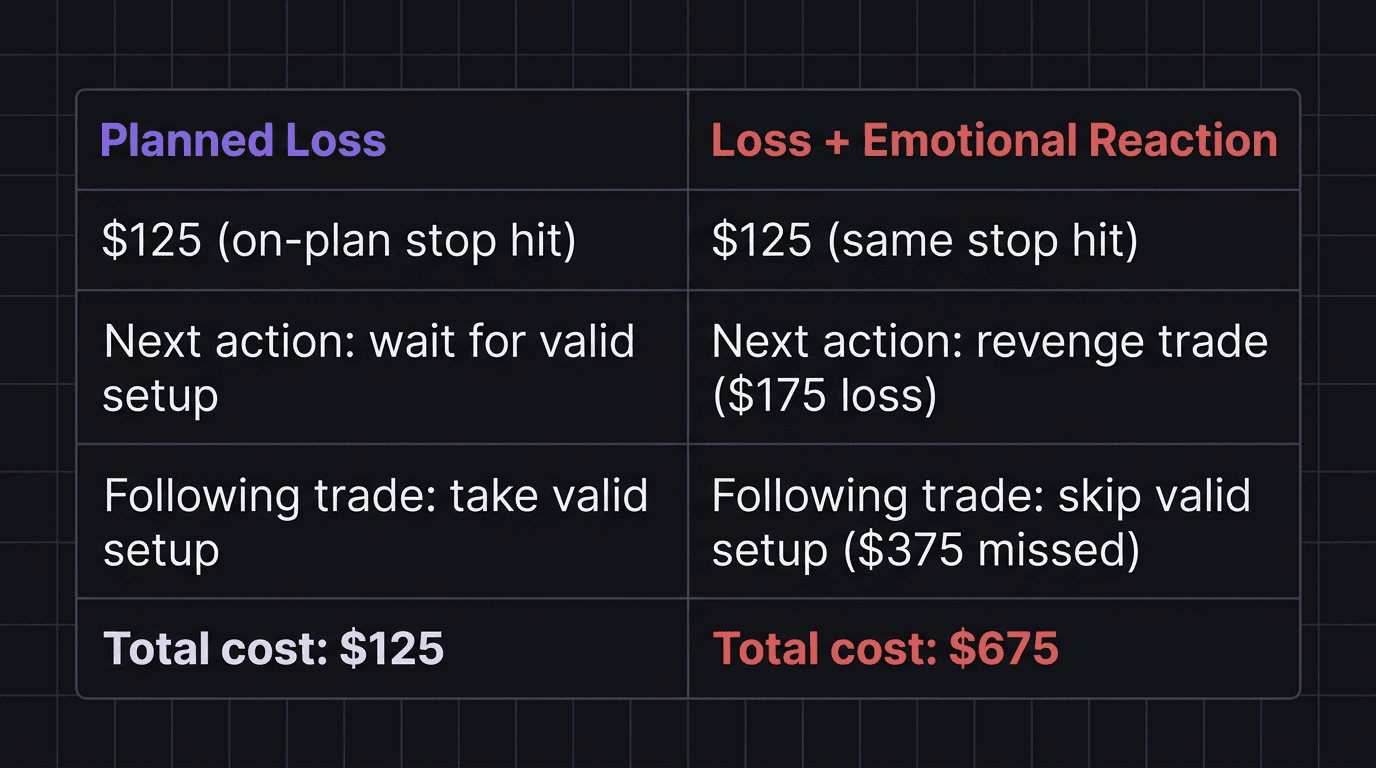
The loss itself costs you $125 in the example above. But the emotional reaction to the loss can cost multiples of that.
Walkthrough: The Reaction That Cost More Than the Loss
Same trader, same strategy. Trade 7 is a loss ($125). Normal, planned, expected. But this is the third loss in a row, and the trader starts feeling the pull.
Trade 8: no valid setup exists, but the trader enters anyway to "make it back." This trade was never in the plan. Loss: $175 (they used a wider stop because "this needs room to work").
Trade 9: now down $300 in unplanned losses. The trader skips a valid setup because they are afraid of another loss. That setup would have been a winner: $375 left on the table.
Scorecard:
Cost of planned loss (trade 7): $125
Cost of revenge trade (trade 8): $175
Cost of skipped trade (trade 9): $375 in missed profit
Total emotional tax: $550
The planned loss was $125. The emotional reaction cost $550. The reaction was 4.4 times more expensive than the loss itself.
This is why reframing matters. It is not about feeling better. It is about preventing the cascade of bad decisions that follows each loss when you treat it as a personal failure instead of a business expense.
How to Actually Reframe (Not Just Say It)
Knowing that losses are normal is not the same as believing it under pressure. Here are specific practices that build the belief through repetition and evidence.
Track planned vs. unplanned losses separately. In your journal, tag every loss as either "plan" (stop hit on a valid setup) or "off-plan" (revenge trade, early entry, position outside playbook). After a month, calculate the dollar difference. Most traders find their off-plan losses exceed their planned losses by 2x or more. That data makes the reframe real.
Calculate your loss expectancy before the week starts. If your strategy has a 40% win rate and you plan to take 10 trades this week, you should expect 6 losses. Write that number down Monday morning: "I expect 6 losses this week. That is normal." When loss 4 hits on Wednesday, you are not surprised. You are on schedule.
Review losing streaks in backtesting data. Go back to your backtested sample and find the longest losing streak. If your 200-trade backtest had a 7-trade losing streak in it and the system was still profitable at the end, then a 5-trade losing streak in live trading is not evidence that the strategy is broken. It is evidence that the strategy is performing normally.
Compare to business costs. A restaurant with $50,000/month in revenue and $35,000/month in costs does not call the ingredient bill a "failure." The owner calls it "the cost of doing business." Your losing trades during a streak are the cost of participating in a probabilistic market. The only question is whether the revenue (winning trades) exceeds the costs (losing trades) over a meaningful sample.
The Shift That Changes Everything
The reframe is complete when you can take a loss and feel neutral. Not happy, not angry. Just neutral. The same feeling you get when you buy groceries. Money left your account. Value was exchanged. Business continues.
This shift does not happen in a day. It might take months of deliberate practice, reviewing data, and catching yourself in the moment when the amygdala fires. But every time you take a planned loss, tag it as "cost of business" in your journal, and move to the next setup without emotional interference, the neural pathway gets a little stronger.
You are not training yourself to enjoy losses. You are training yourself to process them without the cascade of bad decisions that follows.
How EdgeFlo Supports the Reframe
EdgeFlo's trading journal lets you tag losses by type (planned vs. off-plan) and track the cost difference over time. The emotion tagging feature captures your state at each trade, so you can see the correlation between emotional reactions and off-plan behavior.
When the data shows that your planned losses average $125 and your off-plan losses average $300, the reframe stops being abstract. It becomes a clear financial argument for treating losses as costs, not catastrophes.
The Edge Brief
Receive Insights on trading psychology, discipline, and the behavioral patterns that create consistent traders from our Founder and the EdgeFlo team, delivered to your inbox.
Think different. Trade different.
Why should traders treat losses as a cost of business?
How do you stop feeling bad about trading losses?
What percentage of trades can a profitable trader lose?
How do losing streaks affect trading psychology?

Turn discipline on.
Every session.
EdgeFlo is the environment serious traders operate inside.
Start 7-Day Free Trial
Cancel anytime.
No long-term commitment.

Think Different, Trade Different.