

Refine Your Trading Edge With Small Adjustments
Refine your trading edge through small, data-driven adjustments. Learn why incremental changes beat full overhauls and when to stop refining.

You do not need a new strategy. You need to make your current one slightly better. Refining your trading edge is about small, data-driven adjustments that improve performance over time. Not complete overhauls. Not strategy hopping. Just finding where your edge leaks and plugging the holes one at a time.
This is the work that separates traders who plateau from traders who keep improving.
TL;DR
Refining your edge means making one small change at a time based on journal data, not gut feeling.
Full strategy overhauls after a bad week destroy your sample size and restart your learning curve.
The best refinements come from your trade journal: better entries, tighter stops, or improved trade management.
Stop refining when your data shows consistent positive expectancy over 100 or more trades.
What Refining Looks Like
Developing your trading edge is the first milestone. You find a strategy, test it, and confirm that it produces positive expectancy over a meaningful sample. That is step one.
Step two never ends. It is refinement.
Refinement looks like this: you have been trading your setup for three months. Your win rate is 38% with an average winner of 3.2R and an average loser of 1R. Expectancy is positive. Your equity curve is trending up. But you notice something in your journal. On trades where you enter during the first 15 minutes of the London session, your win rate drops to 25%. On trades where you wait until 30 minutes into the session, your win rate jumps to 48%.
That is a refinement signal. Not "I need a completely different strategy." Just "I should stop taking trades in the first 15 minutes of London."
One variable. One change. Measurable impact.
That is what refinement actually is. Not a revolution. An evolution.
Small Adjustments vs Full Overhauls
The most dangerous mistake traders make is treating a normal losing period as evidence that their entire strategy is broken. They hop to a new approach, abandon months of data, and start from zero.
Here is why that is so costly. Every time you switch strategies, you reset your sample size. The 150 trades of data you collected? Gone. Useless for the new approach. Now you need another 100 to 150 trades just to know whether the new strategy works at all. That is months of work thrown away.
Small adjustments preserve your sample. They let you build on existing data instead of starting over. And they compound. Five small improvements over a year can transform a marginal strategy into a consistently profitable one.
Here are the categories where small adjustments make the biggest difference:
Entry timing. Are you entering too early before confirmation, or too late after most of the move has happened? Your journal will show this through average initial drawdown (how far price moves against you before going your way).
Stop placement. Are your stops getting clipped by normal volatility and then price moves in your direction? Widening your stop by 5 pips and adjusting lot size accordingly might increase your win rate significantly.
Trade management. Are you closing winners too early? Your journal will show the average move after your exit. If price consistently runs 2R further after you close at 1.5R, your management rules need adjustment.
Session filter. Are certain sessions consistently worse for your setup? Remove them from your plan and only trade the sessions where your data shows the highest win rate.
Walkthrough: Small Entry Adjustment, Big Impact
A trader has been entering long at demand zones on EUR/USD using a 15-minute break of structure as confirmation. Over 80 trades, their win rate is 35% with a 3R average winner. Expectancy is positive but slim.
They review their journal and notice that trades where they wait for a retest of the broken structure level after the break have a 50% win rate. Trades where they enter immediately on the break (no retest) have a 24% win rate.
They add one rule: "Wait for a pullback to the break of structure level before entering." They do not change the setup itself. They do not add new indicators. They just refine the entry timing.
Over the next 50 trades, their win rate improves to 46% with the same 3R target. Expectancy nearly doubles.
One small adjustment. Massive improvement. And the trader did not need to learn a new strategy to get there.
Using Journal Data to Refine
Refinement without data is just guessing in a different direction. Your trading journal is the single most important tool for edge refinement because it contains the evidence.
Here is what to look for during your monthly review:
Win rate by session. Break your trades down by London, New York, and Asian sessions. If one session consistently underperforms, consider removing it from your plan.
Win rate by day of week. Some traders find that Monday and Friday setups hit less often due to low volatility or weekly positioning. Your data will confirm or deny this.
Average R by setup type. If you have multiple setup variations (aggressive entry vs. conservative entry, for example), compare their performance. Double down on the one that works best.
Drawdown before profit. How much does price move against you before going your way? If your average initial drawdown is 15 pips on a 25-pip stop, you might be able to tighten your stop to 20 pips and improve your R:R ratio.
Trades after losses. Check whether your performance degrades after consecutive losses. If your win rate drops sharply after two losses in a row, that is a signal to add a "pause after two losses" rule.
Once you identify a pattern, make exactly one change. Test it over 30 to 50 trades. Measure the impact. If positive, keep it. If neutral or negative, revert. Then look for the next refinement.
This is why a quarterly review cycle matters. Monthly data gives you signals. Quarterly data gives you enough sample size to confirm whether a refinement actually worked.
When to Stop Refining and Execute
Over-optimization is the dark side of refinement. It happens when you keep tweaking settings to fit past data perfectly. Every backtest looks incredible. Every live trade falls apart because the strategy has been molded to historical noise rather than repeatable patterns.
Here are the signs you have crossed the line from refining to over-optimizing:
You have changed your strategy rules more than twice in the last month.
Your backtest results look dramatically better than your live results.
You added a rule that only applies to a handful of trades in your sample.
You are making changes based on feelings ("this setup feels wrong") rather than data ("this setup loses money 70% of the time during Asian session").
The rule of thumb: if your expectancy is positive over 100 or more trades and your equity curve trends upward (even with drawdowns), stop refining. Execute. Let the edge compound.
Walkthrough: The Over-Optimization Trap
A trader has a working strategy with 0.5R expectancy per trade. They review their data and notice that adding a specific RSI filter would have turned three recent losses into no-trades. Excited, they add the filter.
Over the next month, the filter also removes two trades that would have been winners. Net effect: zero improvement, plus one more rule to remember.
They add another filter. Then another. After two months, the strategy has seven entry conditions instead of three. The trader takes one trade per week instead of four. Their sample size is too small to measure anything. They have no idea whether the strategy still works because they never get enough trades to find out.
Refinement improves your edge. Over-optimization destroys your sample size and creates a system that only works on data you have already seen.
The best traders refine in small doses, at scheduled intervals, based on real data. Then they execute relentlessly between reviews.
How EdgeFlo Supports Edge Refinement
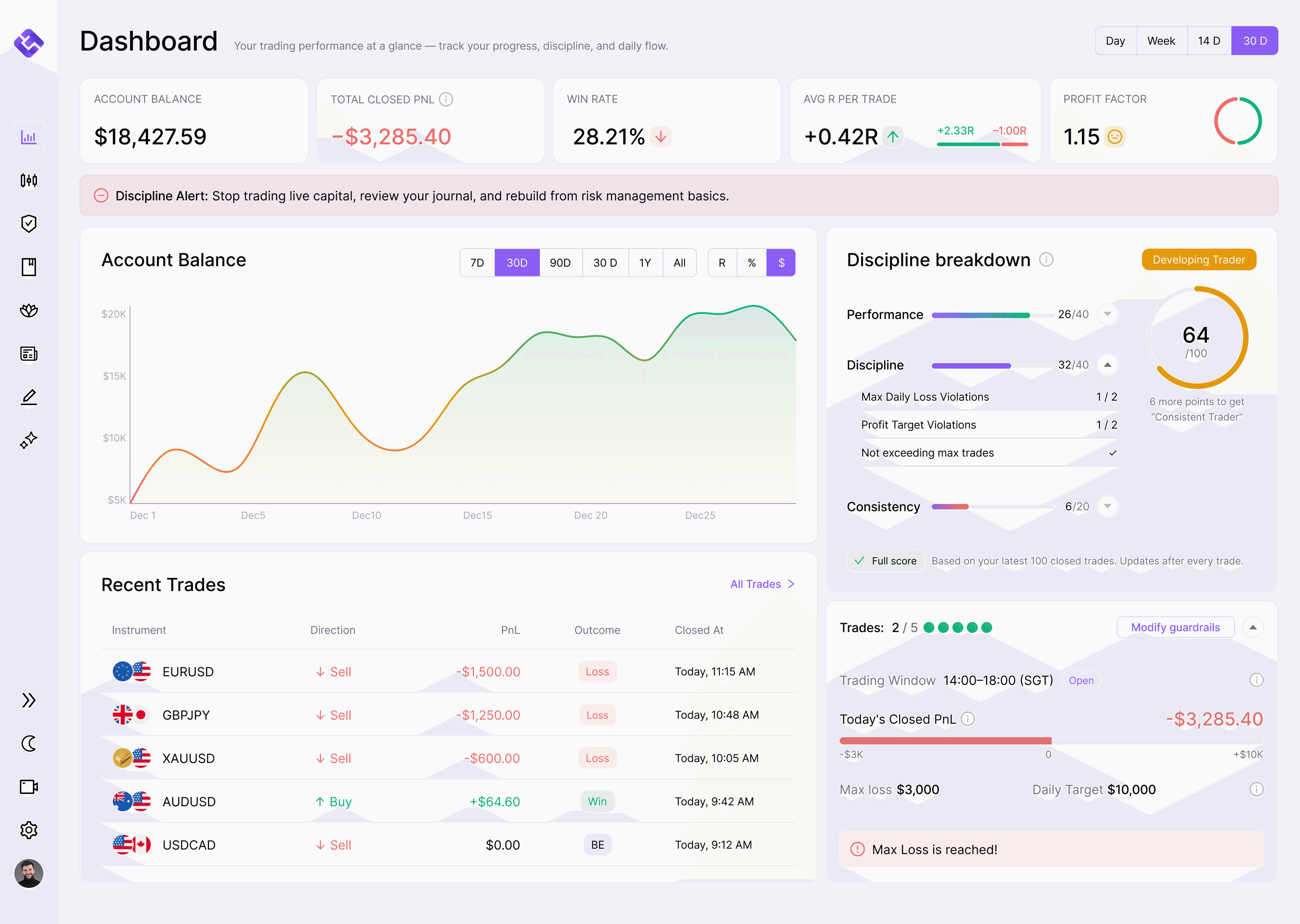
EdgeFlo's journal and dashboard are built for exactly this kind of data-driven improvement. Every trade is automatically tagged with session, pair, setup type, and R multiple. When it is time for a monthly review, you can filter your stats by any variable and see which parts of your edge are performing and which are leaking.
The weekly AI report in EdgeFlo (Plus plan) surfaces patterns you might miss on your own. If your London session win rate dropped over the last three weeks, the report flags it so you can investigate before it becomes a bigger problem.
Refinement is not about working harder on your strategy. It is about using real data to work smarter. EdgeFlo gives you the data layer to make every adjustment count.
The Edge Brief
Receive Insights on trading psychology, discipline, and the behavioral patterns that create consistent traders from our Founder and the EdgeFlo team, delivered to your inbox.
Think different. Trade different.
How often should I refine my trading edge?
What is the difference between refining and over-optimizing?
Should I change my strategy if my win rate drops?
Can I refine my edge without a trading journal?

Turn discipline on.
Every session.
EdgeFlo is the environment serious traders operate inside.
Start 7-Day Free Trial
Cancel anytime.
No long-term commitment.

Think Different, Trade Different.